The Rajnath Singh Dossier: Resign, Raksha Mantri!
The Rajnath Singh Dossier: Resign, Raksha Mantri!
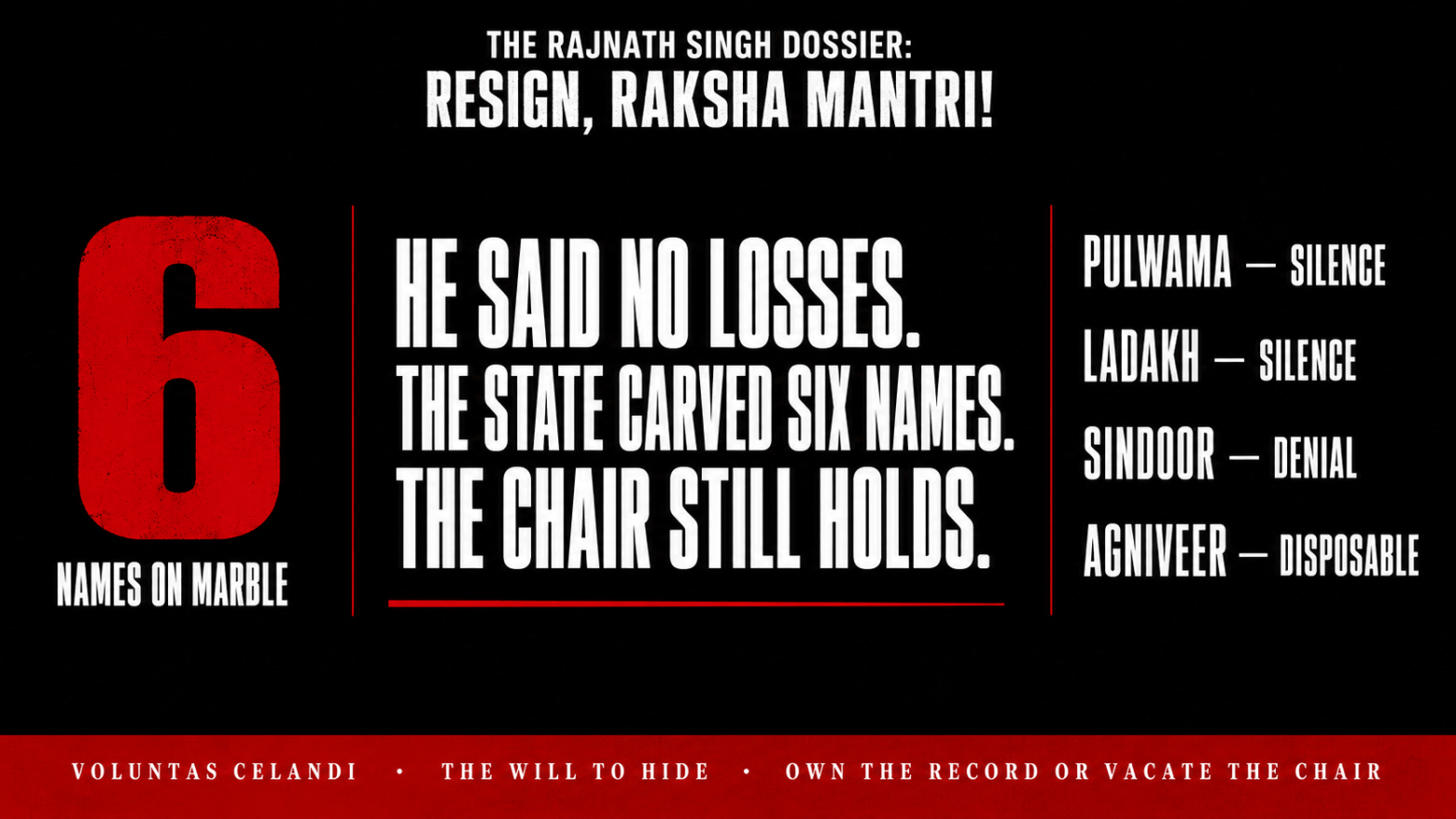
Posted on 9th August, 2026 (GMT 01:55 hrs)
Posted in the public interest. Updated to the public record of August 2026.
ABSTRACT
This citizens’ charge-sheet records Rajnath Singh’s institutional tenure as Home Minister (2014–2019) and Defence Minister (2019–present) through the state’s own certified contradictions: the intelligence and convoy-security collapse that killed forty CRPF personnel at Pulwama on his watch; the selective silence on lost patrolling access in Eastern Ladakh; the Pahalgam attack of 22 April 2025 and the retaliatory Operation Sindoor; the categorical parliamentary denial of any soldier losses on 28 July 2025, followed thirteen months later by the state’s compelled disclosure of six names chiselled onto the National War Memorial; the parallel refusal to admit aircraft attrition until the Chief of Defence Staff conceded it abroad; the conversion of the soldier into a four-year disposable contract under Agnipath; the political shielding of opacity around Rafale; and the quiet advance of dynasty inside a party that campaigns against it. Built exclusively from Hansard, the National War Memorial’s Roll of Honour, Ministry of Defence clarifications and on-record statements of constitutional functionaries, the pattern that emerges is voluntas celandi—the will to hide—operating at the very site of memory, semantic truncation that leaves dual realities permanently open, and the systematic manufacture of impunity upstream of every demand for accountability. The minimum grammar of ministerial responsibility therefore requires the holder of the chair to step down; because the institutional machine is constructed so that no minister of this regime need ever activate that grammar, the deeper structural demand remains the constitutional Right to Recall and the Right to Reject.
Disclaimer: This dossier addresses Rajnath Singh exclusively in his public capacity as the holder of the Union Home and Defence portfolios — the institutional chairs he has occupied, the powers vested in those offices, the decisions taken under their authority, and the patterns of accountability (or its foreclosure) that attach to the position. It does not target him in any private, personal, or individual capacity outside the exercise of public power. It makes no clinical diagnosis of any individual: where this dossier speaks of pseudology, it names a property of official discourse, never a condition of a person. It does not invent quotations. Where a claim is the government’s own assertion, it is attributed as such and distinguished from independently verified fact. Where the state’s own later disclosure contradicts an earlier ministerial sentence spoken on the floor of the House, the contradiction is internal to the Republic.
0. Preamble
Before the Defence Ministry, before the Home Ministry, before the party presidency that in 2013 formally declared Narendra Modi the prime-ministerial candidate, Rajnath Singh was a lecturer in physics at K.B. Post-Graduate College, Mirzapur, and, in 1991–92, the Education Minister of Uttar Pradesh. In that office he authored the Anti-Copying Act — a statute designed to criminalise the manufacture of false answers dressed as true ones, to punish the passing-off of unearned certification. An examination is a scene in which a subject makes a claim to knowledge and an institution certifies it as true or false.
The man who once legislated against the production of false certification now stands over a parliamentary sentence that the Republic’s own most solemn memorial has falsified. A physicist knows that a measurement is not the phenomenon. “No losses” is a measurement. The Roll of Honour is the phenomenon. When they disagree, a physicist does not blame the phenomenon. Nothing between the sentence in Hansard and the six names on marble is ours.
The juxtaposition belongs to the state. And on 25 July 2026, when Education Minister Dharmendra Pradhan resigned amid the NEET paper-leak storm — only the second Union Cabinet resignation in twelve years of this regime — an older measurement of Rajnath Singh’s own resurfaced and was itself falsified: his categorical 24 June 2015 declaration that “Our ministers do not have to resign. This is not their (Congress) government, this is the NDA government.”
The man who once outlawed false certification now inhabits the permanent falsehood he once criminalised — and his own claim that NDA ministers never resign has itself been certified false by the government he serves. Is it his turn? The following record answers.
I. Pulwama, 14 February 2019 — Failure on His Own Watch as Union Home Minister
The facts, one by one. On the afternoon of 14 February 2019 a convoy of 78 vehicles carrying more than 2,500 Central Reserve Police Force personnel was attacked at Lethpora near Awantipora in Pulwama district. A vehicle-borne suicide bomber rammed an explosive-laden car into a bus in the convoy. Forty CRPF personnel of the 76th Battalion were killed. The payload has been consistently reported as approximately 300 kilograms of RDX — a quantity whose procurement and movement into the valley has never received a full public accounting.
The CRPF is a Central Armed Police Force under the administrative control of the Ministry of Home Affairs. On that date Rajnath Singh was the Union Home Minister. The intelligence assessments, the decision to move an unusually long convoy by road, and the refusal of airlift therefore fell squarely inside his portfolio.
Former Jammu and Kashmir Governor Satyapal Malik — himself a BJP appointee — has stated on the record that the CRPF had requested five aircraft to ferry personnel because “such a big convoy does not travel by road,” and that the request was refused by the Home Ministry. He has further stated that when he raised the lapses directly with the Prime Minister, he was told to “keep quiet,” and that the National Security Adviser told him the same. Contemporaneous reporting documented at least eleven intelligence inputs between 2 January and 13 February 2019 warning of a major Jaish-e-Mohammed retribution operation, including specific warnings of an IED strike along security-force routes; the convoy that finally moved was abnormally long precisely because adverse weather and prior restrictions had piled up personnel at the Jammu transit camp, magnifying both visibility and vulnerability.
Implications and inferences. No minister resigned. No senior official was held publicly accountable in a manner commensurate with the scale of the failure. The Home Minister travelled to Kashmir, chaired meetings, promised the forces a “free hand,” and the attack was subsequently folded into electoral rhetoric — the dead becoming campaign material within weeks. The demand to “keep quiet” is not incidental; it is the first documented appearance, in this record, of the reflex this dossier tracks across a decade: when the state’s failure becomes speakable, the state’s first act is to make it unspeakable. Ministerial responsibility, in the classical sense, means that the holder of a portfolio answers for what happens on his watch and, when the failure is grave enough, steps down. That grammar was never activated.
II. Eastern Ladakh, 2020 — The Silence That Speaks
The facts. After the Galwan Valley clash of 15 June 2020, in which Colonel Santosh Babu and nineteen other soldiers were killed, Rajnath Singh — now Defence Minister — became the government’s principal parliamentary voice. In his statement to the Rajya Sabha on 17 September 2020 (and the earlier Lok Sabha statement of 15 September) he told the House that China continues in illegal occupation of approximately 38,000 sq km in Ladakh; that under the 1963 Sino-Pakistan boundary agreement Pakistan illegally ceded a further 5,180 sq km of Indian territory to China; and that China claims approximately 90,000 sq km in the eastern sector. He set out three principles — respect for the Line of Actual Control, no unilateral change to the status quo, and adherence to all existing agreements — and asserted that Chinese conduct was a complete violation of mutually agreed norms.
Inference. What the statement did not contain is as significant as what it did. There was no acknowledgement of the loss of traditional patrolling access in the Depsang Plains — the precise omission repeatedly flagged by opposition members (including Rahul Gandhi and former Defence Minister A.K. Antony) and by defence analysts. “Not one inch,” ran the rhetoric; the erosion of patrol points was the map. Non-mention is not non-existence. It is a political choice about what may be spoken on the floor of the House — the same choice, in embryo, that Operation Sindoor would later stage on the gravest possible question.
III. Pahalgam and Operation Sindoor — Semantic Truncation and the Pseudology of Victory
The facts. On 22 April 2025 an attack at Pahalgam killed twenty-six people — civilians described in official accounts as targeted by religion, including a Nepali citizen. The government attributed cross-border linkages to Pakistan. Operation Sindoor, the retaliatory response, was launched in the early hours of 7 May 2025: air and missile strikes on alleged terror infrastructure in Pakistan and Pakistan-administered Kashmir. Hostilities ran four days to a ceasefire on 10 May.
On 28 July 2025, during a high-rhetoric Lok Sabha debate on Pahalgam and Operation Sindoor, the Defence Minister stated, per the parliamentary record:
“If you want to ask, have any of our courageous soldiers been killed in this Operation, the answer is no … none of our soldiers were harmed.”
Nearly thirteen months later, on 26 June 2026, the names of six military personnel were inscribed on Wall 3D of the Tyag Chakra at the National War Memorial and published on the Memorial’s Roll of Honour, officially confirmed as having made the supreme sacrifice during Operation Sindoor in May 2025 — the first official public identification of the dead:
- Subedar Major Pawan Kumar — Headquarters 10 Infantry Brigade
- Rifleman Sunil Kumar (Vir Chakra) — 4 Jammu and Kashmir Light Infantry
- Lance Naik Dinesh Kumar — 5 Field Regiment
- Agniveer Mood Muralinaik — 851 Light Regiment
- Havildar Sunil Kumar Singh — 237 Field Workshop Company
- Sergeant Surendra Kumar (Vayu Sena Medal) — 39 Wing, Indian Air Force
Two of the six carried gallantry awards. Congress MP K.C. Venugopal moved a formal breach-of-privilege notice under Rule 223, addressed to Speaker Om Birla, charging that the Minister had misled the House; opposition leaders demanded resignation and a public apology, describing the year-long silence as an insult to the armed forces.
The fairly-stated counter. OBMA does not overclaim, because overclaim is the SLAPP’s doorway. The Ministry of Defence responded that the July 2025 statement had been “selectively quoted,” that it was a targeted rebuttal of a circulating false narrative that Indian pilots and aircraft had been lost, not a claim of zero casualties across the operation; and it is a matter of record that the Director-General of Military Operations publicly paid tribute to the fallen on 11 May 2025, that individual funerals took place, and that some of these men were honoured locally at the time. The honest, narrower, and far harder claim therefore stands undiminished: a categorical sentence was uttered on the floor of the House; the official, consolidated acknowledgement — names, citations, Roll of Honour — was withheld until June 2026; and on Independence Day 2025 the sacrifice went uncited even as gallantry awards multiplied without published citations. Grant the defence its full force and it remains a confession of semantic truncation: a broad proposition (“none of our soldiers were harmed”) deployed to answer a narrow rumour, left standing in the record as a total denial, and glossed as narrow only once the state’s own memorial made the broad reading untenable. The Minister did not say “no pilot was captured.” He said none of our soldiers were harmed. The state now asks us to read the smaller claim inside the larger words. That is the anatomy of the offence.
The second concealment. The casualty denial did not stand alone; the same operation produced a parallel refusal — of aircraft attrition. For weeks the political leadership stonewalled on whether India lost jets. It was not a minister but the Chief of Defence Staff, Gen Anil Chauhan, who — at the Shangri-La Dialogue in Singapore — made the first official admission that the IAF lost fighters in the operation’s opening phase to “tactical mistakes,” quickly corrected. The government reportedly declined a Dassault audit team access to inspect the Rafale fleet; the Defence Secretary insisted no Rafale was lost “in the plural.” The Defence Minister’s own register was deflection dressed as bravado — to Pakistan’s claim of downing fifteen jets he offered sarcasm, that the enemy should “cater for 15 less aircraft” next time — answering a question about attrition with a joke about arithmetic.
Inference: the pseudology of victory. Two concealments, one operation, one reflex. Claims of more than a hundred terrorists killed at nine targets, of no Indian assets damaged, of a ceasefire wholly free of external pressure — all delivered in the register of settled fact while remaining, on open sources, unverifiable. “Victory has become a habit,” the Minister told veterans in September 2025 — the very grammar of spectacle-over-substance a mature military is meant to refuse. This is not the ordinary lie, which respects the law of non-contradiction. It manufactures arthānupapatti — meaning that refuses to cohere — leaving a dual reality in which the sentence can be defended as narrow and heard as total, forever. The same sovereign that spoke “no losses” through its Defence Minister later spoke “six deaths” through its most sacred register. The contradiction is internal to the state; we only decline to let it be forgotten.
IV. Agnipath / Agniveer — The Disposable Soldier
The facts. The Agnipath scheme, introduced in June 2022 and continuously defended by the Defence Minister, recruits personnel for a four-year term. Up to 25 per cent of each batch may be retained for permanent service; the remaining 75 per cent are released with a tax-free Seva Nidhi package (approximately ₹11.71 lakh, built from matched contributions plus interest) and no pension or gratuity. Initial pay begins near ₹30,000 a month, rising to about ₹40,000 by the fourth year; a non-contributory life cover of ₹48 lakh applies during service. Regular soldiers, by contrast, receive higher pay, full allowances, gratuity, and lifetime pension after qualifying service.
The scheme has drawn sustained criticism from the opposition, from sections of the veteran community, and from NDA allies, with protests across several states at its announcement. Concerns centre on unit cohesion and technical-skill retention, the absence of long-term security for the majority who exit, discrepancies in compensation for the families of Agniveers killed in the line of duty, and the conversion of military service into short-term contractual labour. By 2026 the services themselves were reportedly seeking higher retention — Navy proposals near 70–75 per cent for technical trades, Army and Air Force discussions around 50 per cent — an admission that the original 25 per cent was already under internal strain.
Inference: the loop closes on a body. The archive here delivers its most unbearable juxtaposition. Among the six names the state withheld until June 2026 was Agniveer Mood Muralinaik. The emblem of the cut-price soldier died in the very operation whose casualties the Defence Minister denied. The policy that renders the soldier disposable and the sentence that renders his death unspeakable are the same government’s two hands. The soldier is made to live for the state’s purposes and released without the traditional compact of lifelong honour — biopolitics stripped even of its residual duty of care.
V. Rafale — Political Shielding of Opacity
The facts. The 36-aircraft Rafale inter-governmental agreement was finalised in 2016. Rajnath Singh did not author it, but as Defence Minister he became its foremost political defender — demanding an apology from the opposition after the Supreme Court’s 2018 order declining a probe, personally flying the first aircraft, and presenting induction as national vindication. The controversies never fully accounted for in India include the reduction from the earlier 126-aircraft MMRCA framework; the bypassing of state-owned Hindustan Aeronautics Limited as primary production partner; the offset structure that channelled work to a private entity with limited aerospace experience; and the cloak of commercial secrecy around pricing. French judicial authorities opened a formal investigation into alleged corruption, influence-peddling and favouritism — a probe that has continued into 2026. Indian courts closed the matter; French courts did not.
Inference. The allegations we frame as allegations — dismissed at home, live abroad. But the secrecy is not an allegation; it is the method. The same voluntas celandi that would later refuse to count coffins and aircraft first refused to disclose a price. A minister who chooses to make himself the political shield of a contested procurement answers for that choice of opacity.
VI. Dynasty and the Anti-Dynasty Party
The facts. The Bharatiya Janata Party campaigns against dynasty as a structural pathology of its opponents. Under Rajnath Singh the same party has advanced three members of one family into politics. The elder son, Pankaj Singh, has been MLA from Noida since 2017 and a Uttar Pradesh BJP office-bearer. The younger son, Neeraj Singh (University of Leeds MBA), long active as a behind-the-scenes political proxy in Lucknow, was appointed a BJP Uttar Pradesh state vice-president in June 2026 — his first formal party post — and has been discussed for the Lucknow East seat ahead of the 2027 Assembly elections. Internal party hesitation about green-lighting a third family member has itself entered the public record.
Inference. The rule preached to others does not bind the household of power. The critique of dynasty is revealed as a weapon of factional convenience rather than a principle — disposable, like the soldier, the moment it inconveniences the family that wields it.
VII. The Impunity Loop, Applied
The six-moment schema of manufactured impunity maps onto the record with grim fidelity:
- Reclassification. “Casualty” is quietly re-scoped so that “no losses” can later be defended as “no captured pilots”; the loss of aircraft becomes “tactical mistakes, quickly corrected.” The category of harm is narrowed under cover of a broad word.
- Consent manufacture. The unblemished-victory narrative is broadcast into a chamber and media primed to receive military success as national vindication, converting a contested claim into ambient consensus.
- Expert-circuit capture. The subsequent Ministry “clarification” supplies the authoritative gloss that relaunders semantic truncation as precision; the audit that might verify — the Dassault team — is reportedly refused access. The epistemic circuit is closed against outside contradiction.
- Cost displacement. The human cost is displaced onto the six families who carried both the bereavement and the year-long unspeaking of it, and onto forces whose sacrifice is instrumentalised and then, briefly, denied.
- Fast-track cover. The breach-of-privilege notice enters a procedural machinery whose ordinary destination, in this Parliament, is quiet non-admission — the privilege apparatus run as a fast-track away from accountability rather than toward it.
- Stay-and-resume. The contradiction, once surfaced, is neither resolved nor prosecuted; it is left to rest, available for resumption of the same technique on the next occasion. The loop does not end. It idles.
VIII. Theoretical Implications — Voluntas Celandi, Erit Celare, and the Archive of the (Un-)Dead
Nietzsche gave the last century its master-key, the will to power. Our archive of Indian governance names its quieter and, in a democracy, more corrosive companion: the will to hide — voluntas celandi, and in its imperative-of-office mood erit celare (“it shall be concealed”), the standing instruction a regime issues to itself. Its operation is a kryptourgie, a concealment-work whose root is the Sanskrit √gup (to conceal, to guard), yielding jugupsā, the impulse to keep out of sight. Power announces itself; concealment is its shadow labour — and nowhere more spectacular than when it operates at the very site of memory, where the same regime that would erase a death later memorialises it, trusting the two acts will never be read on the same page.
Derrida named the archive’s pathology mal d’archive: the archive both preserves and, by its selection, destroys; it is haunted by what it must at once keep and suppress. The Roll of Honour is an archive of the honoured dead; the parliamentary “no losses” is an attempt to pre-empt that archive — to speak as though the names would never be inscribed. When they are inscribed, the sentence becomes a revenant: it returns, undead, to testify against the man who spoke it. Hauntology is not a metaphor here — six names are the spectres, and Hansard is the séance. Foucault’s biopolitics completes the diagram: the sovereign’s modern power to “make live and let die” acquires a third, stranger operation — not make live, not let die, but deny-having-let-die. The soldier is made to die twice: once on the ground, once in the sentence that unmade the first death, before resurrection as a name on marble when the sentence’s usefulness has expired.
The sharpest instruments, though, are older and closer to home. Kumārila Bhaṭṭa’s Bhāṭṭa Mīmāṃsā furnishes an epistemology of absence exactly fitted to a war over whether an absence is knowledge. Anupalabdhi (non-apprehension) is a valid means of cognition — non-perception is how we know a thing absent — but only where the object, if present, would have been apprehended. Battlefield deaths are precisely what the state does apprehend; the Minister’s “we do not apprehend any loss” was never non-existence, only concealment dressed in the epistemology of absence, and it collapses on Kumārila’s own condition. Arthāpatti (presumption) then forces the inference the two documents compel: there is no third proposition reconciling “no losses” with six inscribed names except that the losses were, at the decisive moment, hidden. And so we arrive at the masthead — arthānupapatti, meaning that refuses to cohere. The structural manufacture of the unverifiable-as-settled is what OBMA calls pseudology: a property of the discourse, publicly falsifiable, asserted without a single claim about the private soul of any man. This is the method’s armour as well as its ethics — a juxtaposition of Hansard against the Roll of Honour is a fact the state has certified; the rigorous path and the defensible path are one path.
IX. Why the Chair Must Be Vacated NOW
Ministerial responsibility is not a matter of personal criminal guilt. It is the constitutional expectation that the holder of a portfolio answers for the record compiled under that portfolio and, when the failures are grave enough, steps down. The record compiled under Rajnath Singh’s successive chairs includes:
- forty dead CRPF personnel on the Home Ministry’s watch, with documented intelligence warnings, a refused airlift request, and an instruction to “keep quiet”;
- a selective parliamentary silence on lost patrolling rights in Eastern Ladakh;
- a categorical denial of any soldier losses in Operation Sindoor, later falsified by the state’s own memorial, and a parallel refusal to admit aircraft attrition until the CDS conceded it abroad;
- a recruitment scheme that releases three-quarters of each cohort without pension — one of whose Agniveers lies among the six unspoken dead;
- the political shielding of opacity around a major defence procurement still under judicial investigation in France;
- the quiet advance of dynasty under anti-dynasty rhetoric.
No resignation has followed any of it. The chair remains occupied. The record does not.
THE DEMAND
Own the record or vacate the chair.
RESIGN, RAKSHA MANTRI.
Resignation is the minimum grammar of a democracy that still claims to mean what it says. Because the institutional machine is built so that no minister of this regime is required to activate that grammar, the structural demand follows with equal force:
- The Right to Recall. The people’s power, by defined petition and secret ballot, to remove an elected representative before the end of term at every tier from panchayat to Parliament — grounded in the Preamble’s “We, the People” and Article 1’s declaration of a democratic Republic.
- The Right to Reject. A binding None-of-the-Above that countermands an election when voters refuse every candidate on offer, the rejected barred from recontesting that election — grounded in the freedom of expression the Supreme Court itself held (PUCL, 2013) to include the freedom to reject.
A vote cast once in five years and never recoverable is not sovereignty. It is a receipt. We demand the power to recall the goods. The Republic wrote both the sentence of 28 July 2025 and the six names on the Roll of Honour. It owes itself the reconciliation. The chair remains occupied. The record does not.
Note on sources. Built by compelled juxtaposition from the state’s own record and contemporaneous reporting of official figures — Hansard and PIB statements; the National War Memorial Roll of Honour (names inscribed 26 June 2026); the Rule 223 breach-of-privilege notice of 30 June 2026; Ministry of Defence clarifications; the CDS’s Shangri-La remarks; on-record statements by a former J&K Governor; and reporting in Deccan Herald, National Herald, The Tribune, The Diplomat, Scroll, The Quint, Outlook and ETV Bharat. Contested matters are marked as such; the government’s defence is stated in its own terms. No quotation is invented; no clinical claim is made about any individual.
References
- Pulwama attack, 14 February 2019 – 40 CRPF personnel killed: https://en.wikipedia.org/wiki/2019_Pulwama_attack
- Satyapal Malik statements on refused airlift request and “keep quiet” instruction: https://frontline.thehindu.com/news/pm-modi-nsa-doval-silenced-me-on-security-lapses-leading-to-pulwama-attack-former-jk-governor-satyapal-malik/article66743512.ece
- Rajnath Singh Rajya Sabha statement on Eastern Ladakh / China, 17 September 2020: https://www.livemint.com/news/india/rajnath-singh-in-rajya-sabha-india-keeping-a-close-watch-on-chinese-activities-along-lac/amp-11600325274747.html
- Pahalgam attack, 22 April 2025 (26 killed) and launch of Operation Sindoor: https://en.wikipedia.org/wiki/2025_Pahalgam_attack
- Official MEA statement on Operation Sindoor: https://www.mea.gov.in/Speeches-Statements.htm?dtl/39473
- Rajnath Singh Lok Sabha statement, 28 July 2025 – “none of our soldiers were harmed”: https://www.businesstoday.in/india/story/none-of-our-soldiers-were-harmed-rajnath-singh-on-operation-sindoor-says-this-on-indian-aircraft-losses-486654-2025-07-28
- Names of six personnel inscribed at National War Memorial (26 June 2026) and published on Roll of Honour: https://www.thehindu.com/news/national/names-of-six-personnel-who-died-in-action-during-op-sindoor-inscribed-at-national-war-memorial/article71152029.ece
- Detailed list of the six names (including Agniveer Mood Muralinaik): https://indianexpress.com/article/india/vir-chakra-for-rifleman-sunil-kumar-agniveer-among-six-army-iaf-personnel-killed-in-operation-sindoor-names-made-public-10759508/
- CDS Gen. Anil Chauhan admission of aircraft losses at Shangri-La Dialogue (May 2025): https://theprint.in/defence/cds-gen-chauhan-admits-to-losses-during-op-sindoor-rejects-pakistans-claim-of-6-fighters-downed/2643186/
- Agnipath / Agniveer scheme – 25 % retention, Seva Nidhi package, later internal pressure for higher retention: https://indianexpress.com/article/india/agnipath-scheme-armed-forces-seek-larger-retention-of-agniveers-after-end-of-4-year-tenure-10772991/
- Rafale deal controversy and ongoing French judicial investigation: https://en.wikipedia.org/wiki/Rafale_deal_controversy
- Neeraj Singh (younger son of Rajnath Singh) appointed UP BJP Vice-President, June 2026: https://indianexpress.com/article/political-pulse/rajnath-singhs-younger-son-gets-a-uttar-pradesh-bjp-role-who-is-neeraj-singh-10757872/
- Rajnath Singh statement, 24 June 2015 – “Our ministers do not have to resign… This is NDA government”: https://timesofindia.indiatimes.com/india/this-is-not-upa-smriti-irani-sushma-swaraj-wont-quit-rajnath-singh/articleshow/47803116.cms
- Dharmendra Pradhan resignation as Union Education Minister, 25 July 2026 (NEET paper-leak protests): https://indianexpress.com/article/india/cjp-protest-dharmendra-pradhan-resigns-education-minister-10803141/
- India Today report on viral 2015 remark after Pradhan’s resignation: https://www.indiatoday.in/india/story/rajnath-singh-old-remark-neet-paper-leak-controversy-dharmendra-pradhan-resignation-cjp-2956103-2026-07-25


Comments
Post a Comment