An Open Letter to Mr. Ajay Gopikisan Piramal (Yes, Again!)
Posted on 20th August, 2026 (GMT 08:57 hrs)
ABSTRACT
This open letter to Ajay Piramal is a satirical indictment of Piramal as an agential structure of corporate power, wielding pratijñābhaṅga, dharma, and satyāgraha to expose the contradictions of “conscious capitalism,” the DHFL “resolution” (?), depositor dispossession, and the collusive architecture linking capital, State apparatus, and institutional power. Piramal is neither an isolated individual nor an aberration, but a particularly revealing node in India’s dynastic neo-capitalist order—the same oligarchic formation embodied, in their own equally consequential ways, by Adani and Ambani, the notorious twins of India’s corporate duopoly.
DISCLAIMER: This letter addresses “Mr. Ajay Piramal” principally as a structure of corporate and financial power, not as a private individual divorced from that structure. Mr. Ajay Gopikisan Piramal is named because he is its public face and a principal representative of the enterprise; the critique concerns the systems, institutions, corporate practices, financial arrangements, political relationships, and ideological claims associated with that structure, rather than asserting anything about his private motives, character, or inner life. The satire and deliberately provocative language are rhetorical devices of public-interest criticism, not substitutes for evidence. And Piramal is hardly unique: Adani and Ambani—the notorious twins of India’s duopoly capitalism—are equally implicated in the structural concentration of wealth, political influence and corporate power that this letter interrogates; Piramal belongs to the same broader fraternity of neo-capitalist dynasties and, like Ambani, represents a form of dynastic, nepotistic capital whose privileges are reproduced across generations. The target, therefore, is not merely one man, nor even one conglomerate: it is the machinery of contemporary capitalism in present-day India under the siege of Saffron Fascists and the political economy that permits a handful of dynastic corporate houses to accumulate extraordinary economic and institutional power while ordinary citizens are left to absorb the risks, losses and consequences.
Sub: On the Anatomy of Pratijñābhaṅga: A Satyāgrahī’s Mirror
Dear Friend,
(Gandhi addressed the Viceroy — and, notoriously, Herr Hitler — as “Dear Friend.” I keep the custom. Ahiṃsā begins in the vocative. It costs me nothing, and it disarms you of the one thing your legal notices are built to provoke.)
I write to convey my regards and — I mean this without irony, though you will struggle to believe it — my gratitude. You have become my teacher. In the patient study of pratijñābhaṅga, the breaking of the vow, I could have found no more diligent instructor. My tuition is published here, and I attach it not as a threat but as an offering — my guru-dakṣiṇā to the guru who taught me the subject:
Read it, Friend. Consider it the meal I have cooked for you. Whether you accept it is your affair; I have made it either way.
The two facts on which everything else rests
Strip away the Sanskrit, the Shakespeare, and the philosophy, and the whole matter reduces to two figures a child could check.
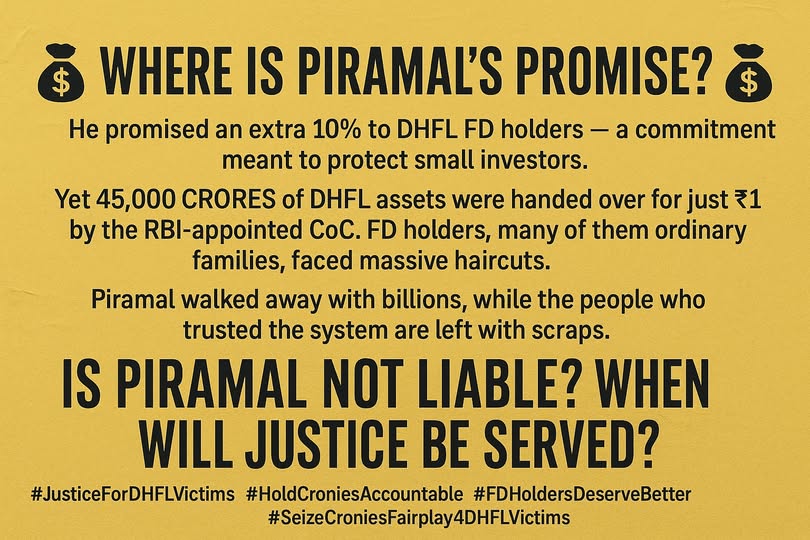
One. In your own bid you pledged, in writing and in public, “10 per cent over and above the admitted claim amount” of the fixed-deposit holders. (The Times of India, 22 December 2020; the bid document itself.) That sweetener never materialised. FD holders were handed the base 23.08 per cent and not a paisa of the promised extra — and when the recovery is honestly recalculated to the actual date of payment, even that shrinks to roughly 19.64 per cent. The 10 per cent was not a payment. It was bait. A jumla in a bid document. A vow professed to win the auction and broken the moment the gavel fell — pratijñābhaṅga reduced to a spreadsheet cell that was quietly left blank.
Two. DHFL’s own forensic auditors traced siphoning of over ₹45,000 crore through the fictitious “Bandra Book Entities.” In the resolution plan, the right to recover that ₹45,000 crore of fraud proceeds — money that in law and in conscience belongs to us, the fleeced creditors — was assigned to you, Piramal, for a notional value of one rupee. ₹45,000 crore of recoverable assets. For one rupee. And this feat of arithmetic was not performed in a vacuum — it was blessed, expedited, and shielded by the presumed finality of an IBC process operating hand-in-glove with the ruling BJP dispensation to whom, as the record of electoral bonds and PM CARES contributions is alleged to show, you were no stranger.
That is the foundation. A promised 10 per cent that vanished, and ₹45,000 crore that became one rupee — with the State holding the door. Everything below is only commentary.
A vow (pratijñā) can be broken only by one who has first professed it. You have professed a great many. You invoke Vaiṣṇava dharma; you quote the Gītā at your investors; you have trademarked an oxymoronic thing called “conscious capitalism.” Each profession is a vow. And so, by your own standard — never mine — you have handed me the very instrument by which to measure you, not as an individual, but as a structure. Let us measure. I brought the ruler; you supplied the units.
Gandhi bound himself by eleven vows, the ekādaśa vrata. Three concern us here.
Satya — truth. You speak the dialect Orwell named doublespeak. “Conscious capitalism” is the anaesthetic administered before the extraction; “philanthropy” is the receipt issued afterward. Deleuze and Guattari would recognise the operation with clinical precision: your capital decodes and deterritorialises — it dissolves the depositor’s savings into abstract flow — and then reterritorialises the proceeds onto the most archaic sacred codes it can find: temple, Gītā, dharma, nation. The split is not a pathology of your mind; it is the machine you serve, and you are its most devout mask. The mirror I hold up shows no abiding self behind the mask — only māyā wearing a rudrākṣa.
A compilation of the alleged controversies, for the curious:
And a word on Oxford — since satya is precisely the point. You are said to have “delivered an Oxford Talk.” You did no such thing. You stood in the city of Oxford, at a session convened by the student-run Oxford India Forum and trumpeted through .com channels the University’s own ox.ac.uk never once blessed — in Oxford, geographically; never by Oxford, institutionally. It is a Schrödinger’s lecture, alive and dead at once: it exists because it was announced, not because it was heard. Baudrillard kept a word for a copy that has mislaid its original — simulacrum — and your Oxford is its purest specimen: the veneer of the spires without the substance of the seminar, proximity to a brand mistaken for wisdom, prestige laundered into authority the way a token rupee launders ₹45,000 crore. And the content beneath the gown? Viksit Bharat recited like catechism — the hunger, the farmer’s rope, the shuttered newsroom all quietly cropped from the frame. It was not epistemology, Friend; it was PR in academic costume, the very same anaesthetic as “conscious capitalism,” merely wearing robes it did not earn. Contrast a genuine invitation — a Tharoor at the Oxford Union, asked because he had something to say — with an appearance curated so the photograph would say it for you. A man secure in his own satya need not borrow Oxford’s. He tells the truth plainly; and the truth, having no sponsor, requires no venue.
Asteya — non-stealing. Now we arrive at the arithmetic, and here I must be indelicate, because numbers do not do ahiṃsā — they merely sit on the page and refuse to blush.
The fixed-deposit holders of DHFL — my spouse and I among them — had claims admitted at ₹5,375 crore. We were paid back ₹1,241–1,243 crore. That is a recovery of 23 paise in the rupee: a 77% haircut.
This was not inflicted on traders or equity players, engaged in the risky zone of the chaosophical share market. It was inflicted on roughly 77,000 households, many of them pensioners, whose only “offence” was placing money in a licensed, regulated housing-finance company.
Mid-sized depositors (those above the ₹2-lakh full-repayment slab) were given 40–43% of their principal and told to be grateful.
And you, Friend? For a total consideration of ₹34,250 crore you acquired the enterprise — and, as a garnish, you were assigned the rights to some ₹45,050 crore of alleged-fraud and avoidance recoveries for the princely sum of one rupee. One rupee. I have paid more for a cup of chai and received more froth. The depositor’s 77 per cent evaporated on one side of the ledger and re-condensed, by a coincidence the Gītā would call karma and an auditor would call design, on yours.
No quantity of Vaiṣṇava piety launders an asteya-bhaṅga of that magnitude. In the Buddha’s vocabulary this is micchā-ājīva — wrong livelihood; and its opposite, sammā-ājīva, right livelihood, is not a CSR line item, not a hospital wing with your name on the lintel. It is a precept. You cannot tithe your way out of a broken precept any more than a man can bathe in the Ganga to un-sign a contract.
Aparigraha — non-possession. Here I need write almost nothing. Your balance sheet is my footnote, and it is a long footnote.
On the itching palm.
Permit me a detour through a second scripture — not Eastern this time, but you strike me as a man of broad reading. In Julius Caesar, Brutus turns on his brother-in-arms:
“Let me tell you, Cassius, you yourselfAre much condemn’d to have an itching palm.”
An itching palm, Friend, is Shakespeare’s name for the hand that cannot stop reaching — the palm that itches for the coin and scratches itself raw on the savings of others. The Buddha, less poetic and more precise, names the same fire lobha — greed — with its siblings dosa (hatred) and moha (delusion). At the root of every bhaṅga I have catalogued sits this one itch. The Vaiṣṇava you claim to be would name that fire in Sanskrit and flee it. You have built a temple to it, hired a priest, and called the temple charity.
So here is my diagnosis, offered without malice and with the thoroughness of a grateful student: the promise you made in public — the additional 10 per cent to deposit holders, announced during the bidding and dutifully reported (The Times of India, 22 December 2020) — was the itch performing sincerity. It scratched the headline; it never reached the ledger. A jumla, in the local dialect. The sweetener that dissolved before it touched the tongue. That single undelivered promise is the whole of pratijñābhaṅga in one line: you kept the flag and broke the conduct.
Now, the SLAPP.
Since 2023 you have sent me letters upon letters — e-mails and snail-mails, through DSK Legal and through the good offices of Mumbai’s Sheriff — pursuing, with impressive persistence, a man whose correct legal name your notices have never once managed to spell correctly in its entirety. I confess I do not recognise this “PCHFL” (anymore) that hunts financially abused pensioners for the crime (?!) of raising their voice. In a republic that has, to its shame, no anti-SLAPP statute, such perpetual intimidation is not an aberration; it is a business model. You litigate the victim on the same spreadsheet on which you booked the recovery.
For the record:
But permit me an older story. A brahmin, Akkosaka Bhāradvāja, once stood before the Buddha and abused him at length. The Buddha asked: if you prepare a meal for a guest and the guest declines it, to whom does the meal belong? “To me,” said the brahmin, “since I must take it back.”“Just so,” said the Buddha, “the abuse you offer me, which I do not accept, remains yours.”
I do not accept your gift, Friend. Your intimidation, undelivered into fear, returns to sender with the postage due. This is abhaya — fearlessness — the one currency in which I happen to be wealthy, having been relieved of the others. Slap me with another SLAPP if you must. Karma is a patient accountant; it does not require my signature to keep your ledger, and unlike the NCLT, it grants no adjournments.
I know how swiftly the NCLT and the NCLAT can move when capital knocks. I know, too, how a victim-depositor’s petition can be made to wait — how a commodity called “justice” can be administered as deterrence. I will not call the benches names; I record only, as a witness under oath to his own experience, the asymmetry between the speed extended to the ₹34,250-crore acquirer and the silence extended to the ₹1,241-crore casualty. Let the record stand. Anicca governs even this. Benches, regimes, balance sheets — all are impermanent. The legitimation crisis a power suffers when it can no longer be believed is not a slogan; it is anicca arriving on schedule, and it does not accept bribes to run late.
One last thing, since it is the heart of the matter.
Let me be plainer than the satyāgrahī is usually permitted to be, for the mirror shows what it shows. You are not merely near the ruling party. The record — electoral bonds encashed, PM CARES filled, Flashnet transactions made with special premium, benches that sprint for the acquirer and slumber for the depositor — reads as collusion, and I will let the reader reach for a gentler synonym if one comforts them. But the arrangement with the State is only the outer ring. The inner ring is (perhaps) the theocracy, and the theocracy is where the real jumla lives.
You are a disciple of Radhanath Swami. You built him a temple — Sri Sri Radha Govindadeva — inside your own Piramal Vaikunth at Thane, and offered it to the public as devotion. I will not litigate the old and unproven shadows that have long trailed your guru’s name. Here, I note only the architecture of the thing: a Vaiṣṇava philanthro-capitalism engineered so that every extraction arrives pre-blessed. The depositor is fleeced on Monday; the deity is garlanded on Tuesday; and the garland is then produced as proof that Monday never happened. That is “conscious capitalism” — not an ethic but a liturgy, the incense that sanctifies the loss. (Whether ISKCON’s Cold-War cartography ever wandered through Langley I leave to those with more appetite for rabbit-holes than I possess. The ledger before me needs no help from any agency to convict; greed signs its own confession.)
And notice, Friend, your fondness for the letter D.
DHFL — where 77,000 households learned exactly what your promise weighs.
Digwal — your API plant, welcomed by the US FDA with a Form-483 and four observations.
Dahej — your Gujarat site served a closure order by the pollution board, which you carried up to the Supreme Court rather than into compliance.
Deposits, drugs, discharge.
A devotee’s alphabet, recited in a single consonant. I do not claim the letter is destiny. I claim it is a pattern — and a pattern, Friend, is only a vow repeated until it stops pretending to be an accident.
So here, at last, is the whole of it. The flag-waving Hindutva your Mr. Piyush Goyal and Co. advertise has made you one of its own: the protector of spectacular sanātana—the “most ancient” costume, the party of ₹15 lakh that never landed, two crore jobs a year that never came, farmers’ incomes supposedly doubled while farmers continued to die by suicide, housing for all by 2022 that never materialized…..and so on. None of that will save you. Because dharma is not a flag you fund, a corporatized mandir you gift, a swami you patronise, or a trademark you register at the patent office. Dharma is conduct. You have kept the price-tagged costume—the temple, the guru, the liturgy, the saffron party’s warm regard—and broken the conduct. That is the whole indictment. And it is written not in my scripture, but in yours.
So I await your next SLAPP without anxiety and without hatred — I bear you none; ahiṃsā forbids it, and I have frankly no use for it. The satyāgrahī does not speak in high decibel, because the truth is not improved by volume, only cheapened by it. I hold up the mirror; you are free to look away.
And if you insist on hearing the satyāgrahī, then hear him clearly: the powerful have always been hard of hearing, and the top one per cent have perfected the condition. Their ears are not deaf to profit; they are deaf to the people who bear its costs. So yes, the voice may have to be loud—but the hatred need not be.
“It takes a loud voice to make the deaf hear.” — Auguste Vaillant The words Bhagat Singh and B. K. Dutt carried into the Central Legislative Assembly on 8 April 1929.
The door to right conduct — to asteya reversed, to the 77,000 FD households made whole, to the itching palm at last held still — is not one I can close, and it is one you can still walk through. It remains open.
With regards, and with the gratitude of a grateful student,
A DHFL depositor. A satyāgrahī. Not, whatever your notices (perhaps) insist, a defendant who will flinch.
Shyama Prasad Mukherjee: A Political Profile Posted on 23rd June, 2026 (GMT 04:41 hrs) ABSTRACT Shyama Prasad Mukherjee (1901–1953) was a Bengali barrister and politician who rose rapidly through alleged paternal influence to become the youngest Vice-Chancellor of Calcutta University. Entering politics as a Congress candidate in 1929, he shifted to the Hindu Mahasabha in 1939, served as Finance Minister in Bengal’s coalition government, explicitly offered cooperation to the British Governor to suppress the 1942 Quit India Movement, and advocated the communal (in the negative sense of the term as in South-East Asia) partition of Bengal in 1947. As Nehru’s Minister of Industry and Supply (1947–1950), he resigned over the Liaquat–Nehru Pact and, with RSS backing, founded the Bharatiya Jana Sangh in 1951. He opposed the Hindu Code Bill’s reforms on women’s rights and Article 370’s special status for Jammu and Kashmir, while his Mahasabha-linked relief efforts during the 1943–44 Beng...
Of Debt and Delusion: India’s $747 Billion Burden and the Mirage of Neoliberal GDP Fetishism Posted on 30th December, 2025 (GMT 15:55 hrs) ABSTRACT This article critically examines India’s external debt surge to approximately USD 747 billion by mid-2025—a near-doubling since 2014—as a hallmark of crony capitalism under the Modi regime, where liberalized external commercial borrowings (ECBs) and public sector bank hollowing facilitate upward redistribution, oligarchic consolidation (favoring conglomerates like Adani and Ambani), and asymmetric risk socialization amid volatile private dominance (over 77% non-government), USD-heavy exposure (54%), and intergenerational burdens. Intersecting with GDP misreporting flaws (IMF C-grade accounts, unorganized sector proxies inflating growth) and colonial-era inequality peaks (top 1% holding 40% wealth), this financialized precarity—diagnosed via Toussaint’s World Bank “never-ending coup” and Lazzarato’s “indebted man”—enforces neolibe...
Oligarchs, Jokes, and a Pinch of Democracy: An Agit-Prop Oligarchs, Jokes, and a Pinch of Democracy: An Agit-Prop Posted on 29th May, 2025 (GMT 13:09 hrs) ABSTRACT This agit-prop is a sharp, satirical theatrical performance set in a dystopian 2025 Mumbai comedy club, blending the traditions of Charlie Chaplin, Bertolt Brecht, and Dario Fo to mount a fierce critique of India’s current political and media landscape. Using the techniques of “total theatre” and “epic theatre,” the play breaks the fourth wall and demands audience engagement, creating a space where humour becomes rebellion. Anchored by Akash Banerjee’s scathing monologues and featuring an ensemble of comedians like Munawar Faruqui, Vir Das, and Kunal Kamra, alongside journalists such as Ravish Kumar and Dhruv Rathee, the performance employs alienation effects and direct address to spotlight the nexus of politics, propaganda, and profit. The stage becomes a visual battleground of symbols: a Modi impersonator lies in a hos...



Comments
Post a Comment