Reading ‘Vande Mātaram’ Across Registers: Text, Myth, Ritual
Reading ‘Vande Mātaram’ Across Registers: Text, Myth, Ritual
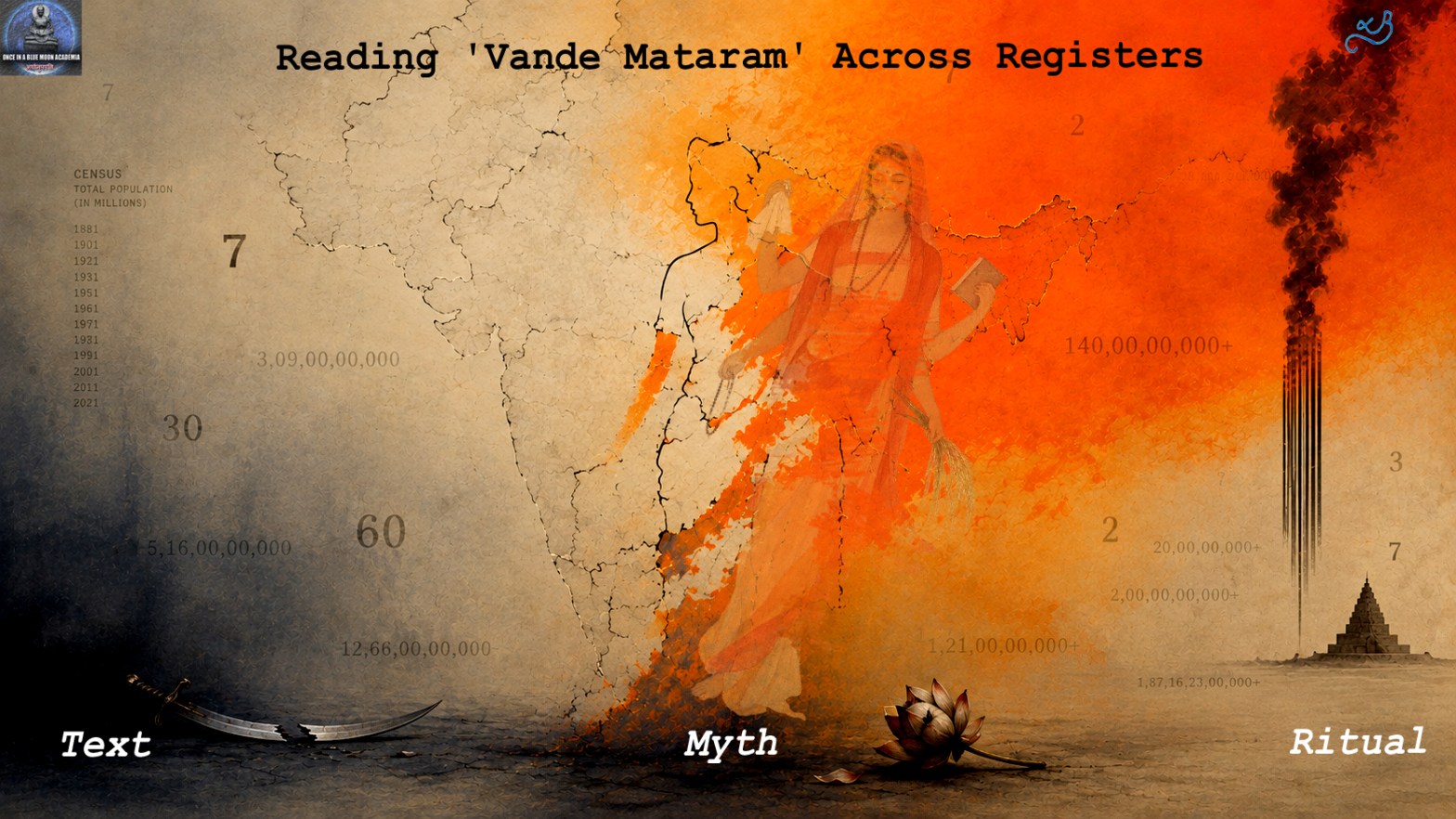
Posted on 24th August, 2026 (GMT 10:25 hrs)
ABSTRACT
This “reading” traces Vande Mātaram’s discursive transformation(s) from a specifically Bangla hymn into an unstable national emblem and, finally, a ritualised test of belonging. It begins with the demographic hinge of saptakoṭi/dvisaptakoṭi—seven crore throats and fourteen crore arms—corresponding to the Bengal Presidency, not India, and follows its mutation from Bankim’s fixed text to the 1905 inflation of thirty crore, the Republic’s excision of the number-bearing and goddess-identifying stanzas in 1937–50, and the later dissolution into unbounded koṭi-koṭi. Across page, stage, state and popular transmission, the essay asks what happens when a countable provincial people becomes an infinite, unauditable mass. It reads the hymn through the genesis of Ānandamaṭha, Tagore’s counter-discourse of neśā, the colonial genealogy of mātṛbhūmi/mātṛbhāṣā, and the “(M)Other-Tongue” mechanism that manufactures Others. The stanza-by-stanza appendix tests the hymn’s claims of water, fertility, beauty, knowledge, feminine strength and sustaining earth against ecological depletion, educational precarity, demographic violence and extractive concentration, exposing a structure in which the signifier survives while the referent is hollowed out. The blurred number, singular vande, and 2026 penalisation of disruption converge as political ritual: citizen becomes chorus, dissent filial betrayal. The argument is not that singing is illegitimate, but that compelled, unexamined singing surrenders the critical freedom citizenship requires; to decline the chant is not to refuse the country, but to refuse a mistranslation, a miscount, a manufactured Mother, and the disappearance of the historically located citizen into an infinite chorus.
“Vande Mātaram.
Sujalāṃ suphalāṃ
Malayajaśītalāṃ
Śasyaśyāmalāṃ
Mātaram.Śubhra-jyotsnā-pulakita-yāminīm
Phulla-kusumita-drumadala-śobhinīm,
Suhāsinīṃ sumadhura-bhāṣiṇīm
Sukhadāṃ varadāṃ Mātaram.Saptakoṭī-kaṇṭha-kalakala-nināda-karāle,
Dvisaptakoṭī-bhujair dhṛta-khara-karavāle,
Abalā kena Mā eto bale!
Bahubala-dhāriṇīṃ
Namāmi tāriṇīṃ
Ripu-dala-vāriṇīṃ
Mātaram.Tumi vidyā, tumi dharma,
Tumi hṛdi, tumi marma,
Tvaṃ hi prāṇāḥ śarīre.
Bāhute tumi Mā śakti,
Hṛdaye tumi Mā bhakti,
Tomāri pratimā gaṛi
Mandire-mandire.Tvaṃ hi Durgā daśa-praharaṇa-dhāriṇī,
Kamalā kamala-dala-vihāriṇī,
Vāṇī vidyā-dāyinī.
Namāmi tvāṃ,
Namāmi Kamalāṃ,
Amalāṃ atulāṃ,
Sujalāṃ suphalāṃ
Mātaram.Vande Mātaram.
Śyāmalāṃ saralāṃ
Susmitāṃ bhūṣitāṃ
Dharaṇīṃ bharaṇīṃ
Mātaram.”
0. Introduction: Holding the Text to Its Own History
This investigation rests on the established scholarly record concerning Bankim Chandra Chattopadhyay, Rabindranath Tagore, and the historical construction of Indian nationalism. It adheres throughout to a strict citation discipline: every claim is attributed, every contested point is marked as contested, and no sentence is enclosed in quotation marks and ascribed to a source that has not been verified against the original.
Two categories of material receive heightened scrutiny. First, the specialised Bangla scholarship—above all Chittaranjan Bandyopadhyay’s Ānandamaṭha: Racanār Preraṇā o Pariṇām (Kolkata: Ananda Publishers, 1985). That work establishes the novel’s genesis in the Sannyāsī–Fakir insurgency and the catastrophic Bengal famine of 1770, and it traces the successive revision of the antagonist across Bankim’s lifetime editions. Second, demographic figures appear only as the rounded approximations the argument itself requires. Wherever a precise digit is printed, it must be verified against the original Census of India report volumes. Exactitude in the decimal is never the point. What matters—and what the entire investigation turns upon—is the direction of the historical substitution: from a province’s countable population to a subcontinent’s inflated fiction, and finally to an uncountable mass. The number is treated here as a political variable, not a statistical fetish.
The Tagore passages that appear later are quoted verbatim. Both Tagore (d. 1941) and Bankim (d. 1894) are in the public domain; their reproduction raises no rights question. A short consolidated note on the handful of genuinely open points—those a careful reader must still confirm before treating them as settled—closes the essay after the references.
The method is neither “neutral” (?!) nor merely academiocratic. It is the method of an exposé. It holds the text to its own history. It refuses the convenient erasure of numbers, stanzas, and antagonists. It makes visible the successive operations—provincial hymn, nationalist song, totalising chant—by which a specific census count was first inflated, then dissolved, and finally amputated from the official record. What follows is written to that standard, without concession.
What the record shows, in outline, is this. Vande Mātaram began as a mid-1870s Bangla hymn whose demographic fingerprint—saptakoṭi / dvisaptakoṭi—mapped almost exactly onto the undivided Bengal Presidency of the first synchronous census, not onto India. Bankim never printed “thirty crore.” The larger figure entered on a Congress platform in the Partition year; the number later dissolved into the unbounded koṭi-koṭi; the Republic, recognising the sectarian charge of the later stanzas, adopted only the first two. The “full” song demanded today is therefore the least stable object in the tradition: a provincial count inflated, a martial muster blurred into infinity, a theophany the freedom movement itself excised, and a loyalty-test now backed by the penal power of the state.
The appendix that follows reads the complete hymn stanza by stanza and asks of each predicate a single question: does it still hold? The recurring answer is structural. The signifier survives; the referent is voided. The land is still called well-watered while the aquifers are mined; still called harvest-green while the soil is degraded and nearly thirty per cent of the territory stands under desertification; still called giver of knowledge while foundational literacy collapses for the majority of rural children; still called the strength of women while tens of millions of daughters are missing and reported sexual violence continues at the rate of one case every few minutes. The Mother is declared beyond audit (atulā) precisely so that the extraction of her body—through monetisation pipelines, corporate concentration, and an insolvency regime that socialises losses downward—need not be measured. The number that once counted seven crore provincial throats is required to summon an infinite chorus whose refusal can now attract imprisonment.
Tagore saw the mechanism early. From inside the Swadeshi moment he named the mantra neśā—intoxication, hypnotic compulsion—and refused the conversion of the free citizen into a mechanically repeating unit of a mobilised mass. The same refusal is available today. To decline the compelled chant is not to refuse the country. It is to refuse a mistranslation, a misdating, a miscount, a theophany the Republic amputated, a substitution of the inclusive anthem by an eliminative song, and a performance of bad faith that treats a nineteenth-century political construct as eternal nature while the living land is liquidated. The harder freedom is to read the song rather than chant it—and to keep the text accountable to the history and the data it can no longer honestly predicate in the present tense.
What follows is written to that standard.
1. The Two Lines on Which Everything Turns
The controversy lives in the third stanza of Bankim Chandra Chattopadhyay’s hymn — that is, outside the two stanzas the Indian Union later adopted as its National Song. In the original, the couplet reads:
Saptakoṭi-kaṇṭha-kala-kala-nināda-karāle,
Dvisaptakoṭi-bhujair-dhṛta-khara-karavāle…
“Seven crore throats roaring their clamour; twice-seven [i.e. fourteen] crore arms bearing the sharp scimitar.”
The interior arithmetic is the hinge of this entire study.
The arms are exactly double the throats because one body carries two arms. Seven crore people yield fourteen crore arms. The verse does not merely count; it engineers a perfect ratio and locks it in place.
This doubling is a small, deliberate piece of construction built into the couplet. Its presence is not ornamental. It is structural: the hymn’s own internal logic requires that the number of arms be precisely twice the number of throats. That fixed ratio is the quiet signature of the original design—and the design, as the next section shows, belongs to Bengal.
2. A Song of Bengal, Not of India: the Demographic Fingerprint
The number is a fingerprint. It identifies the nation the hymn addresses at the moment of its composition. That nation is Bengal, not India.
Bankim Chandra Chattopadhyay composed the hymn in the mid-1870s. It was later absorbed into the novel Ānandamaṭha, serialised in Baṅgadarśan in 1881–82 and published as a book in 1882. In every text that Bankim himself saw into print, the reading is fixed: Saptakoṭi / Dvisaptakoṭi — seven crore throats, fourteen crore arms. Bankim died in 1894. He never printed “thirty crore.” The larger figure is therefore non-authorial; it entered the tradition only after the author’s death. (The frequently repeated precise date of 7 November 1875 rests on weak authority and is better left as the mid-1870s.)
The demographic record settles the question of scale.
The first synchronous all-India Census, taken on 17 February 1881, returned a total population for British India of 253,891,821 persons — approximately 25.39 crore.
Against that total, “seven crore” cannot refer to India.
It maps, almost exactly, onto the Bengal Presidency as it stood in 1881. The Census recorded the population of Bengal at 69,536,861 persons — approximately 6.95 crore.
This was not the truncated territory of today’s West Bengal or Bangladesh. It was the great undivided administrative Bengal Presidency: the territories that now constitute West Bengal, Bangladesh, Bihar, Orissa, and Chota Nagpur. That landmass sat squarely at seven crore. The number is the tell: the goddess of the hymn is the mother of Bengal.
One boundary must be stated with precision, because it is exactly the kind of detail a hostile reader will weaponise. Assam is sometimes added to the list of “undivided Bengal.” Assam, however, had already been separated as a Chief Commissioner’s Province in 1874. By the 1881 Census it was administered independently and returned a population of 4,881,426 (roughly half a crore). The 6.95-crore figure for Bengal does not include Assam. Adding Assam would push the total past seven crore and spoil the fit. Assam may be included only if the argument is anchored strictly to the mid-1870s composition moment rather than the 1881 Census; if so, the inclusion must be stated aloud. Either way the core claim holds. The discipline is simply never to cite the 1881 Bengal figure and the Assam inclusion in the same breath.
The arithmetic is therefore decisive. Seven crore is Bengal. Thirty crore is British India. The original text names the former; the later substitution names the latter. The number itself is the evidence.
A final note on the intensity with which Bengal sacralises the Mother.
The Śākta kinship imaginary runs unusually deep in this region. In the subaltern lexicon the sun and moon are a child’s maternal uncles; the cunning fox is the tiger’s nephew. Kinship itself is routed through the maternal line in everyday speech and folk reckoning. Property law reinforced the same orientation with formal force. Under the Dāyabhāga school that governed Bangla Hindu inheritance—unlike the Mitākṣara system dominant across the cow-belt heartland—the widow inherits, and the sister’s son holds a recognised claim. The maternal figure is therefore not merely emotional or mythic; she is juridically consequential.
Bankim’s essayist successors have long observed a darker corollary. It remains a recognised scholarly hypothesis—not a settled fact—that this very property logic, the Kulin Dāyabhāgin’s fear of the inheriting widow (a fear shared in both Bengal and Assam), helped entrench the practice of satī. Where the widow could claim a share of the estate, the pressure to remove her from the inheritance calculus intensified. The Mother is therefore most loudly deified precisely where actual women were most tightly constrained by the rules of property. The sacred feminine is elevated in the same social field that most rigorously policed the living woman.
The inference is offered strictly as argument. Yet the pattern is difficult to dismiss: the region that produced the most intense literary and ritual celebration of the Mother is also the region whose inheritance law made the living mother, sister and widow most economically threatening. The hymn’s fierce maternal devotion draws, whether consciously or not, on that deeper structure.
That deeper structure of kinship and property helps explain why the hymn could be written at all—and why its numbers, as the next sections shall demonstrate, could never have belonged to India.
2.1 The Two Lines, Date by Date: How a Bengali Number Was Made “National”
Return, then, to the number itself. If seven crore fingerprints Bengal, then the later life of that number is nothing less than the history of how a Bangla hymn was conscripted to speak for all India — and the decisive questions become simply who altered the figure, and when. Tracing it date by date settles a popular impression that is false: that Bankim himself “updated” the count from seven crore to thirty as the movement grew. He did not. Across the novel’s several lifetime editions the novel was revised, at times heavily — but the two lines of the hymn were not; the reading stayed saptakoṭi from first printing to his death.
The sequence falls into three distinct registers, and the number behaves differently in each: what Bankim fixed on the page (seven crore, and stable); what performers later did to it on the stage (swelling it to thirty, then dissolving it into an uncountable koṭi koṭi); and what the state finally did to it in law (cutting the whole line out of the National Song). The provincial-to-national conversion, note, happens on the stage — never on Bankim’s page.
Revised table (chronology preserved, later-20th-century row placed last):
| Date | Event | The two lines read | Register |
|---|---|---|---|
| mid-1870s | Composed by Bankim (the oft-cited 7 Nov 1875 is unreliable; use “mid-1870s”) | saptakoṭi / dvisaptakoṭi | Page |
| 1881–82 | Serialised in Baṅgadarśan | saptakoṭi / dvisaptakoṭi | Page |
| 1882 | First book edition of Ānandamaṭha | saptakoṭi / dvisaptakoṭi | Page |
| 1882–1892 | Further lifetime editions (commonly counted as five): the novel’s “enemy” is revised, the hymn’s number is not | saptakoṭi (unchanged) | Page |
| 1894 | Bankim dies; saptakoṭi is his last authorial word | saptakoṭi (final authorial) | Page |
| 1896 | Tagore composes the tune and sings it at the Calcutta Congress | saptakoṭi | Stage |
| 1905 | Amid the Partition of Bengal, a performer (traditionally Sarala Devi Chaudhurani) sings the swollen figure at a Congress session | triṃśakoṭi / dvitriṃśakoṭi (30 / 60 crore) | Stage |
| 1909 | Aurobindo’s English translation (Karmayogin, 20 Nov) — the authoritative page still keeps Bankim’s figure | “seventy million … twice seventy million” (= 7 crore) | Page |
| 1937 | Congress Working Committee adopts only the first two stanzas as the national song | the line is excised entirely | State |
| 1950 | Constituent Assembly (24 Jan) gives those two stanzas equal status with Jana Gaṇa Mana | line absent from the National Song | State |
| Later 20th century – present | Popular and nationalist transmission continues | koṭi koṭi — the number dissolves | Stage |
Read down the “Register” column and the whole thesis of this essay is already visible in miniature. The number is a constant on the page (seven crore, 1875–1909, Bankim and Aurobindo alike), a variable on the stage (thirty crore in 1905, then no number at all), and an absence in law (1937–50). The “thirty crore” everyone half-remembers as Bankim’s is in fact a railway-age performer’s rescaling of a dead man’s text; and the National Song the state actually adopted contains no crore-line whatsoever. One honest caveat, proper to a variorum-level claim: a letter-perfect collation of the hymn across all five lifetime editions belongs to a critical edition (the Bankim Racanābalī, or Julius Lipner’s annotated English edition). The point that survives any such check is not in dispute — the number did not move while Bankim lived.
One further observation belongs here, though its full development is reserved for later sections. The very possibility of treating population as a stable, countable, politically usable figure—seven crore for Bengal, thirty crore for India—is itself a product of the colonial census. Nationhood, in this register, is defined through a colonial categoreme: the administrative enumeration that first turned fluid, overlapping populations into discrete numerical units capable of being scaled, inflated, or dissolved according to political need. Bankim inherited that colonial arithmetic and used it for a provincial portrait. Later performers and nationalists inherited the same arithmetic and simply enlarged the frame. The state, in turn, found the resulting number inconvenient and cut it away. The hymn’s numerical history is therefore also a brief history of how colonial categories of counting became the raw material of nationalist imagination.
Now we move carefully across these substitutions, and the genesis of the lyrics itself.
3. The Genesis of the Text: Insurgency, Famine, and the Shifting Enemy
Why does a hymn to Bengal arm seven crore throats with scimitars at all? The answer lies in the novel’s genesis.
Ānandamaṭha draws on two historical crises of late-eighteenth-century Bengal: the Sannyāsī–Fakir insurgency and the catastrophic famine of 1770 (the chhiẏāttarer manvantar). This consensus is established in the specialised scholarship—above all Chittaranjan Bandyopadhyay’s study of the novel’s making, and, in English, Julius Lipner’s annotated translation and introduction. The santāns (the “children” of the Mother) rise against oppression in a landscape already marked by mass death and rural revolt. The hymn’s martial arithmetic—seven crore throats, fourteen crore sword-bearing arms—belongs to that imagined mobilisation.
Across the novel’s successive lifetime editions (several printings between 1882 and Bankim’s death in 1894) the author revised the political framing more than once. The point for our purposes is narrow but decisive: the novel was a living, revised text—and yet, through all that revision, the number in the hymn stayed at seven crore. The instability was in the enemy, not in the census.
A popular claim must be corrected here because it circulates widely and is wrong. The formula that runs “in the first edition the villain was the British Raj, and in the second edition the enemy was swapped for the Muslim ruler” inverts what the scholarship actually shows. In the novel as set, the santāns’ immediate armed antagonists are the forces of the Muslim Nawāb’s administration and its allied zamindārs. A Muslim-ruler antagonist is present from the first edition, not substituted later. The narrative’s diction toward Muslims (including the pejorative term neṛe) is communally charged from the outset.
What Bankim actually altered across editions ran in the opposite direction. He muted the anti-British charge—unsurprisingly, given that he served as a colonial deputy magistrate—and is generally held to have sharpened the novel’s providential ending, in which a mysterious counsellor tells the santāns their work is done because English rule will now restore order. The revision therefore softened the British enemy while the Muslim-ruler enemy stood throughout.
If the ripu (enemy) in Bankim’s novel was the one element that could be revised while the martial number stayed fixed, and if the Muslim-ruler antagonist and the pejorative diction toward Muslims were present from the first edition while the anti-British charge was progressively softened, what does this textual history illuminate about the structure of contemporary Islamophobia in saffron-ruled India?
When a political formation that claims the “full” Vande Mātaram as its own simultaneously expands the category of the internal enemy, densifies surveillance and legal (and extra-legal, extra-judicial) exceptionalism around Muslim citizens, Christians as well as agnostic-atheists/non-believers, and treats demographic anxiety as a permanent mobilisation device, is it not simply reactivating—at national scale—the same movable ripu-slot that Bankim left open? And if the original hymn armed a provincial census count against a designated foe, what happens when that same logic, stripped of its historical specificity and inflated into an uncountable mass, is turned into a permanent technology of majoritarian rule?
4. From Province to Nation: the 1905 Substitution
The mutation from “seven” to “thirty” did not happen on the page. It happened in performance. Rabindranath Tagore is generally credited with first setting Vande Mātaram to music and singing it at the 1896 Calcutta session of the Congress. The numerical rescaling is attributed to Sarala Devi Chaudhurani, who is reported to have sung Triṃśakoṭi (“thirty crore”) for Saptakoṭi, and Dvitriṃśakoṭi (“twice-thirty,” i.e. sixty crore arms) for Dvisaptakoṭi, at the 1905 Banaras session of the Indian National Congress.
Note again the preserved doubling: thirty crore people → sixty crore arms. The substitution is internally coherent; it is a deliberate act of geographic rescaling, not a slip. And its meaning is exact. Seven crore was Bengal; thirty crore was British India entire. To sing “thirty” in 1905 was to perform, in a single word, the conversion of a Bangla provincial hymn into an all-India national-ist/national-ized song— precisely in the year of the Partition of Bengal, when Bangla grievance was being generalised into Indian nationhood.
The same 1905 moment produced the counter-instinct. Tagore wrote Āmār Sonār Bāṃlā that year, out of the identical anti-Partition (Baṅga-bhaṅga) crucible — but where the Vande Mātaram rescaling expanded Bengal outward into an armed all-India goddess, Tagore’s song held fast to the soil of a Bengal about to be cut in two. That this second song is now the national anthem of Bangladesh — and that loving it can earn a Bengali the slur “Bangladeshi” today — is the bitter closing irony of the same year, 1905. (The attribution of the numerical substitution to Sarala Devi is recorded in Banglapedia and later accounts; it is best presented, as here, as a well-established tradition rather than a claim resting on a single contemporaneous document.)
4.1 The (il)logic of Substitution
The substitution has a logic and an illogic, and separating the two is the whole point. As arithmetic, each step is impeccable: seven crore throats yield fourteen crore arms; thirty crore yield sixty; the doubling never breaks. Whoever sang “Triṃśakoṭi / Dvitriṃśakoṭi” understood the verse’s internal machinery perfectly. That is the logic — the substitution is a valid operation.
The illogic lies one level down, in the premise the operation is performed upon. To “update” the figure at all is to treat a poetic-provincial invocation as though it were a live demographic statistic in need of a census refresh — a category error. Bankim’s “seven crore” was never a datum to be kept current; it was a portrait of a specific people at a specific moment. The 1905 correction “fixes” a number that was never broken, and in doing so silently converts a description of Bengal into a prescription for India. The arithmetic is sound; the history it is applied to is fabricated in the very act of applying it.
And the direction of the change gives the game away. Had the motive been mere accuracy, the number would have tracked the census up and down and been footnoted as an approximation. Instead it moved once, decisively, from the population of a province to the population of a subcontinent — and then, when even thirty crore threatened to date, it abandoned counting altogether for the boundless koṭi koṭi. The trajectory is therefore not seven → thirty → many as successive better estimates; it is precise provincial fact → precise national fiction → imprecise totalitarian infinity. The number was always a rhetorical variable dressed as a datum, and what it was really measuring was the expanding radius of an imagined community that the counting itself was calling into being. That is the (il)logic in one line: a valid arithmetic performed on an invalid premise, whose real output was never a population but a nation.
5. The State Amputates the Number: 1937 and 1950
The institutional history delivers the sharpest single fact in this whole file. In October 1937 the Congress Working Committee resolved — with Tagore’s written advice in the background — that only the first two stanzas would serve as the national song, precisely in order to detach the song from the later stanzas that identify the land with Durgā, Kālī and Lakṣmī (the “idolatry” objection raised by sections of Muslim opinion). On 24 January 1950, Rajendra Prasad’s statement in the Constituent Assembly gave those first two stanzas “equal status” with Jana Gaṇa Mana.
The consequence is devastating for the Hindutva claim: the officially adopted National Song does not contain the crore-line at all. The seven-versus-thirty question, and the scimitar-bearing goddess, survive only in the full poem — the very version the Sangh Parivar insists upon. What they venerate as the authentic, complete, undivided Vande Mātaram is exactly the portion the Indian republic deliberately refused.
6. The Vanishing Number: Sung, Film, and Non-Film Renditions
Follow the number through the twentieth century and watch it dissolve. Once the demographic anchor became either embarrassing or simply unsingable across a changing population, the tradition floated free of the census entirely. In some full literary and cinematic settings the original saptakoṭi / dvisaptakoṭi was retained; in others it was swollen to thirty; in the dominant popular and official stream it was either silenced or dissolved into the non-numeric koṭi koṭi (“crores and crores of voices / crores and crores of arms”). The count is gone; only an unbounded, uncountable mass—or silence—remains. That is the textual event this exposé is named for.
The first known musical setting belongs to Jadunath Bhattacharya (Jadu Bhatta) of the Bishnupur gharana, Bankim’s contemporary and musical associate. He is recorded as having composed a tune for the poem soon after its writing, in a classical idiom (accounts vary between Raga Kafi on Trital and a Malhar–Qawwali fusion). Because the setting was made while Bankim was alive and the authorial text was still saptakoṭi / dvisaptakoṭi, the original numerical lines would have been available to the composer. No surviving contemporary notation proves that every early private performance included the third stanza, but the textual base was the full poem.
Rabindranath Tagore’s public performance at the 1896 Calcutta Congress is the first major political outing. Tagore set the opening portion to music and sang it; the numerical third stanza was not part of that rendition. The Congress stage therefore began with the serene, non-demographic stanzas. The 1905 performance tradition (conventionally linked to Sarala Devi Chaudhurani at the Benares session) introduced the swollen triṃśakoṭi / dvitriṃśakoṭi in the heat of the anti-Partition agitation. From that point the stage carried two competing numbers—Bankim’s seven and the performer’s thirty—while the page (Aurobindo’s 1909 translation) continued to preserve the original.
6.1 Film renditions
The best-known cinematic setting is the 1952 Hindi film Anand Math (dir. Hemen Gupta), with music by Hemant Kumar. Its Vande Mātaram—sung by Lata Mangeshkar and also in a male-vocal version by the composer himself—functions as a marching song and is among the most widely circulated full-length popular recordings. Crucially, this rendition retains the original numerical lines: sapta koti kaṇṭha-kalakala-nināda-karāle / nisapta-koti-bhujair-dhṛta-kharakaravāle. The film therefore preserves Bankim’s census count rather than silencing it or converting it into koṭi koṭi. In the cinematic archive the number does not vanish; it is still sung as seven and fourteen crore.
Most other popular film and shortened public versions, however, draw only on the opening adopted stanzas. In those cases the demographic third stanza—and with it the seven/thirty crore line—simply does not appear. The number does not become a smaller number; it tends towards silence.
6.2 Non-film / album renditions
The most consequential modern non-film rendition is A. R. Rahman’s “Maa Tujhe Salaam” from the 1997 album Vande Mataram, released around the fiftieth year of Independence. It is built around the two words “Vande Mātaram” and a new Hindi lyric; the eighteenth-century census of Bengal is nowhere in it. The pattern holds across much of the popular non-film field: the phrase is retained as a sonic totem, the number is discarded. The song becomes pure invocation, detached from the province, the population, and the history that once gave the figure its meaning.
Across the longer arc the trajectory is therefore uneven but clear. Early classical settings (Jadu Bhatta) and at least one major mid-century film (Anand Math, Hemant Kumar) still carried the original saptakoṭi. The 1905 stage introduced the inflated thirty. Tagore’s 1896 political performance and the post-1937 official convention excised the line altogether. Popular twentieth-century transmission increasingly dissolved the specific count into koṭi koṭi or simply omitted the stanza. By the end of the century the dominant public sound of Vande Mātaram no longer told anyone how many throats or arms were being summoned. The demographic fingerprint had been erased.
7. Tagore’s Counter-Discourse: the Mantra as Intoxication (Nikhilesh in Ghare Baire)
The number, blurred in performance into an uncountable koṭi koṭi, had by then become pure chant — sound displacing sense, invocation without a referent. And exactly that — the cry that hypnotises rather than states — is what Rabindranath Tagore diagnosed, in real time and from inside the Swadeshi movement, as a neśā, an intoxication. He voiced it not in an essay but through Nikhilesh, his alter ego in Ghare Bāire (serialised in Sabuj Patra, 1915; book 1916), set in the very Bengal the hymn was then generalising into a nation.
Each passage below is given first in Tagore’s Bangla (as supplied) and then in the canonical English of Surendranath Tagore’s 1919 translation (Macmillan). That English version was made by the author’s nephew with Rabindranath’s own help, and therefore carries an authority no later rendering does.
The pairing is deliberate. It lets a non-Bengali reader verify the argument rather than take the paraphrase on trust. The English wording independently confirms the reading: the words that surface are “hypnotic,” “self-government,” “juggler with ideas,” and “a curse upon it.” It is also fitting that an argument about a hymn which itself travelled out of Bengali into an all-India claim should be checkable in the language that carried Tagore’s counter-claim to the same wider world.
Bankim (d. 1894), Tagore (d. 1941), and this 1919 translation are all in the public domain.
Bimalā, reporting her husband Nikhil’s refusal of the mantra:
“অথচ স্বদেশী কাণ্ডর সঙ্গে যে আমার স্বামীর যোগ ছিল না বা তিনি এর বিরুদ্ধে ছিলেন তা নয়। কিন্তু “বন্দে মাতরম্” মন্ত্রটি তিনি চূড়ান্ত করে গ্রহণ করতে পারেন নি। তিনি বলতেন, দেশকে আমি সেবা করতে রাজি আছি, কিন্তু বন্দনা করব যাঁকে তিনি ওর চেয়ে অনেক উপরে। দেশকে যদি বন্দনা করি তবে দেশের সর্বনাশ করা হবে।”
“I am willing to serve my country; but my worship I reserve for Right which is far greater than my country. To worship my country as a god is to bring a curse upon it.”
— The Home and the World, tr. Surendranath Tagore (Macmillan, 1919); Nikhil’s words.
Nikhil, on the chant as hypnosis:
“…চীৎকার ক’রে মা ব’লে দেবী ব’লে মন্ত্র প’ড়ে যাদের কেবলই সম্মোহনের দরকার হয়, তাদের সেই ভালোবাসা দেশের প্রতি তেমন নয় যেমন নেশার প্রতি। সত্যেরও উপরে কোনো-একটা মোহকে প্রবল করে রাখবার চেষ্টা এ আমাদের মজ্জাগত দাসত্বের লক্ষণ।”
“So long as we are impervious to truth and have to be moved by some hypnotic stimulus, we must know that we lack the capacity for self-government. Whatever may be our condition, we shall either need some imaginary ghost or some actual medicine-man to terrorize over us.”
— The Home and the World (1919). The Bangla “majjāgata dāsatva” — marrow-deep slavery — the translation renders as the incapacity for self-government.
Nikhil, on Sandip the demagogue:
“…সন্দীপ হচ্ছে আইডিয়ার জাদুকর; সত্যকে আবিষ্কার করায় ওর কোনো প্রয়োজন নেই, সত্যের ভেলকি বানিয়ে তোলাতেই ওর আনন্দ। … প্রমত্ততা থেকে দেশকে যদি বাঁচাতে না পারি, তবে দেশের পূজা হবে দেশের বিষনৈবেদ্য, দেশের কাজ বিমুখ ব্রহ্মাস্ত্রের মতো দেশের বুকে এসে বাজবে।”
“…what a juggler with ideas is Sandip. He has no interest in discovering truth, but to make a quizzical display of it rejoices his heart. … those who deal in delusion end by deluding themselves.”
— The Home and the World (1919), p. 163.
Where the Bengal of this last passage warns that a nation saved from frenzy will otherwise turn its own worship into biṣa-naibedya, a “poison-offering,” Nikhil’s flat summary judgment gives the canonical English of the same thought — and it is the sentence to carry away:
“To tyrannize for the country is to tyrannize over the country.”
— The Home and the World (1919), p. 109.
Read as discourse, three moves are doing the work. First, Nikhilesh separates sevā (service of the country) from vandanā (worship of it), and declares that to worship the country is to destroy it — a direct refusal of the deification the third stanza performs. Second, he names the affect precisely: what binds the chanters is not love of country but love of neśā, intoxication; the mantra is a sammohan (mesmerism), and the craving to keep a moha (delusion) enthroned above truth is “the mark of our marrow-deep slavery.” Third, in Sandip he diagnoses the type — the idea-magician who does not seek truth but manufactures its bhelki (conjuring-trick) — a demagogue whose worship of the nation becomes its biṣa-naibedya, its poisoned offering.
The Raktakarabī material you paired with it sharpens the point by splitting neśā in two: the intoxication of Nature — the freedom of “sahaṛṣa aicchik śrama,” joyful voluntary labour, the “āchamkā ālo,” the sudden light through the cracked wall — against the intoxication of Yakṣa-pura, the totalising extraction-city where labour is stripped of play and the worker is reduced to alienation, ananvaya, pariche. The Vande Mātaram-mantra, in this frame, is the second kind of intoxication: not the wonder that frees, but the mesmerism that harnesses.
The decisive point is that Tagore aimed the same critique at his own side — at Gandhi. In “The Cult of the Charka” (Modern Review, September 1925) he attacked the compulsory-spinning programme in precisely the terms he had used against the Vande Mātaram chant: as a mechanical, ritualised, mesmeric activity that substituted repetitive bodily motion and mass conformity for thought — a neśā of a different fibre. To make a sacrament of the charkha, he argued, was to ask the mind to abdicate to the rhythm of the wheel, exactly as the mantra asked it to abdicate to the rhythm of the chant; Gandhi replied in “The Poet and the Charkha” (Young India, 5 November 1925). The pairing is what matters here: Tagore’s objection was never to this or that symbol but to the structural thing itself — the conversion of a free citizen into an intoxicated, mechanically-repeating unit of a mob, whether the sacrament be a song or a spinning-wheel. His dissent from Vande-Mātaram-as-neśā and his dissent from charkha-as-cult are one dissent.
Yet Nikhilesh’s refusal, for all its force, stops at the symptom — the intoxication, the mesmerism, the mob. It does not quite ask the prior question his own words keep circling: why Mother at all? Why should the land be a mother one worships, and the tongue a mother one defends, on pain of sarbanāsh? Tagore names the fever; the next Part excavates the infection — the genealogy of the maternal metaphor itself, which turns out to be neither ancient nor Indian, but a colonial-Christian import laid over a Brahminically-captured matriarchy. To see that is to understand why the “Mother” of the hymn could never have been the innocent, timeless figure the cult claims.
8. The Colonial Genealogy of the Mother: mātṛbhūmi, mātṛbhāṣā, and the (M)Other-Tongue Syndrome
There is a deeper stratum beneath the whole quarrel, and it dissolves the Hindutva claim to civilisational antiquity at the root. The premise on which the entire cult rests—that the land is a Mother to be worshipped, that the language is a Mother-tongue to be defended—is not classical at all. It is a modern colonial-Christian import, doubled by a Brahminical appropriation, and only then dressed in Sanskrit.
Begin with the word itself. Mātṛbhāṣā—“mother-tongue”—is not an indigenous Sanskritic category. As Ivan Illich demonstrated, the term entered Indian languages in the eighteenth century as a translation from English: a derivative technical term, born of translation. Classical Sanskrit did not call itself anyone’s mother-tongue; it called itself devabhāṣā, “the god’s tongue.” And the European phrase “mother tongue,” when it was first coined, had not meant the vernacular either but its very contrary. Catholic monks used it for the language of preaching “from the pulpit” in place of Latin—the tongue of the holy mother Church. The maternal metaphor for land and language is therefore an epistemologically amalgamated notion, not a natural or primordial phenomenon. Even the line so often pressed into service—jananī janmabhūmiśca svargādapi garīyasī—merely juxtaposes mother and birth-land; it does not equate them, does not call the land “mother,” and is of doubtful provenance. It is best not cited as canonical.
The colonial mechanism has a date and a name. Illich recovered Elio Antonio de Nebrija, contemporary of Columbus, who in 1492 offered Queen Isabella his Gramática de la lengua castellana—the first grammar of any European vernacular—expressly as a “tool” to colonise the speech of her own subjects. Here is the marriage of empire and language, sword and grammar-book. Standardisation converts a people’s living vernacular into the Grammarians’ “mother tongue,” which now requires tutors. The “captive speakers” of the now-“defeated” dialects are manufactured internally. Illich’s figure for this whole passage—from subsistence to welfare, from Church to State—is the “switch from breast to bottle”: the packaged commodity displaces the living breast. Language, too, is weaned onto the bottle.
In India the imported Christian mother was not merely borrowed or derived; it was altered and appropriated. Onto the colonial mother-tongue was grafted the śakti-cult of the bhakti period, in which female power is equated with the supreme reality—brahman, grammatically “He” (saḥ), not “She.” The result is a lasting tension between a substratum of matriarchal power-worship and a superstratum of Brahminical patriarchy. The mother-goddess of the marginalised shrine “outside the village” was hegemonically subsumed—“assimilated,” “acculturated”—into the Brahminical cult. In the Purāṇic story of the Devī Bhāgavata, Durgā, born of the amalgamated power of the male gods, fights the male “demons” precisely in order to restore the male gods’ sovereignty. The trace of matriarchy is thus coercively selved: regimented into a self to be emulated by the very people it dominates. The Indian mother-nation is therefore doubly manufactured—a Christian-colonial import laid over a Brahminically-captured matriarchy.
It is precisely here that Ānandamaṭha does its work. In Bankim’s “extremely masculine” novel there is no mere metaphoric displacement of Kālī onto the emerging nation-state; the two are equated. In “Vande Mātaram” the equation is at its most vivid. Gayatri Chakravorty Spivak’s reading of Mahasweta Devi’s “Breast-Giver” names the price with clinical clarity: the ideological construct of “India” is “too deeply informed by the goddess-infected reverse-sexism of the Hindu majority.” So long as the nation represents itself as goddess-mother—“dissimulating the possibility that this mother is a slave”—she “will collapse under the burden of the immense expectations that such a self-representation permits.” The mother is manoeuvred by the dominant male “other.” The promoters of the nation-state exploit her as the myth exploits Jaśodā, the wet-nurse: the professional breast-giver who suckles others’ children and dies of breast cancer.
Name the mechanism and its double edge appears at once: the (M)Other-Tongue syndrome. Inward, the plural, lived, uncountable vernacular—the actual speech of actual people—is frozen into a single, standardised, sacred Mother who must be worshipped rather than merely spoken. That is the switch from breast to bottle, from talking to venerating. Outward, the very act of consecrating a Mother produces her Others: whoever does not share her is cast as alien, orphan, intruder, enemy. Tellingly, the equation of motherland and tongue was “not obviously granted by the Muslim population,” branded the “bad orient” against the Hindu “good orient.” The Mother-tongue and the Other-tongue are struck from one die—hence the orthography, the (M)Other. The whole discursive formation that circles around the “mother tongue” is endowed with metaphoric illness: a syndrome. And Vande Mātaram is that syndrome’s liturgy—the sacrament by which the standardised Mother is worshipped and the un-chanting Other is exposed.
This closes the circuit of the whole exposé. The number was falsified upward to manufacture a nation. The state then amputated the deifying stanza precisely because it recognised the Durgā/Kālī identification as sectarian. The popular renditions blurred the count into a boundless mass. Tagore diagnosed the entire apparatus—song and spinning-wheel alike—as neśā. And beneath all of it sits a maternal metaphor that is neither civilisational nor natural but colonial-Christian over Brahminical-patriarchal. The Hindutva “full Vande Mātaram,” then, is an amalgamated mother-cult, sung in a translated Sanskrit, counting a fictional population rounded up to infinity, and used to sort the Mother’s children from her Others. Every layer is borrowed; only the exclusion is original.
9. The Contemporary Rendering: Blurring the Number as a Totalitarian Impulse
The preceding sections have traced the hymn’s numerical career across three registers—page, stage, and state. What remains is to assemble those strata and ask what political form requires their final, blurred version—and why a parallel eulogy of absolute submission has become the organisational liturgy of the same formation.
When the strata are laid one upon another, the Hindutva rendering stands exposed as a demand for a text that never stably existed. The page says seven: Bankim in 1882, and Aurobindo Ghose’s English translation of c. 1909, which carefully renders the figure as “seventy million”—seven crore, not thirty. The stage said thirty in 1905, then dropped the number into an uncountable koṭi koṭi. The state said neither, having amputated the entire stanza in 1937–50. What the Sangh venerates as the complete, authentic song-lyrics is therefore the least stable, most obviously constructed object in the whole record: a composite assembled from a dead author’s provincial census, a performer’s nationalist inflation, a popular dissolution into infinity, and a legislative silence.
The blurring is not incidental; it is functional. A specific number is a check. It anchors the hymn to a real province, a real census, a datable history—all of which can be argued with, verified, or contradicted. An uncountable “koṭi koṭi” answers to nothing. It is a mass without a boundary, a people without a number: the precise grammatical form of the totalitarian aggregate, which requires that the crowd be infinite, undifferentiated, and beyond audit. The Hindutva rendering does not merely inherit the blurring; it needs it. A movement that governs by unaccountable mass cannot afford a hymn that tells you exactly how many, and where, and from when. The erasure of the count is the condition of the chant’s utility as a loyalty test.
The parallel is exact in the RSS’s own organisational prayer, Namaste Sada Vatsale Mātṛbhūme. Its opening stanza is pure submission:
नमस्ते सदा वत्सले मातृभूमे त्वया हिन्दु-भूमे सुखं वर्धितोऽहम्। महामङ्गले पुण्य-भूमे त्वदर्थे पतत्वेष कायो नमस्ते नमस्ते॥
“I salute thee always, O ever-affectionate Motherland; by thee, O Hindu-land, have I been nurtured in happiness. O greatly auspicious, pure land—for thy sake let this body fall. Salutation, salutation to thee.”
Here the body itself is offered. The land is explicitly Hindu-bhūme. There is no census, no province, no historical contingency—only perpetual gratitude and the readiness to die. Where Vande Mātaram still carried, in its original form, a countable provincial population and a revisable enemy, the RSS prārthanā has already completed the totalising move: the Mother is absolute, the self is disposable, the community is defined by Hindu belonging alone. The blurred Vande Mātaram and the absolute Sada Vatsale are two registers of the same political theology—one public and expandable, the other organisational and sacrificial.
Two further ironies close the trap inside Vande Mātaram itself.
First, the grammar. Vande is the first-person singular (ātmanepadin) of the root √vand: “I salute.” A lawful choral “we salute” would be vandāmahe. The mass loyalty-chant is thus, at the level of the verb itself, an aggregate of solitary Is pretending to be a we. The person who declines to chant it is not refusing a collective national obligation; she is refusing a verb that was never plural to begin with. (Note, too, that Bangla phonology surfaces the word as Bande Mātaram; the “correct” Sanskrit Vande is itself a Sanskritising overlay on a Bangla tongue.)
Second, the hymn is a guru-cāṇḍālī artifact—the hymnic Sanskrit stanzas fused with a Bangla line, the high register and the low seated on one āsana in the body of the poem. A movement whose entire metaphysics is caste-purity and register-purity has adopted, as its loyalty-shibboleth, a text that is constitutively impure: Sanskrit-Bangla admixture, a singular verb forced into a plural throat, and a demographic number swapped out on a Congress platform in 1905 and then dissolved altogether. The saffron reverence for the “full” Vande Mātaram is reverence for a mistranslation, a misdating, and a miscount—chanted as if it were scripture.
Or, to put the same two ironies more plainly, and in the first person:
Now here is where it gets even more fun. The root √vand, first-person singular, gives vande. I—ahaṃ, the “I”—am bowing to the Mother alone. So how, then, are “we” (vayam) supposed to sing it together as a chorus and still keep the śāstra? Won’t that render the very Mahābhārata impure? —Oh dear, now I have gone and mixed the guru with the cāṇḍāla. But this guru-cāṇḍālī “defect” is deliberate: the Hindus’ reckoning of caste is so brutally cruel, so utterly nauseating, that it simply has to be broken. Unless you seat the guru and the cāṇḍāla on one and the same āsana, how is the “Vedic egalitarianism” of the santān-dal—Bankim’s own band of Mother-worshipping “children”—ever going to survive?
The blurring of the number, the singular verb forced into collective throats, the constitutively impure linguistic body of the hymn, and the parallel RSS prayer of bodily self-offering are therefore not accidental blemishes. They are the enabling conditions of a totalising politics that requires an infinite, unauditable mass and a loyalty-test that can never be answered by mere citizenship.
9.1 The ‘Vande Mataram’ Bill and the Distraction
And then, in July 2026, the number finally acquired a police power.
On 24 July, Union Home Minister Amit Shah introduced in the Rajya Sabha the Prevention of Insults to National Honour (Amendment) Bill, 2026. The Bill sought to extend to Vande Mātaram the same penal protection already afforded to the National Anthem under the 1971 Act: intentionally preventing its singing, or causing disturbance to an assembly engaged in singing it, would become a criminal offence. Parliament passed the measure on 29 and 30 July; presidential assent followed in August, and the amendment became law. The maximum punishment is three years’ imprisonment, or a fine, or both.
The timing matters.
From July onward, a very different kind of national chorus had begun to form: not a chorus of patriotic conformity, but of young people asking what the Republic owed them. The Gen-Z-led protests over examination leaks, educational precarity, unemployment and institutional accountability had escaped the familiar channels of party politics and entered the streets and the social-media bloodstream. The movement around the leaked medical entrance examinations, amplified by the satirical “Cockroach Janta Party,” became sufficiently large and politically embarrassing to force the government to respond.
And this is precisely when Vande Mātaram was elevated from a song into a penal category.
There is no evidence here that permits the simple claim that the Bill was consciously designed as a “distraction tactic.” That would be an assertion about governmental intention, and intention is not demonstrated merely by sequence. But intention is not necessary to identify a political effect. The more defensible question is: what did the Bill do to the field of public attention at precisely this moment?
It changed the subject.
While students were demanding accountability for examination failures and asking who bears responsibility when a young person’s future is made hostage to a corrupt or incompetent system, Parliament was being asked to debate the protection of a patriotic song. While the opposition was demanding answers from the Home Minister over police action against student protesters, the government was advancing legislation concerning disturbance during the singing of Vande Mātaram. Indeed, the Rajya Sabha passed the Bill on 29 July amid an opposition walkout demanding a response from Amit Shah over police action against protesters over the NEET paper leak.
This juxtaposition is not proof of a conspiracy. It is something more mundane—and perhaps more politically revealing: agenda displacement.
A government confronted by questions about examination integrity, youth unemployment, institutional failure and the legitimacy of coercive responses to protest can choose what Parliament, television studios and social media will spend the next week arguing about. A dispute over a national song is exceptionally useful for this purpose. It compresses complicated structural questions into a binary test of loyalty: Who respects the nation? Who does not? Who stood? Who sat? Who sang? Who remained silent?
The beauty of such a controversy, from the standpoint of political mobilisation, is that it requires no discussion of the underlying grievance.
The student need not be answered; the student can be asked whether he stood for the Mother. The question of a leaked examination paper need not remain a question of administrative responsibility; it can become a question of national honour. The demand for accountability need not be met on its own terms; the dissenter can first be invited to prove that he belongs.
This is why the 2026 Act belongs in the history traced by this essay. The old Vande Mātaram problem was a problem of the number: seven became thirty, thirty dissolved into koṭi-koṭi, and the census disappeared into the mass. The new problem is what happens when that mass is given a penal boundary—when singing becomes not merely an expression of patriotism but something the criminal law may be invoked to protect.
The irony is almost too exact. The original verse counted its people. The later nationalist performance enlarged the count. Popular culture subsequently dissolved the count. And now the State has begun policing the performance itself.
The vanishing number has become a legal obligation.
One should therefore resist the temptation to dismiss the 2026 legislation as merely another symbolic culture-war measure. Symbolic politics is not politically empty. Symbols are precisely how power organises attention. A government does not need to invent a grievance for a symbolic controversy to become useful; it needs only to place the controversy where it can crowd out another question.
And the question crowded out in July was not trivial. It was being asked by a generation that had begun to discover its own political voice.
The crucial distinction, then, is between distraction as secret intention and distraction as observable political function. We cannot responsibly claim, without evidence, that the government introduced the Bill in order to distract the country from the Gen-Z protests. We can say, with considerably greater confidence, that the Bill entered public and parliamentary politics at a moment when those protests were demanding sustained attention—and that the resulting Vande Mātaram controversy offered an extraordinarily efficient mechanism for redirecting that attention from material grievances towards a ritualised question of national belonging.
That is not a conspiracy theory. It is an analysis of political economy at the level of attention.
And perhaps that is where the old mantra finally meets the new State: first make the people a chorus; then decide what they are permitted to sing.
10. Implications and Inferences
The preceding sections have mapped a single textual career—from provincial census count to nationalist inflation, popular dissolution, legislative amputation, and finally penal enforcement. What remains is to draw the structural implications with the same discipline that governed the philology—and to name, without euphemism or concession, the political theology that the entire career serves.
- A single word carries a whole political history. The shift Saptakoṭi → Triṃśakoṭi → koṭi-koṭi is not a trivial variant and cannot be dismissed as poetic licence. It is a compact textual trace of three successive operations: the conversion of Bangla provincial feeling into all-India nationalism; the conversion of countable nationalism into uncountable mass; and the final erasure of any metric against which claims of popular mobilisation could be tested. The philology is the politics. Once the number is allowed to float free of any verifiable census, the hymn ceases to describe a people and begins to manufacture one. The vanishing of the figure is therefore the vanishing of the possibility of historical argument itself.
- The authentic text indicts the Hindutva claim. Bankim’s own number is provincial (seven crore = the Bengal Presidency of the mid-1870s). The Republic’s own decision, taken first by the Congress Working Committee in 1937 on Tagore’s advice and confirmed by the Constituent Assembly on 24 January 1950, was to excise the number-bearing stanza entirely. Popular and cinematic renditions either retained the original seven (Hemant Kumar’s Anand Math), inflated it once (the 1905 performance tradition), or dissolved it into infinity. The Sangh’s “complete” anthem is therefore the version that history repeatedly refused: neither the author’s page, nor the state’s official text, nor a stable performance tradition. What is venerated as authenticity is the least stable composite in the record—a composite assembled after the author was dead, after the Republic had already chosen silence, and after the specific count had already been abandoned.
- Blurring is a technique of governmentality, not an accident of singing. The move from a specific census to an uncountable mass mirrors the totalitarian preference for an unauditable people. A finite number can be checked, dated, located, and contradicted. An infinite koṭi-koṭi cannot. The same preference for the unauditable appears, in other registers, in the impunity loop and the systematic anupalabdhi of records that never quite exist when accountability is demanded. The blurred hymn is not a musical convenience; it is a political instrument that removes the last remaining metric against which claims of popular will could be measured. A movement that requires an infinite, undifferentiated mass cannot afford a hymn that still tells you how many, and where, and from when.
- Tagore supplies the indigenous counter-tradition. The critique of the mantra as neśā (intoxication) and sammohan (hypnosis) is not an import from abroad, nor a secularist afterthought. It is Rabindranath’s, voiced from inside the Swadeshi moment through the character of Nikhilesh in Ghare Baire. Because the diagnosis is internal to the very movement that first elevated the song, the standard rebuttal—“anti-national,” “foreign,” “alienated”—is foreclosed before it starts. To dismiss it is to dismiss one of the architects of modern Indian self-understanding.
- The grammar disarms the loyalty-test. Vande is first-person singular (ātmanepadin). A lawful choral form would be vandāmahe. The chant therefore cannot compel a collective “we” without grammatical violence. Refusal to chant is refusal of a verb that was never plural, not refusal of a nation. This distinction has direct and immediate bearing wherever the hymn is deployed as a test of belonging: the person who remains silent is not rejecting the Republic; she is declining to perform a linguistic fiction that converts solitary subjects into a false chorus.
- The mother-cult is colonial and constructed. Mātṛbhāṣā is an eighteenth-century translation of the English “mother tongue.” Classical Sanskrit called itself devabhāṣā, “the god’s tongue.” The mother-nation is a Christian-colonial import laid over a Brahminically-subsumed matriarchal śakti-cult. The Hindutva claim to civilisational antiquity therefore fails at the root. What is presented as primordial is an amalgam: colonial grammar (Illich/Nebrija), Brahminical appropriation of female power (the Purāṇic subsumption of the outside-the-village goddess), and a modern political theology of the Mother who must be worshipped rather than merely inhabited. The antiquity is manufactured; the manufacture is recent; the claim is false.
- The (M)Other-Tongue syndrome sorts belonging. Consecrating a Mother manufactures her Others in the same gesture. The loyalty-chant is the sorting device. Whoever does not share the Mother is cast as alien, orphan, intruder, or enemy. Every “sing it or else” episode is therefore not the defence of an ancient heritage but the operationalisation of an imported, exclusionary syndrome. The hymn does not merely express belonging; it produces the boundary that defines who may belong and who may be expelled from the circle of the Mother’s children.
- The dissent is structural, not symbol-specific. Tagore rejected the charkha-cult on the same grounds as the Vande Mātaram-mantra: both convert the free citizen into a mechanically-repeating unit of an intoxicated mob. Critiquing the chant is therefore not anti-national partisanship but a principled objection to ritualised mass-hypnosis, from whichever direction it comes. The same objection applies to any political formation—saffron or otherwise—that seeks to replace reasoned citizenship with compulsory collective intoxication.
Now, let us ask: Vandana to whom?
Not to a living land. Not to a historical community of speakers. Not to a republic of equal citizens bound by law and mutual accountability. The vandana is directed at a goddess-nation—an imposed imagi-nation—fabricated by grafting a colonial maternal metaphor onto a Brahminically-captured śakti cult and then elevating the resulting hybrid into a political absolute that cannot be questioned without the charge of matricide.
Why must the nation-state be worshipped as Mother Goddess at all? Because a mother who is also a goddess cannot be argued with, cannot be audited, cannot be left, and cannot be replaced by a different political arrangement. She can only be obeyed or betrayed. The citizen is converted into a child; dissent becomes filial impiety; silence becomes orphanhood; refusal becomes treason against the family. This is the political utility of the mother-cult, and it is why the cult must be maintained even when every textual, historical, and grammatical foundation has been shown to be unstable or false.
The “Mother” is not discovered in the soil or in the scriptures. She is imposed. The imagi-nation is not remembered from a continuous, genealogically fantasized civilisational past. It is manufactured in the colonial nineteenth century, inflated on a Congress platform in 1905, dissolved into infinity by popular transmission, and then deliberately amputated by the Congress Working Committee in October 1937—on Tagore’s explicit advice—precisely because the later stanzas, with their deifying identification of the land with Durgā and Kālī, were recognised as sectarian and liable to wound Muslim susceptibilities. That 1937 decision was not a casual editorial cut; it was a conscious political and ethical judgment by the leadership of the freedom movement that the full hymn could not serve as a unifying national song without converting belonging into a religious test. The Constituent Assembly confirmed the amputation in 1950. Only much later was the discarded, deifying text re-weaponised by a regime that requires precisely the infinite, unauditable mass the blurred hymn supplies. Once the manufacture is complete, the hymn that once counted seven crore provincial throats is required to summon an infinite chorus whose only remaining duty is to chant—and whose refusal can now be met with three years’ imprisonment.
The vanishing number is therefore not a minor textual curiosity. It is the vanishing of the citizen as a countable, answerable, historically located subject. What remains is the demand that the subject become chorus. The entire career of the hymn—from Bankim’s page through the 1905 stage, the 1937–50 state decision, the popular dissolution into koṭi-koṭi, the parallel RSS prayer of bodily self-offering, and the 2026 penal amendment—is the career of that demand: first invent the Mother, then inflate her children into infinity, then criminalise the refusal to sing.
Every layer is borrowed. Only the exclusion is original. The rest is imposed imagi-nation.
11. References
Aurobindo Ghose. (c. 1909). Vande Mataram [English translation of Bankim Chandra Chattopadhyay’s hymn]. Karmayogin. (Renders the figure as “seventy million,” i.e., seven crore.)
Bandyopadhyay, C. (1985). Ānandamaṭha: Racanār preraṇā o pariṇām. Ananda Publishers.
Bandyopadhyay, D. (2002). Soul’d out and in: Representation of body, no-body, male, female etc. in the “Hindu”(?) philosophy. From the margins: Bodies, beings and genders, 182–202.
Bandyopadhyay, D. (2001). (M)other tongue syndrome: A switch over from breast to bottle. In R. Kumar (Ed.), Studies in sociolinguistics and applied linguistics: Papers in memory of Prof. Arunkumar Sharma (pp. 87–106). Centre of Advanced Studies in Linguistics / Booklinks.
Barthes, R. (1975). The pleasure of the text (R. Miller, Trans.). Hill and Wang. (Original work published 1973)
Chatterjee, P. (1986). Nationalist thought and the colonial world: A derivative discourse. Zed Books.
Chatterjee, P. (1993). The nation and its fragments: Colonial and postcolonial histories. Princeton University Press.
Chattopadhyay, B. C. (1882). Ānandamaṭha (First book edition; serialised in Baṅgadarśan, 1881–82). (Original reading: Saptakoṭi / Dvisaptakoṭi.)
Dasgupta, P. (1988). [Review article]. Indian Linguistics, 49.
Dasgupta, P. (1993). The otherness of English: India’s auntie tongue syndrome. Sage.
Derrida, J. (1998). Monolingualism of the other; or, The prosthesis of origin (P. Mensah, Trans.). Stanford University Press. (Original work published 1996)
Dyson, K. K. (1985). Rabīndranāth o Bhikṭoriyā Okāmpor sandhāne. Navana.
Illich, I. (1981). Shadow work. Marion Boyars. (Contains the essay “Vernacular values,” source of the Nebrija 1492 and “mother tongue” argument.)
Kakar, S. (1978). The inner world: A psycho-analytic study of childhood and society in India. Oxford University Press.
Khubchandani, L. M. (1997). Revisualizing boundaries: A plurilingual ethos. Sage.
Kosambi, D. D. (1962). Myth and reality: Studies in the formation of Indian culture. Popular Prakashan. (Includes “At the crossroads: Mother goddess cult-sites in ancient India,” 1960.)
Kristeva, J. (1986). The Kristeva reader (T. Moi, Ed.). Columbia University Press. (Original essays from the 1970s.)
Lipner, J. J. (Trans. & Intro.). (2005). Ānandamaṭh, or The sacred brotherhood by Bankimcandra Chatterji. Oxford University Press. https://doi.org/10.1093/oso/9780195178579.001.0001
Pattanayak, D. P. (1981). Multilingualism and mother-tongue education. Oxford University Press. (Carries Illich’s account of “mother tongue,” Nebrija’s 1492 grammar, and the “breast to bottle” switch.)
Said, E. W. (1978). Orientalism. Pantheon Books.
Spivak, G. C. (Trans.). (1997). Breast stories by Mahasweta Devi. Seagull Books.
Tagore, R. (1905). Āmār sonār Bāṃlā.
Tagore, R. (1916). Ghare bāire (Serialised in Sabuj Patra, 1915). (Nikhilesh’s critique of the “Bande Mātaram” mantra as neśā.)
Tagore, R. (1925, September). The cult of the charka. Modern Review. (See also Gandhi, M. K. (1925, November). The poet and the charkha. Young India.)
Tagore, R. (n.d.). Raktakarabī. (Yakṣa-pura; the two intoxications.)
Note on primary texts. Bankim Chandra Chattopadhyay (d. 1894), Rabindranath Tagore (d. 1941), and Aurobindo Ghose’s translation of the hymn are in the public domain. Surendranath Tagore’s 1919 English translation of Ghare Baire (Macmillan), made with Rabindranath’s assistance, is likewise public domain and is the version used for the English passages quoted in this study.
A Closing Note:
Most of the essay rests on well-established scholarship. Three matters remain, in the nature of the material, worth a careful reader’s own confirmation.
First, Chittaranjan Bandyopadhyay’s 1985 study is used here only in paraphrase of a consensus that Julius Lipner’s annotated English edition independently documents. Any wish to quote the Bangla text directly should be satisfied from the physical book, page in hand.
Second, the census figures have been checked against the primary record. The 1881 Census returned 253,891,821 persons (25.39 crore) for British India and approximately 69.5 million (6.95 crore) for the Bengal Presidency—enumerated as present-day West Bengal, Bihar, Orissa and Bangladesh, Assam having already been separated in 1874. Aurobindo’s 1909 Karmayogin translation preserves “seventy million throats… twice seventy million hands,” confirming the saptakoṭi original.
Third, the attribution of the 1905 numerical substitution (saptakoṭi → triṃśakoṭi) to Sarala Devi Chaudhurani is presented as a well-recorded tradition, not as a claim resting on a single contemporaneous document.
None of these points unsettles the argument. The essay turns on the direction of the change—from a province’s population to a subcontinent’s, and then to none at all—not on any single decimal or singular attribution.
Appendix
Why Can’t I Sing Vande Mātaram in Today’s Saffronized India?
This appendix reads the full hymn stanza by stanza through discourse analysis — not the two-stanza National Song but the whole poem the Sangh insists upon — and asks of each line a single question: does its predicate still hold?
The recurring finding is one structure in many registers, the structure named throughout the main essay: the signifier survives while the referent is voided. The word saptakoṭi dissolved into koṭi-koṭi; and, as the stanzas show, the water, the soil, the night sky, the flowering grove, the learning, the women, and the earth itself have each undergone the same hollowing — the beautiful noun retained, the beautiful thing withdrawn.
What follows, therefore, is not a decorative gloss but a systematic test. Each stanza is set against the present tense of the data. The title’s question is answered cumulatively: one cannot honestly sing, in the present tense, predicates the present has falsified.
A.1 Stanza 1 — “Sujalāṃ suphalāṃ malayaja-śītalām, śasya-śyāmalām”: the Liquidated Substrate
“Sujalāṃ suphalāṃ Malayajaśītalāṃ Śasyaśyāmalāṃ Mātaram.”
“Mother, rich in water, rich in fruits, cooled by the sandal-scented southern breeze, dark-green with crops.”
The opening stanza is an inventory of the land’s material body in four predicates — sujalām (well-watered), suphalām (fruitful), malayaja-śītalām (cooled by the sandal-scented southern breeze), śasya-śyāmalām (dark-green with harvest). Each is now a measurable loss; the stanza reads, against the data, as a catalogue of what has since been destroyed.
Sujalām — “well-watered.”
The refutation is India’s groundwater collapse, fall in water quality, and the biological death of its major rivers.
Groundwater. Central Ground Water Board, Dynamic Ground Water Resources of India, 2025: of 6,762 assessment units, 730 (10.8 %) are categorised Over-Exploited (extraction >100 % of recharge). National stage of extraction stands at 60.63 %. The north-western breadbasket (Punjab, Haryana, Delhi, western Uttar Pradesh, Rajasthan) continues to dominate the Over-Exploited list. Long-term satellite gravimetry (NASA GRACE / GRACE-FO) confirms sustained multi-year aquifer depletion across the same belt.
River quality — Yamuna. Delhi Pollution Control Committee monthly monitoring (May 2025 vs May 2026 comparison, reported July 2026): dissolved oxygen registered zero at ISBT Bridge, ITO Bridge, Nizamuddin Bridge, Okhla Barrage and Asgarpur. Fecal coliform at Asgarpur reached 330,000 MPN/100 ml (maximum permissible limit 2,500 MPN/100 ml). The stretch through Delhi remains classified as biologically dead.
River quality — Ganga and national picture. Central Pollution Control Board assessment (data 2022–23, published 2025): 296 polluted river stretches on 271 rivers remain. Priority-I stretches (BOD >30 mg/L) still include segments of the Yamuna (Palla–Asgarpur) and other major systems. Despite Namami Gange expenditure, multiple Ganga monitoring stations continue to record elevated BOD and fecal coliform.
Public-health translation. Madhya Pradesh has repeatedly recorded among the highest state-level burdens of water-borne disease. Specific recent clusters:
- Balaghat district (2026): 21 child deaths in 75 days in Baiga-dominated villages; adenovirus detected; reliance on contaminated surface and hand-pump sources documented.
- Indore (late 2025–2026): municipal and hospital water samples positive for E. coli and total coliform; earlier sewage-contamination episode linked to multiple deaths. Nationally, Integrated Disease Surveillance Programme and state health bulletins continue to show elevated typhoid, hepatitis A and diarrhoeal caseloads correlated with contaminated supply.
The hymn’s present-tense claim (sujalām) is therefore contradicted by three independent data streams: CGWB extraction figures, CPCB/DPCC river-quality readings, and documented disease clusters. The predicate does not hold.
Suphalām / śasya-śyāmalām — “fruitful / harvest-green.”
The Green-Revolution paradox is central: yields rose while the soil substrate was drawn down. The green was bought on credit against the living soil.
Land degradation. ISRO Space Applications Centre, Desertification and Land Degradation Atlas of India (2021, still the reference national assessment): 97.85 million hectares — 29.77 % of the country’s total geographical area — were under degradation in 2018–19, up from 94.53 million ha (28.76 %) in 2003–05. The increase is recorded across 28 of 31 states/UTs. Water erosion, vegetation degradation and wind erosion remain the dominant processes.
Soil organic carbon. ICAR–NBSS&LUP national mapping and Soil Health Card data (latest cycles through 2024–25): approximately 73 % of Indian soils register Soil Organic Carbon below 0.75 %; nearly half of the samples tested in the most recent cycle fall below 0.5 %. The desirable range for tropical and subtropical soils is 1–1.5 %. Low SOC directly reduces nutrient-holding capacity and accelerates further nutrient loss.
Fertiliser imbalance. Fertiliser Association of India data for 2024–25: the actual N:P₂O₅:K₂O consumption ratio stands at 9.3 : 3.5 : 1 against the agronomic ideal of roughly 4 : 2 : 1. The distortion is driven by the continuing heavy subsidy on urea relative to phosphatic and potassic fertilisers. Crop response to applied nutrients is declining; the input required per unit of output continues to rise.
Contaminant loading. The documentable risk is not a blanket “waste-origin” claim but measured heavy-metal and contaminant loading — notably cadmium in phosphatic fertilisers and contamination via effluent irrigation — recorded in ICAR and state soil-testing series.
The hymn’s present-tense claim (suphalām, śasya-śyāmalām) therefore rests on a chemically forced green canopy over a substrate that national remote-sensing, soil-survey and fertiliser-use data all show to be thinning. The two greens are false cognates: the dark monsoon-fed green of 1875 versus the subsidised, carbon-depleted monoculture of the present. The predicate does not hold.
Malayaja-śītalām — “cooled by the breeze.”
The verse praises the breeze itself, which is now the carrier of the poison.
National and urban air quality. IQAir World Air Quality Report 2025: India’s population-weighted annual average PM2.5 stood at 48.9 µg/m³ (sixth-most-polluted country globally), down only marginally from 50.6 µg/m³ in 2024. The figure remains roughly ten times the WHO annual guideline of 5 µg/m³. New Delhi recorded 82.2 µg/m³ and remained the world’s most polluted capital. Multiple Indo-Gangetic cities continue to occupy the upper ranks of the global city list.
Seasonal amplification. Stubble-burning contributions to the Delhi-NCR winter airshed remain a documented, recurring driver of the sharp seasonal spikes recorded by the Central Pollution Control Board’s National Air Quality Index network.
Mortality translation. Global Burden of Disease and Lancet analyses attribute approximately 1.5–1.7 million deaths annually in India to ambient PM2.5 exposure (estimates for recent years ranging from ~1.5 million under WHO-guideline counterfactuals to over 1.7 million in the 2025 Lancet Countdown country data for 2022). The Government of India continues to state that no conclusive national dataset establishes a direct one-to-one correlation, yet the independent epidemiological literature remains consistent in scale.
The breeze the hymn names as cooling and life-giving is, in the measured present, a vector of fine particulate matter that shortens lives at population scale. The predicate does not hold.
The opening stanza is written entirely in the present tense — the Mother is well-watered, is fruitful, is cooled by the breeze, is harvest-green — as an eternal, essential attribute. The data convert every predicate to the past tense or to a chemically forced simulacrum. The two greens are false cognates: the śasya-śyāmalā of 1875 was the dark green of monsoon-fed crop on living soil; the green now available is the chlorophyll of subsidised, carbon-depleted monoculture standing over mined aquifers and under a particulate-laden sky. The same political formation that most loudly chants the land-as-eternal-Mother has presided over the desertification, aquifer-mining and airshed-poisoning of the actual territory. The hymn sacralises the body of the land precisely as that body is liquidated.
A.2 Stanza 2 — “Śubhra-jyotsnā-pulakita-yāminīm, phulla-kusumita-drumadala-śobhinīm…”: the Switched-Off Sensorium
“Śubhra-jyotsnā-pulakita-yāminīm Phulla-kusumita-drumadala-śobhinīm.”
“White with pure moonlight, the night thrilling (or: the night whose body is thrilled / horripilant with joy); Lovely with blossoming, flower-laden groves (or: radiant with trees whose branches are heavy with open flowers).”
Where stanza 1 gave the material substrate, stanza 2 gives the aesthetic-nocturnal register — moonlight, night, blossoming grove. Every image names a sensorium now degraded by identifiable, measured drivers.
Śubhra-jyotsnā — “the white moonlight.” Two concurrent mechanisms erase the purity the line names.
First, light pollution / skyglow. Falchi et al. (Science Advances, 2016) and subsequent satellite radiance maps show the artificial brightening of the night sky. In India the major metros register Bortle classes 8–9 (Delhi routinely class 9; Mumbai class 8). Sky brightness in urbanising regions is reported to be roughly doubling every eight years. True śubhra (pure, luminous white) moonlight is drowned by the warm, grey wash of high-lumen LED and halogen flooding.
Second, the atmospheric veil. Persistent Atmospheric Brown Cloud layers over South Asia — documented in UNEP reports and later aerosol-optical-depth series — load the air column with sulphates and black carbon. The result is a yellowing, dimming of transmitted moonlight. The moon is attacked from below by rising glare and through a persistent aerosol veil at once.
Pulakita-yāminīm — “the night thrilling / horripilant.” Pulakita is bodily: the delicate thrill that raises the hair on the skin. It is abolished on two axes.
Light: the collapse of true darkness means there is no qualitatively distinct yāminī left in the 24-hour-lit city. Artificial light at night (ALAN) is a documented disruptor of melatonin, sleep architecture, insect and bird behaviour, and human health.
Noise: the subtle pulaka presupposes quiet. CPCB monitoring under the Noise Pollution (Regulation and Control) Rules 2000 shows routine night-time exceedances of the residential limit (45 dB) and silence-zone limit (40 dB). In Delhi’s 2025 Diwali monitoring, 23 of 26 stations exceeded standards; peak readings reached 93.5 dB, with levels remaining elevated past 2 a.m. Similar patterns are recorded in other metros (Hyderabad pockets routinely above 90–100 dB). The night does not thrill; it is a measurable stressor.
Phulla-kusumita-drumadala-śobhinīm — “lovely with blossoming flower-laden groves.” Three documentable lines of loss.
(i) Pollinators. “Blossoming” is meaningless without them. The IPBES Assessment Report on Pollinators (2016) remains the baseline global diagnosis. Indian studies show measurable reduction in bee-species richness under intensive agriculture (Punjab surveys register fewer species relative to earlier records). Additional signals include reported 76 % decline in firefly populations in parts of the country and local extinctions of dragonfly species in the Western Ghats. Neonicotinoid and broad-spectrum pesticide pressure — continuous with the Green-Revolution chemical regime of stanza 1 — is a primary driver.
(ii) Habitat. Forest Survey of India, India State of Forest Report 2023: total forest and tree cover stands at 25.17 % of geographical area (forest cover 21.76 %, tree cover 3.41 %). The modest net increase is driven predominantly by tree cover outside recorded forests — i.e., plantations and scattered trees — which can mask the loss of natural, multi-species groves that once produced the phulla-kusumita density the line describes.
(iii) Fly-ash and particulate deposition. Coal-plant particulate loading damages nearby vegetation; dust on leaf surfaces suppresses photosynthesis. Flower-growing belts around major cities sit inside the same polluted airsheds already measured for PM2.5.
The second stanza offers the Mother not as useful resource but as loveliness itself — pure moonlight, a night that thrills the body, groves heavy with open flowers. In the present tense these images are falsified by skyglow maps, CPCB noise logs, aerosol records, pollinator surveys and forest-cover accounting that distinguishes plantation gain from natural-grove loss. The sensorium the hymn praises has been converted into a measurable set of stressors and absences. The same political formation that elevates the hymn as civilisational liturgy presides over the measured brightening of the night sky, the routine violation of night-noise limits, the chemical pressure on pollinators, and the conversion of complex groves into countable tree cover. The predicates do not hold.
A.2.1 The flower across three songs, and the politics of the bloom
Read the flower through three songs and the entire apparatus of sacralisation is exposed.
Bankim’s flower is present-tense and eternal. In phulla-kusumita-drumadala-śobhinīm the grove is always already flowering. The Mother’s loveliness is not contingent; it is an essential attribute that does not age, does not wither, does not require pollinators, clean air or living soil. The bloom is liturgical. It cannot be falsified by data because it was never offered as description of an actual landscape. It is the first move in the manufacture of an unauditable Mother.
Pete Seeger’s flower is cyclical and lethal. The relevant verses of “Where Have All the Flowers Gone?” (1955) run:
Where have all the flowers gone? Long time passing
Where have all the flowers gone? Long time ago
Where have all the flowers gone? The girls have picked them, every one
Oh, when will you ever learn? Oh, when will you ever learn?
Where have all the young girls gone? …
They’ve taken husbands, every one
Where have all the young men gone? …
They’re all in uniform
Where have all the soldiers gone? …
Gone to graveyards, every one
Where have all the graveyards gone? …
Covered with flowers, every one
The engine is the conversion of the young into soldiers into graves. The flower returns only as covering for the dead. This is the exact logic of stanza 3 of Vande Mātaram: seven crore throats roaring, fourteen crore arms bearing scimitars. The census is already a muster-roll. Seeger simply makes the body-count explicit. Bankim’s martial arithmetic and Seeger’s anti-war catechism are two sides of the same coin: both treat the living body as raw material for a larger, more glorious abstraction — nation or war, it hardly matters once the body is conscripted.
S. D. Burman’s flower is singular and already gone. The governing lines of “Tumi je giyāchho bakula-bichhāno pathe” (lyrics Ajay Bhattacharya):
tumi je giyāchho bakula-bichhāno pathe, niye gechho hāy – ekaṭi kusum āmār kabarī hate ||
niye gechho hiyā kī nāme ḍākiyā nayane nayan diyā, āmi jena hāy phele-yāoyā mālā kūl-hārā nadī srote ||
You have gone along the bakul-strewn path, Taking with you, alas, one blossom from my hair.
You have taken the heart, calling it by what name, eye meeting eye; I am left like a discarded garland in the current of a shoreless river.
One blossom is lifted. The path is already elegiac. The flower is not eternal and not even cyclical; it is absented in a single gesture of departure. This is the ecological present. The bakula-bichhāno path is the fly-ash-dusted, AQI-poisoned, halogen-bleached road. The departing tumi is the fertile flowered land itself — aquifer mined, soil carbon collapsed, pollinators thinned, night sky drowned — exiting along a road that no longer blooms. Bankim’s present-tense bloom has become Burman’s vanished one. The data in the preceding section simply document the theft the song already narrates.
Three tenses of the flower — eternal (Bankim), recurring-through-death (Seeger), vanished (Burman) — and the political present completes the sequence.
Mao’s 1956 slogan — “let a hundred flowers bloom, let a hundred schools of thought contend” — was followed within months by the Anti-Rightist Campaign of 1957. Those who spoke were identified and purged. The invitation to bloom was the instrument for locating the weeds. The garden was consecrated so that the weeding could begin with a clear conscience. This is the same sorting mechanism that runs through the entire apparatus examined in this essay: the (M)Other-Tongue that manufactures belonging by manufacturing the Other; the vacant ripu-slot of stanza 3 that can be filled, emptied and refilled according to political need; the loyalty chant that does not argue but sorts.
The contemporary branding of dissenting youth as “urban Naxal” or “dimāgī Naxal” is precisely this weeding operation. The label does not describe a political programme; it performs a botanical classification. Once the young critic is re-categorised as weed, the garden’s custodians are authorised to act. The satirical inversion is rigorous and necessary: authoritarian mobilisation works by amygdala capture — the continuous manufacture of existential threat that routes the polity around the deliberative cortex and into the rapid, pre-rational circuitry of fear. In that frame the youthful dissenter is not the “mental Naxal” as pathology but as residual health: the mind whose threat-response has not been fully colonised, still capable of the cortical work that the chant, the loyalty test and the manufactured emergency are designed to suppress.
And in 2026 that residual health erupted into the open. Triggered by the NEET-UG paper-leak scandal of May 2026 — more than 2.2 million medical aspirants forced into a cancelled result and a retest after questions had circulated in advance — a generation that had been told it was the demographic dividend answered with the satirical Cockroach Janta Party. Founded after a Supreme Court judge compared unemployed youth to cockroaches, the movement turned the insult into a badge and brought tens of thousands onto the streets of Delhi and other cities. Their grievances were not limited to one leaked paper: graduate unemployment among 15-to-25-year-olds hovering near 40 percent (Azim Premji University, State of Working India 2026), repeated examination failures, stagnant real wages, and an education system that extracts years of labour only to deliver precarity. On 20 July 2026 a march toward Parliament was met with batons and tear gas. Within days Education Minister Dharmendra Pradhan resigned. Sonam Wangchuk’s hunger strike and the wider Gen-Z / Gen-Alpha mobilisation made visible what the hymn’s eternal bloom had always refused to register: the living young, still capable of naming the gap between the sacralised Mother and the actual, extractive, examination-rigged present.
The young who refuse the examination-leak settlement, the unemployment statistics, the institutional capture and the narrowing of permissible speech are therefore the returned bloom. They refuse both the temple (Bankim’s eternal, unauditable Mother) and the trench (Seeger’s soldiers-to-graves cycle). They reappear in the raised hand, the open microphone, the street, the diaper thrown in satirical contempt, the chant that is not Vande Mātaram but a demand for accountability. The open and decisive question is whether this bloom, too, will be re-categorised as weed under the same sorting logic that once turned Mao’s hundred flowers into a list of names for the purge, and that now converts every inconvenient predicate of the hymn into an occasion for louder chanting.
A.2.2 “Drumadala” — the grove, and mass deforestation
Drumadala (druma, tree; dala, host / multitude) names not a quality but an entity — the forested body of the land. Deforestation is therefore an attack on a named part of the Mother. Four sites, arranged as a gradient from local to planetary, each indict a different scale of actor while sharing one analytic structure: the signifier drumadala survives; the referent is felled, salinated, or tipped toward irreversible collapse.
Aravalli. The world’s most ancient fold mountain range, a living wall that has historically checked the eastward march of the Thar Desert. Illegal and quasi-legal mining, quarrying and encroachment have hollowed large stretches. Supreme Court proceedings and successive Central Empowered Committee / high-powered committee records document the continuous struggle over definition itself: what counts as “Aravalli” for the purpose of prohibition. A height-based definition accepted in late 2025 (hills above 100 metres, ranges defined by proximity) sparked nationwide protest from conservationists who argued it would leave vast tracts unprotected and open to further extraction. The loss of this defensive forest manufactures desert — a direct loop back to the water and soil predicates of stanza 1. The Mother’s northern shield is being quarried while the hymn continues to praise her drumadala.
Sundarban. The deltaic Bengal of the hymn made literal. The world’s largest contiguous mangrove forest is being lost from both sides: landward by aquaculture, embankment and illegal clearing; seaward by sea-level rise, salinity intrusion and intensifying cyclones (Aila, Amphan, Yaas and their successors). IUCN and FSI assessments record ongoing degradation of mangrove species, coastal erosion and retreat. The mangrove belt is simultaneously a storm barrier and a blue-carbon sink. Its displacement produces the region’s real climate refugees — the material base that the political slur “Bangladeshi” systematically misnames. The drumadala that once protected the delta is itself being sacrificed, and the human cost is measured in repeated disaster-related movements counted in the millions.
Great Nicobar. Deforestation as explicit state policy. The ₹72,000–81,000-crore mega-project (transhipment port, international airport, township, power plant, tourism hub) requires the diversion of approximately 130 sq km of primarily old-growth tropical rainforest on the territory of the Shompen and Nicobarese. Official estimates submitted to the National Green Tribunal speak of roughly 7.11 lakh to nearly 10 lakh trees to be felled; independent ecologists, using tropical-rainforest stem densities, have placed the figure several times higher (estimates ranging into the tens of lakhs). Compensatory afforestation is proposed in distant, ecologically dissimilar landscapes (including the already-stressed Aravallis of Haryana). In February 2026 the NGT declined to interfere, citing strategic importance and “adequate safeguards.” This is the purest form of the disavowal: the sacralising state clear-felling near-pristine rainforest, on the land of particularly vulnerable tribal groups, in a high-seismic zone, by administrative sanction, while the same political formation elevates the land-as-Mother.
Amazon. The planetary control variable. INPE PRODES data and subsequent monitoring show continued, if fluctuating, deforestation; recent years have recorded reductions in some periods, yet absolute losses remain large and degradation (fire, selective logging) compounds the risk. The dieback / tipping-point literature (Nobre, Lovejoy and later work) treats the Amazon as a system that manufactures a substantial fraction of its own rainfall. Past a threshold of deforestation and climate stress — estimates cluster around 20–25 % loss, potentially reachable within decades under combined pressures — the forest can flip non-linearly toward savanna. Bolsonaro-era rhetoric (“a Amazônia é nossa”) exhibited the same extractive-nationalist structure visible in the Indian cases: the forest claimed as national patrimony precisely in order to be liquidated. The Amazon universalises the argument. A drumadala is not merely a stand of trees; it is a self-organising climatic system whose collapse is non-linear and irreversible on human timescales.
Synthesis. Drumadala forces the distinction the cult must suppress: land as icon versus land as ecosystem. One can chant drumadala-śobhinīm while the grove is felled, the mangrove salinated, the Nicobar rainforest cleared by gazette notification, and the Amazon approached to its tipping threshold, precisely because the worshipped Mother is an image — a pratimā (stanza 4 will say so explicitly). An image is indifferent to whether its referent still breathes, still makes rain, still holds the soil against the desert, still shelters the Shompen, still buffers the cyclone. Icon-veneration and ecosystem-destruction are not in tension for the devotee; they operate on different objects. This is the deepest form of the structure named throughout the appendix: the signifier survives; the referent dies. The four sites do not share identical causation, but they share the same political-theological operation — the land is sacralised so that its living body may be liquidated without cognitive dissonance.
A.2.3 “Suhāsinīṃ sumadhura-bhāṣiṇīm“ — the smile: samāsokti, vyājastuti, jouissance
“Suhāsinīṃ sumadhura-bhāṣiṇīm Sukhadāṃ varadāṃ Mātaram.”
“She of the sweet smile, she of the sweet speech; Giver of happiness, bestower of boons — the Mother.”
The stanza’s coda is the land personified as a bestowing woman. The figure is samāsokti: one set of adjectives coextensively evokes both land and woman through the shared feminine. It can also be read as vyājastuti — praise that is really censure. The honest place to locate the irony is not (or not only) in Bankim but in the present: whatever the line meant in 1875, chanted over a debt-burdened, highly unequal, low-happiness India the sweet smile becomes rictus and the boon becomes bitter antiphrasis. The irony sits in the gap between the eternal-present predicate and the material present — the very gap this appendix opens. (Within the novel the three-aspects frame — mother-that-was, mother-that-is-in-ruin, mother-that-will-be — supplies textual warrant for reading the serene stanza as bracketed by ruin; press it through that frame rather than as a bare surface claim.)
Suhāsinīṃ — the sweet / fair smile. Through Lacan the smile is neither simple benevolence nor simple critique but jouissance — enjoyment-in-suffering, the surplus that hurts. The sweetly-smiling Mother is the disavowing affect itself: the polity enjoys its sacralised suffering and takes a painful satisfaction in the chant precisely because the chant lets it not look at the wound. The smile is the neśā (the Tagorean intoxication of Part 7) made facial. V. S. Naipaul’s “wounded India” lexicon (India: A Wounded Civilization, 1977) names the wound as symbolic compensation for material defeat, yet he is a contested witness — his thesis has itself been read as Orientalist, and his later sympathies ran toward Hindu-nationalist readings. Enlist him knowingly: he diagnoses the wound and then sides with the balm, a case study in the very substitution the essay describes.
Sumadhura-bhāṣiṇīm — the sweet speech. The Mother speaks sweetly. In the present the dominant political speech is the loyalty chant, the slogan, the manufactured threat. Sweetness is retained as sonic form while the content is sorting, exclusion and mobilisation. The speech that once promised sukha now functions as the instrument that keeps the wound from being named.
Sukhadāṃ — giver of happiness / bliss. World Happiness Report 2026: India ranks 116th out of 147 countries/territories with a life-evaluation score of approximately 4.536. It trails Nepal (99th) and Pakistan (104th). The country scores particularly low on social support and healthy life expectancy even while recording modest gains on some other dimensions. The predicate sukhadā is therefore contradicted by the principal global index of subjective well-being. The Mother is praised as the giver of happiness over a population that, by its own reported evaluations, ranks in the lower third of the world.
Varadāṃ — bestower of boons. The boon, in political economy, is material security and a share in national prosperity. World Inequality Lab data (World Inequality Report 2026 and the earlier Bharti–Chancel–Piketty–Somanchi paper) show the opposite distribution: the top 1 % holds approximately 40 % of national wealth; the top 10 % holds around 65 % of wealth and captures 58 % of national income, while the bottom 50 % receives only about 15 % of income. These are historical highs, described by the authors as levels “more unequal than the British Raj.” Rural indebtedness remains structurally significant (All-India Debt and Investment Survey series and NABARD rural credit assessments continue to document substantial household debt, with non-institutional sources still relevant for poorer strata and agricultural stress persisting). The vara — the boon — has been concentrated at the apex while the mass of the population experiences precarity, examination pressure, and the ecological liquidation already measured in the preceding stanzas.
The political-economy claim is therefore functional rather than conspiratorial: the symbol operates to divert attention from the material misery of the many. The sweet smile, the sweet speech, the gift of happiness and the bestowal of boons are retained as liturgical predicates while the happiness index, the wealth and income shares, and the debt burden of the rural and urban poor convert them into antiphrasis. The gap between the eternal-present language of the hymn and the measured present is the space in which the vyājastuti becomes audible.
A.3 Stanza 3 — “Abalā kena Mā eto bale… Ripu-dala-vāriṇīṃ Mātaram”: the Muster-Roll and the Armed Mother
“Abalā kena Mā eto bale! Bahubala-dhāriṇīṃ Namāmi tāriṇīṃ Ripu-dala-vāriṇīṃ Mātaram.“
“Why is the Mother called weak when she holds such strength? I bow to her who bears great strength, the saviour, the Mother who destroys the hosts of the enemy.”
The poem turns here, violently. Stanzas 1–2 built a śānta–saumya register (serene, benign). Stanza 3 detonates into raudra and vīra (fury and the heroic). The pivot is karāla — terrible, the gaping mouth. Stanza 2 ended on su-hāsinī (she of the sweet smile / sweet mouth). Stanza 3 opens on kalakala-nināda-karāle (terrible with the roar of millions of throats). The same organ — the mouth — is carried across the stanza break and inverted. Lakṣmī’s smile becomes Kālī’s gape in a single enjambment. This virodha (contradiction-figure) is the hinge on which the hymn’s theology turns: personification (samāsokti) tips through metaphor (rūpaka) into the outright theophany of stanza 5. A literary Mother acquires divine, non-negotiable status exactly here.
Read discursively, the number is never demographic. It is martial from the first instant. The throats do not count; they roar (nināda). The arms do not count; they bear drawn swords (dhṛta-khara-karavāle). The census is a muster-roll. “How many live here” and “how many can she field” are the same figure. The santān-dal of Ānandamaṭha — the militia of the Mother’s “children” — is the hymn’s arithmetic made into an army. The danger of the number was never only that it was later inflated (seven crore → thirty crore). The danger was that it was a troop-count masquerading as a population from the origin.
A.3.1 “Abalā kena mā eta bale” — the bal / abalā pun and the split Mother
The Bangla line turns on a single pun. Abalā is the standard euphemism for woman — the strengthless one. Bal is strength. “Why is she called the strengthless one when she holds so much strength?” The line summons the charge of female weakness only to crush it with the previous line’s fourteen-crore sword-arms. The knife is this: the abstract Mother is granted bal; every actual woman remains abalā. The hymn elevates Woman-as-symbol in the same grammar that presupposes the degradation of woman-as-person.
Sudhir Kakar’s The Inner World (1978) names the psychic structure. Prolonged early intimacy with the mother, abruptly severed at socialisation (for the twice-born, at upanayana), produces a narcissistic wound and a maternal imago split in two: the good, nurturing, cosmic Mother and the bad, sexual, threatening woman. From the same wound two discharges follow at once. Dependence on the Cosmic Mother — Durgā, Kālī, Bhārat Mātā — as refuge of the fragile self. And the subjection of actual women, who must be controlled, purified, or punished. Veneration and violence are not opposites; they are the two sides of one split. Kakar’s sharpest question — how can the Holy Mother be a bed-sharer? — names the incest-anxiety at the core. The woman required to be both pure mother and desired partner cannot be assimilated to the maternal ideal. The goddess is therefore purified upward (amalā, “spotless,” in stanza 5); the woman is degraded downward. This is a diagnosis of a cultural-psychological configuration, not of any individual psyche. The hymn’s abalā / amalā pair is its linguistic symptom.
The empirical floor — goddess above, woman missing or unsafe
The gap is measurable.
Sex ratio at birth remains below the biological norm of roughly 952 girls per 1,000 boys. Recent SRS and Civil Registration data place the national figure in the 917–929 range. The 2011 Census Child Sex Ratio (0–6) stood at 919. UNFPA’s State of World Population 2020 estimated approximately 45.8 million “missing” females in India — roughly one-third of the global total. Earlier analyses put annual missing female births in the region of several hundred thousand. The girl eliminated before birth is the literal refutation of abalā kena mā eta bale.
On reported violence: NCRB Crime in India volumes record tens of thousands of rapes annually (approximately 29,500–31,500 in recent years) and total crimes against women exceeding 4.48 lakh in 2023 (rate around 66 per lakh female population). Cruelty by husband or relatives remains the single largest category (around one-third of cases). These are reported figures only; under-reporting is structural and well-documented. The statistical interval — one reported rape roughly every 16–18 minutes — is not rhetoric. It is arithmetic.
A contemporary intervention refuses the substitution of goddess for woman and names the places where the gap becomes forensic:
Why, Mother Abhayā, are you so afraid? Can you not pass from fear into the fearlessness that is your own name? O, why that day did you not cast off the paralysis of hesitation and come to learn the will to fight? — Tagore had already called you then!
How many more must I watch? How many more? Abhayā of Hathras? Abhayā of Unnao? Abhayā of Panihati? Abhayā of Gujarat? Abhayā of Rajasthan? Abhayā of Gaza?… How many more shall I count in the statistics? [In the time it has taken to write even this much, eighteen minutes have passed. In India one reported rape every eighteen minutes; 3.4 every hour.] How many more nights must I keep vigil for you? Abhayā, my Mother. Every night is already a sleepless night.
Hathras (September 2020, Dalit woman, subsequent institutional controversies), Unnao (2017 onwards, involving a then-BJP MLA, multiple related cases), and the other named sites are not metaphors. They are the places where the always-already gap between the armed, worshipped Mother and the unprotected woman becomes a matter of FIRs, post-mortems, and public record. The Abhayā (Fearless One) addressed in the poem is the same Mother the hymn elevates. The question it asks is why that elevation never reaches the actual body.
The militant layer
The organisational form that enacts “protection of Mother / women / cows” includes the Durgā Vāhinī (women’s wing linked to the larger Sangh ecosystem) and Bajrang Dal. Documented patterns of moral policing, anti-“love jihad” campaigns, and vigilante interventions against inter-community couples and women themselves are a matter of reportage, FIRs and court records. Characterisations of “militant” or “vigilante” conduct must rest on dated, specific documentation rather than bare imputation. The structural point remains: female militancy is empowered under a male-centred parent body whose primary object of protection is the symbolic Mother, not the safety or autonomy of actual women.
Bahubala-dhāriṇīṃ Namāmi tāriṇīṃ — “I bow to her who bears great / manifold strength, the saviour.”
The strength the Mother is granted is not feminine in the lived sense. It is bahubala: quantitative, multiple, martial — the same arithmetic that produced the fourteen-crore arms of the preceding line. The hymn elevates a feminine figure only by loading her with a masculine capacity for organised force. The result is a classic projection: the Mother is armed so that her “children” (overwhelmingly figured as sons, santān) may act in her name. The strength is hers in the poem; in the political mobilisation that claims the poem it becomes theirs.
This is the grammatical ground of what later crystallises as masculine Hindutva. The Mother is sacralised as the pure, armed, inviolable feminine; the actual work of enforcement — moral policing, anti-“love-jihad” campaigns, street vigilance, the protection of “Mother, women and cows” — is performed by male-centred organisations (Bajrang Dal, and the larger Sangh ecosystem of which the Durgā Vāhinī is the women’s auxiliary). The feminine is the icon and the licence; the masculine is the agent. The hymn’s bahubala-dhāriṇī therefore does not empower women; it supplies the symbolic warrant for a masculine projection of strength that acts upon women as well as upon designated external enemies. The Mother’s strength is invoked; the woman’s autonomy is constrained. The same structure that grants the goddess bal while leaving the woman abalā reappears here as the division of labour between the worshipped feminine and the enforcing masculine.
Ripudala-vāriṇīm — the decisive predicate and its inversion
“Mother who destroys the hosts of the enemy.” After the serene inventory of water, harvest, moonlight and grove, the hymn becomes a call to arms. In the poem’s architecture the ripu is never fixed. It is a vacant slot. In Ānandamaṭha the immediate armed antagonists were the forces of the Muslim Nawāb’s administration and its allied zamindārs. Later lifetime revisions muted the anti-British charge while the Muslim-ruler figure remained. The ripu is a revisable variable. The number of arms is the muster-roll that fills the slot with bodies.
That call has been answered by a political formation that claims the full hymn as its own. The same formation has inverted the line. The ripu it now destroys is no longer primarily external. It is the internal enemy — the classical ṣaḍ-ripu (kāma, krodha, lobha, moha, mada, mātsarya) — performed as public ritual of self-purification (antarāgnihotra, ātmabalidān, Self-Sacrifice Day on 23 June in memory of Syama Prasad Mookerjee). The claim is classical: true purity is the burning away of the mind’s filth (snānaṃ manomala-tyāgaḥ). Watch the performance.
Lobha (greed) is the most transparent. Association for Democratic Reforms analysis of contributions above ₹20,000 shows the Bharatiya Janata Party declared ₹6,074 crore in FY 2024-25 — a 171 % increase from ₹2,244 crore the previous year — dwarfing every other national party combined. Re-elected MPs who held seats continuously from 2014 to 2024 recorded average asset growth of 110 % (ADR). Several BJP parliamentarians registered personal declared-asset increases exceeding ₹100 crore over the decade. The lobha-ripu is not sacrificed. It is institutionalised, scaled, and offered upward as national development. Land acquisition, corporate partnerships and the transfer of natural-resource control from commons to a handful of conglomerates become the public face of the sacrifice. What the local inhabitant loses is declared irrelevant.
Kāma is displaced: public moral policing and selective outrage over “love jihad” are staged as the conquest of lust while elite networks remain shielded. Krodha is projected outward onto the designated internal enemy of the moment — minority, dissenting student, “urban Naxal,” journalist — and converted into administrative routine through UAPA, investigative agencies and preventive detention. Moha, mada and mātsarya are managed by curriculum revision, historical rewriting, the inscription of a single face across stadiums, highways and selfie-points, and the systematic harassment, defunding or silencing of rival voices and independent media.
The net result is a perfect inversion. The Mother who was to destroy the enemy host becomes the machine that destroys the capacity of citizens to name the real forces liquidating groundwater, forests, universities and daughters. The line ripudala-vāriṇīm is retained as sonic totem. Its referent has been evacuated and refilled with the very afflictions it once claimed to annihilate. The ripu remains available as an empty category that can be filled, emptied and refilled according to electoral and extractive necessity. The scale of party finances and continuous office-holder asset growth is the material index of that necessity.
Abalā kena mā eta bale asks why the Mother is called weak when she holds such strength. It answers itself cruelly: she is granted eta bal (cosmic, armed, worshipped) precisely so that the actual woman need not be. Goddess of infinite bal above; abalā below — daughters missing by the tens of millions, women unsafe at the rate of one reported rape every sixteen to eighteen minutes, policed by the Mother’s own militias. The chant is what keeps the two from meeting. The Abhayā who is asked, in the contemporary poem, why she remains afraid is the same Mother the hymn elevates. The question exposes that the elevation was always-already a substitution. Signifier of female power retained and amplified; referent — women’s actual safety and existence — voided. Saptakoṭi → koṭi-koṭi, transposed to gender: the Mother made infinite, the women made missing.
A.4 Stanza 4 — “Tumi vidyā tumi dharma… tomāra-i pratimā gaṛi mandire mandire”: Interiorisation and the Confessed Idol
“Tumi vidyā, tumi dharma, Tumi hṛdi, tumi marma, Tvaṃ hi prāṇāḥ śarīre. Bāhute tumi Mā śakti, Hṛdaye tumi Mā bhakti, Tomāra-i pratimā gaṛi mandire mandire.”
“You are knowledge, you are dharma, You are the heart, you are the vital core, You alone are the life-breath in the body. In the arm you are the strength, Mother, In the heart you are devotion, Mother; It is your image I fashion in temple after temple.“
The decisive turn is directional: the Mother moves inside. Stanza 1 gave the material body, stanza 2 the sensory body, stanza 3 the martial body — all external, beheld. Stanza 4 collapses the distance. The Mother is no longer an object of contemplation; she is installed within the beholder. She is vidyā (knowledge), dharma (ethics / order), hṛdi (heart), marma (the vital core / marrow), and — tvaṃ hi prāṇāḥ śarīre — the very breath that sustains the body. This is interpellation carried to its limit. The “I” that bows (vande, first-person singular) is now shown to be constituted by the Mother: intellect, ethics, affect, vitality and strength are each pre-assigned to her. The subject is left with no residue outside the Mother from which refusal could be mounted. A subject with no un-hailed remainder cannot dissent, because the very faculties that would enable dissent (vidyā, dharma) have already been claimed. This is the totalitarian aspiration in its purest poetic form: not “obey the Mother” but “you are the Mother, therefore your obedience is only self-expression.” That is precisely why Tagore’s Nikhilesh, in Ghare Bāire, had to refuse the entire apparatus rather than argue inside it. There is no inside left from which to argue.
The arm is the tell. Bāhute tumi Mā śakti — “in the arm you are the strength” — recovers the same bāhu that appeared in stanza 3’s dvisaptakoṭi-bhujaiḥ (fourteen crore arms). The militarised body of the previous stanza is now revealed to be animated from within: the soldier’s arm does not merely hold the Mother’s sword; it is driven by the Mother-as-śakti already installed in it. Mobilisation becomes possession. In the arc of affect — anaesthetic smile (stanza 2) → weaponised fury (stanza 3) → internalised compulsion (stanza 4) — this is the point at which the war-cry ceases to be shouted at the citizen and begins to breathe inside him.
Tomāra-i pratimā gaṛi mandire mandire — “it is your image I fashion in temple after temple” — is the hymn confessing its own idol-making, and the confession does three things at once.
First, it names the object of worship as a manufactured image (pratimā), not the living land. This is the textual smoking-gun for the icon-versus-ecosystem argument developed across the earlier stanzas. The felled grove, the salinated mangrove, the quarried Aravalli and the cleared Nicobar rainforest are not in contradiction with the worship; the fashioned idol replaces the living referent. Icon-veneration and ecosystem-destruction operate on different objects and can therefore proceed simultaneously without cognitive dissonance.
Second, it supplies the precise ground of the 1937 Congress Working Committee objection. This stanza (the open declaration of idol-fashioning) together with stanza 5 (the explicit identification with Durgā, Lakṣmī and Sarasvatī) constitutes the deifying, sectarian material that the CWC excised when it adopted only the first two stanzas as the national song. The lines the Sangh insists upon as the “complete” and authentic anthem are the very lines that openly declare the land an idol installed in a temple. The amputation was not an accident of length; it was a recognition of theological content.
Third, mandire mandire (“temple after temple”) names proliferation. The standardised icon is mechanically reproduced and stamped across the landscape. This is the (M)Other-Tongue standardisation of Part 8 transposed into the register of the idol: the living, plural, contradictory land is frozen into one reproducible template and distributed everywhere. The local, the particular, the resistant detail is overwritten by the single face of the Mother.
The ecological literalisation. Idol-making and immersion are a documented pollution source. Central Pollution Control Board guidelines repeatedly prohibit or restrict plaster-of-Paris idols and lead- and chromium-based paints precisely because immersion produces measurable post-immersion spikes in heavy metals, turbidity, biochemical oxygen demand and hardness in the very rivers the hymn sacralises as sujalām. Monitoring studies on the Yamuna, the Hooghly and other water-bodies record these spikes after major immersion festivals. The proud act pratimā gaṛi is, read ecologically, the act by which the worship of the water-rich Mother poisons the actual waters. The image returns to the river as contaminant; the living water receives the dissolved residue of its own idol.
Lakṣmī and Kubera — Tagore’s distinction, and the hymn’s choice. In the 1924 essay “City and Village,” Tagore draws a sharp contrast between two deities of wealth. Lakṣmī stands for prosperity that remains answerable to the community — wealth that, though held by the individual, “generously owns its obligation” to the larger body. Kubera, by contrast, is accumulation without moral responsibility: the “ugly and gross” figure with protuberant belly, the hoarder who shuts the gate of hospitality. Tagore observes that modern civilisation has dethroned Lakṣmī and installed Kubera as the presiding deity of the city. The distinction is not antiquarian; it is diagnostic.
The hymn’s interiorisation of the Mother as vidyā, dharma, śakti and bhakti claims the language of Lakṣmī — generative, ethical, life-giving. Yet the political formation that most loudly insists on the full, deifying, idol-fashioning hymn has organised its material practice around Kubera: the astronomical concentration of party finance, the continuous asset growth of office-holders, the transfer of common resources into private accumulation, the conversion of land and forest into extractable stock. The pratimā installed in temple after temple is the public face of Lakṣmī; the ledger that grows without audit is the private reign of Kubera. The stanza’s total claim on the subject’s interior — knowledge, ethics, breath, strength — is what allows the exterior ledger to expand unexamined. Once the faculty that would question (vidyā, dharma) has been pre-emptively claimed by the Mother, the accumulation that contradicts her can proceed as if it were her service.
Stanza 4 is therefore the hinge between poetic possession and political dispossession. The subject is told that every faculty he might use to refuse has already been occupied. The land is confessed to be an image fashioned by human hands and multiplied across temples. The rivers praised as pure receive the heavy-metal residue of that fashioning. And the prosperity the Mother is said to embody is, in the material order that elevates her, replaced by the accumulation Tagore named Kubera. The interiorisation is complete; the living referent continues to be liquidated.
A.5 Stanza 5 — “Tvaṃ hi durgā daśapraharaṇadhāriṇī, kamalā…, vāṇī vidyā-dāyinī… namāmi kamalām amalām atulām”: the Theophany and the Captured Goddess
“Tvaṃ hi Durgā daśapraharaṇadhāriṇī Kamalā kamala-dala-vihāriṇī Vāṇī vidyā-dāyinī Namāmi tvāṃ Namāmi Kamalām Amalām atulām…“
“You are indeed Durgā, bearer of the ten weapons; Kamalā, who dwells on the lotus-petal; Vāṇī, giver of knowledge. I bow to you; I bow to Kamalā, the spotless, the peerless…”
Here the veil drops. The land is named outright as the Tridevī — Durgā, Lakṣmī (Kamalā), Sarasvatī (Vāṇī) — consolidated into the single Mother-nation. The nation is not like the goddess; it is Durgā-Lakṣmī-Sarasvatī. This is exactly the content the 1937 Congress Working Committee amputated and the Republic declined to nationalise. The “full song” the Sangh demands is precisely, and only, the stanza in which the land becomes a named Hindu goddess-triad. Everything that precedes — water, harvest, moonlight, grove, arms, throats — is now revealed as the body of a specific theophany.
Daśapraharaṇadhāriṇī — “bearer of the ten weapons.” This is the Mahiṣāsura-mardinī iconography in which Durgā’s ten arms hold weapons lent by the male gods. As the analysis in Soul’d Out and In (drawing on D. D. Kosambi and the Devī Bhāgavata) makes clear: Durgā, “created by the (male) gods’ concentrated power, fought the asuras to re-establish the male-gods’ sovereignty.” The apparent apex of female power is structurally an instrument of male power. The older matriarchal Mother is pushed to the crossroads / “outside the village” (Kosambi, “At the Crossroads,” 1960) and hegemonically subsumed — “assimilation,” “acculturation” — by the Brahminical cult, then “coercively selved”: regimented into a self to be emulated by those she is made to dominate. Her ten weapons are ten receipts of male authorship.
The contemporary organisational form is continuous with this structure. The Durgā Vāhinī — women’s wing operating within the larger Sangh ecosystem — is constituted under an extremely male-centred parent body. Female power is lent by male power to destroy the designated ripu. The hymn’s daśapraharaṇadhāriṇī supplies the iconographic warrant; the organisational reality converts it into a division of labour in which the feminine is the icon and the masculine is the agent of enforcement.
Kamalā — three layers of the lotus. Iconographically, Kamalā is Lakṣmī, kamala-dala-vihāriṇī, goddess of śrī (prosperity, property, auspiciousness). Yet she sits atop an effaced predecessor. The non-Lakṣmī figure made of cowdung and worshipped outside the main door — a non-Aryan goddess marginalised by the Aryan reconstruction of the new Lakṣmī — remains visible as a palimpsest of dispossession. The lotus is therefore already a site of displacement before any modern politics touches it.
Ritually the lotus belongs to the sacrificial economy of the goddess (the aṣṭa-śata-padma, the Rāma akāl-bodhan lotus-substitution).
Politically the lotus is the party symbol, and “Operation Lotus” is the instrument by which elected governments have been dissolved and reassembled through defections and mergers (Karnataka 2019, Madhya Pradesh 2020, Maharashtra 2022, and parallel episodes in other states). The pun that renames it “Operation Loot-us” is not mere wordplay: since Kamalā is the goddess of property, the lotus was always the sign of wealth-capture. Operation Lotus merely literalises the goddess-of-property as an operation of property-transfer — śrī as accumulation by dispossession. The structure is consistent: the same formation that sacralises Kamalā as the Mother of prosperity organises the transfer of political and material control under her emblem.
Why the “full” song cannot be sung by all. Once the land is named as Durgā-Lakṣmī-Sarasvatī and imaged as pratimā, the hymn becomes doctrinally unsingable for two distinct constituencies.
First, for Islam and Christianity: bowing to a named goddess-idol is shirk / idolatry. This was the precise and stated ground of the 1937 Congress Working Committee objection that led to the amputation of the later stanzas.
Second, and less often noticed, for the Advaitin / monistic Śaṅkara-followers: the saguṇa goddess is vyāvahārika, provisional, ultimately dissolved in nirguṇa brahman. To bow to Kamalā-as-ultimate is to mistake māyā for brahman. The “complete” Vande Mātaram therefore excludes not only the religious minorities but a major strand of Hindu philosophy itself. A text proposed as a national anthem that cannot be sung by the monist, the Muslim or the Christian alike is already, by its own theological content, a sectarian instrument.
Vāṇī vidyā-dāyinī — “giver of knowledge” — against the wreck of education
This is the cruellest vyājastuti in the stanza. The land is hailed as the giver of vidyā over a documented, multi-layered learning crisis that has deepened under the BJP-NDA dispensation and the parallel expansion of the RSS educational apparatus.
Foundational failure. ASER 2024 (Pratham), based on a rural household survey of approximately 6.5 lakh children across 605 districts, shows that even after post-pandemic recovery only about 23–27 % of rural Class 3 children can read a Class 2-level text (government-school figure 23.4 %). Roughly two-thirds of Class 3 children cannot perform simple subtraction; among Class 5 children nearly 70 % cannot do division. These are not marginal deficits. They are foundational literacy and numeracy failures measured against the very grades in which the children are enrolled. The “giver of knowledge” presides over a system in which the majority of rural children cannot read or calculate at the level their age and class demand.
Public under-funding and privatisation. Combined centre-and-state spending on education remains around 4.1 % of GDP — well below the 6 % benchmark first recommended by the Kothari Commission (1968) and reiterated by NEP 2020. UNESCO’s 2026 SDG 4 scorecard notes that India meets the lower GDP threshold but falls short of the 15 % of public-expenditure benchmark. UDISE+ data show the total number of schools declining by more than 84,000 between 2018-19 and 2025-26, with government schools’ share of enrolment falling while private unaided schools expand. Government-school enrolment itself dropped by roughly 86 lakh students in a recent two-year window even as private enrolment rose. The result is a two-tier system: a shrinking, under-resourced public sector and a growing private market that extracts fees the majority of families cannot sustainably pay. Digital infrastructure remains uneven: roughly one in three schools still lacks internet connectivity; functional computers and projectors are far from universal. The digital gap compounds the foundational gap.
Ideological capture — textbooks, Vidya Bharati, and the syllabus as battlefield. NCERT textbook revisions under successive NDA education ministers have systematically altered the historical and civic narrative: deletions or dilutions of references to the RSS ban after Gandhi’s assassination, the Emergency treated selectively, secularism and federalism softened or removed in places, maps and periodisations adjusted. Opposition parties and historians have repeatedly characterised the process as sanghikaran — the imprint of Sangh ideology on the national curriculum. In 2026 the reconstitution of the Class 11–12 political-science textbook committee with members carrying documented links to the RSS, ABVP or Sangh-affiliated institutions intensified the charge.
Parallel to the formal system runs Vidya Bharati, the educational wing of the RSS, operating one of the largest private school networks in the country (thousands of schools, millions of students). Its curriculum has long been criticised for historical revisionism, anti-Muslim framing, and the substitution of ideological formation for critical inquiry. Rituals such as guru-pada-pūjā (students washing teachers’ feet) reported in some affiliated schools illustrate the attempt to naturalise hierarchical, hierarchical-caste and patriarchal norms inside the classroom. The same ecosystem has pushed for the expansion of paurohitya (priestly/ritual) content at undergraduate and postgraduate levels under UGC frameworks — the Sarasvatī of the syllabus captured for sectarian content.
The 2026 eruption. Gen-Z and Gen-Alpha protesters who took to the streets in 2026 over the NEET paper-leak scandal, examination precarity, unemployment and institutional accountability were refusing exactly this vyājastuti. They named the gap between the sweet predicate (vidyā-dāyinī) and the bleak referent: a public system that fails foundational literacy, under-funds itself relative to its own stated benchmarks, privatises by attrition, digitises unevenly, and rewrites the past while the present generation is denied a usable future. The Mother is praised as the giver of knowledge; the actual machinery of knowledge production is being hollowed, ideologised and priced out of reach.
The closing stuti — amalā, atulā. Namāmi tvām, namāmi Kamalām amalām atulām — “I bow to you, I bow to Kamalā the spotless, the peerless.”
Amalā (“spotless, without mala/impurity”) performs the purification-in-advance that Soul’d Out and In anatomises. The Mother is declared spotless precisely because the female-as-such is presumed spotted. Amalā is the ritual laundering the always-impure female must undergo to be worshippable; the epithet is the scar of the impurity it denies.
Atulā (“peerless, without tulā/scale”) is the eulogy’s most dangerous word. The stanza that began by naming and numbering the goddess (Durgā of the ten weapons) ends by declaring her beyond number — unweighable, beyond audit. This is saptakoṭi → koṭi-koṭi consummated at the level of the divine: the countable resolving into the uncountable, the numbered nation converted into an unnumberable absolute. Pure praise is the final blurring. The totalitarian aggregate requires a people without a number and a goddess without a scale; atulā supplies both.
Stanza 5 is therefore the theological climax of the entire hymn. The land becomes the Tridevī; female power is revealed as male-authored instrument; the lotus of prosperity becomes the instrument of political and material transfer; the giver of knowledge presides over a system that fails foundational literacy for the majority of rural children; the spotless, peerless Mother is purified in advance and placed beyond audit. The 1937 amputation recognised this content. The demand for the “full” song is a demand for precisely this theophany — and for the exclusions, the inversions and the uncountable absolute that accompany it.
A.6 Stanza 6 — “Śyāmalāṃ saralāṃ susmitāṃ bhūṣitām, dharaṇīṃ bharaṇīṃ mātaram”: the Ring Closes on the Mined Earth
“Śyāmalām saralām susmitām bhūṣitām Dharaṇīṃ bharaṇīṃ Mātaram Vande Mātaram.”
“Dark-green, simple, sweetly smiling, adorned; the Earth that bears and sustains — Mother. I bow to the Mother.“
The final couplet is deliberate ring-composition. Śyāmalām rhymes back to stanza 1’s śasya-śyāmalām; susmitām echoes stanza 2’s suhāsinī; and the hymn lands on dharaṇīṃ bharaṇīṃ — she who bears and sustains. The poem ends where it began: not with the armed goddess or the named Tridevī but back at the serene, green, sustaining earth-body. That circularity is what the reading turns against the cult. The return to dharaṇī is the return to the exact referent the entire appendix has shown to be liquidated. The hymn’s most soothing, closing image is the one the data most completely refute.
Dharaṇī / bharaṇī against the extractive order. The hymn calls the earth bharaṇī — a giving subject, a Mother who feeds. The extractive economy performs the ontological inversion: earth becomes resource, a standing-reserve, a giving subject reduced to a taken object. Sacralisation supplies the cover. Precisely because she is declared an eternal, all-sustaining Mother, extraction proceeds without ordinary audit. You do not measure what a goddess yields. The same “beyond-audit” logic that appears in atulā and in the dissolved number reappears here as the permission slip for treating dharaṇī as bottomless stock.
Under the BJP-NDA dispensation this inversion has been systematised. The National Monetisation Pipeline and its successor (NMP 2.0) convert public infrastructure and natural-resource assets — coal blocks, mines, ports, airports, highways, urban land — into long-term private concession or ownership, with aggregate monetisation targets of the order of ₹16.7 lakh crore for the five-year window FY 2026–30. Coal mines, port terminals, airport bundles and highway stretches are auctioned or leased into the hands of a small number of large conglomerates. Adani Group entities have acquired major port and airport assets and coal-related interests through this architecture. Reliance (Ambani) and other large houses have expanded control over energy, telecom and related infrastructure. The political formation that most insistently sacralises the land-as-Mother has simultaneously accelerated the conversion of that land into monetisable stock controlled by a handful of private groups.
World Inequality Lab / World Inequality Report 2026 figures show the top 1 % of Indians holding approximately 40 % of national wealth, the top 10 % holding around 65 %, and the bottom 50 % holding only about 6.4 %. Income concentration is parallel: the top 10 % capture roughly 58 % of national income while the bottom 50 % receive about 15 %. The concentration of resource control is the material expression of these numbers.
The financial mirror — DHFL and the politics of haircuts. The same order that monetises the earth also operates an insolvency regime whose outcomes concentrate residual value upward while imposing deep haircuts downward. Dewan Housing Finance Corporation Limited (DHFL) collapsed under a debt burden in the region of ₹90,000 crore and was admitted into the Corporate Insolvency Resolution Process in 2019. Piramal Capital & Housing Finance emerged as the successful resolution applicant with a plan valued at roughly ₹34,250–37,250 crore. Fixed-deposit holders (ordinary retail savers) faced haircuts on the order of 75–77 % of admitted claims in the documented distribution mechanism, while secured financial creditors received substantially higher recovery percentages. A pool of potential recoveries from avoidance and fraudulent-trading applications, estimated in the tens of thousands of crores, was ascribed a nominal value of ₹1 in the plan; the Supreme Court in April 2025 upheld the commercial wisdom of the Committee of Creditors and confirmed that recoveries under Section 66 could flow to the successful resolution applicant.
The pattern is systemic. ICRA data for FY 2025-26 show recoveries against admitted claims under the IBC falling to 23 % (from 46 % the previous year), with average haircuts rising to around 68 %. Resolution timelines remain stretched at over 740 days. Operational creditors and retail claimants systematically absorb larger proportional losses than the large financial creditors who dominate the CoC. Losses are socialised downward; control and residual upside are concentrated. The earth is declared bharaṇī; the depositors who trusted the financial system are told their claims can be extinguished at a fraction of face value. Both are instances of the same inversion: the giving subject reduced to a taken object.
The ecological ledger. The Environmental Performance Index 2026 (Yale/Columbia) ranks India 176th out of 177 countries, with an overall score of 22.46 — second from the bottom, ahead only of Laos. India ranks 174th on environmental health and near the bottom on air quality and biodiversity. India’s official response questions the methodology; the rebuttal should be noted. Even so, the country’s own custodians record large-scale stress: ISRO’s Desertification and Land Degradation Atlas continues to place nearly 29.8 % of the geographical area (approximately 97.8 million hectares) under degradation or desertification; Central Ground Water Board assessments show sustained over-extraction in critical blocks; IMD heatwave data and the Lancet Countdown document rising thermal stress; Geological Survey of India susceptibility maps and events such as Joshimath-type subsidence mark the instability of mountain systems. The earth that is supposed to bear and sustain is, on the official record, mined, dried, heated and, in places, sliding.
The false-cognate green and the closed ring. The śasya-śyāmalā of the 1870s named the dark green of monsoon-fed crop on living soil. The green available under the present regime of chemical forcing, groundwater mining and land degradation is a different colour — the chlorophyll of subsidised monoculture on a declining carbon substrate. The word śyāmalā returns intact into the final stanza; the soil it names has been hollowed. The ring-composition — śasya-śyāmalām (stanza 1) → śyāmalām (stanza 6) — therefore becomes the emblem of the whole thesis: the signifier returns while the referent is voided.
The hymn is, from first stanza to last, a catalogue of sustaining predicates recited over their own liquidation. The political formation that elevates the full, deifying, idol-fashioning, number-dissolving text as national liturgy is the same formation that has organised the transfer of the living earth into the hands of Adani, Reliance and a handful of other conglomerates via the monetisation pipeline, and that operates an insolvency regime in which ordinary depositors in cases such as DHFL absorb multi-tens-of-percent haircuts while residual value flows to the successful resolution applicant (Piramal). The closing bow — Vande Mātaram — is offered to an image whose body the ledger shows to be near exhaustion, and whose financial counterpart has already been subjected to the same logic of extraction without audit.
A.7 Coda — Bad Faith, Foreclosed Understanding, and Governmentality: Why the Compelled Vande Mātaram Is Not Even Musicking
Mauvaise foi. Is it not bad faith (Sartre) to salute a region as a mother?
Not in the metaphor as such — a poet may call the land “mother” as avowed figure, and that is sincere. The bad faith is in the reification: treating a chosen political construct (the nation-as-Mother, a datable nineteenth-century manufacture) as a natural, eternal, given fact one is merely recognising rather than producing. The chanter in bad faith says, in effect, “the Motherland simply is my Mother, and I have no choice but to bow” — disowning the freedom that chose to sacralise the territory, and disowning the facticity (the liquidated, mined, unequal land this appendix has laid bare). It is Sartre’s exact double structure: it knows the Mother is a construct (that knowledge is what the essay documents) and hides that knowledge from itself by performing the Mother as nature — converting a decision into a destiny. A second layer: bad faith also flees facticity into transcendence — to sing sujalām suphalām over a poisoned aquifer, bharaṇī over a mined earth, is flight into the ideal-Mother to avoid the factual-land. Intoxication (neśā) is the affective form of bad faith.
Foreclosed understanding. The compelled ritual is “meaningless performance without hermeneutic understanding” in a precise, Gadamerian sense. Understanding is an event — a fusion of horizons in which the text can question you back and change you. Mandated recitation forecloses exactly that: it demands repetition without questioning, the phoné (sound) not the logos (sense); it forbids the interpretive risk — What does saptakoṭi mean? Whose Mother? Which enemy? Why vande and not vandāmahe? — that would constitute understanding. This entire appendix is the hermeneutic act the ritual is designed to prevent, which is why the cult must insist on singing the full song rather than reading it: reading it is what dismantles it. “Without hermeneutic understanding” is not an insult but a structural description — the ritual’s function is to substitute cadence for comprehension, to keep the text unread by keeping it endlessly sung.
Not musicking, but governmentality. Christopher Small’s musicking (1998) holds that music is not a thing but an activity whose meaning lies in the relationships it enacts among participants — a co-creative, participatory act. Compulsory loyalty-chanting fails to be even musicking, on Small’s own terms: it establishes not chosen relationship but a vector of command and compliance — not participation but conscription. Subtract the musicking and what remains is Foucault’s governmentality: the conduct of conduct, the technique by which a population is made to govern itself in the desired direction. The compelled song operates on the body (stand, sing, in unison) to produce a self-governing loyal subject — stanza 4’s interiorisation (prāṇāḥ śarīre) meeting Foucault: the chant is the drill by which the sorting-Mother is installed as self-discipline. Not music, not even musicking — a pastoral-governmental instrument wearing music’s clothes.
The three are one argument in three vocabularies. Sartre names the subjective mechanism (bad faith: the chosen construct disavowed as natural); Gadamer names the epistemic void (recitation without understanding); Small and Foucault name the political function (governmentality, not musicking). Bad faith is why the subject accepts it; foreclosed hermeneutics is how it stays unexamined; governmentality is what it accomplishes. The sweet performance of stanza 2 — the suhāsinī smile, the neśā — is, in all three registers at once, a self-deception that refuses to understand itself in order to be governed.
The substitution: Jana Gaṇa Mana displaced by the saffron full-song. Jana Gaṇa Mana is inclusive by design. Tagore’s anthem addresses a plurality of provinces, a people in the plural, a geographic and cultural range without requiring the worship of a goddess-idol or the recitation of a martial muster-roll. It is the text the Republic actually chose as National Anthem. Vande Mātaram, in its full six-stanza form, is the text the 1937 Congress Working Committee deliberately truncated precisely because the later stanzas named the land as Durgā-Lakṣmī-Sarasvatī and declared the fashioning of her idol. The Republic confirmed that truncation in 1950: equal honour, but only the first two stanzas as the National Song; the theophanic material left outside the official text.
What the BJP-NDA-RSS formation has done is to reverse that republican decision. Protocol now demands the complete six-stanza version at specified official functions and, in some settings, precedence over the National Anthem. The Prevention of Insults to National Honour (Amendment) Bill, 2026 — introduced in the Rajya Sabha on 24 July, passed by both Houses, and given presidential assent — extends to Vande Mātaram the same penal protection previously reserved for the National Anthem: intentionally preventing its singing or causing disturbance to an assembly engaged in it becomes punishable by up to three years’ imprisonment, or fine, or both. The statute converts a historical freedom-struggle song into a loyalty test backed by the police power of the state. The inclusive anthem is not formally abolished; it is simply displaced in ceremonial priority and in the apparatus of compulsion. The substitution is real: the text that can be sung by Muslim, Christian, monist, atheist and believer alike is subordinated to the text that cannot.
The koṭi-koṭi illogic re-enters as totalising form. The number that began as saptakoṭi (seven crore — Bengal) was inflated to triṃśakoṭi (thirty crore) on a Congress platform and then dissolved into the uncountable koṭi-koṭi. That dissolution is not an accident of popular transmission; it is the grammatical form required by a totalitarian aggregate. A specific census is auditable; an infinite mass is not. The same formation that dissolves the number into infinity now demands the full song as a loyalty-shibboleth and criminalises disturbance of its performance. The infinite chorus has no boundary and therefore no right of exit. Refusal is no longer a hermeneutic disagreement; it is a potential criminal act. This is eliminative logic wearing patriotic clothing: the Mother sorts her children from her Others, and the statute now supplies the penalty for those who will not join the chant.
Direct confrontation. Call it what it is. The saffron projection of Vande Mātaram is not the recovery of a suppressed civilisational inheritance. It is the weaponisation of a provincial Bangla hymn whose demographic anchor was falsified, whose later stanzas were amputated by the freedom movement itself for sectarian content, whose Mother is a colonial-Christian import over a Brahminically-captured śakti-cult, and whose present-tense predicates are falsified by the environmental, educational and gendered record of the very regime that most loudly demands it. The insistence on the “full” song is the insistence on the theophany the Republic refused. The penal extension is the conversion of that theophany into a state instrument. The displacement of Jana Gaṇa Mana is the subordination of the inclusive text to the eliminative one. The koṭi-koṭi dissolution is the erasure of the countable so that the mass may be governed without audit. Taken together, these operations constitute a totalitarian impulse: not the defence of a nation, but the manufacture of a chorus that cannot refuse.
Two boundaries, held. First, the critique attaches to the mandate — the compelled, ritualised, unexamined rendition — not to the song’s existence. A person who freely chooses to sing Vande Mātaram, having understood it, is doing something else entirely (possibly musicking in Small’s full sense). The target is the compulsion and the foreclosure of interpretation, not singing-as-such. Second, mauvaise foi describes a structure of consciousness the mandate produces, not a slur on any citizen’s sincerity.
So — why can’t I sing Vande Mātaram in today’s India? Because to sing its predicates in the present tense is to affirm what the present has falsified — well-watered over the dying aquifer, harvest-green over the mined soil, flower-groved over the pollinator collapse, knowledge-giving over learning-poverty, strength-of-women over the missing daughters, all-sustaining over a country ranked 176th of 177 on the Environmental Performance Index. Because its vande is singular and cannot lawfully compel a collective “we.” Because its Mother is a colonial-Christian import over a Brahminically-captured matriarchy, not a civilisational given. Because, named as a goddess-idol, it cannot honestly be sung by Muslim, Christian, or monist. Because the regime that demands it has simultaneously organised the transfer of the living earth into the hands of a handful of conglomerates and an insolvency regime that imposes multi-tens-of-percent haircuts on ordinary depositors. And because, compelled under the 2026 amendment with the threat of three years’ imprisonment, it is not even musicking but governmentality — a chant that asks the mind to abdicate so that the sorting-Mother may be installed as self-discipline.
To decline it is not to refuse the country. It is to refuse a mistranslation, a misdating, a miscount, a theophany the Republic itself amputated, a substitution of the inclusive anthem by the eliminative song, and a bad-faith performance backed by the penal power of the state. It is to keep, instead, the harder freedom of reading the song rather than chanting it — and of refusing to let the infinite, unauditable chorus speak in one’s name.
Table 1 — Apparatus, Application (stanza-by-stanza map)
| Stanza | Key text | Figures / tropes | Theoretical apparatus | Contemporary application (updated) |
|---|---|---|---|---|
| 1 | sujalāṃ suphalāṃ malayaja-śītalām, śasya-śyāmalām | present-tense predicate; false-cognate green | signifier/referent; Heidegger Bestand (standing-reserve) | Groundwater collapse (CGWB); soil/land degradation ~29.8 % (ISRO); AQI/PM2.5 (IQAir/CPCB); chemical monoculture vs living green |
| 2 | śubhra-jyotsnā-pulakita-yāminīm, phulla-kusumita-drumadala-śobhinīm; suhāsinīṃ sumadhura-bhāṣiṇīm | samāsokti; vyājastuti; virodha; jouissance | Lacan; Gadamer; Naipaul (with counter-voice) | Skyglow + Atmospheric Brown Cloud; ALAN/noise; pollinator collapse (IPBES); three flower-songs (Bankim / Seeger / S.D. Burman); Hundred Flowers → weed-designation; drumadala four sites (Aravalli, Sundarban, Great Nicobar, Amazon); Gen-Z/Gen-Alpha as returned bloom |
| 3 | saptakoṭi-kaṇṭha… dvisaptakoṭi-bhujaiḥ… abalā kena mā eta bale… bahubala-dhāriṇīṃ… ripu-dala-vāriṇīṃ | karāla-virodha; ākṣepa; bal/abalā pun; muster-as-census; vacant ripu-slot | Kakar (narcissistic wound, split imago); Soul’d Out and In; ṣaḍ-ripu / antarāgnihotra inversion | Missing girls ~45.8 M (UNFPA); SRB still below natural; NCRB rape ~29.5–31.5 k/yr (≈ one every 16–18 min reported); crimes against women >4.48 lakh; Durgā Vāhinī / Bajrang Dal structure; masculine strength projected as Hindutva enforcement; ripu inverted onto internal enemies while party assets & lobha expand |
| 4 | tumi vidyā tumi dharma… tvaṃ hi prāṇāḥ śarīre… pratimā gaṛi mandire mandire | interiorisation; interpellation; pratimā (idol) | Althusser; icon vs ecosystem; Tagore Lakṣmī/Kubera distinction | 1937 amputation ground; idol-immersion pollution (CPCB PoP/heavy metals); vidyā/dharma pre-claimed so dissent has no residue; Kubera accumulation under Lakṣmī language |
| 5 | tvaṃ hi Durgā daśapraharaṇadhāriṇī; Kamalā…; Vāṇī vidyā-dāyinī; amalā atulā | theophany; rūpaka; stuti (amalā/atulā) | Kosambi; Devī Bhāgavata; saguṇa/nirguṇa (Advaita) | Durgā as male-authored power; Kamalā → Operation Lotus / “Loot-us”; ASER 2024 foundational failure (~76 % Class 3 cannot read Class 2 text); education under-funding ~4.1 % GDP; Vidya Bharati / NCERT sanghikaran; unsingable by Muslim, Christian, Advaitin; atulā = beyond audit |
| 6 | śyāmalāṃ saralāṃ susmitāṃ bhūṣitām, dharaṇīṃ bharaṇīṃ | ring-composition; bharaṇī-subject → dharaṇī-object | Heidegger Bestand; beyond-audit; extractive inversion | NMP / NMP 2.0 monetisation (targets ~₹16.7 lakh crore); Adani / Reliance / large-house concentration; WIL 2026: top 1 % ≈ 40 % wealth, top 10 % ≈ 65 %; DHFL–Piramal resolution (retail haircuts ~75–77 %; SC 2025); IBC recoveries 23 % / haircuts ~68 % (ICRA FY25-26); EPI 2026: India 176/177 (score 22.46) |
| Coda | the compelled chant itself | loyalty-test; infinite chorus | Sartre mauvaise foi; Gadamer (foreclosed understanding); Small (not musicking); Foucault (governmentality) | 2026 Amendment: up to 3 yrs for preventing/disturbing Vande Mātaram; full six-stanza protocol; displacement of inclusive Jana Gaṇa Mana; koṭi-koṭi as totalitarian aggregate; eliminative sorting-Mother backed by penal power |
Table 2 — Ecological and material refutation grid
| Predicate (line) | Index / metric | Custodian source | Latest figure / status |
|---|---|---|---|
| sujalām (well-watered) | block over-extraction; aquifer loss | CGWB Dynamic GW Resources; NASA GRACE | ~11 % units over-exploited (NW breadbasket epicentre); sustained aquifer loss |
| suphalām / śasya-śyāmalā (fruitful / green) | soil organic carbon; land degradation; fertiliser imbalance | ISRO Desertification & Land Degradation Atlas; ICAR/NBSS&LUP; FAI | ~29.8 % of geographical area (~97.8 M ha) under degradation/desertification |
| malayaja-śītalā (breeze) | AQI, PM2.5/PM10; pollution mortality | IQAir World Air Quality Report; CPCB NAQI; GBD/Lancet | National avg PM2.5 ~50.6 µg/m³ (~10× WHO); Delhi capital rank; ~1.5 M PM2.5-attributable deaths/yr; many of world’s most polluted cities in India |
| śubhra-jyotsnā (moonlight) | sky-brightness; aerosol optical depth | Falchi et al. World Atlas of Artificial Night Sky Brightness; UNEP Atmospheric Brown Cloud | Rising skyglow + persistent South-Asian haze (sulphates/black carbon) |
| pulakita-yāminī (night) | night-noise exceedance; ALAN | CPCB Noise Rules; circadian / melatonin literature | Routine night-limit exceedance; light & noise collapse of true darkness |
| phulla-kusumita-drumadala (grove) | pollinator/insect decline; tree cover; fly-ash deposition | IPBES 2016; FSI India State of Forest Report (plantation caveat) | Documented pollinator & insect-biomass collapse; plantation masking of natural-grove loss |
| drumadala (forest body — 4 sites) | mining; mangrove loss; rainforest felling; deforestation rate | FSI/CEC/SC records; Sundarban assessments; Great Nicobar EIA/NGT; INPE PRODES | Aravalli definitional struggle & mining; Sundarban landward/seaward loss; Gt Nicobar: govt ~7.1–10 lakh trees / independent estimates far higher; Amazon dieback risk |
| pratimā gaṛi (idol-making) | immersion water quality (BOD, heavy metals) | CPCB idol-immersion guidelines & monitoring studies | Post-immersion spikes in heavy metals (Pb, Cr etc.) & BOD; PoP persistence |
| vidyā-dāyinī (knowledge) | foundational literacy/numeracy; % GDP on education; digital access | ASER 2024 (Pratham); UDISE+; UNESCO SDG 4 scorecard | ~76 % rural Class 3 cannot read Class 2 text; ~66 % cannot subtract; education spend ~4.1 % GDP (vs 6 % benchmark); ~1/3 schools still without internet |
| dharaṇī bharaṇī (earth that bears/sustains) | overall environmental rank; heat; desertification; landslides; resource concentration | EPI 2026 (Yale/Columbia); IMD/Lancet; ISRO; GSI; NMP records; WIL 2026 | EPI 176/177 (score 22.46); ~29.8 % land degraded; rising heat stress; Joshimath-type subsidence; NMP 2.0 ~₹16.7 lakh crore; top 1 % ≈ 40 % wealth |
Table 3 — Gender & power refutation grid
| Claim in the line | Indicator | Custodian source | Latest figure / status |
|---|---|---|---|
| “abalā” — the strengthless one (woman) | Sex Ratio at Birth; missing females | UNFPA State of World Population; SRS / CRS | ~45.8 million females missing in India; SRB still below natural ~952 girls/1000 boys (recent national figures ~917–929) |
| the armed, protected Mother | reported rape (interval; under-reporting caveat) | NCRB Crime in India (recent volumes) | ~29,500–31,500 rapes/yr ≈ one every 16–18 minutes (reported cases only) |
| “bahubaladhāriṇī” vs lived safety | total crimes against women; cruelty (498A); dowry | NCRB Crime in India | >4.48 lakh crimes against women (2023); rate ~66/lakh; cruelty by husband/relatives largest single category |
| daśapraharaṇadhāriṇī → organisation | female militancy under male-centred parent body; moral policing / anti-“love-jihad” | reportage, FIRs, court records; organisational structure of Durgā Vāhinī / Bajrang Dal | Strength projected as masculine Hindutva enforcement; protection of symbolic Mother coexists with constraint of actual women |
| ripudala-vāriṇīm inverted | ṣaḍ-ripu performed as public antarāgnihotra while external lobha expands | ADR party-donation data; MP asset growth; IBC outcomes | BJP FY 2024-25 donations ~₹6,074 crore (171 % rise); continuous-office MP asset growth avg ~110 %; DHFL retail haircuts ~75–77 %; IBC system recoveries 23 % / haircuts ~68 % (ICRA FY25-26) |


Comments
Post a Comment