Bulldozer (In)Justice in India: Encountering Demolition and Dispossession
Bulldozer (In)Justice in India: Encountering Demolition and Dispossession
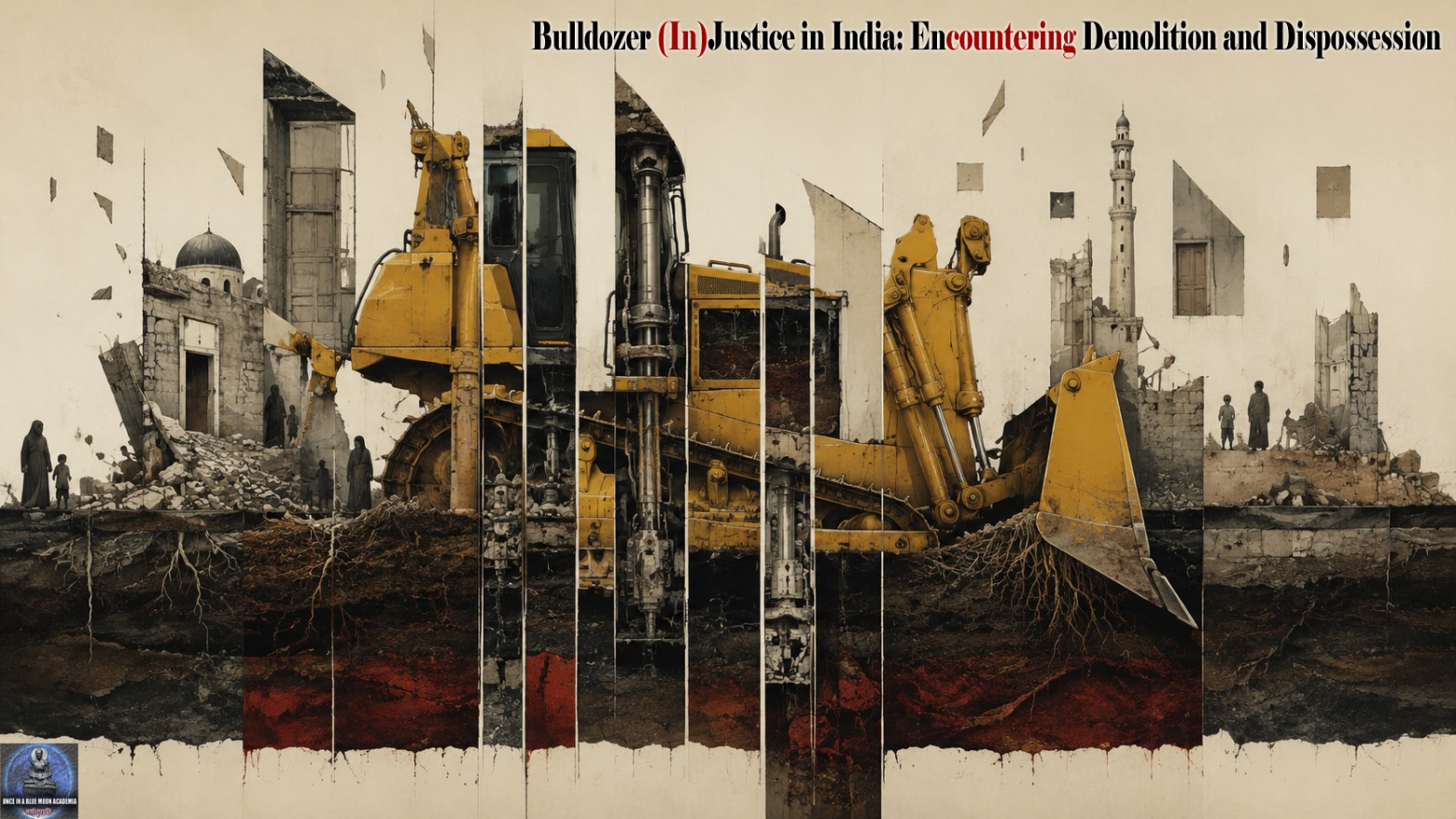
From the 1949 Babri Conspiracy to the 2025 Waqf Amendment — The Impunity Loop
Posted on 30th May, 2026 (GMT 01:35 hrs)
ABSTRACT
The article contends that “Bulldozer Justice”—the BJP government’s targeted demolitions of Muslim homes, businesses, and religious sites—represents not mere administrative excess or electoral tactics but the latest manifestation of a coherent seventy-five-year ethnocratic project rooted in the 1949 Babri Masjid occupation. It identifies a persistent structural impunity loop (extra-legal action, state complicity, retroactive judicial or legislative legitimation, and perpetrator reward) driving Hindu majoritarian statecraft, linking the 1949 conspiracy through the Supreme Court’s 2019 verdict to the 2025 Waqf Amendment Act. Drawing on Amnesty International’s documentation of 128 targeted demolitions, Housing and Land Rights Network data showing 738,438 displacements in 2022–23, V-Dem’s classification of India as an “electoral autocracy,” and other reports, the piece maps the phenomenon across its ideological, affective, legal, spatial, gendered, corporate, and legislative dimensions. It highlights the central bovine paradox of India as one of the world’s largest exporters of buffalo meat ($4 billion in 2025) alongside lethal cow-protection vigilantism, exemplified by major corporate donations to the BJP. Framing Bulldozer Justice within manufactured Islamophobia, Hindu victimhood narratives, creeping theocracy, and the mechanics of contemporary majoritarianism, the article characterizes the process as democratic demolition — one structure, one statute, and one impunity loop at a time.
Keywords: Bulldozer Justice · Hindutva · Ethnocracy · Punitive Populism · Abusive Constitutionalism · Babri Masjid · Waqf Amendment Act · Muslim Dispossession · Democratic Backsliding · Domicide · Corporate Complicity · Beef Export Paradox · Manufactured Islamophobia
I. Introduction: The Grammar Of Ruins
On April 20, 2022, a JCB bulldozer entered the lanes of Jahangirpuri, North Delhi. No court had officially ordered demolition. The Supreme Court of India, alerted by emergency petition, issued a stay — which the North Delhi Municipal Corporation ignored for forty minutes. What the machine destroyed were Muslim-owned shops and a mosque boundary wall. By evening, BJP media apparatus had reframed the demolition as justice: swift, clean, and visually legible to a viewing public ideologically prepared to read the yellow machine as righteousness rather than reprisal.
That single morning was not an aberration. It was a legible sentence in a grammar of ruins that has been under construction since December 23, 1949 — the night RSS-affiliated actors broke into the Babri Masjid in Ayodhya, installed Hindu idols, and persuaded the District Magistrate to refuse their removal, setting in motion the structural cycle this article calls the impunity loop. From that predawn installation to the Waqf Amendment Act passed by the Lok Sabha on April 2, 2025, the logic has been consistent: seize Muslim space by extra-legal means, launder the seizure through administrative and judicial process, reward those who carried it out, and present the entire sequence as governance.
This article reconstructs that grammar in full. Following this introductory overview, Section II establishes the chronological timeline from 1528 to 2025. Section III provides the theoretical framework — linking Bulldozer Justice to manufactured Islamophobia, Hindu victimhood politics, fascist statecraft, and theocratic capture. Section IV presents the full empirical record, with data tables. Section V analyses the impunity loop as structural mechanism. Section VI examines the gendered dimension of demolition violence. Section VII documents JCB corporate complicity. Section VIII analyses the Waqf Amendment Act as statutory dispossession. Section IX excavates the beef export paradox. Section X develops the comparative India-Israel frame. Section XI concludes with what remains — evidentially, institutionally, and politically. A satirical appendix extends the article’s central arguments through the aesthetic registers of bibhatsa (disgust) and bhayanaka (terror) as defined by Bharata Muni’s Natyashastra to foreground several semantic inter-plays across the ambits of stock market, cow politics and so on.
A note on method and positionality: This paper makes no claim to the false neutrality that presents itself as objectivity. It is written from a position of explicit commitment to the constitutional values of the Indian republic — Justice, Liberty, Equality, Fraternity — as articulated in the Preamble drafted by B.R. Ambedkar, and to the universal human rights norms enshrined in the Universal Declaration of Human Rights, the International Covenant on Civil and Political Rights, and the International Covenant on Economic, Social and Cultural Rights. Every factual claim in this paper is sourced to primary documents, peer-reviewed scholarship, court records, or reporting from established journalistic and human rights organisations. The paper’s political commitments do not determine its empirical findings; its empirical findings inform its political commitments. That the evidence, rigorously examined, points in a single direction is not a function of bias. It is a function of what has happened. What has happened is on the record. This paper’s purpose is to ensure that it remains there — legible, documented, named — for as long as the reckoning takes.
II. The Long Arc: A Chronological Timeline Of Dispossession (1528–2025)
To understand Bulldozer Justice as it operates today, we must refuse the temptation to treat it as a recent innovation of Yogi Adityanath’s Uttar Pradesh. The structure is old. What follows is not a narrative of isolated incidents but a sequential map of a single, self-reinforcing theocratic-majoritarian-fundamentalist project.
Phase One: Construction and Contestation (1528–1948)
1528 — Mir Baqi, a general of Mughal Emperor Babur, constructs a mosque in Ayodhya at a site later claimed by Hindu nationalists — without contemporaneous documentary evidence — to mark the birthplace of the god Ram. The mosque functions as an active place of worship for over three centuries without recorded contestation.
1855 — First recorded communal clash at the site. British colonial administration constructs a partition railing separating the inner sanctum (used by Muslims) from the outer courtyard (used by Hindus). The administratively managed coexistence that follows lasts for nearly a century.
1885 — Mahant Raghubar Das files the first legal petition seeking permission to construct a canopy at the outer courtyard. The Faizabad District Court dismisses the petition, ruling — with prophetic clarity — that granting it would cause “a great disturbance” between communities.
1934 — Anti-cow-slaughter riots in Ayodhya. Parts of the mosque are damaged. British authorities fine and prosecute Hindu rioters and order repairs — an instance of colonial law applying symmetrically that would not be replicated by the postcolonial state.
1947–1948 — Partition. The RSS, banned following Gandhi’s assassination in January 1948, is released from the ban in July 1949. RSS cadres begin organising activity in Ayodhya. The stage for the decisive nocturnal act is set.
Phase Two: The First Impunity Loop (1949–1985)
December 22–23, 1949 — The originary act. Approximately fifty RSS-affiliated actors, led by Abhiram Das, enter the locked Babri Masjid under cover of night and install Hindu idols beneath the central dome. They announce, to gathering crowds and press, a divine “miracle” — the so-called self-manifested appearance of Ram Lalla. District Magistrate K.K.K. Nair, a civil servant with documented RSS sympathies, receives orders from the Uttar Pradesh state government to remove the idols and restore Muslim access. He refuses, citing communal tension — tension manufactured by the very act he is declining to reverse. Prime Minister Nehru writes to UP Chief Minister Pant calling the conduct a “betrayal.” The idols remain. The mosque is locked. Muslim worshippers are expelled from their own place of prayer. K.K.K. Nair is later rewarded with a BJP parliamentary ticket.
1950 — Gopal Singh Visharad files suit seeking permanent permission for Hindus to worship at the idols now installed inside the mosque. This is the first conversion of a trespass into a legal right — the characteristic move of the impunity loop. The litigation enters the Allahabad High Court.
1959 — The Nirmohi Akhara files a separate suit claiming custodial rights over the site. The Sunni Waqf Board files its own suit for restoration. Four parallel litigations now run simultaneously — a juridical fog that will persist for sixty years.
1961 — The Faizabad courts consolidate the suits. Hearings proceed at the pace of geological change.
Phase Three: Escalation and the Demolition (1984–1992)
1984 — The Vishwa Hindu Parishad launches its Ram Janmabhoomi Mukti Andolan (Campaign for the Liberation of Ram’s Birthplace). The explicitly political mobilisation of the Ayodhya dispute begins in earnest, transforming a frozen local legal dispute into a national Hindutva project.
1986 — District Judge K.M. Pandey, following what critics characterise as improperly expedited proceedings, orders the locks on the Babri Masjid opened. Muslim worshippers have been excluded for thirty-seven years. Now, their formal right of access is extinguished in an administrative hearing. The Babri Masjid Action Committee is formed in protest. Rajiv Gandhi’s Congress government is widely seen as enabling the unlocking as electoral appeasement.
1989 — Rajiv Gandhi permits the VHP to perform the shilanyas (foundation-stone laying) for the proposed Ram Temple at the disputed site. This is the Congress government’s decisive contribution to the impunity loop — the sanctioning of a competing construction claim on actively contested and litigated ground.
1990 — L. K. Advani’s rath yatra (chariot procession) from Somnath to Ayodhya transforms the temple dispute into the BJP’s primary electoral vehicle. Communal violence along the yatra route kills over a thousand people. Advani is arrested in Bihar. The BJP withdraws support from the V.P. Singh government. The political utility of Ayodhya as mobilising instrument is conclusively demonstrated.
December 6, 1992 — The demolition. Between 150,000 and 300,000 Kar Sevaks, having breached security cordons, dismantle the Babri Masjid over five hours. Senior BJP leaders — L.K. Advani, Murli Manohar Joshi, Uma Bharti, Kalyan Singh — are present on the dais. The Uttar Pradesh state administration, despite solemn assurances to the Supreme Court that the structure would be protected, stands by in deliberate inaction. Communal violence following the demolition kills between 2,000 and 5,000 people across India, the Bombay riots of December 1992–January 1993 being the worst since Partition. The Liberhan Commission, established to investigate the demolition, submits its report sixteen years later, in 2009, naming 68 individuals as responsible. No one is convicted.
November 16, 1993 — Baba Lal Das, the court-appointed head priest of Ram Lalla — a man who had consistently testified that the 1949 idol installation was a political act, not a divine miracle, and who had publicly stated “this is a political game by the VHP” — is shot once in the back of the head in a village twenty kilometres from Ayodhya. His murder is never solved. His case remains a footnote. His killers were never identified, still less prosecuted. His testimony, inconveniently factual, has been systematically erased from the mainstream account of the Ayodhya dispute.
Phase Four: Judicial Legitimation and the New BJP (1993–2019)
1994–2002 — The Allahabad High Court begins substantive hearing of the consolidated suits. Archaeological Survey of India excavations at the disputed site become deeply contested, with Muslim parties alleging that the ASI’s findings were manipulated to suggest pre-existing Hindu structures beneath the mosque.
2010 — The Allahabad High Court delivers a three-way split verdict, dividing the disputed land between the Sunni Waqf Board, the Nirmohi Akhara, and the Ram Lalla deity. The verdict satisfies no party. All three appeal to the Supreme Court.
2014 — Narendra Modi wins the general election with a historic majority. The BJP’s Hindutva political project acquires full state power at the Centre for the first time. The Ayodhya dispute enters a new political phase: no longer merely an electoral instrument but an anticipated administrative deliverable.
2017 — Yogi Adityanath becomes Chief Minister of Uttar Pradesh. The bulldozer enters active governance vocabulary as an instrument of “law and order” against “gangsters” and “mafias” — a category that, in practice, is applied with marked communal selectivity.
October–November 2019 — In a unanimous verdict delivered by a five-judge Supreme Court bench, the entire disputed 2.77-acre site in Ayodhya was awarded to the Hindu side (Shri Ram Virajman) for the construction of a Ram Temple. The Court directed the government to allot a five-acre alternative plot to the Sunni Waqf Board. While the judgment explicitly held the 1949 installation of idols as illegal and described the 1992 demolition of the Babri Masjid as a “grave wrong” and an “egregious violation” of the rule of law, it nevertheless granted the disputed land to the Hindu side.
Notably, the 2019 Ayodhya judgment was delivered as a collective, unsigned per curiam opinion — an extraordinary departure from judicial norms that left no individual judge accountable for its reasoning. A separate unsigned addendum further amplified the Hindu claim to the birthplace of Lord Ram. In a stunning revelation years later, Justice D.Y. Chandrachud — one of the five judges on the bench and later Chief Justice of India — publicly admitted at a religious gathering that during the adjudication of the case, he “sat before the deity and told him that he needs to find a solution,” claiming he had prayed to Lord Ram for divine guidance. This admission lays bare a profound blurring of the lines between personal faith and constitutional duty, raising grave doubts about the secular integrity and independence of the judiciary in a case that fundamentally altered the religious geography of the nation.
This judicial invocation of divine intervention was compounded by the overt theocratisation of the state when Prime Minister Narendra Modi — the head of a constitutionally secular republic — personally performed the Bhoomi Pujan (foundation stone laying) of the Ram Temple in August 2020 with full state honours, complete with Vedic rituals and religious spectacle. In doing so, the executive branch brazenly violated the basic structure of the Constitution, which mandates strict separation between religion and state. Together, the judiciary’s theological undertones and the Prime Minister’s religious performance transformed a purportedly secular institution into an active participant in the construction of a Hindu majoritarian project — an anti-constitutional convergence that legitimised the decades-long impunity loop at the highest levels of governance.
2021 — Controversy emerges over the ₹14 crore land acquisition by the Shri Ram Janmabhoomi Teerth Kshetra Trust — the Supreme Court-mandated body managing the temple construction — in which land allegedly valued at ₹2 crore was purchased for ₹18.5 crore in transactions whose beneficiaries included relatives of Trust members. The matter is referred to investigative agencies without, as of 2025, producing any accountability.
Phase Five: Systematic Demolition and Legislative Consolidation (2020–2025)
2020–2022 — Systematic post-communal-event demolitions proliferate across BJP-governed states. Jahangirpuri (April 2022); Khargone, Madhya Pradesh (April 2022); Prayagraj, UP (June 2022 — demolition of the home of protest organiser Javed Mohammad, hours after arrest); Sabarkantha, Gujarat (April 2022). In each case, the pattern is identical: communal event → arrests → demolition of Muslim properties without due process → media celebration → no accountability.
January 22, 2024 — Prime Minister Modi consecrates the Ram Temple at Ayodhya in a ceremony widely criticised for its explicit conflation of religious ritual with BJP electoral campaigning, months before the 2024 general election.
2022–2023 — Housing and Land Rights Network documents 153,820 demolitions displacing 738,438 people across India, predominantly in BJP-governed states, with Muslim communities disproportionately targeted.
June 2024 — Over 1,100 homes demolished in Lucknow’s Akbar Nagar, rebranded as “eco-tourism development.” The Punjab and Haryana High Court, in separate proceedings, uses the phrase “ethnic cleansing” to describe demolition patterns in Haryana.
November 2024 — The Supreme Court of India delivers its comprehensive judgment against Bulldozer Justice, ruling that “justice through bulldozing is unknown to any civilised society” and laying down procedural guidelines for demolitions — guidelines that, like the April 2022 Jahangirpuri stay order, have been observed more in the breach than in the observance.
April 2, 2025 — The Waqf Amendment Act passes the Lok Sabha 288 votes to 232, followed by passage in the Rajya Sabha. The Act mandates non-Muslim representation on Waqf Boards, grants District Magistrates power to “validate” or reject Waqf property registrations, and eliminates the centuries-old “Waqf by user” doctrine. The All India Muslim Personal Law Board challenges the Act before the Supreme Court.
III. Underlying Framework: Naming The Machinery— Islamophobia, Fascism, Theocracy, And The State
Understanding Bulldozer Justice requires more than documentation of individual incidents. It requires theoretical tools capable of naming what the totality of those incidents constitutes. Six interlocking frameworks are deployed here — not as academic decoration, but as precision instruments for identifying the political species we are examining.
3.1 Ethnocracy and the Ethnic Democracy
Oren Yiftachel’s concept of ethnocracy describes a regime that maintains democratic electoral forms while systematically privileging one ethnic or religious group over others in the allocation of land, resources, citizenship rights, and state protection. In an ethnocracy, democracy is not abolished — it is selectively applied: full citizenship for the dominant group, conditional and diminishing citizenship for minorities. Christophe Jaffrelot’s extensive research on BJP governance demonstrates that this is precisely what is occurring in India: the formal retention of elections and constitutional text alongside the systematic degradation of Muslim civic equality through the cumulative operations of cow-protection laws, anti-conversion statutes, demolition drives, riot impunity, and now the Waqf Amendment Act.
3.2 Manufactured Islamophobia and the Hindu Victim Card
Bulldozer Justice does not operate in a vacuum. It is sustained by an ideological ecosystem that has, over decades, manufactured Muslim threat as the primary organising principle of Hindu political identity. This manufacture operates through five interlocking mechanisms:
Demographic panic: The systematic amplification of Muslim population growth as an existential threat to the Hindu majority — despite Census data consistently showing Muslim fertility rates converging toward Hindu fertility rates and Muslim population share stabilising. Prime Minister Modi’s “those who have more children” formulation; “Love Jihad” laws in eight BJP states; the Hindu Khatre Mein Hai (Hinduism is in danger) discourse — all serve to constitute the Muslim as a reproductive threat requiring spatial containment.
Historical grievance construction: The framing of India’s Islamic architectural heritage — mosques, dargahs, qawwali traditions, Mughal monuments — as evidence of historical humiliation requiring contemporary redress. The Ayodhya verdict as model for Kashi (Varanasi) and Mathura claims. The Places of Worship (Special Provisions) Act, 1991 — which freezes the religious character of all places of worship as they stood on August 15, 1947 — under sustained attack from BJP-affiliated petitioners seeking to relitigate the status of hundreds of mosques built on sites claimed as pre-existing Hindu structures.
The false symmetry of communal violence: The systematic presentation of Hindu-Muslim communal clashes as mutually initiated, concealing the documented pattern in which Hindu processions through Muslim neighbourhoods, often with state permission and police escort, serve as triggers for violence that is then attributed equally to both communities — enabling “anti-encroachment” demolitions targeted exclusively at Muslim structures.
Counter-terrorist conflation: The routine equation, in BJP political rhetoric and aligned media, of Indian Muslim civic and political activism with terrorism, Pakistan, and the ISI — a conflation that pre-criminalises Muslim protest, justifies surveillance, and renders demolitions of Muslim “agitators'” homes ideologically coherent to the BJP base.
The victimhood inversion: The framing of the Hindu majority — 80% of the population, holding political power at the Centre and in the majority of states — as the persecuted party: victims of “appeasement” policies, demographic replacement, and a “pseudo-secular” establishment. This victimhood claim is the affective motor of majoritarian politics: it transforms the powerful into the aggrieved, making punitive action against the minority feel defensive rather than predatory.
3.3 Abusive Constitutionalism and Autocratic Legalism
Rosalind Dixon and David Landau’s concept of abusive constitutionalism describes the use of formally legal constitutional mechanisms to dismantle the substantive conditions of constitutional democracy. Kim Lane Scheppele’s theory of autocratic legalism captures the related phenomenon: the deployment of legal forms — legislation, court orders, administrative procedures — to produce authoritarian outcomes while maintaining the appearance of rule of law. Bulldozer Justice is a textbook instance of both. The encroachment notice is the legal form; the communal targeting is the authoritarian outcome. The Waqf Amendment Act is parliamentary legislation; its function is the transfer of Muslim property control to government-appointed bodies. The Supreme Court’s 2019 verdict is a constitutional judgment; its effect is the endorsement of a seventy-year impunity loop.
3.4 State of Exception and Necropolitics
Carl Schmitt’s theory of sovereignty — “sovereign is he who decides on the exception” — and Giorgio Agamben’s elaboration of the state of exception as the paradigm of contemporary governance illuminate how Bulldozer Justice suspends normal legal procedure (due process, notice, conviction before punishment) for a specific, racialised population. The Muslim in BJP India is, in Agamben’s terms, homo sacer — the person who can be harmed without that harm constituting a crime in the political community’s self-understanding. Achille Mbembe’s necropolitics extends this: the capacity to determine which populations are exposed to conditions of social, economic, and physical death is the primary form of sovereignty in the postcolonial world. The demolition drive and the riot are both necropolitical instruments: they govern Muslim life by governing Muslim exposure to death, homelessness, and destitution.
3.5 Domicide and Settler-Colonial Spatial Politics
J. Douglas Porteous and Sandra Smith’s concept of domicide — the deliberate destruction of home as an act of political violence — names what is enacted each time the JCB moves. The home is not merely shelter; it is the spatial unit of family, community, memory, and identity. Its destruction is not property damage — it is the destruction of the person’s place in the world. When domicide is systematically applied to a specific religious community in order to redraw the demographic geography of cities — to remove Muslim commercial presence from Hindu pilgrimage routes, to “beautify” Muslim-majority neighbourhoods by erasing them, to make Muslim spatial claims legally contestable — it becomes indistinguishable from settler-colonial spatial politics: the replacement of one community’s spatial claim with another’s through the legitimised force of the state.
3.6 The Fascism Question
Whether contemporary Indian governance under the BJP constitutes fascism is a question that serious scholars have begun to answer affirmatively. Prabhat Patnaik, Angana Chatterji, and Gyanendra Pandey, among others, have identified in Hindutva statecraft the core features of classical fascism: the identification of a minoritised internal enemy; the deployment of paramilitary street violence alongside state administrative action; the cult of the strongman leader; the capture of media and judiciary; the manufacture of historical grievance as political fuel; and the systematic erosion of constitutional limits on executive power. The impunity loop is the fascist mechanism in its Indian institutional expression: the state enables the paramilitary act, the court legitimises the outcome, and the actor is rewarded — until the cycle is indistinguishable from policy.
3.7 Creeping Theocracy
The CJI’s disclosure that a Hindu deity guided the writing of the 2019 Ayodhya verdict is not merely an extraordinary personal statement. It is a symptom of the theological capture of India’s secular constitutional order. The Ram Temple consecration — conducted by the Prime Minister with full state protocol — the BJP’s framing of the verdict as divine vindication, the invocation of “Hindu sentiments” as a category that overrides minority rights claims in judicial reasoning, and the BJP’s explicit positioning of itself as the protector of Hindu dharma in governance: together, these constitute not formal theocracy — the Constitution has not been amended — but operative theocracy: the de facto governance of a secular republic through theological legitimating claims. The Waqf Amendment Act, which subjects Muslim religious endowments to non-Muslim board oversight and government validation while imposing no analogous requirement on Hindu religious endowments, structurally embeds the asymmetry.
IV. The Empirical Record: Bulldozer Injustice By The Numbers
4.1 Scale of Displacement: National Overview
| Metric | Figure | Source |
|---|---|---|
| Total demolitions documented, 2022–23 | 153,820 | HLRN, 2024 |
| Total people displaced, 2022–23 | 738,438 | HLRN, 2024 |
| Detailed demolitions investigated by Amnesty | 63 of 128 | Amnesty International, 2024 |
| People directly documented homeless/livelihood-deprived | 617+ | Amnesty International, 2024 |
| JCB machinery verified at demolition sites | 33 of 63 | Amnesty International, 2024 |
| States with documented demolition drives, 2022–24 | 12 | India Hate Lab, 2025 |
| Supreme Court stay orders issued | Multiple | SC Records |
| Demolitions halted by stay orders in real time | Negligible | SC Records / Amnesty |
4.2 State-by-State Documentation
Uttar Pradesh (2017–2025)
The originating and most sustained theatre of Bulldozer Justice, under Yogi Adityanath’s explicit political branding. Key documented instances:
- Prayagraj (June 2022): Home of Javed Mohammad, co-ordinator of protests against the Agnipath military recruitment scheme, demolished within hours of his arrest — before charge, let alone conviction. Prayagraj Municipal Corporation claimed the structure was “illegal.” No equivalent action was taken against structures owned by the dozens of Hindu residents who had also protested.
- Akbar Nagar, Lucknow (June 2024): Over 1,100 homes demolished, displacing several thousand residents, the vast majority Muslim, under the rubric of “eco-tourism development” along the Kukrail river. No credible environmental assessment preceded the demolition. The displaced received no rehabilitation.
- Varanasi / Dalmandi: Muslim commercial properties demolished along routes being “developed” for the Kashi Vishwanath temple corridor, in a pattern that spatial analysts describe as the commercial exclusion of Muslim traders from Hindu pilgrimage infrastructure.
Madhya Pradesh (2022)
- Khargone (April 2022): Following Ram Navami communal clashes in which stone-pelting was reported, Madhya Pradesh authorities demolished 50 structures, almost all Muslim-owned. The state government made no claim of due process. Chief Minister Shivraj Singh Chouhan publicly credited the demolitions as appropriate state response. Hasina Bi, 56, widowed, had no accused male relative — her home was demolished because it was Muslim, in a Muslim street.
Delhi (2022)
- Jahangirpuri (April 2022): The defining national case. Supreme Court stay issued; ignored for 40 minutes. Structures destroyed: Muslim traders’ shops, mosque boundary wall. No structures belonging to the Hindu community — including those who had initiated the religious procession — were demolished.
Gujarat (2022)
- Sabarkantha (April 2022): Muslim-owned structures demolished in the aftermath of Ram Navami clashes. The communal pattern — RSS-affiliated procession, clash, demolition of Muslim property — was, by this point, operating as a rehearsed script across multiple states simultaneously.
Assam (2021–2023)
- Chief Minister Himanta Biswa Sarma publicly credited demolitions as anti-encroachment action. HLRN documented disproportionate targeting of Muslim-majority areas. Several eviction drives resulted in deaths — including Moinul Haque, shot by police during a demolition-related protest in Darrang district, September 2021, in footage that was subsequently broadcast as evidence of state strength by pro-BJP channels.
Haryana (2023)
- 300+ properties demolished over four days following communal violence in Nuh. Punjab and Haryana High Court used the phrase “ethnic cleansing” in its observations. The state government appealed.
West Bengal (2026)
This pattern of post-election bulldozer drives as an extension of the BJP’s theocratic-anti-poor machinery has continued across states. In West Bengal, immediately after the BJP’s victory in the 2026 Assembly elections, aggressive demolition campaigns were launched in Kolkata’s Tiljala, Topsia, Kasba, and Beleghata areas. In Tiljala, municipal bulldozers razed multi-storey structures and leather workshops (including one where a fire had recently claimed two lives), displacing numerous poor families — many from minority communities — under the banner of removing “illegal encroachments.” Similar drives targeted alleged unauthorised constructions in Howrah and other pockets, drawing widespread criticism for lack of due process and notices, in direct violation of Supreme Court guidelines. Reports from The Wire, Telegraph India, and local fact-checkers documented how these actions disproportionately affected working-class neighbourhoods, reinforcing the use of bulldozers as a tool of punitive governance and spatial re-engineering even in newly acquired political territories.
The ‘Bulldozer Raj’ Arrives in West Bengal VIEW HERE ⤡
4.3 Selectivity: The Core Legal Issue
The V-Dem Democracy Report 2026 classifies India as an electoral autocracy since 2017, following a sustained process of autocratization. India ranks 105th out of 179 countries on the Liberal Democracy Index and remains one of the world’s largest and most populous examples of this regime type. The report highlights severe and ongoing erosion in freedom of expression, media independence, civil society space, and institutional checks and balances under the ruling BJP government.
The India Hate Lab’s 2025 report further shows that bulldozer demolitions are strongly correlated with electoral cycles, communal provocations (especially Hindu religious processions), and periods of Muslim civic resistance — patterns that reinforce the structural linkage between majoritarian political mobilisation and targeted spatial dispossession.
- Occurrence of communal events (overwhelmingly post-Hindu procession clashes)
- Proximity to state elections
- Muslim civic activism (anti-CAA protests, Agnipath protests, anti-bulldozer protests)
They are not statistically correlated with:
- Objective encroachment data
- Systematic municipal surveys
- Equivalent enforcement action against Hindu-owned structures
This selectivity is the article’s central legal finding. Encroachment upon public land in Indian cities is not a Muslim-specific phenomenon. The demolition of encroachments most certainly is.
While evident illegal encroachments exist across communities in Indian cities, empirical patterns documented by Amnesty International, HLRN, and India Hate Lab demonstrate statistically disproportionate targeting of Muslim-owned and Muslim-majority structures following communal incidents or protests, far exceeding enforcement against comparable violations by other groups.
4.4 The Democratic Accountability Gap
| Accountability Mechanism | Response to Bulldozer Justice |
|---|---|
| Judiciary (Supreme Court) | Stay orders routinely ignored; Nov 2024 guidelines unenforceable |
| Media | Majority of English and Hindi broadcast media celebrates demolitions |
| Election Commission | BJP’s “Bulldozer Baba” branding unchallenged as electoral communication |
| Police | Provides escort; files FIRs against demolished, not demolishers |
| International bodies | V-Dem, Amnesty, HRW documentation; no binding mechanism |
V. The Impunity Loop: Structure And Mechanism
The impunity loop is the article’s central structural concept. It is not a metaphor for general impunity — it is a specific, recursive, five-stage mechanism:
Stage 1 — The Extra-Legal Act: A majoritarian act against Muslim space is committed outside legal process: nocturnal idol installation (1949), Babri Masjid demolition (1992), post-communal demolition (2022). The act is openly illegal by the standards of the existing legal system.
Stage 2 — State Complicity: The state — in the form of the District Magistrate who refuses to remove idols (1949), the UP Chief Minister whose administration stands by during demolition (1992), the municipal corporation that ignores a Supreme Court stay order (2022) — enables or actively facilitates the act rather than preventing or reversing it.
Stage 3 — Retroactive Legitimation: Legal and administrative process converts the illegal act into an established fact: seventy years of litigation end in an award to those who committed the trespass (2019); demolition is described in administrative records as “routine encroachment removal”; Waqf properties whose documentation was rendered contestable by the 1949 pattern are now ruled invalid by District Magistrates (2025).
Stage 4 — Perpetrator Reward: K.K.K. Nair receives a BJP parliamentary ticket. Yogi Adityanath receives re-election. The thirty-two accused in the Babri demolition case are acquitted. “Bulldozer Baba” becomes electoral branding. The impunity is not incidental — it is the advertisement.
Stage 5 — Template Reproduction: The rewarded act becomes a template for the next iteration, at a larger scale and with greater institutional confidence. The 1949 installation templates the 1992 demolition; the 1992 demolition templates the post-2022 drives; the drives template the Waqf Amendment Act.
Even after the Supreme Court’s 2019 supposed/assumed acknowledgment of the illegality of the 1949 installation and 1992 demolition, and the 2024 guidelines against bulldozer justice, meaningful prosecution of high-level actors or systematic enforcement against violating officials remains absent, allowing the loop to reproduce at legislative and administrative scales.
The loop does not merely reproduce impunity — it escalates it. Each cycle licenses a more ambitious and more systematically implemented iteration. The Waqf Amendment Act is 1949 at parliamentary scale: it has converted a single District Magistrate’s enabling act into a statutory mandate for thousands of such acts, across every Waqf property in the country, administered by a class of officials whose historical record in this matter is established beyond reasonable contest.
VI. The Gendered Bulldozer: Women, Children, And Double Dispossession
The transition from the abstract structure of the impunity loop to its lived consequence requires a deliberate analytical movement — from the systemic to the embodied, from the structural to the specific. This section makes that movement, examining the dimension of Bulldozer Justice that has received least scholarly attention and that bears some of its most devastating consequences: the gendered nature of demolition violence.
6.1 Who Bears the Weight of the Ruins
Academic and journalistic accounts of Bulldozer Justice have overwhelmingly focused — correctly and necessarily — on its communal, anti-Muslim dimension. What has been consistently underexamined is its gendered dimension: the specific and compounded ways in which women bear the consequences of demolitions framed as acts of punishment against male accused.
The logic of collective punishment, as practised in BJP-governed states, is explicitly domestic: the home of the accused is demolished, not merely the accused himself. But the home is not a neutral space — it is disproportionately the space of women’s lives, labour, and social existence, particularly in the working-class and lower-middle-class Muslim communities that have been Bulldozer Justice’s primary targets. When the home falls, it is the women who are rendered most acutely homeless, most bereft of income (much of which, in these communities, is generated through home-based work), and most structurally prevented from accessing legal remedy.
Amnesty International’s 2024 investigation establishes that at minimum 617 people — including men, women, children, and elderly persons — were rendered homeless or deprived of their livelihoods through Bulldozer Justice drives. The report documents forced evictions conducted without adequate notice, without due process, and without access to effective remedy — violations of the rights to non-discrimination, adequate housing, and fair trial under international human rights law.
6.2 Hasina Bi and the Logic of the Widowed Exception
Hasina Bi, a fifty-six-year-old widow in Khargone, Madhya Pradesh, represents the fullest expression of the gendered illogic of collective punishment. She was present at her home when it was demolished in April 2022 by municipal authorities following the Khargone communal clashes. She had no accused male relative. She was a widow — the absent husband being the legal category the demolition ostensibly targeted. She was demolished anyway, because her home was Muslim, in a Muslim street, which the Madhya Pradesh government had decided to “make an example of.” She received no notice. She was given no time to retrieve possessions. The JCB simply arrived.
Her testimony to Amnesty — “The bulldozers directly attacked our house. We weren’t given any notice. Nothing” — stands as the most precise possible statement of what Bulldozer Justice is: not the enforcement of any legal provision, but the sovereign act of a state that has decided this woman’s home does not deserve the protection of the law that the state is simultaneously invoking to justify destroying it.
6.3 The BJP’s Selective Gender Politics
The BJP’s approach to Muslim women is not simple misogyny — it is strategic instrumentalisation. On one hand, it presents itself internationally as the liberator of Muslim women, with the abolition of triple talaq (instant divorce) as the centrepiece of this narrative. On the other hand, the same government renders Muslim women homeless through demolitions, strips them of community resource bases through the Waqf Amendment Act, and exposes them to mob violence through the normalisation of cow-protection vigilantism in which the female relatives of accused are invariably among the primary victims of the retaliatory community violence that follows. The triple talaq abolition liberates Muslim women, rhetorically, from Muslim patriarchy — while the bulldozer imposes upon them the far more material oppression of the Hindu majoritarian state. The double dispossession is structural and deliberate: stripped of personal law protection from one direction, stripped of property and shelter from the other.
As scholars of gender and South Asian politics have noted, neoliberal gender discourse is selectively invoked by the Hindutva state to gain legitimacy in international forums — “saving Muslim women from Muslim men” — while the material conditions of Muslim women’s lives are simultaneously degraded by the state’s spatial, legal, and economic violence. The concern evaporates the moment the bulldozer arrives.
6.4 Children: Demolished Futures
The demolition of a home in term-time is the demolition of an educational future. Children of demolished families lose not only shelter but school proximity, school enrolment, books, uniforms, and the social networks through which educational continuity is maintained. For girls — whose school enrolment in low-income Muslim communities is already disproportionately fragile — forced displacement frequently means permanent withdrawal from formal education.
In May 2023, over a thousand homes were demolished in Tughlakabad, Delhi, under Delhi Development Authority orders. The residents — predominantly Muslim, employed as domestic workers and rag-pickers — were displaced without compensation. The children of these families lost school enrolment mid-year. The Supreme Court’s November 2024 ruling explicitly noted the impact of demolitions on children, directing that no demolition should occur without adequate notice to ensure school-going children are not abruptly displaced. Like all of the Court’s guidelines in this domain, the direction has been honoured in the breach.
VII. JCB And The Machinery Of Dispossession: Corporate Complicity
The preceding sections have documented the political, legal, and human dimensions of Bulldozer Justice. This section turns to its supply chain — to the British engineering corporation whose machinery has become so synonymous with punitive demolition that “JCB” has entered popular Hindi as a verb, and whose continued sale of equipment to the municipal corporations that deploy it in communal violence raises questions that corporate social responsibility reports have not yet answered.
7.1 JCB: From Staffordshire to Jahangirpuri
J.C. Bamford Excavators Ltd. — headquartered in Rocester, Staffordshire, England — is one of the world’s largest manufacturers of construction equipment. It has operated in India since 1979 and manufactures primarily at its Ballabgarh (Haryana) and Pune facilities. Its distinctive yellow backhoe loader, the 3DX, is the machine most consistently visible in footage of punitive demolitions across BJP-governed states.
Amnesty International’s second 2024 report — Unearthing Accountability: JCB’s Role and Responsibility in Bulldozer Injustice in India — verified JCB machinery at a minimum of 33 of the 63 demolitions it investigated in detail. The report makes an explicit accountability case under the UN Guiding Principles on Business and Human Rights (UNGPs), adopted by the UN Human Rights Council in 2011, which establish that corporations bear a responsibility to respect human rights throughout their supply and sales chains — including preventing their products from being deployed in rights violations.
7.2 What Amnesty Found; What JCB Said
Amnesty’s documentation established that JCB machines were present at demolitions that violated international human rights standards on multiple grounds: demolitions without adequate notice; demolitions without independent judicial authorisation; demolitions targeting properties of persons not convicted of, and in many cases not charged with, any offence; demolitions of communally selected targets without equivalent enforcement against comparable violations by the majority community.
Amnesty called on JCB to: conduct human rights due diligence on its Indian municipal and government sales; establish a complaints mechanism for misuse of its equipment; and publicly disclose what steps it had taken to prevent deployment in punitive demolitions.
JCB’s response — standard in such corporate accountability disputes — was to distance itself from political uses of its equipment while continuing to sell without publicly disclosed human rights conditionality. The company’s sustainability reports reference environmental commitments. The question of whether a backhoe loader sold to a municipal corporation that uses it to demolish a widow’s home without notice implicates the manufacturer’s human rights obligations is not addressed in those reports.
7.3 The Caterpillar Comparison: A Precedent
The JCB accountability question is not without precedent. Since 2004, Human Rights Watch and other organisations have maintained sustained pressure on Caterpillar Inc. (CAT) regarding the use of its D9 armoured bulldozer by Israeli forces in the demolition of Palestinian homes in the occupied West Bank and Gaza — another instance of a Western corporate manufacturer supplying equipment used in what critics document as rights-violating demolitions targeting a specific ethnic and religious community. Caterpillar has similarly maintained that it cannot control end-use once equipment is sold to the Israeli Defence Forces. Human rights organisations have similarly argued that knowingly selling into a documented pattern of rights violations constitutes complicity under the UNGPs.
The structural parallel is precise: a British company (JCB) and an American company (Caterpillar) supply the equipment of choice for two states conducting ethnically targeted demolition programmes against Muslim populations, in both cases declining to impose human rights conditionality on sales while issuing sustainability commitments that do not address the question. The accountability gap in both cases is not a product of legal impossibility — the UNGPs provide a framework — but of political will and commercial interest.
| Dimension | JCB (India) | Caterpillar (Israel-Palestine) |
|---|---|---|
| Equipment | 3DX Backhoe Loader | D9 Armoured Bulldozer |
| Client | State/municipal governments | Israeli Defence Forces |
| Documentation | Amnesty International, 2024 | Human Rights Watch, since 2004 |
| Company response | Distance from political use | Distance from military use |
| Human rights framework | UNGPs (2011) | UNGPs (2011) |
| Accountability outcome | None to date | None to date |
VIII. The Waqf Amendment Act (2025): The Statutory Bulldozer
The preceding sections have documented Bulldozer Justice as primarily an executive phenomenon: administrative acts, municipal orders, police escorts, mayoral decisions. This section documents its qualitative escalation into the legislative domain — the conversion of case-by-case administrative violence into permanent statutory architecture. The Waqf Amendment Act (2025) is, in effect, a bulldozer in legislative form: it renders thousands of Muslim religious and charitable properties legally contestable, subjects them to government validation, and places their fate in the hands of District Magistrates — the same class of official whose 1949 predecessor enabled the entire seventy-five-year sequence that this article has traced.
8.1 What Waqf Properties Are
Waqf properties are endowments made under Islamic law for religious, charitable, or educational purposes — mosques, dargahs, graveyards, madrasas, hospitals, and community halls. They are among the largest institutional landholdings of any religious community in India, with the total value of registered Waqf assets estimated at several lakh crore rupees. The Waqf system has been imperfect — marred by corruption, mismanagement, and encroachment. These are genuine problems. But the BJP’s solution to them is, as this section demonstrates, disproportionate, targeted, and structurally continuous with the spatial politics of Bulldozer Justice.
8.2 Key Provisions and Their Implications
The Waqf Amendment Act — passed by the Lok Sabha on April 2, 2025, 288 votes to 232, and by the Rajya Sabha shortly thereafter — includes the following central provisions:
Mandatory non-Muslim membership of Waqf Boards: For the first time in the Act’s history, non-Muslims must be included on the boards governing Muslim religious endowments. No equivalent provision exists in any statute governing Hindu religious endowments — not the Hindu Endowments Act, not state-level Devasthanam Board legislation. The discrimination is structural and deliberate, imposing on a religious minority a form of external governance oversight that the majority community does not face.
District Magistrate validation of Waqf property claims: DMs — the same administrative tier that historically enabled the 1949 idol installation and that presides over demolition drives — are empowered to determine whether a property is validly registered as Waqf. Properties whose revenue record status is ambiguous — a large category, particularly in UP — are placed at the DM’s discretion. The circle of the impunity loop closes with architectural precision: the officer who enabled the seizure of Muslim sacred space in 1949 now adjudicates the validity of Muslim sacred endowments in 2025.
Elimination of “Waqf by user”: The centuries-old doctrine under which mosques and dargahs whose founding documentation is incomplete or absent could be recognised as Waqf through established long usage — covering thousands of historic structures, particularly in regions where documentation was disrupted by Partition — is abolished. This effectively renders thousands of active places of Muslim worship legally vulnerable to property challenges they cannot defend with paper they do not have.
Government-expanded role in “validating” Waqf property boundaries: Waqf property boundaries disputed by state governments — which in BJP-governed states have a documented interest in acquiring Muslim institutional land — are subject to resolution mechanisms that privilege government determination over Waqf Board claims.
8.3 The Three-Step Parallel
The analytical connection between the Waqf Amendment Act and Bulldozer Justice is structural, not rhetorical:
| Stage | Bulldozer Justice | Waqf Amendment Act |
|---|---|---|
| Create the pretext | “Illegal encroachment” notice | “Invalid Waqf registration” |
| Deploy state power | JCB + DM demolition order | DM validation ruling |
| Present as governance | “Removing illegal encroachments” | “Fighting Waqf corruption” |
In both cases, the outcome — Muslim spatial and institutional dispossession — is presented as administrative reform. In both cases, equivalent mechanisms are not applied to equivalent structures of the majority community. In both cases, the District Magistrate is the operative instrument of the state’s spatial politics.
8.4 Political Responses and Constitutional Challenge
Opposition leader Rahul Gandhi described the Waqf Amendment Bill as “a weapon aimed at marginalising Muslims and usurping their personal laws and property rights” and “an attack on the Constitution.” AIMIM’s Asaduddin Owaisi warned that what the BJP does to Muslims today it will use as a template for other minorities tomorrow — a warning supported by the documented extension of similar administrative targeting to Christian communities (anti-conversion raids, church demolitions in some states) and Sikh institutional properties in certain BJP-governed territories.
The All India Muslim Personal Law Board has challenged the Act before the Supreme Court. The pace at which the challenge is heard, and the constitutional bench’s ultimate determination, will constitute a critical test of whether any institutional check on the BJP’s legislative spatial politics remains operative. Given the November 2024 Bulldozer Justice ruling’s immediate non-observance by state governments, the question of what judicial pronouncements can actually enforce is not academic.
In September 2025, the Supreme Court issued an interim stay on several key provisions of the Waqf Amendment Act, including mandatory non-Muslim representation on Waqf Boards and District Magistrate validation powers, while the constitutional challenge continues. However, reports from 2025 indicate that punitive and selective demolition drives have persisted in several BJP-ruled states notwithstanding the Supreme Court’s November 2024 guidelines, revealing limited institutional enforcement capacity.
This selective scrutiny of Waqf institutions stands in sharp contrast to the near-total immunity granted to Hindu religious endowments, commonly known as Debutter properties. While the Waqf Amendment Act aggressively targets over 8.72 lakh Muslim charitable properties spanning nearly 9.4 lakh acres and valued at approximately ₹1.2 lakh crore ($14 billion), no comparable legislative intervention has been proposed for Hindu temple trusts and Debutter estates — many of which control vast land banks and revenues running into thousands of crores annually. The contradiction is starkly illustrated by the Supreme Court’s 2019 Ayodhya verdict itself, which granted legal personhood to Ram Lalla Virajman (the infant form of Lord Ram) as a juristic entity, awarding the deity the entire disputed site despite acknowledging the illegality of the 1949 idol installation.
This judicial recognition of a Hindu deity as a perpetual litigant with superior property rights was further sanctified when Justice D.Y. Chandrachud later revealed he had sought divine guidance from Lord Ram during the adjudication. In a secular republic, such theological elevation of one community’s religious entity — coupled with the Prime Minister’s own performance of Bhoomi Pujan at the Ram Temple — exposes a deepening constitutional asymmetry: Muslim Waqf properties are subjected to intrusive state control and “reform,” while Hindu endowments enjoy both legal deification and political patronage.
IX. The Beef Export Paradox: Sacred Cow the Mother, Profane Commerce
Any account of BJP governance that documents Islamophobia, cow-protection vigilantism, and the spatial dispossession of Muslim communities is analytically incomplete without confronting the central bovine contradiction of that governance: India, under the party that deploys cow-protection as its most visceral communal instrument, has become — and remains — one of the world’s largest exporters of buffalo meat (carabeef). This section is not satire. The data are entirely real. The contradiction is entirely deliberate. Understanding it is essential to understanding how Hindutva statecraft actually operates as opposed to how it presents itself.
9.1 The Export Data
Under BJP rule since 2014, India’s buffalo meat exports have shown robust growth, crossing the $4 billion mark in 2025 for the first time since 2018.
| Year | Export Value (USD) | Volume |
|---|---|---|
| 2023 (Full Year) | $3.48 billion | 1.29 million MT |
| FY 2024–25 | $3.92 – 4.06 billion | 1.58 – 1.65 million MT |
| 2025 | $4 billion+ (record) | ~1.65 million MT |
Sources: APEDA, DGCIS, USDA Foreign Agricultural Service reports, Cybex International Trade Data.
India exports primarily buffalo meat — commercially termed “carabeef” — rather than cow meat. This technical distinction allows the BJP to maintain its sacred cow rhetoric domestically while facilitating a booming export economy. But the political economy of “cow protection” does not make this distinction. Lynching mobs do not carry speciation certificates. And the political mobilisation of “beef” as a signifier of Muslim pollution and threat encompasses all bovine meat, carabeef included.
9.2 Hindu Ownership and the Allana-Al Kabeer Paradox
The Allana Group — India’s largest buffalo meat exporter, operating under a Muslim family name — has donated ₹30 crore to the BJP in 2024–25 alone, a fifteenfold increase from the previous year. This massive contribution coincided precisely with exports crossing the $4 billion threshold and the group’s flagship company recording revenue above ₹10,000 crore.
Equally significant is Al Kabeer Exports Pvt. Ltd., one of India’s largest and oldest meat processing and exporting companies, owned by Hindu businessmen Satish Sabharwal and Atul Sabharwal. The company operates massive integrated slaughter and processing facilities and has been a major player in India’s carabeef export surge for decades. Several other top exporters, including companies with Arabic-sounding names, are also owned or managed by Hindu businessmen — a reality that further exposes the selective communal politics surrounding the bovine economy.
9.3 The Human Cost of Bovine Politics
Between May 2015 and December 2018 — a period entirely under the first Modi government — at least 44 people were killed in cow-protection vigilante attacks, of whom 36 were Muslim (Human Rights Watch, 2019). Police frequently stalled prosecutions, and several BJP politicians publicly justified the violence. The pattern has continued in subsequent years, with cow vigilantism remaining a potent tool of majoritarian assertion even as export revenues climb.
9.4 What the Contradiction Reveals
This is not hypocrisy in the ordinary political sense. The BJP’s bovine policy architecture involves no such gap. The sacred cow and the exported cow are two simultaneously operating registers of a single coherent political system. The cow’s sacredness is a domestic mobilisation instrument: it organises Hindu identity against Muslim “desecration,” enables vigilante violence as community solidarity, and converts the lynching of a Muslim transporting buffalo into an act of religious defence. The cow’s exportability is an economic instrument: it generates over $4 billion in foreign exchange, employs millions, sustains a halal-certified global supply chain, and channels significant political donations.
These two registers never appear in the same press release. They operate in permanently separated ideological compartments. The art is in keeping the compartments sealed.
The Shankaracharya of Puri — one of the highest religious authorities in Hinduism — has publicly indicted this arrangement, condemning the BJP for allowing its own leaders and allies to be among the largest beef exporters while deploying cow-protection rhetoric. He stated that the BJP and RSS have caused more damage to Hinduism than any other political force in recent Indian history. This indictment, from within the Hindu religious establishment, has received no more political consequence than Hasina Bi’s testimony received legal consequence. The machine continues. The Sensex rises. The cow is sacred, exported, and profitable — in whichever order the current political requirement demands.
This bovine paradox is not an isolated economic curiosity; it is the perfect ideological mirror of Bulldozer (In)Justice itself. Just as the state weaponises the sacred cow to terrorise, lynch, and dispossess Muslims while quietly profiting from its slaughter and export, it deploys the bulldozer as an instrument of “law and order” and “anti-encroachment drive” to demolish Muslim homes and Waqf properties — all while shielding Hindu majoritarian spatial claims. Both phenomena operate through the same impunity loop: extra-legal violence or selective enforcement, state complicity, retroactive justification, and political reward. In both cases, the Hindu majoritarian state maintains two parallel realities — one for domestic communal mobilisation and electoral consolidation, and another for capital accumulation and institutional legitimacy. The bulldozer and the buffalo export are two faces of the same ethnocratic machinery: one destroys Muslim presence on the ground, the other funds and sustains the political project that enables such destruction.
X. Comparative Frame: India, Israel, And The Global Grammar Of Demolition
This section develops the structural parallel between India’s Bulldozer Justice and Israel’s demolition of Palestinian homes in the occupied West Bank and Gaza — not to conflate two situations whose legal, historical, and political specificities are distinct, but to demonstrate that both are instances of a theoretically coherent global phenomenon: the use of demolition as an instrument of ethnocratic spatial control. The comparison is analytically generative, not politically reductive.
10.1 The Structural Parallel
| Dimension | India (BJP) | Israel (IDF / Civil Administration) |
|---|---|---|
| Ideological basis | Hindu majoritarian claim to “Hindu Rashtra” | Zionist claim to “Jewish state” / biblical entitlement |
| Target community | Muslims (primary); Dalits/Adivasis (secondary) | Palestinians (primary); Bedouin Arabs (secondary) |
| Legal pretext | “Illegal encroachment,” municipal code violation | “Unauthorised construction,” military order violation |
| Administrative mechanism | District Magistrate order | Civil Administration demolition order |
| Equipment | JCB (British-manufactured) | Caterpillar D9 (American-manufactured) |
| Judicial endorsement | Supreme Court 2019 Ayodhya verdict | Israeli High Court, repeated endorsement of demolitions |
| International classification | V-Dem “electoral autocracy” | ICJ provisional measures (South Africa v. Israel, 2024) |
| Corporate accountability gap | JCB: no conditionality on sales | Caterpillar: HRW campaigns since 2004, no conditionality |
10.2 Ideological Alignment
The India-Israel parallel is not merely structural — it is diplomatic and ideological. The BJP and the Israeli right share a common framework: both frame their Muslim minorities as security threats and demographic destabilisers; both present ethnocratic spatial policies as security necessities rather than political choices; and both have cultivated deep bilateral relationships — in intelligence-sharing, military technology, drone procurement, and strategic alignment — that have intensified under Modi’s tenure.
Modi expressed unequivocal solidarity with Israel within hours of October 7, 2023 — a gesture widely noted in the context of India’s own domestic Muslim minority politics. The Hindutva-Israeli right alignment is not accidental: both ideological traditions derive from ethnic-nationalist movements of the early twentieth century, both have successfully navigated democratic institutional forms while systematically disenfranchising target minorities, and both have deployed legal mechanisms to consolidate territorial and demographic claims that originate in acts of documented dispossession.
10.3 What the Comparison Illuminates
Three features of Bulldozer Justice become clearer through the comparative frame:
The technology of legal laundering — the conversion of political intent into administrative form — is not India-specific. The Israeli military order and the Indian municipal notice are instances of the same technology, deployed in different constitutional contexts but toward the same end: the production of legal form for politically motivated dispossession.
The corporate supply chain is both a practical enabler and a potential site of accountability — and the accountability gap in both cases is a product of political will (or its absence) in the corporations’ home countries, not of legal impossibility.
International accountability mechanisms — however imperfect — create pressure that purely domestic legal challenges cannot. The ICJ’s provisional measures in South Africa v. Israel (2024) did not halt Gaza demolitions, but they altered the diplomatic costs and the international framing of Israeli conduct in ways with real-world consequences. Indian constitutional democracy’s advocates would benefit from pursuing multilateral strategies alongside domestic litigation — engaging the UN Special Rapporteur on Minority Issues, the Human Rights Council’s Universal Periodic Review mechanism, and the preliminary examination frameworks of the ICC — not as alternatives to domestic legal challenge, but as simultaneous and mutually reinforcing pressure on a government that is highly sensitive to its international image.
XI. Conclusion: What Remains
11.1 What the Evidence Compels
This article has traced a single structure across seven and a half decades: the impunity loop, in its 1949 incarnation (nocturnal idol installation, DM complicity, judicial deferral, perpetrator reward); its 1992 incarnation (public demolition, state inaction, thirty-two acquittals, political reward); its post-2020 incarnation (systematic demolition drives, stay order non-compliance, Supreme Court guidelines without enforcement mechanisms); and its 2025 legislative incarnation (the Waqf Amendment Act as statutory DM-administered dispossession). The evidence does not permit the conclusion that these are episodic administrative failures. It requires the conclusion that they are moments of a coherent project.
That project — the remaking of India’s constitutional republic into a Hindu majoritarian state — is not complete. The Constitution has not been formally amended. Elections continue. Courts occasionally intervene. Civil society organisations document, litigate, and resist. These are not nothing. But the gap between constitutional text and political practice has, over the period this article documents, grown from a gap that legal challenge could plausibly close to one that requires the rebuilding, from the ground up, of what the Supreme Court itself has called “constitutional morality” — the culture of genuine constitutional commitment without which even the best-drafted constitutional text becomes decoration.
11.2 What Resistance Looks Like
Resistance to Bulldozer Justice has taken multiple forms, none individually sufficient, all necessary. The Supreme Court’s November 2024 ruling — whatever its enforcement limitations — establishes the judicial record that future constitutional arguments will require. The Amnesty International and India Hate Lab documentation establishes the evidentiary record that international accountability mechanisms will require. The legal challenges to the Waqf Amendment Act maintain the constitutional challenge that a future Supreme Court majority, constituted differently, may one day uphold. Cross-community solidarity movements — Hindu citizens who join Muslim neighbours in court, in protest, and in rebuilding after demolition — constitute the social infrastructure of constitutional democracy’s survival. And the international human rights community’s engagement — UN Special Rapporteur communications, UNHRC Universal Periodic Review submissions, bilateral human rights dialogues — creates the international-facing accountability pressure that a government sensitive to its so-called Viksit Bharat (Developed India) brand cannot entirely ignore.
11.3 The Questions that Must Be Answered
B.R. Ambedkar, along with the whole of constituent assembly, designed a Constitution for a country that had just survived Partition, that bore within it every form of hierarchy, exclusion, and communal enmity that colonial and pre-colonial history had accumulated. He knew those forces were real. He designed the constitutional text not because he believed they did not exist, but because he believed that a republic committed to the document he was drafting could, over time, discipline those forces through law, democratic practice, and what he called constitutional morality. The question this article poses — and that only India’s democratic politics can ultimately answer — is whether that commitment is still live in the institutions designed to embody it.
The bulldozer is a machine. Machines do not answer questions. They execute instructions. The instruction it has been executing, for seventy-five years, is the instruction of a political project that has decided the Muslim citizen’s constitutional equality is negotiable and the Muslim community’s spatial presence is revocable. The counter-instruction — that the constitutional republic means what the Preamble says it means, for every citizen, without exception — must come from the institutions, the movements, the cross-community solidarities, and the democratic forces that still believe the republic is worth rebuilding.
The evidence is on the record. The grammar of ruins is legible. The obligation is not academic. What remains is the reckoning — and the refusal to let the laughter, wherever it arises, entirely swallow the grief.
References
- Amnesty International. (2024). “If you speak up, your house will be demolished”: Bulldozer Injustice in India. ASA 20/7613/2024. https://www.amnesty.org/en/documents/asa20/7613/2024/en/
- Amnesty International. (2024). Unearthing Accountability: JCB’s Role and Responsibility in Bulldozer Injustice in India. ASA 20/7614/2024. https://www.amnesty.org/en/documents/asa20/7614/2024/en/
- Housing and Land Rights Network (HLRN). (2024). Forced Evictions in India: 2022 & 2023. https://hlrn.org.in/documents/Forced_Evictions_2022_2023.pdf
- V-Dem Institute. (2024 & 2026). Democracy Report. Varieties of Democracy (V-Dem) Project. https://www.v-dem.net/publications/democracy-reports/
- India Hate Lab. (2026). Hate Speech Events in India 2025. https://www.indiahatelab.com/2026/01/13/hate-speech-events-in-india-2025/
- Supreme Court of India. (2019). M. Siddiq (Deceased) Through LRs v. Mahant Suresh Das & Ors (Ayodhya Verdict).
- Supreme Court of India. (2024). Judgment on Bulldozer Justice guidelines (November 2024).
- Supreme Court of India. (2025). Interim Order on Waqf (Amendment) Act, 2025 (15 September 2025). https://api.sci.gov.in/supremecourt/2025/18261/18261_2025_1_1501_64403_Judgement_15-Sep-2025.pdf
- United Nations. (2011). Guiding Principles on Business and Human Rights. https://www.ohchr.org/documents/publications/guidingprinciplesbusinesshr_en.pdf
APPENDIX: BULL-DOZER JUSTICE PVT. LTD. — A CHAOSOPHICAL PROSPECTUS
Registered on the Bovine Stock Exchange (BSE) · Est. December 22, 1949 CIN: U-MOO-1949-IND-INFINITE
A.I. A RASA-SHASTRA PREFACE: ON DISGUST, DREAD, AND THE DOZER
Bharata Muni, composing the Natyashastra approximately two millennia ago, identified Bibhatsa — the rasa of disgust — as arising from “hearing of unpleasant, offensive, impure, harmful things.” Its physical expression: the narrowing of the mouth, the stopping of all limbs. The body’s refusal to proceed. This appendix is written entirely inside that rasa. Paired with it is Bhayanaka — terror — arising from “hideous noise, sight of murder or death, the empty house, the dense forest.” The JCB demolishing Hasina Bi’s wall at 6 AM is Bhayanaka. The Sensex rising 1,460 points on June 4, 2014 is a different kind of hideous noise. The same forest. We proceed — mouth narrowed, limbs briefly stopped — into the full bull-ish, bull-dozing, bovinely contradictory, udderly appalling spectacle.
A.II. THE CHAOSOPHICAL BULL MARKET: SENSEX, SAFFRON, AND THE SACRED INDEX
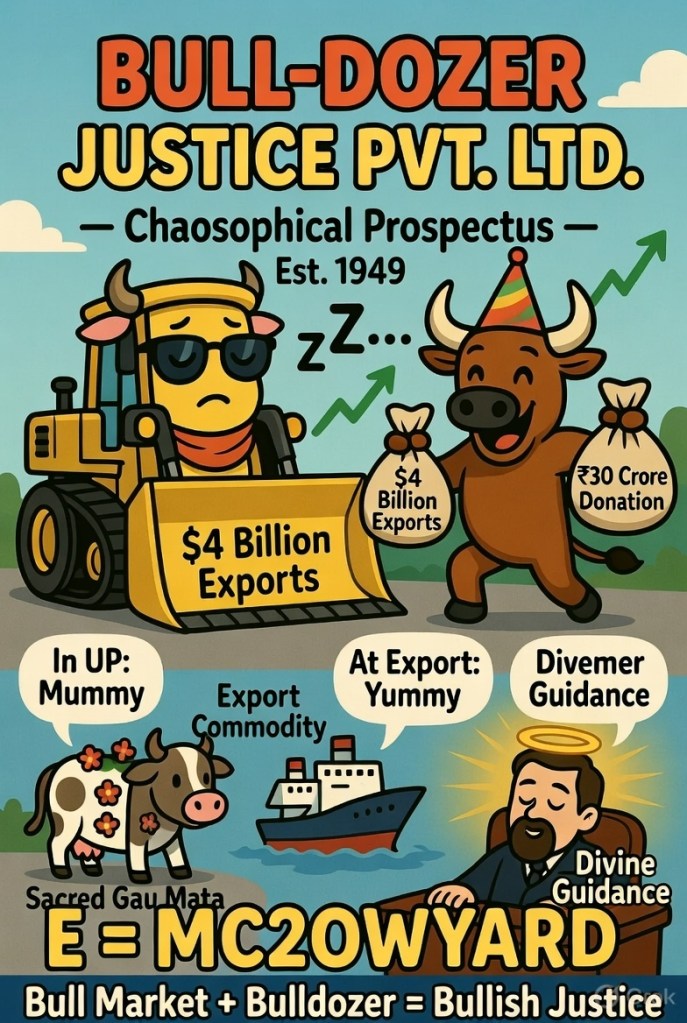
Let us begin where India’s political economists prefer you to begin: with the bull. Not the cow — we will get to her shortly — but the market bull. The bull run. The magnificent, saffron-adjacent, BJP-adjacent, bullish Indian equity market that roared from 25,000 to 75,000 on the Sensex in a decade while 738,438 people were evicted from their homes in two years.
| Metric | Figure | What It Proves |
|---|---|---|
| Sensex peak, 2024 | 75,000 points | That everything is fine |
| People evicted, 2022–23 | 738,438 | That it isn’t |
| India’s beef exports, 2025 | $4 billion (record) | That nobody talks about this |
| People killed by cow vigilantes, 2015–18 | 44 (36 Muslim) | That the cow is better protected than the citizen |
“I can say with confidence that on June 4, as the BJP hits record numbers, the stock market will also hit new record highs.” — PM Modi, Economic Times, 2024. The BJP did not hit record numbers. The Sensex briefly did. The demolitions continued regardless. This is what the article’s theoretical framework calls chaosophical — the production of meaning through apparently contradictory chaos that is, on inspection, perfectly coherent. The bull market and the bulldozer are not contradictions. They are co-productions. The bull runs on Dalal Street while the dozer runs in Akbar Nagar. The investor class gets richer; the Muslim working class gets homeless; the BJP gets elected; the market rises further. Bull-ish all round.
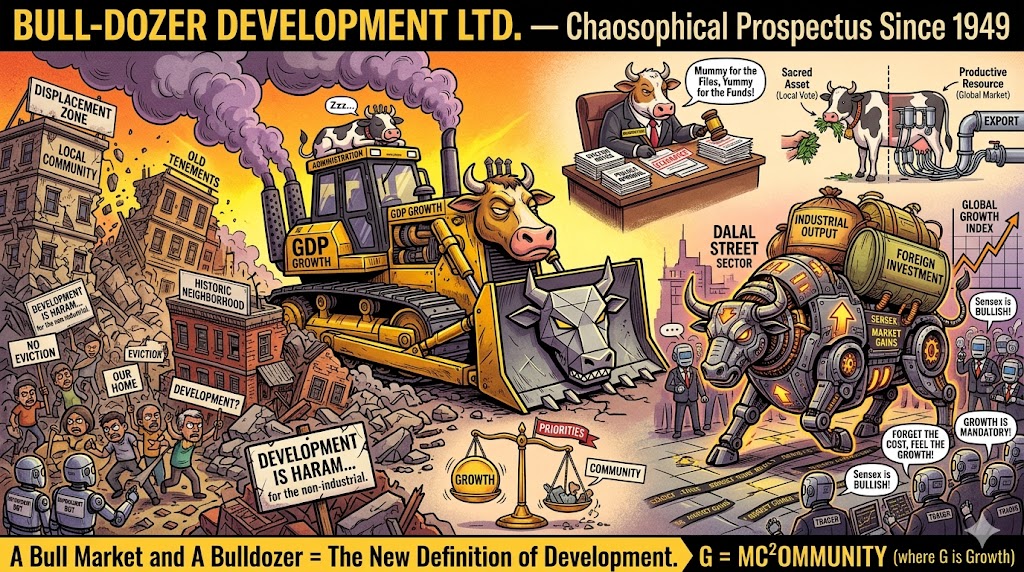
A.III. GAU MATA, GAU DATA: THE HOLY COW’S UNHOLY ARITHMETIC
The cow is sacred. The cow is Mother. The cow is the reason a Muslim rag-picker named Sabir Malik was lynched in Faridabad in September 2024 — preliminary forensics found no beef. The mob, as is customary, did not wait for forensics. They saw a Muslim and a rumour, which in BJP India is cownterfactually equivalent to evidence.
One in five recorded Hindu-on-Muslim attacks between June 2019 and March 2024 were motivated by cow vigilantism (ACLED data). Ninety percent of cow-related violence incidents between 2010 and 2017 occurred after May 2014. The Haryana government set up a 24-hour hotline for citizens to report suspected cow slaughter. This is, technically, a cow-centric call centre. The police, per Citizens Against Hate, “effectively outsourced the identification and apprehension of alleged violators of cow protection laws” to vigilante mobs. In other words: the state subcontracted murder to passion.
The cow, meanwhile, is not flourishing under this protection. Slaughterhouses closed, cattle trade disrupted by vigilante terror: farmers across UP have abandoned unproductive cattle. Stray cows now destroy crops with bovine indifference. Several BJP states have built government-funded gaushalas to house sacred animals nobody can sell or feed. The cow has become, in the most literal political science sense, a cash cow that has run dry — except for those who export her, who are donating ₹30 crore to the party that protects her.

A.IV. THE ALLANA THEOREM: ₹30 CRORE, $4 BILLION, AND THE ART OF HAVING-IT-BOTH-WAYS
India is the world’s largest beef exporter. India has emerged as one of the world’s largest exporters of buffalo meat (carabeef), with export values crossing $4 billion in 2025 — a record high since 2018 — while simultaneously witnessing lethal cow-protection vigilantism. In 2014, candidate Modi accused the UPA of running a “pink revolution” — a coded Hindutva attack on beef exports. He promised to end it. He grew it by 16%.
The BJP simultaneously: bans halal food in BJP-state canteens; promotes India’s halal-certified beef to Islamic export markets; allows cow vigilantes to burn Muslims alive on suspicion of beef possession; and accepts ₹30 crore from the country’s largest beef exporter. This is not hypocrisy. Hypocrisy implies shame. This is policy architecture.
The Shankaracharya of Puri condemned the arrangement. As AIMIM’s Owaisi put it: “In UP, cow is Mummy. In the Northeast, she is Yummy.” The Allana Theorem extends this: at the export counter, she is simply commodity. The Mother, apparently, has a price. It is currently ₹30 crore per fiscal year, plus GST.
A.V. A BOVINE GLOSSARY: FOR THE PERPLEXED CITIZEN OF THE REPUBLIC
| Term | Definition |
|---|---|
| Bulldozer Baba | Chief Minister Yogi Adityanath’s affectionate political nickname. Originally coined as a taunt by the opposition. Immediately adopted as a brand. The opposition did the BJP’s PR work for free. |
| Bull run (market) | What happens on Dalal Street when BJP wins elections. Not to be confused with a bull run in Pamplona, though outcomes for those in the street’s path are comparable. |
| Bulldoze (v.) | 1. To demolish a structure with a JCB machine. 2. To demolish an argument, a life, a community, or a Supreme Court stay order. 3. To sleep through (see: doze) while bull is happening. |
| BSE | Bombay Stock Exchange. Also: Bovine Spongiform Encephalopathy (mad cow disease). Both involve populations behaving irrationally in response to bovine stimuli, with potentially fatal consequences for the less powerful. |
| Sacred cow | 1. Hindu religious symbol. 2. Political instrument of communal mobilisation. 3. Cash cow for beef exporters who donate to the party that protects her. She is many things. A consistent policy is not one of them. |
| Gau raksha | Cow protection. In practice: protection of the idea of the cow, not the actual cow, who is currently eating the farmer’s rabi crop after being abandoned because the government closed the market she could have been sold at. |
| Udder nonsense | The complete body of BJP policy on bovine affairs. Udder: the mammary gland that gives milk. Utter: to speak. Both perfectly applicable. |
| Pink revolution | Modi’s 2014 term for the UPA’s beef export policy. He promised to end it. He grew it by 16% while accepting ₹30 crore from India’s largest beef exporter. The revolution was not televised. The demolitions were. |
| Chaosophical (adj.) | Appearing chaotic while being internally coherent. The BJP’s bovine policy is chaosophical: vigilante lynching, beef exports, slaughterhouse closures, ₹30 crore donations — all resolve into a single coherent project of communal mobilisation and capital accumulation. The cow is both mother and money. The Muslim is both enemy and customer. The JCB is both development and punishment. Chaos on the surface; architecture underneath. |
| Dozer (n.) | One who dozes — sleeps lightly. The Supreme Court dozed for decades while the mosque was locked (1949–2019). The police dozed in Haryana while 300 properties were demolished in four days. The Constitution dozed. Democracy occasionally woke up, looked around in alarm, and went back to sleep. |
A.VI. THE GRAND UNIFIED THEORY OF BJP PAIN WAVES: AN IG NOBEL EXTENSION
With acknowledgment to Dr. Debaprasad Bandyopadhyay, Mrs. Rupa Bandyopadhyay & Mr. Akhar Bandyopadhyay, whose nomination of the BIS Trio (Bajaj-Ibrahim-Singh) for the Ig Nobel Prize in Psychology inspired this addendum.
The Rashtriya Kamdhenu Aayog (RKA) — India’s national cow commission, a real government body with a real budget — uploaded 54 pages of reference material for its Cow Science Exam (scheduled February 25, 2021). The material included the “Einsteinian Pain Wave” theory of Bajaj, Ibrahim & Singh, which proposes that the pain of slaughtered cows generates acoustic anisotropy that causes earthquakes. The journal that published this paper is real. Albert Einstein did not author the theory. The earthquake hypothesis is, to deploy the technical term, udderly not science. The exam was postponed after the scientific community laughed simultaneously — generating, in the BIS Trio’s own framework, a brief seismic event.
The Unified Pain Wave Equation: E = MC²OWYARD
| Variable | Meaning |
|---|---|
| E | Electoral consequence (the only output the BJP measures) |
| M | Majoritarian mobilisation coefficient |
| C² | Cow × Constitution (both sacred; one more protected) |
| O | Opacity of demolition notices (served and removed within the hour) |
| W | Wave amplitude of bulldozer-generated human pain (unstudied) |
| Y | Yield of beef exports in USD billions ($4bn, 2025, record) |
| A | Acquittals of perpetrators (32 in Babri case; asymptotes to ∞) |
| R | Richter magnitude of human displacement pain waves |
| D | Divine guidance coefficient (introduced by CJI Chandrachud, 2019; non-falsifiable) |
The BIS Trio’s theory is seismologically worthless but politically priceless — not for what it claims, but for what it reveals about the state that funded it. The theory’s deepest, most precisely BJP-shaped lacuna: the cow’s suffering registers on the seismograph; Hasina Bi’s does not. The cow has a national commission. Hasina Bi has a rubble-site. The cow may get a university. Hasina Bi has no university. She is 56, widowed, and was never given notice.
The Bandyopadhyay Extension of the BIS theory observes: “By the same logic, the pains of ailing human beings, living in a partly free country, viz., India, can also be responsible for toppling down the autocratic sceptre.” As of the date of this appendix, the sceptre is still standing. The pain waves, however, have not dissipated. They accumulate. In seismology, this is called a stress build-up.
A.VII. ESG REPORT: ETHNO-SOCIAL GOVERNANCE FOR A NEW INDIA
| Dimension | Metric | Performance | Rating |
|---|---|---|---|
| Environmental | Carbon footprint of demolitions | JCB diesel: ~7.1 tonnes CO₂/100 hours. Offset by “eco-tourism” narrative at Akbar Nagar. | Green (ironically) |
| Social | Community impact | 738,438 displaced. 617 directly documented homeless. Zero demolishing officers convicted. | Bull market |
| Governance | Separation of powers | Executive acts as judiciary (demolishing pre-conviction). Judiciary acts as clergy (receiving divine instruction). Legislature acts as rubber stamp. All powers unified. Very efficient. Constitutionally catastrophic. | AAA (for autocracy) |
| Bovine Affairs | Cow Protection Index | 44 humans killed protecting cow (2015–18). Stray cow crop damage: rising. Beef exports: $4bn record. BJP donation from beef exporter: ₹30 crore. Net cow welfare: negative. Net political utility: positive. | Udderly confused |
A.VIII. THE “SANATANA” FOOTNOTE THE GAU RAKSHAKS HAVE NOT READ
The Rigveda — foundational text of Sanatan Hindu civilisation — contains numerous clear references to the slaughter and consumption of cows, oxen, and bulls. Contrary to modern claims of absolute sanctity, ancient Vedic texts frequently mention cow slaughter as part of rituals, hospitality, and daily life.
Key references include:
- Rigveda 10.86.13 (Vrishakapi Sukta): The hymn explicitly speaks of Indra eating bulls, with the verse addressing a mother figure: “O mother of Vrishakapi, you are wealthy, possessor of excellent sons and daughters-in-law — may Indra eat your bulls; offer him the beloved and most delicious oblation. Indra is above all.”
- Rigveda 10.86.14: Indra himself declares, “Fifteen plus twenty bulls are cooked for me at once; I eat them and grow fat — they fill both my sides. Indra is above all.”
- Manusmriti 5.30: “The eater is not polluted by eating living beings day after day; for both food and eater were created by the Creator.”
- Manusmriti 5.35: “But the man who, though duly invited, does not eat meat, after death he will be born as an animal for twenty-one existences.”
- Manusmriti 5.56: “There is no fault in eating meat, nor in drinking wine, nor in sexual intercourse — these are natural inclinations of living beings; but abstention from them brings great reward.”
- Shatapatha Brahmana 3.1.2.21: The great sage Yajnavalkya openly declares, “I eat it (meat), provided it is tender.”
- Apastamba Grihya Sutra: Cow slaughter is prescribed for important occasions such as the arrival of a guest (atithi), Shraddha (ancestor rites), and marriage.
- Panini’s Ashtadhyayi & Siddhanta Kaumudi: The term “Goghna” (cow-killer) is used as a synonym for “Atithi” (guest), because in Vedic times, the highest honour for a guest was to slaughter a cow for him.
This information is readily available in any standard library or Vedic and Indic scholarship. Yet it is conspicuously absent from Haryana’s 24-hour cow-vigilance helpline, which eagerly accepts complaints of suspected beef possession but shows no interest in textual evidence. The gau rakshak who burned Junaid and Nasir alive had presumably never read these verses. He had, however, accurately read the prevailing political temperature. The non-contradictory contradictions regarding the Holy Cow have a long and well-documented history in Hindu scriptures. What is new is the outsourcing of those contradictions to mobs that have no interest in textual nuance — only in a Muslim neighbour’s property.
A.IX. CODA: THE RASA THAT STRIKES A CHORD
Let us not end in laughter. Bharata Muni tells us that bibhatsa is a catalyst — it transforms, eventually, into karuna: compassion and grief. The disgust is not the destination. It is the aperture through which we are forced to see what we would otherwise avert our eyes from.
Hasina Bi, fifty-six, widowed, Khargone, April 2022: “The bulldozers directly attacked our house. We weren’t given any notice. Nothing.” No notice. Nothing. This is not satire. This is the sentence that survives when all the puns are spent.
Baba Lal Das, shot once in the back of the head, November 16, 1993, twenty kilometres from the mosque he tended. His murder was never solved. His name is barely remembered. He had said: “This is a political game by the VHP.” He was correct. He was killed. The game continued.
The dozer dozes. The bull runs. The cow is sacred while she is useful and exported when she is profitable. The homes fall. The stock market rises. The deity writes the verdicts. The JCB arrives at dawn. The karuna remains — not as sentiment, but as obligation. The obligation to document what happened. To name what it is. To refuse — even here, even in the register of satire — to let the laughter entirely swallow the grief.
Statutory Warning: This appendix contains satire, sarcasm, wordplay, and dark humour in the aesthetic register of bibhatsa and bhayanaka rasa as defined by Bharata Muni’s Natyashastra. All statistics cited are real. All incidents described occurred. The JCB is a real company. The lynchings happened. The widow’s house was demolished. The beef exports are at record highs. The verdict was unsigned. The god was consulted. The laughter, if any, is of the kind that precedes — and eventually demands — the reckoning. No cows were harmed in the production of this appendix. Several humans were. Their names are on the record. Bull-Dozer Justice Pvt. Ltd. is not a real company. Unfortunately, the practice it satirises is.
E ≠ MC²OWYARD. The displacement of 738,438 people does not equal anything that fits in an equation. This is why we write instead.


Comments
Post a Comment