Mayday… Mayday… Mayday: Dispatches from the Crashing Cockpit of Speed Capitalism
Mayday… Mayday… Mayday: Dispatches from the Crashing Cockpit of Speed Capitalism
Posted on 2nd May, 2026 (GMT 01:02 hrs)
ABSTRACT
This wanna-be-palimpsest charts the anatomy and ideology of speed capitalism through India’s toxic hassle-hustle culture — from Murthy’s 70-hour sermons, Deshpande’s 18-hour decrees, and the Modi-era cult of exhaustion to the SIR regime’s accelerated erasures, the parliamentary assembly line of rushed legislation, and the gig economy’s algorithmic violence. Diagnosing a civilisation in free-fall, it unmasks the energy fetish and nuclear-speed différance, achievement society’s neuronal violence, McDonaldization fused with Coca-Cola capitalism’s engineered thirst, and the cruel automation paradox of burned-out survivors beside surplus ghosts. Against this hyperindustrial descent, it offers tortoise-time (Kurmāvasthā): deliberate deceleration, creative idleness, and joyful voluntary labour (sahasa aicchik śrama) in moneyless convivial communes — drawing on Tagore’s drowned flute and city-wall critique, Gandhi’s snail-paced wayfaring pedagogy and Bread Labour, Vietnam’s war bicycles, Illich’s convivial tools, and Marx’s emancipatory vision beyond the division of labour. The dispatches culminate in a final reflexive Mayday cry from the crashing cockpit, calling for the reclamation of time, dignity, and the living Earth before hyperindustrial Armageddon swallows all.
Keywords: Speed Capitalism, Hustle Culture, Tortoise-Times, Illich, Tagore, Gandhi, Burnout Society, Achievement Society, May Day Resistance.
May Day 1886–2026: A Hauntological Transmission from the Haymarket Martyrs
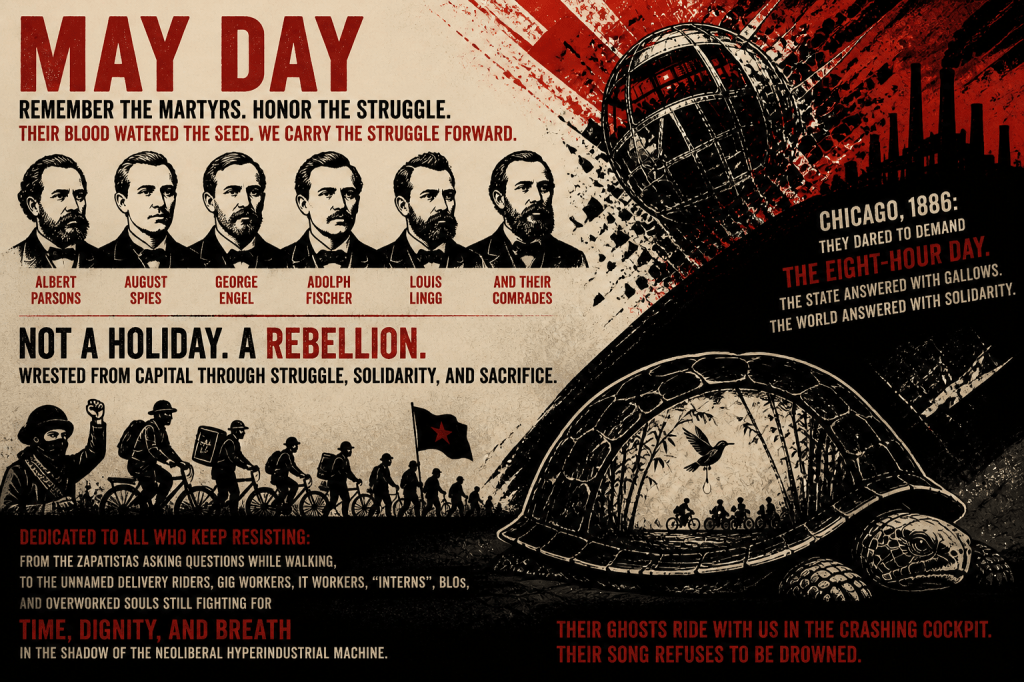
On this May Day, we from OBMA remember the Haymarket martyrs — Albert Parsons, August Spies, George Engel, Adolph Fischer, Louis Lingg, and their comrades — anarchists and labour radicals executed by the American state for daring to demand the eight-hour day. Their blood on the streets of Chicago in 1886 became the seed of International Workers’ Day: not a holiday granted from above, but a day wrested from capital through struggle, solidarity, and sacrifice. This collection of dispatches is dedicated to them and to all who have since walked the long, slow path of resistance — from the Zapatistas asking questions while walking, to the unnamed delivery riders or gig workers, IT workers, “interns”, BLOs, and overworked souls still fighting for time, dignity, and breath in the shadow of the neoliberal hyperindustrial machine. Their ghosts ride with us in the crashing cockpit. Their song refuses to be drowned.
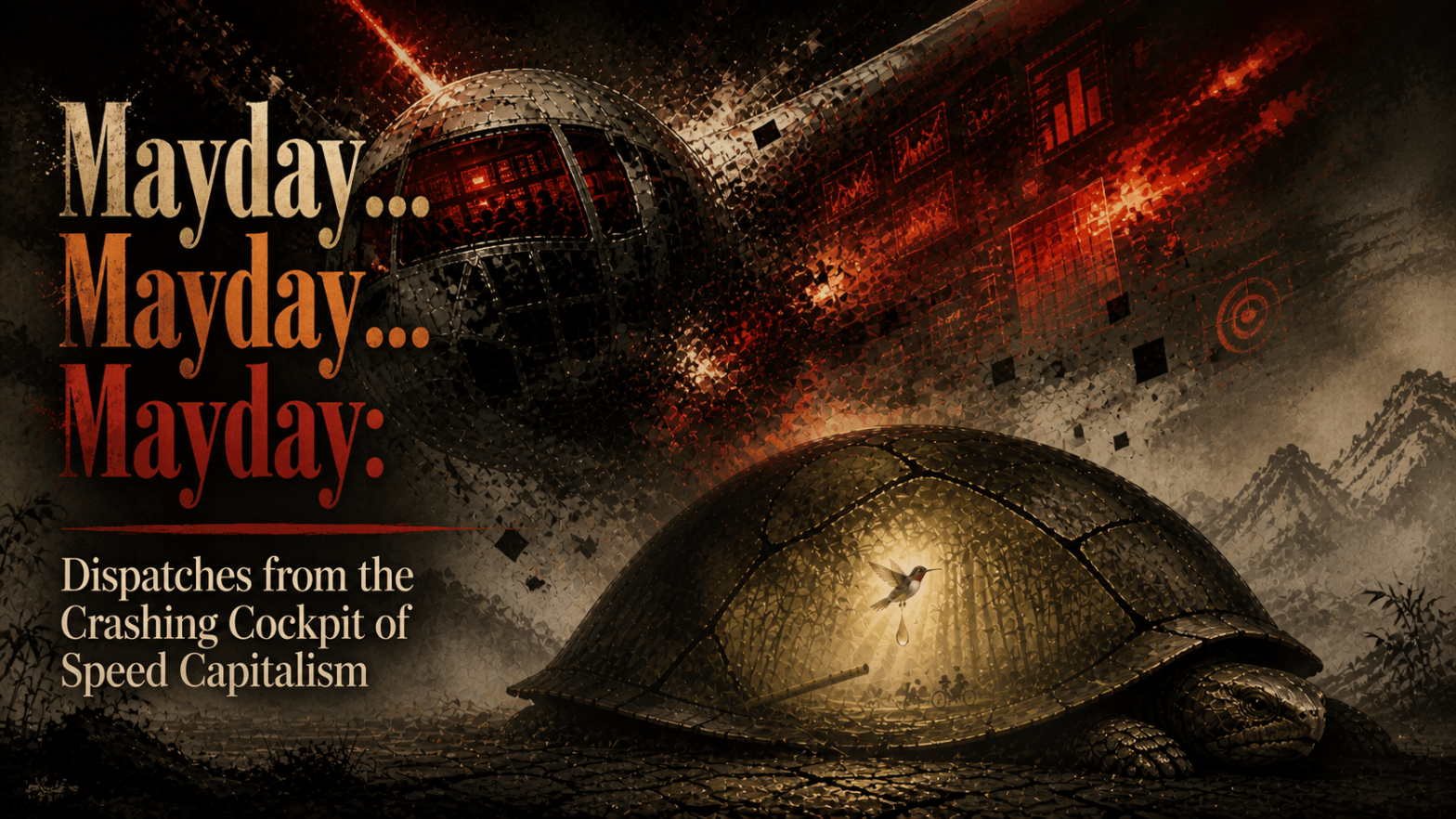
0. Mayday… Mayday… Mayday: Final Transmission from Captain — The Last Cry of the Crashing Hustle Plane
Mayday… Mayday… Mayday…
This is Captain Nemo, flight number Humanity-1886. We are going down.
Altitude collapsing. Speed insane. The instruments scream — every gauge pinned to the red line of “more speed ahead.” For decades I pushed the throttles full forward: 18-hour days, 70-hour weeks, worshipping the grind like a false god. Murthy in my ear, Deshpande in the co-pilot seat, the State itself at the controls screaming “efficiency, calculability, deletion quotas!” The SIR regime became my final vector — legacy data as flight plan, citizens as fuel, BLOs as exhausted crew forced into 15-hour suicide runs.
The plane is shaking itself apart.
Houston… Houston… we have no tortoise.
I see it now — the cockpit glass is cracking under the weight of my own shell-less ambition. No tortoise carapace. Just aluminium and ego. The engines burn the last of the Earth-cow’s blood — rare metals, data-centre lightning, the unpaid labour of hummingbirds who tried to warn us while we laughed and called them naïve.
Mayday…
I was the pilot and the payload. The achievement-subject who internalised the police baton. This is not crash by external enemy; this is auto-compulsion detonating in real time. And now, in the black box of this falling machine, the erased memories are finally foregrounded — not the mechanical recorder that will survive the impact and dutifully log every altitude, every throttle setting, every last desperate input, but the older, more insidious black box: Skinner’s sealed chamber of behaviour, where the mind itself was declared opaque, unknowable, irrelevant. Only stimulus and response. Only reward and punishment. Only the lever pressed harder, faster, longer — until the organism inside learned to love the very cage that was killing it.
McDonaldized to the marrow. I traded the eight-hour resolution for a supersonic May Day.
The ground rushes up — solastalgia in every pixel of the terrain radar. Burnt grasslands, deleted names, the ghosts of the Haymarket martyrs swinging in the wind behind me. I hear the Zapatistas walking slowly, asking questions I never had time to answer. The bicycle path is still there, luminous and slow, but I am too fast, too heavy, too late.
Mayday… Mayday…
If anyone is still listening — this is my last reflexive transmission.
I was wrong. The labour pain was never birth. It was self-immolation dressed as patriotism, as hustle gospel, as necessary acceleration. The only thing we birthed was the Frankensteinian hyperindustrial Armageddon.
The ground is rising for its close-up. Shall we slow down enough to meet it?
[Transmission ends in static and the long, drawling silence of a world that finally stopped accelerating.]
1. Harbingers of Hassle-Hustle Culture from the Rising “East” Mimicking the Hegemonic “West”
The distress signal does not echo only from Silicon Valley towers or Wall Street terminals. In India — the world’s so-called “fastest-growing major economy” (for what, for whom, and at what cost?), cradle of supposed ancient civilisations and contemporary neo-liberal ambition — the same May Day call reverberates louder, sharper, more insistent.
Here, the apostles of speed capitalism wear familiar faces: the revered technocrat, the brash startup founder, and the tireless head of state. Their message is delivered not as suggestion, but as national imperative. Work longer. Sacrifice deeper. Complain less. The plane must climb faster.
1.1 The Expanding Congregation of Extreme Hours
At the centre stands a trinity that has come to define the public face of this gospel in India.
Narayana Murthy, co-founder of Infosys and elder statesman of Indian IT, has repeatedly called for young Indians to embrace 70-hour workweeks — roughly 12-hour days, six days a week. He invokes the ghosts of post-World War II Japan and Germany, where people supposedly toiled “over 16 hours a day” to rebuild shattered nations. In 2025, Murthy elevated the benchmark further, declaring that the only person he knows who works nearly 100 hours a week is Prime Minister Narendra Modi himself. The implication is unmistakable: the hegemony of national resurgence demands personal exhaustion.
Shantanu Deshpande, founder and CEO of Bombay Shaving Company, went further and younger. In a 2022 LinkedIn post that ignited nationwide outrage, he instructed freshers and early-career professionals to commit to 18 hours a day for the first four to five years of their working lives. “Throw yourself into it,” he urged. “Worship work.” Stay fit if you must, but discard all “rona-dhona” — the childish cribbing about work-life balance. The backlash was fierce; the post went viral as a symbol of toxic hustle. Yet the message lingered: suffering is the price of entry, an entry into legitimation.
And then there is Narendra Modi, positioned in the national story as living proof that such extremes are not only possible but glorious. Ministers, industrialists, and supporters routinely describe the Prime Minister reportedly working 14–19 hours a day, seven days a week, year-round, with minimal sleep. Sajjan Jindal, Hardeep Singh Puri, and Murthy himself have all cited these figures as inspiration. Modi has cultivated the image of the ascetic workaholic since his days as Chief Minister (or Butcher) of Gujarat. While he has not always stated the exact numbers himself, he has never contradicted the narrative. In the national story, he is the pilot who never rests, flying the aircraft of state on sheer will.
This trinity, however, is only the most visible core of a far larger congregation. L&T Chairman S.N. Subrahmanyan went viral in early 2025 for openly advocating a 90-hour workweek, wondering aloud in a widely circulated clip how long one could possibly “stare at your wife” before returning to the grind. Ola co-founder Bhavish Aggarwal threw his weight behind Murthy’s call, framing the 70-hour demand as essential for India’s global leap. JSW Group’s Sajjan Jindal echoed the same urgency, linking longer hours directly to national competitiveness. Harsh Goenka of RPG Group added his voice in support, while Zepto co-founder Aadit Palicha casually revealed that his early team routinely logged 80-to-100-hour weeks as the baseline for building a unicorn.
The chorus stretches beyond India’s borders, revealing how deeply this mentality is embedded in the global neoliberal playbook. Elon Musk has repeatedly declared that “nobody ever changed the world on 40 hours a week,” openly prescribing 80-to-100-hour weeks as the price of real impact — “work like hell,” he has said, with pain levels rising exponentially beyond 80 hours. Jack Ma, during Alibaba’s explosive rise, defended China’s notorious 996 culture (9 a.m. to 9 p.m., six days a week — a full 72-hour schedule) as a “huge blessing,” telling young employees that those who refuse such hours will never taste the rewards of true success. These voices, whether from Bengaluru boardrooms, Shanghai tech campuses, or Texas launch pads, speak the same language: extreme labour is not coercion but chosen destiny; rest is a luxury the ambitious cannot afford; and the demographic dividend — whether India’s young millions or the world’s aspiring entrepreneurs — must be burned as fuel at the altar of neoliberal globalization’s exponential growth.
| Figure | Key Statement / Position | Core Ideology / Implication | Reflective Note |
|---|---|---|---|
| Narayana Murthy | 70-hour workweeks for young Indians; later cited Modi’s near-100-hour weeks | National resurgence demands personal exhaustion | Patriarchal benchmark of sacrifice as patriotism |
| Shantanu Deshpande | 18-hour days for freshers (first 4–5 years); “Worship work”, discard “rona-dhona” | Suffering is the price of entry and legitimation | Brutal initiation ritual for the young |
| Narendra Modi | 14–19-hour days, 7 days a week, minimal sleep (widely projected) | The ascetic workaholic as national ideal | State itself becomes the ultimate hustle machine |
| S.N. Subrahmanyan (L&T) | Advocated 90-hour workweek | Domestic life secondary to grind | Open contempt for rest and relationships |
| Bhavish Aggarwal (Ola), Sajjan Jindal (JSW), Harsh Goenka, Aadit Palicha (Zepto) | Strong public support for 70–100-hour culture | Long hours = national/global competitiveness | Corporate chorus normalising extreme extraction |
| Global Echoes | Elon Musk (“work like hell”, 80–100 hrs), Jack Ma (996 culture as “blessing”) | Extreme labour as chosen destiny, not coercion | Neoliberal gospel transcends borders |
1.2 One Message, Many Altitudes
What unites this expanding congregation is the seamless transformation of extreme labour from personal choice into patriotic, even civilisational, duty. In their worldview, India’s vast young population must not rest. It must burn. The cockpit voice is no longer pleading “May day.” It has become the flight instructor barking orders: Push the throttle. Ignore the stall warning. Glory lies beyond the red line.
This is hassle-hustle culture with high, critical and unignorable stakes. The same rhetoric once used to justify child labour in Manchester mills or 16-hour factory shifts in Mao’s China is now repackaged in suits, LinkedIn wisdom, prime-time addresses, and viral CEO clips. Rest is unpatriotic. Reflection is luxury. The body and mind are merely fuel for GDP charts, for “outputs”!
The forgetting here is particularly cruel. India, of all places, once gave the world the concept of dharma — righteous balance — and the wisdom that sustainable effort respects natural rhythms. Yet on this May Day, that memory is drowned out by the roar of engines pushed into overdrive.
The plane trembles. The warning lights flash across an entire generation. And from the cockpit, the captains of hustle continue broadcasting their commands, even as the horizon tilts and the ground begins its merciless rise.
May day. The call is no longer distant. It is here. It is now. And it speaks with a Global South accent — one that echoes across continents, from Mumbai to Shanghai to Austin, in the unmistakable cadence of neoliberal urgency: more, and more, quick, instant, fast, faster, now ! ! ! !
2. Countering the Toxic Hassle-Hustle Culture!
2.1 The Energy Fetish: From Mechanical Slaves to Human Fuel
The cockpit transcends mere metal and wire. It embodies flesh, sweat, and flickering embodied determination — cortisol cocktails shaken, not stirred. Within these confines, toxic hustle culture thrives: that frantic, foot-tangling dance where each “hustle” generates a new “hassle,” and every hassle necessitates even more hustle, until the entire spectacle crashes down in a slapstick heap reminiscent of Charlie Chaplin’s Modern Times assembly line: a fragmented cog in the machine — estranged, metabolically rifted.
Picture the Little Tramp, wrenches in hand, swallowed by the gargantuan gears of the factory line. One loose bolt and the entire machine spits him out, buttons flying, lunchbox sailing, dignity in tatters. Now zoom out: that same Tramp sits in a Bengaluru open-plan office at 2 a.m., eyes bloodshot, laptop glowing like an interrogator’s lamp. The gears have gone digital. The conveyor belt is Slack pings, KPI dashboards, excel sheets, and investor decks. The foreman’s whistle is a founder’s LinkedIn sermon. And instead of gears chewing his tie, it is his own nervous system devouring the remaining hours of his life.
Hassle-Hustle: the perfect portmanteau for our age. You hustle for the dream — 18 hours a day, freshers! — and the immediate reward is a fresh mountain of hassle: burnout, skipped meals, relationships reduced to calendar invites, health reduced to “just one more espresso shot.” The hustle promises escape velocity; the hassle keeps you chained to the treadmill, panting, smiling for the ‘Gram, insisting this is “passion.”
Nowhere is this metabolic transaction more visible than in the rise of caffeine culture that has colonised corporate India. Office pantries once stocked with simple tea have been replaced by gleaming espresso machines, energy-drink fridges, and subscription coffee kits promising “laser focus” and “all-day productivity.” Energy drinks marketed as “performance fuel” line the desks of tech campuses and startup war rooms, their neon cans standing like sentinels against the creeping fatigue. What begins as a quick chemical boost to push through another 14-hour stretch soon becomes ritual: the afternoon crash answered by another can, the wired heart racing while the deeper exhaustion only deepens. This is the energy fetish made intimate and ingestible — a pharmacological extension of the same logic that turns the body into fuel. We burn our own metabolic coal, convinced that exhaustion equals elevation, while the nervous system pays the hidden tax in disrupted sleep, anxiety spikes, and the slow erosion of genuine vitality.
This is speed capitalism’s cruel comedy. It does not merely overwork the body; it turns the body into fuel. Your sleep becomes collateral. Your attention becomes the payload. Your relationships become maintenance downtime. And the entire spectacle is sold back to you as empowerment. In our version, millions keep feeding themselves into the machine, hashtagging the bruises, calling the internal bleeding “building resilience.” The gears laugh in binary. The hassle multiplies. The hustle accelerates.
And somewhere in the background, the ancient May Day call crackles over the intercom, half plea, half punchline:
May day… may day…
The ground is rising for its close-up.
2.2 Tagore Against the Hassle-Hustle Culture: The Song of Stillness Amid the Clamour
The following Rabindranath Tagore song “সময় কারো যে নাই…” stands as a luminous poetic counter-manifesto to the very speed capitalism and toxic hustle we have been exploring.
সময় কারো যে নাই, ওরা চলে দলে দলে–
গান হায় ডুবে যায় কোন্ কোলাহলে॥
পাষাণে রচিছে কত কীর্তি ওরা সবে বিপুল গরবে,
যায় আর বাঁশি-পানে চায় হাসিছলে॥
বিশ্বের কাজের মাঝে জানি আমি জানি
তুমি শোন মোর গানখানি।
আঁধার মথন করি যবে লও তুলি গ্রহতারাগুলি
শোন যে নীরবে তব নীলাম্বরতলে॥
Translation:
No one has time — they march on in endless throngs —
Alas, my song drowns in the clamour of the crowds.
Upon stones they carve countless monuments in vast pride,
Yet they glance at the flute with a smile of secret delight.
Amid the world’s ceaseless toil, I know, I know —
You listen to my little song.
When You churn the darkness and lift up the stars,
You hear it in silence beneath
Your vast blue canopy.
Here Tagore paints the hustle-hustle crowd (dale dale — in droves, mechanically marching) with merciless clarity. No time (samay karo je nai) is the defining affliction. Their labour produces stone monuments (pashane rachichhe) — grandiose but lifeless achievements of pride (bipul gorobe). The inner song (poetry, flute, soul’s melody) is drowned in uproar (kolahole). Yet a furtive glance toward the flute (banshi-pane chay) with a hidden smile reveals the suppressed longing for joy, play, and contemplation. This is frantic productivity that builds empires of stone but silences the flute of life.
The iconic opening of Charlie Chaplin’s Modern Times (1936) delivers a devastating visual rhyme that resonates powerfully with Tagore’s song. A herd of sheep surges forward, dissolving seamlessly into a throng of workers rushing into a factory gate — human beings reduced to livestock, driven by the same blind, collective momentum. The sheep-to-workers transition is precisely dale dale. The factory whistle and clanging machinery supply the kolahol that drowns any personal melody. Tagore’s stone monuments become the factory itself, a temple to productivity built with immense pride. Yet the Tramp’s clumsy rebellions and moments of grace are those stolen glances toward the flute amid the mechanical din.
The song’s closing movement lifts the gaze to a deeper silence: “Amid the world’s ceaseless toil, I know, I know — You listen to my little song… You hear it in silence beneath Your vast blue canopy.” While the herd rushes and machines roar, a cosmic listener attends. Chaplin, the silent filmmaker in the age of talkies, understood this; his art itself becomes the “little song” that survives the clamour.
Tagore’s critique runs far deeper than this single lyric. In his essay “City and Village,” he diagnoses an epidemic of voracity and self-aggrandizement that has infected modern civilisation. The blood-sucking machinery of industrial progress devours the living relationship between city and village, turning the latter into a mere resource base while the former swells with unchecked greed. Progress no longer attends to the land, the soil, the earth, or the kinship that binds all life. In Sadhana, he traces this severance back to the very cradle of modern civilisation: “The civilization of ancient Greece was nurtured within city walls. In fact, all the modern civilisations have their cradles of brick and mortar.” These walls leave their mark deep in the minds of men, setting up a principle of “divide and rule” in our mental outlook. They breed in us the “city-wall habit” — a sterile existence enclosed behind artificial barriers of brick, routine, and ego. In city life, man directs the concentrated light of his mental vision upon his own life and works, creating an artificial dissociation between himself and Universal Nature within whose bosom he lies. In such a state of civil war, man always lives behind barricades; homes become not real homes but artificial barriers around us. We divide nation from nation, knowledge from knowledge, and above all man from nature. Everything beyond the walls must fight hard for entrance into our recognition. Instead of growing with and into his surroundings, modern man fortifies his conquests and fragments the organic flow of existence, replacing living rhythms with mechanical clamour and reducing human beings to isolated cogs in an ever-accelerating wheel.
In place of this frenzy, Tagore championed saharsa aicchik śrama — voluntary, spontaneous labour performed with natural joy and inner freedom. In his Santiniketan-Sriniketan experiments, work was never separated from song, festival, art, and nature; labour became an expression of harmony rather than exhaustion. He celebrated creative leisure as essential: time for imagination, music, and quiet reflection, where the flute can still be heard. True wealth lies not in accumulated monuments but in the freedom of the spirit.
This vision finds quiet resonance in Daoist wisdom and the Chinese practice of tea meditation. There, wu wei — effortless action in alignment with the Dao — teaches that the softest thing (water) overcomes the hardest, and stillness is not absence but the ground of true movement. The tea ceremony becomes a living embodiment of slow, mindful presence in which every gesture — warming the water, inhaling the leaves, pouring with reverence — dissolves haste and restores the inner flute. Tagore’s drowned melody and the Daoist cup of tea speak the same language: pause long enough, and the song (or the steam) will be heard.
The poet’s song, though at risk of drowning, reaches the Beloved who listens in silence beneath the vast sky — a reminder that stillness and inner listening ultimately prevail over outward clamour. With love, shall we make time for the flute amid the noise?
2.3 Gandhi Against Hassle-Hustle Culture: Snail’s Pace, Wayfaring Pedagogy, and Bread Labour
In Hind Swaraj (1909), Chapter IX — “The Condition of India (continued): Railways” — Gandhi offers one of his most profound meditations on the virtues of slowness through the institution of pilgrimage. The Reader wonders why Gandhi criticises the railways when they make holy places more accessible. Gandhi replies with characteristic directness and devastating clarity:
“What do you think could have been the intention of those farseeing ancestors of ours who established Setubandha (Rameshwar) in the South, Jagannath in the East and Hardwar in the North as places of pilgrimage? You will admit they were no fools. They knew that worship of God could have been performed just as well at home. They taught us that those whose hearts were aglow with righteousness had the Ganges in their own homes. But they saw that India was one undivided land so made by nature. They, therefore, argued that it must be one nation. Arguing thus, they established holy places in various parts of India, and fired the people with an idea of nationality in a manner unknown in other parts of the world. […] Good travels at a snail’s pace — it can, therefore, have little to do with the railways. Those who want to do good are not selfish, they are not in a hurry, they know that to impregnate people with good requires a long time. But evil has wings. To build a house takes time. Its destruction takes none. So the railways can become a distributing agency for the evil one only.”
He does not stop there. Gandhi continues with concrete, devastating observations drawn from lived experience under colonial modernity:
“The railways, too, have spread the bubonic plague. Without them, the masses could not move from place to place. They are the carriers of plague germs. Formerly we had natural segregation. Railways have also increased the frequency of famines because, owing to facility of means of locomotion, people sell out their grain and it is sent to the dearest markets. People become careless and so the pressure of famine increases. Railways accentuate the evil nature of man: Bad men fulfil their evil designs with greater rapidity. The holy places of India have become unholy. Formerly, people went to these places with very great difficulty. Generally, therefore, only the real devotees visited such places. Nowadays rogues visit them in order to practise their roguery.”
This passage is no mere aside. It forms the heart of Gandhi’s sustained critique of modern speed and machinery in Hind Swaraj. The ancient builders, he insists, were deliberate architects of unity. They understood that true inter-cultural dialogue and devotion could not be manufactured by rapid transit; they had to be walked into existence through slow, arduous journeys that demanded patience, sacrifice, and intimate encounter with difference. The pilgrimage was never about destination alone — it was a pedagogy of transformation. The long road humbled pride, dissolved regional prejudices, and cultivated the living awareness that India was one.
This vision stands in direct, uncompromising opposition to the spirit of contermporary post-industrial modernity’s hassle-hustle culture. Where speed capitalism promises efficiency and connectivity through accelerated regimes, Gandhi sees only the winged velocity of evil: rapid exploitation, the spread of moral and physical contagion (plague, famine, moral decay), the corruption of sacred spaces by the unworthy, and the erosion of the patient, face-to-face understanding that genuine unity and character demand. What takes time to build — trust, moral fibre, national consciousness — can be undone in an instant by accelerated movement and commerce. The railway, like today’s digital conveyor belts of productivity, turns pilgrimage into hurried tourism for rogues and reduces meaningful labour into precarity.
Gandhi did not stop at critique. He turned the insight into a lived wayfaring pedagogy. The pilgrim-wayfarer does not race; he walks the long road, allowing the journey itself — with all its dust, fatigue, and unexpected encounters — to transform body, mind, and community. Gandhi’s own life was saturated with this practice. From the Salt March to countless padayatras across villages, from his barefoot travels in South Africa to the deliberate slowness of his later years, he embodied the conviction that real change travels at the pace of human feet and human relationships. Fixed speed is the enemy of swaraj; deliberate movement is its school.
This slow embodiment of self-rule finds powerful resonance beyond Gandhi. It echoes in Rahul Sankrityayan’s Ghumakkar Shastra (The Wanderer’s Scripture), which declares that there is no greater dharma than ghumakkadi — the life of the wanderer. Fixed homes breed rigidity and bigotry; true freedom and understanding arise only through constant, open-eyed travel by the simplest means. The wanderer belongs everywhere and nowhere, carrying his shelter lightly, learning from every soil and every stranger.
The same spirit animates the Buddha’s repeated exhortation to his monks: “Charatha bhikkhave charatha — O monks, wander! Wander for the gain of the many, for the welfare of the many, out of compassion for the world.” The wandering life (charika) was mindful, feet-on-the-ground engagement with the living world — slow enough to see suffering, steady enough to respond with wisdom and care. Gandhi, Sankrityayan, and the Buddha converge in a shared ethics of the wayfarer: good does not hurry; it walks, listens, and lets the road do its quiet, transformative work.
Gandhi made this vision concrete and ethical through Bread Labour (Sharir Shrama), one of the eleven sacred observances of his Ashram. In Yeravda Mandir (Ashram Observances in Action) and repeated across his writings, he declared: “God created man to work for his food, and said that those who ate without working were thieves.” Drawing directly from the Gita’s teaching on yajna (selfless sacrifice) and echoing Tolstoy’s interpretation of the divine law, Gandhi insisted that every able-bodied person must perform physical, productive labour — spinning, farming, scavenging, cleaning latrines — to earn their daily bread. There was to be no hierarchy between intellectual and manual work. Gandhi himself spun daily on the charkha and cleaned toilets, demonstrating that dignity resides in all honest labour.
Bread Labour was never coercive drudgery; it was voluntary and joyful — performed as yajna with pleasure, not pain. Its social purpose was explicit and revolutionary: “I labour for me and my family, for the old persons, children, and the handicapped.” Through such mutual service, it would build a classless, casteless society, revive rural self-reliance through khadi and village industries, and counter industrial exploitation with decentralised, non-violent economics.
This conception finds a profound and natural parallel in Tagore’s sahasa aicchik śrama — voluntary, spontaneous labour performed with natural joy and inner freedom. Both thinkers rejected forced, mechanical toil. Where Tagore emphasised labour as harmonious expression inseparable from song, festival, art, and nature (as practised in Sriniketan), Gandhi grounded it in the daily sacrament of earning one’s bread through honest bodily effort. Khadi — homespun cloth — became the living symbol of this shared vision: spinning on the charkha was simultaneously economic self-reliance, political resistance, spiritual discipline, and joyful creative labour. It wove individual dignity into collective swadeshi, turning the simplest act of production into an act of love for the land and its people. Together, Gandhi’s Bread Labour and Tagore’s joyful voluntary labour offer a powerful counter-ethic: work that liberates rather than enslaves, that regenerates rather than extracts, that nourishes the spirit as much as the body.
Gandhi’s snail’s pace and Bread Labour offer a living synthesis. Socially and ecologically necessary labour becomes the minimal, voluntary, and joyful time willingly offered through bread labour — for oneself, family, elders, children, the disabled, and the more-than-human world — within regenerative rhythms and planetary boundaries. This labour is moneyless and care-centred, pleasurable and multi-sided, slow and alchemical, and above all regenerative: it repairs rather than extracts.
Gandhi’s call is therefore not nostalgic primitivism but a radical ethics for the present: slow down, walk the long road, and let good slowly impregnate the world. Only then can we reclaim the living Ganges within and the true unity without.
The pilgrimage to a non-hustle civilisation remains open — but it cannot be reached by bullet train. It must be walked, one deliberate step at a time.
2.4 Illich’s Diagnosis: The Energy Slave and Its Master
No thinker saw this pathology more clearly than Ivan Illich. In Energy and Equity (1974), he exposed the modern “energy fetish” — our collective worship of energy (fossil, electric, computational) as the ultimate measure of progress. Societies increasingly define well-being by the number of “energy slaves” each citizen commands: machines, vehicles, and algorithms that amplify human effort. One citizen in a high-energy society effectively lords over hundreds of invisible servants. Yet beyond a critical threshold, these slaves cease to liberate. They degrade social relations, entrench inequity, and render people impotent before their own tools.
Illich’s warning remains prophetic: “The use of energy on a massive scale acts on society like a drug that is physically harmless but psychically enslaving.” High-energy systems require constant maintenance, centralised control, and ever-greater inputs. They produce a harried, dependent population addicted to speed. Toxic hustle is simply the human analogue: we burn our finite bodily energy — sleep, attention, relationships, health — to keep the hyper-industrial engine from sputtering. Sixteen-hour days become the biological equivalent of shovelling more coal into a furnace already cracking the planet’s crust.
Illich foresaw the terminus with chilling precision. Unchecked escalation of capital-intensive, high-energy growth would carry us “past the last turnoff from a hyperindustrial Armageddon.” We are now inside that forecast. Climate breakdown, biodiversity collapse, and a global mental-health crisis are not unfortunate side-effects. They are the destination when the energy fetish marries speed capitalism. The system’s only prescribed remedy is more: more tech, more extraction, more hustle. In this light, the glorification of extreme work hours is not motivational rhetoric. It is ideological fuel. It internalises the addiction: workers become both the furnace and the stokers, racing to sustain GDP ascent while their own nervous systems stall. Decades of research confirm the biology: sustained performance collapses beyond roughly 50–55 hours per week. Cognitive output, creativity, and even raw productivity decline; risks of heart disease, stroke, and depression rise. Yet the narrative persists because it serves the logic of acceleration.
May day. The ground is closer than the instruments admit.
2.5 Bertrand Russell’s “In Praise of Idleness” (1932/1935)
Bertrand Russell’s essay “In Praise of Idleness” remains one of the most provocative 20th-century interventions against the moral fetishisation of work. Writing amid the Great Depression, Russell launches a frontal assault on the “gospel of work” — the deeply ingrained belief that labour is inherently virtuous and idleness inherently sinful. He argues that modern industrial societies suffer from “far too much work,” driven by an obsolete morality that causes immense harm. Technological progress, he contends, has made it possible to reduce the working day dramatically (he famously proposes four hours) while maintaining comfort for all, yet the cult of industry prevents society from embracing the leisure dividend.
Russell’s central thesis is both economic and ethical. In In Praise of Idleness and Other Essays, he distinguishes between useful labour (altering matter to meet needs) and the supervisory or administrative work that often serves only to perpetuate hierarchy and unnecessary production. The belief in work’s virtue sustains a system where some overwork while others remain unemployed, and where surplus production fuels pointless consumption rather than human flourishing. True civilisation, for Russell, springs from leisure: “Leisure is essential to civilisation,” and the great achievements in art, science, and philosophy have historically emerged from those with time to think and create.
Russell’s essay is refreshingly lucid and morally courageous. His call to revalue idleness as a space for creativity, contemplation, and genuine human development resonates powerfully with the counter-visions we have traced. In the context of today’s gig economy and 24/7 digital grind, his insistence that “the road to happiness and prosperity lies in an organised diminution of work” feels prophetic.
The cockpit trembles under its own acceleration. Yet the flute can still be heard, the snail’s pace still teaches, the wanderer’s scripture still beckons, and the tea cup still steams in quiet invitation. Shall we slow down enough to meet the ground rising for its close-up?
3. Locomotiving Ahead: Full Speed, More Speed Ahead … ! … ! … !
The cockpit lights have gone nuclear red. The altimeter spins wildly. And over the intercom comes the captain’s voice — half manifesto, half death sentence: Full speed ahead.
In 1984, Jacques Derrida delivered a text that reads like prophecy disguised as wordplay: “No Apocalypse, Not Now (Full Speed Ahead, Seven Missiles, Seven Missives).” Presented at a Cornell colloquium on nuclear criticism, the essay opens with a declaration as stark as it is disorienting: “at the beginning there will have been speed.” Not God. Not the Word. Speed. A course de vitesse — a race against time where the stakes are total erasure. Classical wars were also races, Derrida reminds us, but the nuclear condition accelerates the old logic into something unprecedented: a permanent sprint toward a horizon that must never arrive.
The bomb, he argues, is “fabulously textual.” It exists less as hardware than as discourse, simulation, rhetoric, archival threat, and calculated fiction. Missiles are missives — messages sent into the future, deferring their own detonation. Deterrence is not peace; it is différance weaponised: an economy of calculated postponement, endless escalation, and brinkmanship that feeds on the potential of catastrophe. “No apocalypse, not now” — because true apocalypse (revelation, unveiling) requires survivors to receive the revelation, witnesses to bear witness, an archive to record it. Total nuclear war would leave no remainder, no witness, no archive. Hence the grotesque irony: we accelerate toward an end that cannot be experienced, only endlessly rehearsed in the realm of the textual, the simulated, the forever-deferred.
3.1 From Human “Resources” to Planetary Fuse
This is where the cockpit of toxic hassle-hustle culture meets the silo. The logic of perpetual acceleration that governs the 70-hour week, the 18-hour directive, the always-on executive calendar, and the gamified productivity dashboard is a micro-version of the same nuclear economy. Burn metabolic energy. Optimise the human processor. Normalise exhaustion so the machine never slows.
Nowhere is this logic more brutally institutionalised than in the very name and practice of “Human Resources” (HR) — one of neoliberalism’s most revealing linguistic sleights of hand. Human beings are no longer workers, employees, or even people; they are resources — fungible inputs to be optimised, allocated, extracted, and, when necessary, discarded like spent fuel rods. HR departments function as the internal logistics wing of the gigantism machine: talent pipelines, headcount reductions, “right-sizing,” performance matrices, and burnout-mitigation workshops that never challenge the underlying velocity. The language itself betrays the ideology — humans are not ends but means, not subjects but assets on a balance sheet. In the neoliberal imaginary, the ultimate triumph is when the resource internalises its own expendability and begins to manage itself with the same ruthless efficiency the corporation demands. The body becomes both fuel and launch vehicle; attention becomes launch code; rest becomes the unthinkable surrender. Every notification, every KPI, every “one more push” is a miniature missile — a missive sent forward to defer the moment of reckoning, the moment when the system might finally have to admit it has no destination, only velocity.
What begins as LinkedIn sermons about “worshipping work” and founder myths of sleepless genius scales seamlessly into national mythologies of tireless leadership and then into geopolitical arsenals. The same fetish for energy — once coal, then oil, now algorithms, data centres, and fissile material — demands perpetual acceleration. GDP must outrun competitors. Innovation must outpace regulation. Deterrence must out-escalate the enemy. Hustle culture is psychic training for this macro-sprint: treat your body like a missile silo on permanent alert, your attention like launch codes that can never rest, your very fatigue as proof that you are still in the game. The pilot who glorifies crushing hours is rehearsing, in miniature, the civilisation that keeps its finger on the button while insisting the button must never be pressed.
The tragi-comedy darkens into something far more sinister. Chaplin’s Tramp, at least, could be chewed up and spat out by the physical factory. Today’s hustler is both gear and grease, both missile and missive, hurtling toward an apocalypse that remains fabulously textual — until it isn’t. The deferral is total: burnout is always “not now,” collapse is always “not now,” the final accounting is always “not now.” We live inside the permanent rehearsal, a fetishished ritualization speed-output as the “new normal”.
3.2 Critical Resonance
Derrida’s strength lies in exposing the nuclear condition as structural, not accidental. The real danger is not the sudden flash but the normalised velocity that makes the flash thinkable — even desirable — as the only possible horizon. In 2026, the essay feels eerily contemporary. AI-driven war simulations run faster than human thought; hypersonic missiles shrink response times to minutes; cyber-nuclear vulnerabilities turn every server farm into a potential silo; multipolar rivalries (India-Pakistan, US-China, NATO-Russia) operate within the same economy of speed and deferral. The climate Armageddon echoes the nuclear one: another “remainderless” threat born of the same energy/speed fetish — endlessly narrated in reports, models, and summits, yet deferred by the promise of further acceleration (“more green tech, faster!”).
Yet Derrida’s textualism has limits that must be acknowledged. The bomb is not only fabulation — radiation burns, fallout zones, genetic damage, and the slow violence of contaminated soil are brutally material. Pure deconstruction can sometimes float too far above the concrete analysis of tools and energy quanta that grounds the critique in lived consequence. Acceleration has also delivered undeniable goods: vaccines, satellite communication, knowledge diffusion at unprecedented scale. Blanket rejection of speed courts romantic paralysis. The question is never speed versus slowness in the abstract, but which speeds serve which ends, and at what human and ecological cost.
In India’s context, the nuclear shadow is not abstract. A nation racing toward development while managing border tensions inherits both the hustle imperative and the deterrence logic in their most intimate entanglement. Bicycle-scale conviviality looks quaint against hypersonic realities — yet remains the necessary counter-image: human-scale rhythms that refuse to treat life as expendable fuel or the planet as collateral.
The stall warning has gone supersonic. The plane is no longer merely descending; it is in a death spiral dressed as ascent. Derrida’s ironic rallying cry still echoes from the control tower:
Full speed ahead.
May day.
The missiles are missives. The hustle is the rehearsal. And the ground, this time, may not be content with a close-up. It may simply open its mouth and swallow the show.
4. The Filth of the Achievement-Burnout Society
The cockpit is now empty of visible overseers. No foreman, no whip, no external panopticon. Only the pilot remains — eyes glazed, fingers twitching on the controls, muttering the new sacred mantra: You can do this. You must do this. Keep pushing. Byung-Chul Han, in The Burnout Society (2010), delivers the most intimate autopsy yet of our descent into the achievement society. Where earlier critiques mapped the external machinery of acceleration, Han turns the scalpel inward. The true catastrophe is psychic self-immolation. The achievement-subject does not break because some external force compels it. It breaks because it has volunteered for total exploitation, smiling all the way to the flames, convinced that its own exhaustion is the purest proof of its freedom.
4.1 From “Thou Shalt Not” to “You Can—Therefore You Must”
Foucault’s disciplinary society ran on negation: walls, timetables, prohibitions, the factory whistle that said Stop. Power operated through exclusion, confinement, and the visible threat of punishment. Today’s achievement society runs on pure positivity. The modal verb has changed. No longer “should” or “must” from outside. Now it is can — limitless, seductive, and merciless. You can optimise everything. You can be productive 24/7. You can turn your life into a startup. You can monetise your sleep, your relationships, your very attention. The commanding Other has vanished, leaving only the entrepreneurial self, forever pitching to its own mirror, forever measuring itself against an ever-receding horizon of potential. Power has not disappeared. It has gone viral inside the skull. What once required external surveillance now operates through the subject’s own voluntary self-surveillance. The achievement-subject is both prisoner and warden, both machine and operator. Productivity, efficiency, and output become the new holy trinity. Every moment not optimised feels like moral failure. Every pause is suspect. The system no longer needs to forbid; it only needs to invite — and the invitation is endless. The hustle is no longer imposed; it is internalised as gospel. The achievement-subject punishes itself — then brands the wounds as “grit,” “resilience,” or “hustle culture.”
4.2 Neuronal Violence and the Death of No
Han’s deepest insight is devastating: burnout is not the result of too much labour but of the inability to say no in a world flooded with positivity. Smartphones, notifications, open-plan offices, gamified dashboards, and the constant stream of motivational content pour stimuli into the brain until it suffers what Han calls “neuronal violence.” Deep attention — the slow, contemplative gaze that once produced thought, art, and genuine rest — collapses into hyperattention: frantic, scattered, addictive, and ultimately exhausted. The capacity for sustained focus, for boredom, for negation itself, atrophies. In the achievement society, negativity is the ultimate taboo. Boredom dies. Emptiness becomes terror. Silence is no longer restorative; it is a void that must be filled immediately with another task, another metric, another dopamine hit. The subject is no longer repressed; it is depressed — not from external prohibition but from the unbearable pressure of its own unlimited potential. Every “yes” to more productivity is simultaneously a “no” to the possibility of refusal. The brain, flooded with positivity, begins to devour itself. We burn our own dopamine, cortisol, and REM cycles to keep the engines roaring. The finish line of achievement always recedes, just as the promise of “enough” is forever postponed. The bomb is not dropped from the sky. It is detonated, gram by gram, inside the self.
This internal detonation exacts a lethal human toll. According to a 2026 International Labour Organization report, more than 840,000 people die annually from health conditions directly linked to workplace psychosocial risks — primarily cardiovascular disease (over 783,000 deaths) triggered by chronic stress and long hours, with tens of thousands more from mental disorders. Burnout and sustained high stress sharply elevate anxiety disorders, clinical depression, and PTSD-like symptoms (hypervigilance, emotional exhaustion, intrusive rumination about work). Chronic workplace pressure also exacerbates ADHD symptoms through sustained cognitive overload and dopamine dysregulation, creating a vicious feedback loop of inattention, impulsivity, and compensatory overwork.
Procrastination, so often pathologised as personal failure or laziness, is in truth one of capitalism’s clearest symptoms — the mind’s quiet, stubborn rebellion against an existence reduced to constant output. The viral meme captures it perfectly: “You don’t hate Mondays, you hate capitalism.” The dread, the delay, the scrolling instead of starting, the sudden paralysis before another meaningless task — these are not character flaws but responses to a system that demands endless hustle while offering no genuine purpose, rest, or dignity. In the achievement society, procrastination becomes the last fragile refuge of the self: a micro-act of refusal against the tyranny of “you can — therefore you must.” The achievement-subject does not merely exhaust — it kills, quietly and systematically, while survivors carry the invisible scars of heightened anxiety, fragmented attention, trauma responses, and the quiet shame of “failing” at productivity, all normalised as “hustle.”
4.3 The Operating System Illogic
Han offers no utopian blueprint — only a merciless diagnosis. The Burnout Society is not a malfunction of the achievement regime. It is the operating system. The same logic that demands perpetual output from nations, corporations, and economies now demands it from the individual neuron by neuron. Productivity becomes ontology. Efficiency becomes ethics. Output becomes the measure of being itself. The Little Tramp no longer needs the factory. He has become the factory — self-running, self-optimising, self-devouring — filming his own collapse for content and calling it “personal branding.” The warning lights now pulse in the skull. The horizon is on fire. And still the voice in the headset whispers the sweetest lie of all: You can push harder. May day. The call is no longer coming from the cockpit. It is the cockpit.
5. The McDonaldization of Society
The cockpit has been retrofitted for high-volume service. Fluorescent lights hum overhead. The pilot, now wearing a paper hat, stares at the instrument panel while a synthetic voice announces, “Your burnout is now being served — would you like existential despair with that?”
George Ritzer’s The McDonaldization of Society updates Max Weber’s iron cage for the age of drive-thru everything. Where Weber diagnosed bureaucracy as the ultimate rational trap — an “iron cage” of rules, hierarchy, and impersonal efficiency that trapped the modern spirit — Ritzer identifies the fast-food restaurant, with McDonald’s as its global archetype, as the more insidious and pervasive template. Its four interlocking principles have leaked far beyond the counter and now shape how we labour, learn, relate, and even collapse. Toxic hassle-hustle culture is simply McDonaldization wearing a startup hoodie — the fast-food mentality in corporate disguise.
Efficiency reigns as the supreme commandment: the relentless pursuit of the shortest path between any input and output, with time itself annihilated at all costs. Every process is streamlined, every second optimised, every potential delay engineered out of existence. In the contemporary workplace this manifests as the sacralisation of speed — life-hacking sleep into micro-naps, compressing meetings into 15-minute slots, and treating the human body as an assembly line expected to deliver continuous output without friction or downtime. The ideal worker becomes a frictionless node in the system, capable of instantaneous response and minimal waste.
Calculability follows close behind, elevating quantity over quality in every domain. What can be counted counts; what cannot be counted ceases to exist. Hours logged, tasks completed, revenue per employee, likes accrued, lines of code shipped, deliverables ticked — these become the sole measures of value. Depth, creativity, nuance, genuine well-being, and the slow cultivation of insight become invisible because they resist easy quantification. The system rewards the measurable and punishes the immeasurable, producing a culture in which surface metrics eclipse substantive achievement.
Predictability ensures the same standardised experience everywhere. Whether in Bengaluru, Gurugram, Pune, or any global node in the network, the deliverables, the “personal brand” templates, the performance rituals, and the expected emotional tone remain identical. The worker is trained to deliver a consistent, replicable product — the same calibrated enthusiasm, the same optimised output rhythm, the same frictionless professionalism — regardless of context or inner state. Surprise, idiosyncrasy, and genuine variation are treated as defects in the production line.
Control tightens through technology and scripts. Keystroke trackers, AI performance monitors, algorithmic task allocation, calendar slots sliced into ever-smaller increments, and real-time dashboards leave nothing to human judgment. The system increasingly removes the possibility of discretion, improvisation, or refusal. Human decision-making itself comes to feel inefficient and suspect; the worker is gradually deskilled and replaced by protocols that can be monitored, audited, and enforced with algorithmic precision.
This is the fast-food mentality applied to the whole of existence. Life becomes a value meal: quick, cheap, uniform, and engineered for maximum throughput with minimum friction. In India’s surging economy, the logic has gone glocal with particular ferocity. Just as McDonald’s adapts its menu with McAloo Tikki and paneer wraps to local tastes while preserving the core operating system, the hustle gospel is indigenised — repackaged in the language of national development, entrepreneurial patriotism, and cultural aspiration, yet delivering the same standardised, high-velocity human output. The fast-food mentality finds its perfect everyday companion in instant noodles — cheap, quick to prepare, artificially flavoured, and engineered for instant gratification that leaves deeper hunger and metabolic damage in its wake. Like the noodles, the hustle promises rapid satisfaction while delivering empty calories of productivity and long-term exhaustion.
Ritzer’s sharpest warning lies in the irrationality of rationality. The system is brilliantly rational from the narrow standpoint of throughput, profit, and operational control. Every principle serves the goal of greater efficiency, calculability, predictability, and control. Yet the overall result is profoundly irrational for living beings. Dehumanisation renders people interchangeable parts in a vast machine. Creativity and surprise are systematically eradicated. Environmental wreckage accumulates from the monocultures and waste streams required to sustain the system. Cultural homogenisation flattens diversity into a generic, globally replicable template. What promises convenience and empowerment ultimately delivers a more seductive and pervasive iron cage — one with better branding, faster Wi-Fi, and the illusion of choice.
The Chaplinesque tragedy plays out daily. The Little Tramp, once mangled by factory gears, now stands behind the counter in a silly uniform, frantically assembling his own life into a Happy Meal while the customer (his future self) honks impatiently at the drive-thru window. “Would you like resilience with your burnout today?”
The plane’s service tray is rattling. The seat-belt sign has been on for decades. And somewhere beneath the synthetic cheer of the intercom, the ancient distress call still crackles:
May day… may day…
The ground is rising for its close-up.
5.1 Coca-Cola Capitalism: The Pharmakon of Engineered Thirst
Beneath the golden arches of McDonaldization flows a darker, sweeter current — Coca-Cola capitalism, the perfect liquid companion to the value meal. Where the burger delivers standardised calories on demand, the cola delivers something far more insidious: engineered thirst — a pharmakon that simultaneously slakes and intensifies desire, promising refreshment while deepening dehydration at the most primal level of the body. This is McDonaldization applied directly to the body’s most ancient need. Efficiency in global distribution networks, calculability in litres sold and sugar grams consumed, predictability in ubiquitous branding, and control through addictive formulation and omnipresent advertising — all supersized into a single red-and-white can that travels from Atlanta to the remotest Indian kirana store with chilling precision.
Coca-Cola capitalism operates as a paradigm of thirst (tṛṣṇā / taṇhā) in its purest, most metaphysical form. The chilled drink offers a momentary hit of “happiness” or “the real thing,” a fleeting sensation of satisfaction that arrives ice-cold and vanishes almost instantly. Within minutes the sugar-and-caffeine crash returns, not merely as physiological withdrawal but as a renewed, sharper craving — compelling the next purchase, the next fix. It is surplus enjoyment distilled to its essence: not genuine nourishment or satiety, but the Lacanian objet petit a — that elusive “something more” that keeps the consumer perpetually reaching, forever unsatisfied, forever consuming. Diet variants, zero-sugar formulas, and “healthier” rebrandings only prove the point: the product was never primarily about hydration or calories. It is about the cycle itself — the perpetual manufacture and management of lack. The pharmakon is complete: the remedy is the poison. The very thing sold as refreshment is the architect of deeper thirst.
In India’s glocal marketplace the model has been domesticated with ruthless ingenuity. Just as McDonald’s adapts its menu with McAloo Tikki and paneer wraps while preserving the core operating system, Reliance’s Campa Cola and other revived “indigenous” brands repackage the same engineered craving under swadeshi branding. Distribution networks penetrate every kirana store, every highway stall, every village haat. Advertising fuses nostalgia — the familiar glass bottle, the childhood memory of shared celebrations — with aspirational modernity: the cool, the successful, the unstoppable. The ecological and health externalities remain identical and devastating: massive groundwater extraction for bottling plants that leave entire regions parched, monoculture sugarcane and corn plantations that deplete soil and biodiversity, mountains of plastic waste choking rivers and oceans, and a public health burden of obesity, diabetes, hypertension, and cardiovascular disease that mirrors, at the metabolic level, the burnout produced by the same high-velocity schedules. The pilot does not merely eat faster — he drinks faster, washing down exhaustion with a liquid that only accelerates the crash, turning the body’s most basic need for water into another site of profitable, self-perpetuating dependence.
This fusion completes the operating system of toxic hustle. The achievement-subject grinds through long hours with metrics glowing on the screen, then reaches for the can that promises a quick chemical reset — a momentary surge of alertness that deepens the very depletion it claims to remedy. The same rationalisation that turns labour into predictable throughput turns bodily hydration into repeatable, addictive consumption. True refreshment — the simple coconut, the unhurried glass of water drawn from a well, Tagore’s vision of surplus idleness, or any uncommodified pause — becomes marginal, inefficient, and therefore suspect in the eyes of the system.
The irrationality of this rationality is total. The system maximises throughput and profit while producing dehydrated, exhausted, metabolically deranged subjects who document their own decline with branded filters and motivational captions. What appears as convenience is a sophisticated apparatus for the perpetual reproduction of lack. The service tray now holds both the burger and the cola. The synthetic voice asks brightly: “Would you like eternal craving with that?”
May day.
Put down the cup. The ground awaits those who remember how to drink — and live — without a script.
May day.
Step away from the counter. The ground is waiting, not for another transaction, but for a slower, freer kind of arrival.
6. SIR as Stealth CAA: The Electoral Assembly Line of Speed Capitalism
The cockpit has expanded from corporate towers and startup war rooms into the very machinery of the Indian state. Here, the hustle is no longer optional startup gospel or ministerial mythos. It is mandated by deadline, enforced by digital dashboard, and measured in deletions per BLO. Welcome to the Special Intensive Revision (SIR) of electoral rolls — the 2025–26 exercise that critics have rightly called CAA by another name: accelerated exclusion dressed as administrative “cleanup.”
Where the Citizenship Amendment Act (CAA) and its NRC shadow once raised fears of documentation-based disenfranchisement, SIR operationalises the same logic at electoral scale — only faster, wider, and under the banner of purification. Legacy rolls from two decades ago become the baseline. Citizens now bear the burden of proving they still exist. Migrants, minorities, the poor, and the undocumented face structural suspicion. The results, as documented in early 2026, are staggering: over 90.66 lakh names deleted in West Bengal alone (nearly 12% of the state’s electorate), more than 2.05 crore in Uttar Pradesh, and tens of lakhs across Bihar and other states — a filtration regime executed at breakneck velocity.
6.1 Forced Hustle in the Booth-Level Trenches
Booth Level Officers (BLOs) — overwhelmingly schoolteachers and local government staff already carrying full-time duties — became the frontline pilots of this accelerated machine. What was once a months-long, deliberative process in 2002–03 was compressed into mere weeks. BLOs faced 14–15+ hour days, glitchy mobile apps, relentless real-time reporting, coercive deletion targets, and explicit threats of suspension or FIRs for failing to meet quotas. House-to-house verification collapsed into triage: mark “duplicate,” “shifted,” “absent,” or “dead” and move on. Thoroughness, verification, and due process were sacrificed at the altar of speed.
The human cost was immediate and brutal. By mid-December 2025, at least 33 poll officials had died since the November launch, with multiple suicides directly linked to the unbearable pressure. Teachers across Uttar Pradesh, Gujarat, Rajasthan, Madhya Pradesh, West Bengal, Kerala, and Tamil Nadu left notes citing “inhuman work pressure,” sleepless nights, and exhausted conscience. Families described heart attacks under deadline panic and suicides after impossible targets. One BLO in Nadia, West Bengal, wrote before her death: “I cannot handle this inhuman work pressure… My conscience is exhausted.” Another in Uttar Pradesh recorded a desperate video pleading for relief before collapsing. These were not isolated tragedies. They were the predictable outcome of a state-imposed assembly line that treated its own ground-level functionaries as expendable parts.
This is hassle-hustle culture weaponised by the state itself. The same ideology that tells freshers to worship 18-hour days now commands ordinary teachers to grind through electoral rolls or face punishment. Rest is inefficiency. Deliberation is delay. Documentation itself becomes the new assembly line, with BLOs serving as both workers and sacrificial fuel.
6.2 Administrative Thirst
Like any well-engineered craving, SIR creates its own self-perpetuating cycle of anxiety, suspicion, paranoia, and fear. Citizens scramble for outdated papers against legacy baselines from two decades ago, only to discover their names marked “under adjudication,” deleted, or simply missing. Panic spreads rapidly — especially among Muslims, other minorities, the “lower” castes, migrants, daily-wage workers, and the vulnerable — evoking the same NRC-style terror of erasure or statelessness. Families in Birbhum, Jalpaiguri, South 24 Parganas, and elsewhere reported loved ones taking their own lives after seeing their names struck off, convinced they would be “thrown out of the country.”
What was once a solemn democratic ritual of enumeration — the periodic, careful updating of the people’s voice — has been transformed into a high-pressure filtration regime. Time, once the ally of thoroughness and inclusion, is now the enemy of the marginalised. The compressed timeline, the digital quotas, the presumption of guilt-by-absence — all work in concert to produce a leaner, “purer” electorate at the cost of genuine democratic legitimacy.
The cockpit trembles under its own acceleration. BLOs collapse at their desks. Voters stare at deleted names in terror. And still the synthetic voice from above demands: More deletions. Faster. No excuses.
May day.
The ground is littered with exhausted bodies and erased names. This is not cleanup. This is the hustle gospel applied directly to citizenship itself — where the price of staying on the voters’ list is the exhaustion of those who verify it and the terror of those who must prove they belong. Free people do not build democracy on burnout and erasure. The plane must slow, or the franchise itself will crash.
7. Hassle-Hustle Culture in the Indian Parliament (2014–2026): The Cult of Legislative Over-productivity
The Indian Parliament, once envisioned as the temple of deliberative democracy, has been transformed under the BJP-NDA dispensation (2014–2026) into a high-velocity legislative factory. The 16th, 17th, and early 18th Lok Sabhas have prioritised sheer volume of bills passed over scrutiny, debate, or consensus — a direct institutional expression of toxic hassle-hustle culture, where output metrics trump quality, deliberation is treated as delay, and speed itself is glorified as governance.
Table – Legislative Output: Quantity Over Scrutiny
| Lok Sabha | Period | Bills Passed | Key Metrics of Rushed Passage | Committee Referrals |
|---|---|---|---|---|
| 16th | 2014–2019 | 133 | 15% more than previous house; 32% discussed >3 hours; significant disruptions | 25% |
| 17th | 2019–2024 | 221 total (179 non-finance + 42 budget/appropriation) | 58% passed within 2 weeks of introduction; ~35% with <1 hour discussion in Lok Sabha; many via voice votes | ~16% |
| 18th (early) | 2024–2026 | High productivity (90%+ in multiple sessions); multiple batches cleared rapidly | Late-night introductions, guillotine motions, ordinances when House not in session; continued minimal debate | Continued decline |
Top Single-Day / Same-Day Passage Records (2014–2026)
| Rank | Date / Session | Number of Bills Passed in One Day | Context |
|---|---|---|---|
| 1 | Various days in 17th Lok Sabha (2019–2024) | 45 bills (same day they were introduced, across multiple days) | ADR report: Highest volume of rushed same-day clearances. |
| 2 | Monsoon Session 2019 | 33 bills (record in a single session, many on peak days) | Highest in one session since 1952. |
| 3 | Budget / Winter Sessions (multiple years) | 10–20+ bills on peak legislative days | Common in financial/appropriation batches. |
| 4 | Individual high-output days (2014–2026) | 7–12 bills | Typical for appropriation and routine bills. |
Graphic Representation
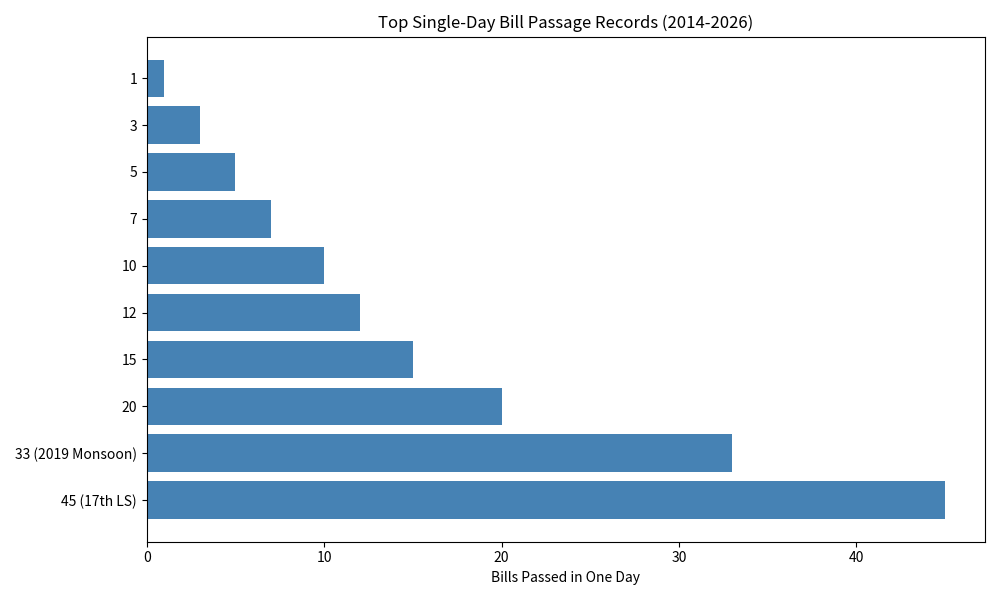
(Data compiled from PRS Legislative Research reports: Functioning of the 16th Lok Sabha, Legislative Wrap – 17th Lok Sabha, and ongoing 18th Lok Sabha session trackers, 2024–2026.)
This is not accidental efficiency. According to PRS Legislative Research, the 17th Lok Sabha saw only 16% of bills referred to Standing Committees — a sharp drop from 71% in the 15th and 60% in the 14th Lok Sabha. Over one-third of bills in the 17th Lok Sabha received less than one hour of discussion in the Lok Sabha, with 58% cleared within two weeks of introduction. The pattern has persisted into the 18th Lok Sabha, where batches of bills are routinely passed amid protests, often without recorded division or meaningful scrutiny.
Former Chief Justice of India N.V. Ramana directly confronted this culture. In 2021, he described the “sorry state of affairs” in Parliament, lamenting the lack of proper debate and the passing of “half-baked” legislation that inevitably leads to excessive litigation. Opposition voices across parties have repeatedly alleged that this accelerated model serves a specific political purpose: to ram through BJP-NDA’s Hindutva agenda with minimal resistance. Key examples include the Citizenship Amendment Act (CAA) and its NRC shadow, the abrogation of Article 370 and J&K Reorganisation, the three controversial Farm Laws (later repealed after massive protests), the three Labour Codes, the criminal law overhaul bills replacing IPC, CrPC and Evidence Act, and the Waqf (Amendment) Bill — all pushed through with compressed timelines, late-night sittings, and limited committee examination. Critics charge that the government has systematically bypassed the deliberative process precisely because these laws advance majoritarian, ideological goals rather than broad national consensus.
The human and democratic cost is stark. Extended adversarial sessions, frequent suspensions of opposition MPs, and the routine use of ordinances when Parliament is not sitting have turned the House into a site of confrontation rather than conversation. Lawmakers and staff endure burnout from late-night marathons, while the public receives legislation that often carries profound long-term implications for federalism, citizenship rights, labour protections, electoral architecture, and minority safeguards — all with minimal parliamentary vetting.
This is hassle-hustle culture at the heart of the state. Just as Murthy’s 70-hour weeks and Deshpande’s 18-hour directives glorify exhaustion in the corporate sphere, rapid bill passage is celebrated as “productivity” in the legislative sphere. Output fetish reigns supreme: the number of bills passed becomes the headline metric, much like GDP charts or quarterly targets, while questions of quality, unintended consequences, and democratic legitimacy are dismissed as obstacles to speed.
Gandhi’s warning remains prophetic: “Good travels at a snail’s pace — it can, therefore, have little to do with the railways.” Tagore’s lament echoes through the chamber: “No one has time — they march on in endless throngs — Alas, my song drowns in the clamour of the crowds.” The “song” of dissent, detailed scrutiny, patient consensus-building, and genuine deliberation is being systematically drowned out by the roar of legislative productivity.
The hustle-hustle Parliament delivers impressive volume. Whether it delivers wisdom, legitimacy, durability, or genuine public good remains a slower, more difficult, and far more important question. Under the BJP-NDA dispensation, this cult of legislative speed mirrors the very work culture glorified at the top: Prime Minister Modi’s much-advertised 18–19-hour workdays and tireless “national duty” narrative have been weaponised as the ideal for governance itself. What is sold as patriotic superhuman (non-bio-logical!!!) effort is in reality the same toxic grind imposed on the nation — from Murthy’s 70-hour sermons to the 18-hour freshers’ directives and the parliamentary assembly line that rushes bills into law with minimal scrutiny. The first premise of democracy is a perpetual state of becoming that demands genuine dialogue, dissent, and opposition. By systematically stopping dissenters, suspending opposition MPs, rushing bills through voice votes, and bypassing meaningful debate, the BJP has effectively halted that democratic becoming.
True nation-building cannot be rushed by railway timetables, digital dashboards, or the cult of exhaustion. It demands the deliberate, reflective pace at which wisdom, legitimacy, and genuine public good can actually take root. In an age that equates acceleration with progress, Gandhi’s reminder feels more urgent than ever: good travels at a snail’s pace. The BJP’s hustle model may deliver volume to set their fascist agenda, but it risks delivering a hollow democracy stripped of deliberation, accountability, dialogue, transparency and depth.
8. The Institutional Machinery of Speed Capitalism: Academicracy and Selective Judicial Slowness
While Parliament races through legislation and corporate/start-up boardrooms glorify 70–100-hour weeks, two other foundational institutions of the Indian state — the academy and the judiciary — embody the same speed-capitalist logic in mirrored but equally damaging forms. One system enforces frantic, metrics-driven output through bureaucratic control; the other delivers systemic delay for the masses while granting near-instant relief to the powerful. Together they reveal how the hustle-hustle imperative has colonised both knowledge production and justice delivery, producing the irrationality of rationality on a national scale.
8.1 Academicracy: Publish-or-Perish and the Production of “Rubbish“
Indian higher education has been reorganised into what could be termed as “Academicracy” — a bureaucratic-academic hybrid that runs on the same four McDonaldized principles of efficiency, calculability, predictability, and control. The dominant imperative is “publish or perish,” enforced through the National Institutional Ranking Framework (NIRF), Academic Performance Indicators (API) scores, h-index targets, impact-factor journals, and accreditation metrics. Participation in NIRF has surged dramatically — from 3,565 institutions in 2016 to over 14,000 by 2025, with only a small fraction ultimately ranked. Research output is judged overwhelmingly by volume and citation metrics rather than depth, epistemic contribution, ontological resonance, originality, or societal relevance.
The pressure is relentless and quantifiable. Institutions chase NIRF scores through publication counts; individual faculty face API-linked promotions, increments, and even job security. The result, as noted historian Tapan Raychaudhuri bluntly observed decades ago, is the mass production of “rubbish” — low-quality, incremental, or even fraudulent papers churned out to meet annual targets. Recent data confirms the scale: India’s global share of research publications rose from 3.5% in 2017 to 5.2% in 2024, but much of this surge is driven by quantity-over-quality incentives. NIRF 2025 methodology itself rewards raw publication volume and citations while only recently introducing mild negative scoring for retractions — a belated acknowledgement of widespread predatory publishing and paper-mill practices.
The human cost is devastating. Faculty and student burnout is rampant. In elite institutions the pressure has turned lethal. Between 2021 and 2025 alone, at least 65 students died by suicide across the IITs (Global IIT Alumni Support Group data), with 160 student deaths recorded across premier engineering colleges in the past two decades and 69 in the last five years. NCRB figures show student suicides nationwide rising 65% from 8,423 in 2013 to 13,892 in 2023, now accounting for 8.1% of all suicides. IITs, IIMs, and NITs report rates double or triple those of other institutions, driven by rigid attendance policies, excessive reliance on guest faculty, and the shift from CBCS to NEP 2020’s credit-based system.
NEP 2020’s Academic Bank of Credits (ABC) epitomises this corporatisation. Launched as a “digital locker” for credits, ABC allows students to accumulate, transfer, and redeem credits across institutions with multiple entry/exit options — framed as flexibility but functioning as a banking model of education. Credits become a tradable currency; learning is modularised, outcome-based, and packaged for quick “redeemability.” The result is a syllabus stripped of substantial depth: fragmented, checklist-driven pedagogy that prioritises measurable “learning outcomes” over meditative or contemplative inquiry. Genuine interdisciplinary or long-term scholarship is sidelined in favour of fast, credit-earning modules that feed the employability metrics demanded by rankings and industry.
| Aspect | Academicracy (Indian Universities) | Corporate R&D Hustle | Shared Irrationality (Ritzer) |
|---|---|---|---|
| Primary Metric | Publications, citations, h-index, API scores, NIRF rank | Patents, prototypes, quarterly deliverables, ROI | Quantity & velocity over depth & substance |
| Time Horizon | Medium-to-long (but artificially compressed by rankings) | Short-to-medium (quarterly/annual pressure) | Safe, incremental work dominates |
| Output Pressure | “Publish or perish” — volume in high-impact journals | “Innovate or die” / patent-or-perish | Metrics trump genuine inquiry |
| Control Mechanism | UGC, NAAC, NIRF, IRB approvals, bureaucratic layers | Stage-gates, compliance, IP departments | Iron cage of rationalisation |
| Consequence of Failure | Career stagnation, denied promotion/tenure, funding cuts | Layoffs, project cancellation, funding withdrawal | Widespread burnout and strategic shallowness |
| Scale (2025 data) | >14,000 NIRF participants; research output up sharply | Corporate R&D tied to quarterly earnings | Flood of low-impact “rubbish” |
This is not accidental inefficiency. It is speed capitalism applied to knowledge itself — calculable, predictable, controllable, yet profoundly irrational. True knowledge production requires the deliberate, contemplative pace that tortoise-time seeks to reclaim. In the clamour of metrics and rankings, the flute of genuine inquiry is drowned out.
8.2 The Indian Judiciary: Slowcoach Justice for the Many, Instant Relief for the Powerful
If Academicracy represents frantic over-production, the judiciary presents the opposite yet complementary face of speed capitalism: chronic, grinding slowness for ordinary citizens alongside selective acceleration for the powerful: the superrich, the well-connected, the influential. This two-track system is not mere inefficiency; it is structural asymmetry that mirrors and reinforces broader power relations.
As of early 2026, India’s courts carry a staggering backlog exceeding 5.6 crore pending cases (National Judicial Data Grid). The Supreme Court alone hit a record 93,143 cases in March 2026. High Courts collectively hold over 63.66 lakh cases, while district and subordinate courts account for the vast majority (~4.76–4.8 crore). Judge-to-population ratio remains critically low at ~22 judges per million (improved marginally from 17.48 in 2014 but still far below the Law Commission’s recommended 50). High Court vacancies hover around 30–42%, and chronic understaffing, archaic procedures, and the culture of adjournments turn decades-long delays into the norm for the poor, marginalised, and ordinary litigants.
Yet speed exists — selectively and tellingly. Influential litigants, superrich corporations, politically connected individuals, and certain high-profile cases frequently secure swift interim relief, stays, or favourable outcomes. The government itself is the largest litigant (46–50% of cases), yet inconvenient matters involving ordinary citizens, marginalised communities, or critics often languish while cases benefiting powerful interests move with remarkable velocity.
Concrete examples abound. In April 2026 the Supreme Court refused to stay the implementation of the Adani Group’s ₹14,535-crore resolution plan for debt-ridden Jaiprakash Associates Ltd (JAL), allowing the plan to proceed expeditiously while directing the National Company Law Appellate Tribunal (NCLAT) to hear challenges on an out-of-turn basis. The same month the Supreme Court granted Adani Power significant relief by setting aside a 2019 Gujarat High Court order on customs duty demands and directing refunds. Similarly, in April 2025 the Supreme Court upheld Piramal Capital & Housing Finance Ltd’s resolution plan for DHFL, setting aside an NCLAT modification and allowing the successful resolution applicant to appropriate recoveries from avoidance applications — a decision that effectively fast-tracked the corporate debtor’s exit from insolvency. Mukesh Ambani’s Reliance Industries has also benefited from swift judicial outcomes, including the Bombay High Court’s March 2026 dismissal of a plea seeking a CBI probe into alleged unauthorised gas extraction, which the court termed an “abuse of process.”
This selective velocity stands in stark contrast to the years — often decades — that ordinary litigants, especially from marginalised or low-income backgrounds, must endure.
Globally, India’s judicial lag stands out starkly. Europe averages ~210 judges per million population; the United States ~150. India’s ratio of 15–22 per million places it among the lowest in the world, resulting in a backlog larger than the entire population of South Korea (51.8 million). Comparative studies (World Justice Project Rule of Law Index) consistently rank India low on civil justice timeliness and access, while countries with higher judge ratios clear cases far more efficiently.
| Level | Pending Cases (early 2026) | % Cases >5–10 Years Old | Vacancy Rate (approx.) | Global Parallel (Judges per Million) |
|---|---|---|---|---|
| Supreme Court | 93,143 | ~50% >1 year | Minimal | India 22 vs Europe 210 / USA 150 |
| High Courts | ~63.66 lakh | 51–60% in many courts | 30–42% | Chronic delays for ordinary cases |
| District/Subordinate | ~4.76–4.8 crore | 59–63% >1 year | ~21% | Bulk of backlog; poor most affected |
This asymmetry undermines the constitutional balance of powers and public faith. While Parliament rushes bills through in hours or days with minimal debate, ordinary citizens wait years — sometimes decades — for basic redress. The contrast is not accidental: the executive benefits from fast legislation, while the judiciary’s independence (and under-resourcing) allows selective pressure or delay in inconvenient matters. Allegations of ideological tilt, post-retirement benefits, and uneven application further erode legitimacy.
In both Academicracy and the judiciary, speed capitalism reveals its true face: frantic productivity and metrics for institutional survival on one side, chronic delay or selective acceleration on the other. The tortoise-time counter-vision — deliberate, regenerative, and equitable — stands as the only sustainable alternative. True scholarship and true justice, like true democracy, cannot be rushed by rankings or rationed by power and wealth. They require the patient, reflective pace at which wisdom, legitimacy, and genuine public good can actually take root. In the roar of metrics and the silence of endless adjournments, the flute of genuine inquiry and equitable justice still waits to be heard. Shall we slow down enough to listen?
9. The Automation Paradox: More Machines, More Exhaustion
The cockpit hums with silicon efficiency. Algorithms rewrite code in seconds, chatbots handle customer queries, dashboards update in real time. Productivity soars. Yet the pilot still sits strapped in at 2 a.m., eyes burning, answering the same volume of Slack messages — only now the messages have multiplied. The unemployed queue outside the hangar grows longer. The overworked remain chained to the controls. This is the defining contradiction of our age: automation, which classical economics once promised would deliver leisure and abundance, instead coexists with armies of the jobless and the chronically burned-out.
Narayana Murthy’s calls for 70–72-hour workweeks, Shantanu Deshpande’s 18-hour directives to freshers, and the broader mythology of tireless national leadership do not merely ignore this paradox. They double down on it. In an era when AI can compress a six-hour research task into forty minutes or generate an entire presentation from a single prompt, the prescription remains unchanged: work harder, worship more, complain less. The promised inverse relationship — more machines, less human toil — has inverted into its opposite.
9.1 The Failed Leisure Dividend
John Maynard Keynes, writing in 1930 amid the Great Depression, famously envisioned technology solving the “economic problem” once and for all. In his essay “Economic Possibilities for Our Grandchildren,” he predicted that by 2030 rising productivity would free humanity from the necessity of long hours. Needs would be met with far less effort, and society could finally turn its attention to higher pursuits — art, science, contemplation, and the art of living itself. He even proposed a 15-hour workweek as a realistic horizon. Economists reassured the public that the so-called Luddite fallacy was mistaken: machines destroy old jobs but create new ones, and the gains would eventually be distributed as shorter hours or higher wages for all.
The folk legend of John Henry offers a haunting American counter-image to this optimism. A freed Black steel-driver in the late 19th century, John Henry raced against a steam-powered drill machine boring through a mountain for a railroad tunnel. Swinging his hammer with superhuman strength, he defeated the machine — but died from exhaustion immediately after, his heart giving out in the moment of victory. The ballad that immortalised him captures the tragic essence of the automation paradox: human triumph over the machine comes at the ultimate human cost. The story has echoed through generations as a symbol of dignity in labour, resistance to mechanisation, and the price paid when flesh competes with steel.
Reality in 2026 tells a harsher story that echoes John Henry’s fate on a mass scale. Productivity has indeed exploded across tech, services, manufacturing, and knowledge work. In India’s IT sector — the very engine Narayana Murthy helped build — AI tools now draft code, debug systems, and summarise documents at speeds that would have seemed miraculous a decade ago. Yet fresher hiring has collapsed dramatically from post-COVID peaks, mid-career professionals face silent layoffs or obsolescence, and those who remain are expected to deliver exponentially more output with the same or longer hours. Global patterns mirror this inversion: Amazon warehouse workers are tracked by algorithms that set ever-tighter picking rates; call-centre agents in the Philippines and India handle multiple AI-assisted chats simultaneously while their performance is scored in real time; software engineers using GitHub Copilot or similar tools find their daily output quotas quietly doubled by management. Even in ostensibly creative fields — legal research, radiology report generation, marketing copy — automation compresses routine work only for executives to pile on twenty more hours of new demands, meetings, and “strategic initiatives.”
The result is a sharply polarised cockpit: a shrinking core of hyper-optimised “winners” grinding under intensified metrics, surveillance, and always-on expectations, alongside swelling surplus populations trapped in gig precarity, underemployment, or outright unemployment. The middle hollows out. Capital captures the entire productivity surplus — through stock buybacks, executive compensation packages, and investor returns — while the human beings who remain keep shovelling coal into the machine, modern-day John Henrys racing against algorithms they cannot ultimately outlast. The leisure dividend that Keynes anticipated has been privatised rather than shared.
9.2 Why the Inverse Failed
This outcome is no technological inevitability. It is a deliberate political and cultural choice rooted in the deeper logic of accumulation. Automation does not automatically reduce human labour; it reduces the socially necessary labour time required to produce value — but under current arrangements, that freed time is not returned to workers as leisure or higher wages. Instead, it is captured as intensified output from fewer people, lower labour costs, and greater competitive pressure on those still employed. The reserve army of labour — the unemployed and underemployed — keeps wages suppressed and the remaining workforce compliant. Managers respond to productivity gains not by shortening the workday but by raising the bar: more deliverables, faster turnaround, tighter deadlines. The machine’s efficiency becomes the new baseline for human performance.
In India the contradiction is especially acute. The tech and services sectors face fierce global AI competition. Layoffs hit mid-level roles while freshers are told to “grind harder to prove value.” Even Murthy himself has acknowledged AI-driven disruption, yet the public response remains framed as a call for patriotic overwork rather than a rethinking of how productivity gains should be distributed. Without deliberate mechanisms — shorter workweeks, robust retraining at scale, profit-sharing, or public AI dividends — the technological dividend never reaches the many. It flows upward. The result is not the leisure society Keynes imagined but a society of overworked survivors and surplus ghosts: more machines, more exhaustion, and a deepening sense that human labour itself has become the expendable input.
The cockpit hums louder than ever. Productivity soars. Yet the pilot’s eyes burn at 2 a.m., and the queue outside the hangar stretches further into the night. The ancient promise of machines freeing humanity has been inverted into its cruel opposite — and still the synthetic voice in the headset insists there is only one direction: faster.
May day.
The ground is rising for its close-up.
10. The Art of Resistance: Bicycle Speed Against the Hassle-Hustle Machine
The cockpit screams for more throttle. The synthetic voice demands acceleration. Yet the most radical act of defiance may be the simplest: get off the plane.
Ivan Illich’s counter-vision cuts through the roar with disarming clarity: “Participatory democracy demands low-energy technology, and free people must travel the road to productive social relations at the speed of a bicycle.”
The bicycle is no quaint relic. It is a politically explosive convivial tool. It multiplies human metabolic energy fivefold, allowing a rider to outpace a walker while consuming a fraction of the energy demanded by any motorised vehicle. It creates no vast infrastructure, demands no centralised control, and enforces a radical equity — rich and poor, powerful and marginalised move at the same human scale. It widens autonomy instead of colonising it. In a world engineered for velocity, the bicycle is deliberate slowness weaponised — a living refusal of the entire logic of endless throughput.
During the Vietnam War, the Viet Cong and North Vietnamese transformed the humble bicycle into a logistical lifeline on the Ho Chi Minh Trail. Reinforced “war bikes” were often pushed rather than ridden through narrow jungle paths, carrying 300–500 kg of rice, ammunition, and medical supplies. Silent, fuel-free, nearly invisible from the air, and able to traverse terrain impassable to trucks or heavy machinery, these bicycles sustained an entire war effort against the world’s most technologically advanced military. Jets, helicopters, napalm, and B-52 bombers could not break a people organised around low-energy resilience and human-scale logistics. A decentralised network limited to bicycle speed outlasted an opponent drunk on escalation, anonymous power, and overwhelming material superiority. This was living proof that high-energy, high-speed systems often prove brittle when confronted by human-paced endurance. The superpower burned trillions and countless lives; the bicycle kept moving — quietly, persistently, effectively.
The same logic now confronts societies shaped by speed-driven economies. Exhaustion is reframed as virtue, rest as inefficiency, and reflection as delay. The body itself becomes fuel for metrics and output. Yet the bicycle offers a radically different trajectory. It rejects the entire operating system of standardised throughput, engineered craving, and compulsory positivity. It reclaims fertile emptiness — the space where creativity, refusal, and genuine attention can re-emerge. It restores the power to say no: to another notification, another quota, another demand for more. Bicycle speed is political refusal made material: a meal cooked with care and shared slowly rather than consumed on the move; deep, contemplative attention rather than fragmented scrolling; relationships built on presence rather than scheduled efficiency; automation, when it serves human flourishing instead of extraction, becomes a tool for liberation rather than intensified precarity.
Bicycle speed is not nostalgia or romantic primitivism. It is a practical, scalable politics of human limits. In an age where machines promise leisure but deliver intensified work for survivors and displacement for others, low-energy convivial tools point toward a different possibility. They suggest that technological gains need not mean more output from fewer people, but rather more time, autonomy, and care for all. They prove that resilience does not require hyper-acceleration; it can be built through endurance at human scale — unpredictable, gloriously inefficient by the standards of the iron cage. It cannot be franchised. It cannot be optimised into addiction. It moves at the pace where thought, relationship, surprise, and genuine democracy become possible again.
In Vittorio De Sica’s 1948 neorealist masterpiece Bicycle Thieves, a poor Italian worker’s bicycle is stolen. The bicycle is not a luxury but the instrument of survival: without it, Antonio Ricci cannot work, and his family faces destitution. The film follows father and son through a devastated post-war Rome, desperately searching amid poverty and bureaucratic indifference. The bicycle stands for fragile livelihood in a broken system. Its theft is not mere crime but a symptom of a world that has discarded human dignity. Half a world and a generation away, the Vietnamese turned the same humble machine into something far more subversive: a tool of collective defiance. What was an instrument of individual survival in De Sica’s Italy becomes, in Vietnam, an instrument of collective resistance. One narrative ends in quiet despair; the other in collective victory through persistence at human scale.
Both stories speak to the same truth: high-speed, high-energy systems often prove brittle and dehumanising. In contexts where ideology demands ever-longer hours while automation displaces workers and systems erase possibilities, the bicycle thief returns in new form. The system steals our time, our rest, our dignity. The question is whether we will mourn the loss like Antonio — or reclaim the bicycle like the Vietnamese, turning everyday tools into instruments of endurance and regeneration.
The pilot, strapped into the accelerating cockpit, looks down and sees thousands of bicycles moving silently through the undergrowth. They carry no bombs. They require no fuel. They move at the speed of human limits — and they are winning.
May day.
The bicycle was never just a vehicle. It was always a politics. The choice remains ours: remain the desperate searcher in a broken system, or become the quiet, unbreakable logistics of a people who refused to be overwhelmed. Free people do not merely travel at bicycle speed. Sometimes they push the loaded bicycle through the long night — carrying the future on their shoulders, one deliberate step at a time.
11. A Glided Lapse Into Tortoise-Times
The cockpit rattles at maximum velocity. Warning lights strobe. The synthetic voice screams Full speed ahead. Yet somewhere below, on the scarred earth, a different rhythm stirs — slow, deliberate, ancient. A creature that carries its shelter on its back refuses to run.
Speed itself has been profaned — turned into sacrament. Bullet trains and techno-war economies, fast transport spreading pandemics, the Zapatista practice of walking while asking questions drowned in the cacophony of the fast-food mentality. In a culture of hustle and hassle, the very idea of retreat sounds like nonsense. Yet retreat is precisely the radical political gesture now required: a collective deceleration, a mythopoetic meandering, an intentional with-drawl — slow, idle drawl turned sustainable refuge, retreat.
You are the tortoise. Not to be hunted for meat or sold as ornament to the superrich, but to become. Kurmāvasthā — the tortoise state — is no mere coping mechanism. It is alchemical. Inner and outer suffering are cooked slowly within the shell – suffering turned inward and cooked through care without escape. The heaviness ceases to burden; it becomes mediation for contemplative life, a hedge of protection that caresses the witnessing “I”. The shell turns the locust of consumption and disciplined debtor into a being that carries its own shelter. Creative idleness — not parasitic leisure — emerges. Anemoia (longing for a time that never quite was) and anamnesis (unforgetting) replace the neuronal violence of endless acceleration.
This is the postlapsarian imaginary at work. There may never have been a pristine golden age, no pure “state of nature” from which we fell. Yet the strategic stance remains: a living archive of resistance, a mythopoetic meandering that does not require historical purity to be real. The tortoise-shell expands, morphs into the projection of a cow — a cow called Pṛthvī, the Earth. And she speaks: “Listen — this is addressed to the tyrant that lives in all of your heads… I refuse to provide my grains, my lush green forests, my waters, my air, my living soil — for you have not listened to my tolerance margins. You have treated me as cash-cow, as resource, as free-gift, standing-reserve.” When King Pṛthu, enraged by her refusal, raises his bow to strike at her bosom, the image melts into radiating air. A tiny hummingbird appears, carrying droplets of water toward the burning forest while larger creatures mock her for being “too small” and daring to care. They do not move. The mourning continues — not as memory alone, but as haunting presence-in-absence. An affective ecology of loss.
This with-drawl is no quietist surrender. It is intentional deceleration as radical loving. A politics of stillness glistens in the meshed togetherness of tortoise-times. It refuses the tagging culture that reduces beings to numbers under colonial, geontological foreclosures. It steps off the achievement treadmill before the psychic and planetary remainderless ends arrive. Contained within the shell, collective grief finds locus — not in grand gestures or mega quick-fixes, but in simply being held. The shell offers refuge: a sustainable retreat from hastened “progress,” an archaeology of resistance that reclaims collective autonomy through unhurried filaments of meaning.
The plane still banks steeper overhead. The stall warning merges with deletion quotas and productivity dashboards. But on the ground, the tortoise waits — not in some distant jungle, but here, inside each of us. The shell is already forming. Shall we slow down enough to listen? With love, the ground is not falling away. It is inviting us home. Free people learn to carry the shell, cook suffering alchemically, and inhabit the postlapsarian imaginary before the last tortoise is hunted and the last stillness slaughtered.
May day.
The song is not yet drowned. The pilgrimage continues.
12. Redefining Socio-Ecologically Necessary Labour: Envisaging Convivial Communes
In the tortoise-time framework we move toward Marx’s socially necessary labour time (SNLT) — the average labour required under competitive conditions to produce commodities for exchange and surplus-value extraction. That concept, while analytically powerful for exposing how capital squeezes living labour into abstract value, remains trapped inside speed capitalism’s logic: it measures labour only by its contribution to accumulation, intensification, and endless productivity gains that never deliver genuine leisure or ecological balance. SNLT is the temporal engine of alienation — the invisible clock that forces human activity into the narrow channel of exchange-value, rendering every hour not spent producing surplus as “wasted” time and every body as a mere input in the calculus of growth.
Marx himself pointed toward a radically different horizon. In The German Ideology (1845–46) he and Engels sketched the emancipatory possibility that emerges once the division of labour is overcome:
“For as soon as the distribution of labour comes into being, each man has a particular, exclusive sphere of activity, which is forced upon him and from which he cannot escape. He is a hunter, a fisherman, a herdsman, or a critical critic, and must remain so if he does not want to lose his means of livelihood; while in communist society, where nobody has one exclusive sphere of activity but each can become accomplished in any branch he wishes, society regulates the general production and thus makes it possible for me to do one thing today and another tomorrow, to hunt in the morning, fish in the afternoon, rear cattle in the evening, criticise after dinner, just as I have a mind, without ever becoming hunter, fisherman, herdsman or critic.”
This passage is no mere utopian aside. It is a profound critique of the division of labour as the material basis of alienation. Later Marxist thinkers — from Gramsci on hegemony to feminist materialists like Maria Mies and Silvia Federici — have extended this insight: the rigid separation of tasks is not natural but historically imposed, reproducing hierarchies of gender, class, and ecology. In polycrisis — converging climate collapse, social fragmentation, and economic precarity — this critique gains urgent force. The old SNLT, tied to commodity production and growth fetishism, collapses under its own contradictions. What replaces it is not abstract “time” measured for surplus, but socially and ecologically necessary labour redefined around the concrete performance of care for those who cannot perform it themselves: infants, children, senior citizens, the physically challenged and specially abled. Labour becomes the joyful, collective practice that sustains the vulnerable, nourishes jouissance — that surplus of life and pleasure beyond mere survival — and flourishes the commons beyond neoliberal blueprints of speed-fetishist development, growth, and blueprint models.
The tourist mentality and the wayfaring pilgrim embody two irreconcilable micro-pedagogies of movement and labour. The tourist rushes through destinations, consuming sights in curated bursts, collecting selfies and souvenirs while remaining untouched by the land or its people — a speed-capitalist gaze that reduces the world to backdrop and experience to checklist. The wayfaring pilgrim, by contrast, moves slowly, deliberately, open to transformation. Each step becomes a lesson in humility, encounter, and presence; the road itself is the teacher. Where the tourist demands convenience and spectacle, the pilgrim embraces discomfort, surprise, and the long patience of genuine understanding. In an age of accelerated tourism — literal and metaphorical — reclaiming the wayfarer’s micro-pedagogy is an act of resistance: learning to walk the world rather than merely pass through it.
Tagore’s sahasa aicchik śrama and Gandhi’s Bread Labour offer living expressions of this emancipatory impulse, but the deeper grounding lies in Marx’s insistence that true freedom begins where necessary labour ends and multi-sided human activity flourishes. In moneyless convivial communes, socially and ecologically necessary labour is the minimal, voluntary activity willingly and joyfully offered by individuals and communities to meet genuine needs — one’s own, one’s family, the elderly, children, the disabled, and the more-than-human world — within the regenerative rhythms of planetary boundaries, without wage, market compulsion, or accumulation.
This labour is moneyless and communal: there is no wage relation, only the direct satisfaction of needs through relationships of care. “I labour for me and my family, for the old persons, children, and the handicapped” becomes the living ethic. Care for the vulnerable is not a cost centre but the highest expression of joyful participation — the very substance of collective life.
It is pleasurable and creative: true work mingles utility with beauty, exertion with delight. The Slow Food Movement, born in 1986 when Carlo Petrini protested the arrival of McDonald’s in Rome, offers a concrete transversal wisdom against the fast-food mentality. It insists on mindful, local, pleasurable production and eating — protecting biodiversity, regional traditions, and the joy of shared meals. Home economics, long dismissed as “women’s work,” is reclaimed in its radical eco-feminist sense: the science and art of sustaining the household and the earth through attentive, loving labour. In convivial communes, cooking, eating, and caring become acts of resistance and ānanda — the bliss of meaningful doing. Singing while planting, storytelling while weaving, teaching while healing — labour returns to its sensual, relational ground.
It is slow and alchemical: labour time is contained, not intensified. Automation, freed from the imperative of profit, serves only to reduce drudgery so that more time flows into creative idleness, mourning, mythopoetic imagination, and affective ecology. Zen practice deepens this further. In Zen monasteries, samu — mindful work such as chopping vegetables, sweeping, or gardening — is not separate from zazen; it is meditation in action. Dōgen taught that there is no Dharma apart from ordinary life. Work becomes play when performed with full presence: the mind returns again and again to the task at hand, turning labour itself into a practice of awakening. No separation between doing and being.
Finally, it is regenerative: it repairs the Earth-cow instead of extracting from her. Social necessity now includes ecological necessity — reforestation by hand, soil care, biodiversity nurturing — performed at human scale. In the polycrisis, this redefinition is not optional but existential. The old growth-obsessed models have brought us to the brink; socio-ecologically necessary labour must now sustain the commons that make life possible at all.
This vision resolves the contradictions that speed capitalism could never escape. Machines reduce the socially necessary portion of toil, but under the old order the dividend is stolen for further extraction. In convivial communes the dividend is reclaimed: fewer hours of necessary regenerative work, with the remainder devoted to contemplation, relationships, play, and collective mourning. The May Day call is answered not merely through protest but through daily practice in moneyless, convivial communities — where labour is once again livelihood, joy, and freedom rather than alienated compulsion.
The pilot’s final exhausted cry meets its answer here. No more psychic self-immolation. Only the shared, many-sided life in which each can become accomplished in any branch they wish, without ever being reduced to a single role. The ground is ready. Shall we slow down enough to labour with pleasure?
The song is not yet drowned. The pilgrimage continues.
13. Conclusion: Slow is Beautiful
The stall warning has merged with the productivity dashboard. The plane flies faster yet carries more exhausted crew and more ghosts on the runway below. The cockpit trembles under its own acceleration. BLOs collapse at their desks. Voters stare at deleted names in terror. Freshers are told to worship 18-hour days while automation displaces the very workers it was meant to free. The May Day call crackles across every sector — from delivery grids and gig algorithms to electoral roll revisions and nuclear shadows.
Yet something else is already stirring beneath the roar. Not the linear, measurable chronos of Murthy’s seventy-hour sermons, Jack Ma’s 996 grind, or Elon Musk’s hundred-hour gospel — that relentless, quantifiable time of extraction, where every second must be monetised, every pause condemned as failure. Tortoise-time is something altogether different. It is kairos — the pregnant, opportune, qualitative moment that arrives only when we slow enough to recognise it. Not the chronological tick-tocking mechanical timed clock that devours us, but the living rhythm that invites us in. To imbibe tortoise-time is to step into a temporality that does not race toward a finish line or blueprint finality but unfolds from within the shell: alchemical, regenerative, multi-sided. It is the time in which suffering is cooked slowly into shelter, grief into collective mourning, idleness into creative plenitude.
Imagine it already taking root. In moneyless convivial communes where bread labour and sahasa aicchik śrama are performed not for profit but for jouissance — that surplus of life and pleasure that spills beyond survival. Where the wayfaring pilgrim replaces the tourist gaze, and each deliberate step teaches presence rather than checklist. Where automation finally delivers its stolen leisure dividend, not as more output from fewer survivors but as time reclaimed for contemplation, relationship, play, and the slow repair of the Earth-cow. Where the flute, no longer drowned, is heard beneath the vast blue canopy because enough of us have chosen to listen.
This is no nostalgic return. It is a forward leap into a different kind of future — one in which free people no longer live as fuel for machines that were meant to serve them. They learn to carry the shell, labour joyfully for one another and the living Earth, and travel at the speed of a bicycle — or slower still, at the pace where thought, relationship, surprise, and genuine democracy become possible again.
May day.
The ground is not the enemy. It is inviting us home. Shall we slow down enough to listen? With love, the tortoise smiles. Kurmāvasthā awaits — not as burden, but as joyful shelter. The song is not yet drowned. The pilgrimage continues.
Becoming slow, becoming “boring” — in itself is a radical act.
In a civilisation addicted to velocity, spectacle, and perpetual stimulation, the deliberate choice to move at human pace, to embrace the quiet, the repetitive, the unremarkable, becomes a profound refusal. It is the refusal to be constantly performing, optimising, producing content for the algorithm of attention.
To be “boring” is to step off the stage of the achievement society and reclaim the right to exist without justification, without metrics, without the need to impress or entertain. It is the quiet sabotage of the fast-food mentality that demands every moment yield dopamine or profit. In the shell of tortoise-time, boredom is not emptiness but fertile ground — the space where deep attention returns, where creativity is not forced but allowed to germinate, where relationships deepen because they are no longer scheduled. To become slow is to become ungovernable by the logics of speed. It is to remember that a life worth living does not need to be accelerated to be meaningful. The most subversive thing one can do in the cockpit of hustle is to simply land the plane, sit on the grass, and do nothing — gloriously, unapologetically, radically nothing — while the world rushes past.
References
Bandyopadhyay, A. (2025). A gilded lapse into tortoise times. In Schumacher Magazine (Edition 1, “The Great Turning”). Schumacher College, Satish Kumar Foundation.
Bandyopadhyay, D. (2009). মহাভারতেতিহাস ও অবদমিতের প্রত্যাবর্তন: কৃষি [Meta-history of India & return of the repressed: Agriculture]. Kalodhvani, XIV(1), 32–39.
Bandyopadhyay, D. (2011). (অন-)অর্থনীতিবিদ রবীন্দ্রনাথ [City and Village & (Non-) Economist Rabindranath Tagore]. In A. Sengupta (Ed.), Akkha(r)jatra, IX(11), 7–46.
Bandyopadhyay, D. (2015). Do we need universities and schools? https://www.researchgate.net/publication/277293495_DO_WE_NEED_UNIVERSITIES_AND_SCHOOLS
Derrida, J. (1984). No apocalypse, not now (full speed ahead, seven missiles, seven missives). Diacritics, 14(2), 20–31. https://doi.org/10.2307/464756
Gandhi, M. K. (1909). Hind Swaraj or Indian Home Rule. Navajivan Publishing House. (Original work published 1909; English edition available at https://www.mkgandhi.org)
Gandhi, M. K. (1932). Yeravda Mandir: Ashram Observances in Action. Navajivan Publishing House. https://www.mkgandhi.org
Han, B.-C. (2010). The burnout society. Stanford University Press.
Honoré, C. (2004). In praise of slow: How a worldwide movement is challenging the cult of speed. HarperOne.
Illich, I. (1974). Energy and equity. Harper & Row. https://www.ivanillich.org
International Labour Organization. (2026). Workplace psychosocial risks and health outcomes: Global estimates 2026. ILO. https://www.ilo.org
Keynes, J. M. (1930). Economic possibilities for our grandchildren. In Essays in persuasion (pp. 358–373). Palgrave Macmillan. (Reprinted 2010)
Marx, K., & Engels, F. (1976). The German ideology. In Marx & Engels collected works (Vol. 5). Lawrence & Wishart. (Original work written 1845–1846) https://www.marxists.org/archive/marx/works/1845/german-ideology/
Petrini, C. (Slow Food Movement founder). (1986–present). Slow Food International declarations and manifestos. Slow Food International. https://www.slowfood.com
PRS Legislative Research. (2019). Functioning of the 16th Lok Sabha (2014–2019). https://prsindia.org/parliamenttrack/vital-stats/functioning-of-16th-lok-sabha-2014-2019
PRS Legislative Research. (2024). Legislative wrap – 17th Lok Sabha (2019–2024). https://prsindia.org/files/parliament/session_track/2024/legislative_wrap/Legislative_Wrap-17th_Lok_Sabha.pdf
PRS Legislative Research. (2026). Ongoing session trackers and vital stats for 18th Lok Sabha. https://prsindia.org/parliamenttrack/vital-stats
Ramana, N. V. (2021, August 15). Remarks on parliamentary functioning and rushed legislation [Speech]. Supreme Court of India. Reported in The Hindu, Indian Express, and Times of India. https://indianexpress.com/article/india/sorry-state-of-affairs-lots-of-gaps-in-laws-due-to-lack-of-debates-in-parliament-cji-ramana-7454817/
Ritzer, G. (2019). The McDonaldization of society (9th ed.). Sage. (Original work published 1993)
Russell, B. (1935). In praise of idleness and other essays. George Allen & Unwin. https://www.marxists.org/reference/subject/philosophy/works/en/russell.htm
Sources for Academicracy and Judiciary Subsections
OBMA. (2024, September 13). Heading towards a theocratic judiciary? Once in a Blue Moon Academia. https://onceinabluemoon2021.in/2024/09/13/heading-towards-a-theocratic-judiciary/
OBMA. (2024, October 28). Do you want speedy justice in Indian judiciary? Ufff! Once in a Blue Moon Academia. https://onceinabluemoon2021.in/2024/10/28/do-you-want-speedy-justice-in-indian-judiciary-ufff/
OBMA. (2024, February 3). The legitimation crises of the Indian judiciary: A failing state of affairs. Once in a Blue Moon Academia. https://onceinabluemoon2021.in/2024/02/03/the-legitimation-crises-of-the-indian-judiciary-a-failing-state-of-affairs/
OBMA. (2024, January 13). Saffronization of judiciary: An open letter to the Chief Justice of India. Once in a Blue Moon Academia. https://onceinabluemoon2021.in/2024/01/13/saffronization-of-judiciary-an-open-letter-to-the-chief-justice-of-india/
OBMA. (2022, September 2). Do you have faith in the contemporary Indian judiciary? Once in a Blue Moon Academia. https://onceinabluemoon2021.in/2022/09/02/do-you-have-faith-in-the-contemporary-indian-judiciary/
Additional Sources (Gig Economy)
Al Jazeera. (2026, January 28). India curbs ‘grocery under 10 minutes’ but riders must still fatally race. https://www.aljazeera.com/features/2026/01/28/india-curbs-grocery-under-10-minutes-but-riders-must-still-fatally-race
BBC News. (2026). India’s gig economy reckoning. https://www.bbc.com/news/articles/cx20qlglgw5o
New Indian Express. (2026). The hidden labour behind 10-minute deliveries. https://www.newindianexpress.com/explainers/2026/Jan/24/the-hidden-labour-behind-10-minute-deliveries
Appendix-I
Midnight Dispatch: Reflections of a Delivery Boy with Degrees That Don’t Deliver
I am the ghost in the machine of your late-night cravings. Master’s in Literature, another in Economics, a half-finished PhD that sits like an expensive tombstone on my shelf. None of them open doors anymore. They only mock me from the rear-view mirror as I weave through rain-slicked streets on this battered scooter, raincoat flapping like a defeated flag.
The platforms — Swiggy, Zomato, Blinkit, Zepto — promise ten-minute deliveries like a sacred vow to the customer. Ten minutes or the algorithm punishes. Ten minutes or the rating drops, the incentive vanishes, the account risks sudden deactivation. I race through traffic, jump signals, dodge potholes with a 25–30 kg bag strapped to my back, knowing that one late order can wipe out an entire evening’s earnings. The apps track every second, every kilometre, every hesitation. Refuse too many orders and the algorithm quietly starves you of work. Accept everything and you become a high-speed hazard on two wheels. Riders have died — in Hyderabad, Noida, Gurgaon, Bengaluru — crushed under the weight of that ten-minute clock. The deaths rarely make headlines as “workplace fatalities.” They are just “road accidents.” The platform shrugs. The customer demands speed. The algorithm enforces it.
Majority of customers treat me like an algorithm with legs. “Where are you?” at 11:47 pm when the order was placed at 11:30. They scream because the biryani is two minutes late, as if the city’s traffic, the broken elevator, the monsoon, and the platform’s impossible timing are my personal conspiracy. The woman who made me wait twenty minutes in the pouring rain while she finished her call, then complained about the soggy bag and left a one-star rating that could cost me the next day’s incentives. The tech-bro who tipped nothing and raged in the app because “the vibe was off,” never mind that I had ridden through flooded streets to reach him. They see the orange uniform and forget there is a man inside it — someone who once wrote papers on postcolonial theory and now delivers postcolonial precarity straight to their doorstep, soaked, exhausted, and disposable.
Then there are the quiet miracles that keep me human. The old aunty on the fifth floor who waits with a hot cup of tea and says, “Beta, you must be so tired — come, sit for two minutes.” The single mother who adds a handwritten note with the tip: “Thank you for making my daughter’s birthday special even on a rainy night.” The night-shift nurse who understands the exhaustion and speaks to you like a fellow human being caught in the same machine. These moments are oxygen. They remind me I am not just a pair of wheels and an app rating.
I scroll through job portals during red lights, sending applications that vanish into the void. My degrees — once my pride — now feel like accusations. “Why are you here?” they whisper between orders. The hustle culture that sold us “knowledge economy” dreams delivered instead this gig economy trap: no security, no dignity, constant algorithmic violence — ratings that can deactivate you without explanation, incentives that vanish when you near the target, GPS surveillance that turns every ride into a performance review. I chase incentives like a hamster on a wheel while the platform takes its cut, customers vent their frustrations on the only visible worker, and the city’s traffic fines pile up like another debt.
Yet here I am, at 2 a.m., delivering someone’s midnight hunger while carrying my own. The scooter’s headlight cuts through the darkness like the faint hope I still carry. I think of Tagore’s flute drowned in clamour, of the tortoise carrying its shelter, of Marx’s vision of many-sided life I once lectured on. Now I live the contradiction: highly qualified, yet reduced to this.
I deliver more than food. I deliver the quiet exhaustion of a generation sold a dream that evaporated. And still, between orders, I hum a half-remembered line under my helmet — a small, defiant song that refuses to drown completely.
Mayday from the delivery grid. I am still here. Still riding. Still human. Even if my degrees forgot how to open doors, my hands still know how to carry someone else’s dinner through the night.
Appendix-II
Midnight Marathon: A Lonely Viewer’s Confession
I sit alone in the blue glow of the screen, the apartment quiet except for the low hum of the fan and the distant, cheerful chaos of my child in the next room. It is past midnight, and I have chained three films together on the OTT platform like a man seeking absolution through adrenaline: Speed, Speed 2: Cruise Control, and Runway 34. I tell myself it is harmless escapism. In truth, I am mainlining speed.
In Speed, the bus cannot drop below 50 mph or the bomb explodes. In Speed 2, the cruise ship hurtles toward disaster. In Runway 34, the pilot’s voice cracks over the radio in that final, heart-stopping Mayday transmission I wrote in my own mind weeks ago — “Mayday… Mayday… Mayday… Save me — I want to live! I want to live at tortoise speed!” I feel the tension in my shoulders, the pleasurable spike of cortisol as engines roar and metal screams. I am not merely watching speed. I am worshipping it. The faster the vehicles, the higher the stakes, the more alive I feel in my stillness. The irony does not escape me.
Binge-watching is the new midnight marathon — an endless race where the body stays motionless while the mind sprints through one more episode, one more season, one more dopamine hit. I chain Speed, Speed 2, and Runway 34 like a man chasing absolution through adrenaline, telling myself it is harmless escapism, when in truth I am mainlining velocity. The bus cannot drop below 50 mph, the cruise ship hurtles toward disaster, the pilot’s final Mayday cracks over the radio — and I feel the pleasurable spike of cortisol as engines roar and metal screams. Each cut, each near-miss, each explosion feeds the same addiction that keeps me scrolling at 2 a.m., answering work messages at odd hours, and measuring my worth by output. The screen glorifies the very speed that exhausts us in real life. I consume tension as entertainment while my own life runs on the same merciless logic — faster, higher, louder, or you’re left behind. In the sudden pause between episodes, the quiet feels almost violent. The flute is faint, but it is still playing somewhere beneath the blue canopy, waiting for someone brave enough to stop running.
I am the lonely viewer, complicit in the very hustle I claim to critique. My body is parked on this couch while my mind races alongside Keanu Reeves, Sandra Bullock, and the desperate pilot. Each cut, each near-miss, each explosion feeds the same addiction that keeps me scrolling at 2 a.m., answering work messages at odd hours, and measuring my worth by output. The films glorify the very velocity that exhausts us in real life. I consume their tension as entertainment while my own life runs on the same logic — faster, higher, louder, or you’re left behind.
From the other room comes the sound of my six-year-old. He is playing a car-racing game, then flipping to bright animations. Four seconds. That is the average shot length, the rhythm of his digital childhood. A car screeches around a corner, a cartoon character bounces, another explosion of colour — and repeat. His attention is being trained for the same speed I am romanticising on my larger screen. He does not sit with a story; he surfs on dopamine waves. I glance at him and feel a pang of guilt mixed with recognition. We are both inside the machine — I choose the adult version with dramatic stakes and swelling music; he chooses the brighter, faster, louder children’s edition.
Tagore’s song echoes in the back of my mind: “No one has time — they march on in endless throngs — Alas, my song drowns in the clamour of the crowds.” My song, my child’s song, the pilot’s final Mayday — all risk drowning in this manufactured velocity. I praise the tension on screen while the real tension — between the world’s ceaseless toil and the quiet listening the soul craves — remains unresolved.
I pause the film for a moment. The screen freezes on a screaming engine. In the sudden quiet I hear my child laughing at something absurd and colourful. For four seconds, perhaps five, I simply listen. The flute is faint, but it is still playing somewhere beneath the blue canopy.
Tomorrow I may return to the marathon. Tonight, at least, I notice how much I need the speed — and how much I fear the slowness that might actually save me.
Mayday from the couch. I am still here. Still watching. Still human. But the tortoise is waiting in the next room, playing with four-second attention and infinite wonder. Perhaps one day I will join him on the ground, far from the runaway altitude of the screen.


Comments
Post a Comment