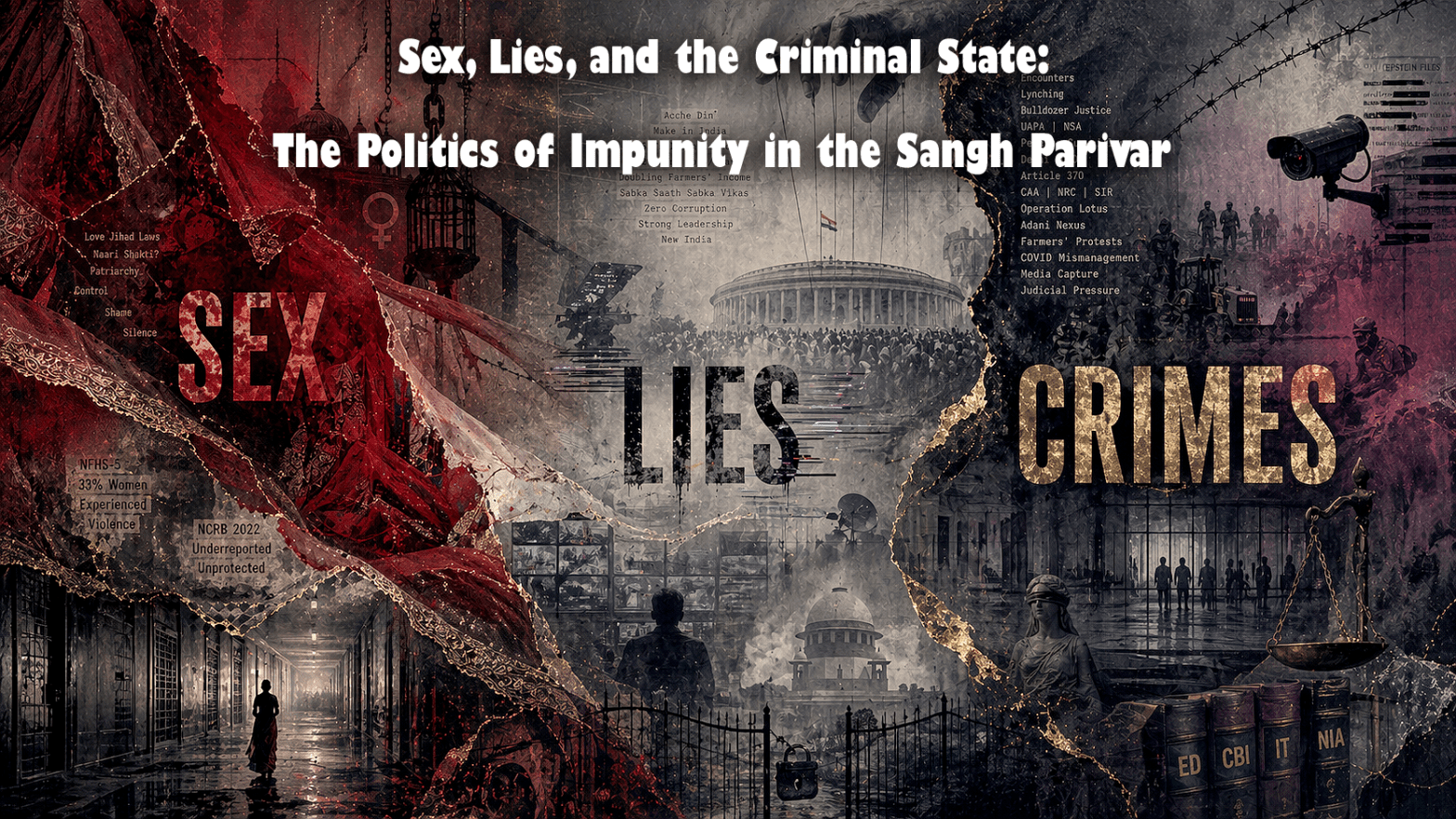
Sex, Lies, and the Criminal State: The Politics of Impunity in the Sangh Parivar
Sex, Lies, and the Criminal State: The Politics of Impunity in the Sangh Parivar
Posted on 22nd April, 2026 (GMT 04:12 hrs)
ABSTRACT
This article offers a sharp critique of the RSS-BJP-Sangh Parivar under Narendra Modi and Amit Shah as a self-reinforcing criminal-political machine that operates through a stark double standard: resistance from rivals, whistleblowers, judges or citizens invites persecution, elimination or institutional violence, while alignment yields protection and the “laundry of deceit” that converts legal vulnerability into political utility. Drawing on Foucault’s biopower and carceral continuum, Marcuse’s surplus repression, and Chomsky’s critique of the reward-punishment model, it traces the apparatus from its Gujarat laboratory — marked by the 2002 pogrom’s sexual violence, Snoopgate surveillance, staged encounters, Haren Pandya’s assassination, Justice Loya’s death, and Sanjiv Bhatt’s imprisonment — to its national expansion through Operation Lotus horse-trading, systemic sexual impunity, godmen paroles, cow vigilantism, Pegasus and digital surveillance, UAPA detentions, bulldozer justice, the Delhi 2020 pogrom, Article 370 revocation, CAA-NRC-SIR protests, the Adani-Hindenburg corporate-state nexus, judicial complicity in cases ranging from the Zakia Jafri clean chit and Ram Mandir verdict to reluctance over the SIR’s mass deletions (including 91 lakh names in Bengal), and the 2026 Epstein Files fallout. NCRB and NFHS-5 data expose pervasive gendered violence and under-reporting, while pseudology — unfulfilled jumlas on jobs, farmers’ income, Acche Din and Viksit Bharat — manufactures consent. The Sangh Parivar thus emerges as an integrated system in which sex, crime, and narrative are weaponised as technologies of biopower to entrench majoritarian authoritarian consolidation.
1. Introduction
This paper offers an all-out critique of the RSS-BJP-Sangh Parivar structuration as a self-reinforcing criminal-political machine currently operating under the “leadership” of Narendra Modi and Amit Shah. Publicly it projects ethnographic Hindutva, moral policing, patriarchal family norms, and the recent “Naari Shakti” rhetoric — all of which function as ideological tools to enforce control over bodies, gender, and sexuality. Operationally, it runs a parallel system of impunity, intimate surveillance, rampant sexual violence, state-enabled crime, pogrom manufacturing, witness elimination, turncoat laundering, communal vigilantism, mob lynching, and spectacular deception of the masses in favour of their selective agenda.
The title of this article draws direct inspiration from Steven Soderbergh’s 1989 film Sex, Lies, and Videotape, which exposed hidden truths and voyeuristic power beneath respectable surfaces. Here, the Sangh Parivar (BJP-RSS-VHP-Bajrang Dal-ABVP and so on) deploys surveillance dossiers, staged encounters, political patronage, horse-trading, godmen protection, cow vigilantism, Pegasus spyware, bulldozer (in)justice, UAPA repression, and pseudology to control bodies, intimacies, dissent, and narratives while maintaining a facade of religious, moral and cultural order.
The empirical core of the present article begins in Gujarat (2001–2014), Modi’s laboratory where the BJP-RSS’ foundational mechanisms were tested and refined. The analysis then traces their national expansion after 2014, documenting the interlocking apparatus of sexual impunity, institutional crime, and systematic deception. Key elements examined include Operation Lotus horse-trading, the “gang of rapists” pattern within the political formation of the Sangh, godmen patronage, cow vigilantism lynchings in the name of caste and religion, Pegasus surveillance, UAPA-NSA detentions, the Delhi 2020 pogrom, Article 370 revocation, CAA-NRC-SIR protests, the Adani-Hindenburg nexus, farmers’ protests, the COVID-19 second-wave crisis, media capture, anti-conversion laws, shrinking civil society space, academic and institutional capture, judicial pressure, digital control laws, and the 2026 Epstein Files fallout.
Subsequent sections dissect the three core modules — Sex, Lies, and Crime — in comprehensive detail, map them onto a clear typology of power, and synthesise how they form a totalising system of biopower sustained by surplus repression and manufactured consent. The paper concludes with the inescapable democratic implications of this fascist project in the contemporary Indian political landscape.
1.1 Contribution and Scope
This study makes a distinct contribution by theorising the Sangh Parivar’s sexual politics not as isolated aberrations but as a deliberate technology of governance that fuses intimate control with the normalization of state criminality and/or state terrorism by the BJP-RSS combine. By weaving together Gujarat’s foundational laboratory with its national and transnational manifestations up to the 2026 Epstein Files revelations, the paper reveals how sexual violence, surveillance, and impunity operate as mutually reinforcing instruments for consolidating authoritarian power.
Beyond cataloguing cases or reported instances, the analysis foregrounds the epistemic dimension: how the regime systematically produces “official ignorance” through data opacity, selective judicial outcomes, and narrative domination, thereby normalising license for the “chosen few” while criminalising resistance. It further illuminates the gendered and communal architecture of this system — where women’s bodies become sites of both symbolic honour and material violation, and where caste, religion, and political loyalty determine access to justice or protection.
As of April 2026, the landscape remains marked by unresolved tensions: occasional judicial pushback coexists with routine paroles for influential/politically-associated figures, prolonged detentions under draconian laws, and the political rehabilitation of accused leaders. This duality underscores the limits of formal institutions in checking a deeply entrenched network of ideological, institutional, and extra-legal power. The paper’s contribution lies in exposing this networked impunity as a coherent system rather than disconnected scandals, offering a robust framework for understanding contemporary India’s slide toward totalitarian consolidation.
1.2 Compressed Timeline of Escalation (2002–2026)
The Sangh Parivar’s project has unfolded through four distinct yet overlapping phases of intensification on the socio-cultural and political fronts:
Phase 1: Gujarat Laboratory (2001–2014) The foundational template was perfected: large-scale sexualised pogrom violence in 2002, intimate surveillance (Snoopgate), staged encounters, targeted elimination of intra-party critics, and the systematic persecution of whistleblowers and judges who dared to probe too deeply.
Phase 2: National Consolidation (2014–2019) Mechanisms migrated from the state to the centre. Operation Lotus engineered defections, cow vigilantism surged dramatically (accounting for 97% of incidents after 2014), Article 370 was revoked with mass detentions and communication blackouts, and the Delhi 2020 pogrom demonstrated the “successful” replication of the Gujarat model at the national capital.
Phase 3: Authoritarian Expansion (2019–2024) The apparatus deepened through digital and legal innovations: Pegasus spyware extended analogue surveillance into a transnational panopticon, UAPA became a tool of indefinite detention, bulldozer demolitions emerged as spectacular punishment, farmers’ protests faced brutal repression, the COVID-19 second wave exposed biopolitical abandonment, the Adani-Hindenburg scandal laid bare the corporate-state nexus, and Electoral Bonds institutionalised opaque political funding.
Phase 4: Totalisation Phase (2024–2026) Normalisation of godmen paroles, expansion of digital control laws, intensified Acche Din/Viksit Bharat rhetoric amid persistent NCRB and NFHS data on gendered violence, and the explosive 2026 Epstein Files fallout brought global scrutiny. The trajectory is clear and deliberate: from regional experimentation to national replication, institutional entrenchment, and finally the attempted total capture of society, discourse, and intimacy.
2. Method(s) and Theoretical Framework
This paper adopts a qualitative interpretive multi-case process-tracing methodology to map the interlocking dynamics of sex, crime, and power under the Sangh Parivar. Rather than treating incidents as discrete events, the analysis traces their genealogical continuity and scalar expansion, revealing how local practices of control evolve into national governance strategies and transnational entanglements.
Central to the framework is a six-fold typology of power that operates as an integrated biopower apparatus:
- Sexual power: The weaponisation of bodies through communal riots, godmen impunity, “love jihad” laws, and selective patronage.
- Surveillance power: The shift from analogue panopticism (Snoopgate) to digital transnational monitoring (Pegasus, DPDPA, Sanchar Saathi, IT rules etc.) and data-protection regimes that enable rather than constrain state oversight.
- Legal-carceral power: The strategic use of UAPA, NSA, ED/CBI/IT Dept. raids, anti-defection loopholes, and selective judicial leniency to punish dissent while rewarding alignment.
- Spectacular punishment: Bulldozer demolitions, public lynchings, and cow vigilantism as performative acts of majoritarian terror.
- Economic power: Crony capitalism exemplified by the Adani-Ambani nexus and the now-invalidated Electoral Bonds scheme as well as the dubiously opaque PM CARES fund.
- Narrative/propaganda power: The systematic deployment of pseudology, media capture, and endless jumlas to manufacture consent and delegitimise opposition.
These six vectors do not function in isolation; they converge to produce a totalising system in which Foucault’s analysis of polymorphic power circulates discourses of threat, loyalty, and morality; Marcuse’s concept of surplus repression enforces ascetic discipline on the masses while granting surplus license to the vanguard; and Chomsky’s sharp critique of behaviourist models exposes the crude reward-punishment conditioning through which the Sangh Parivar apparatus manufactures obedience and suppresses dissent.
Data triangulation draws from primary judicial and investigative records, official statistics (NCRB, NFHS-5, ADR), independent reports (Reuters, HRW, ACLED), and counter-archives, all cross-verified to balance activist insights with formal documentation.
3. The “Sex” Module: Sangh Androcentrism, Rape Culture and Persistent Impunity
The Sangh Parivar’s ideology is fundamentally androcentric and patriarchal, providing explicit doctrinal sanction for the differential treatment of women’s bodies across every level of the continuum.
RSS founder M.S. Golwalkar fiercely opposed the Hindu Code Bill in the 1950s, arguing it would cause “psychological upheaval” to men and destroy the Hindu family structure. He praised Manusmriti as the ideal law code and insisted that women’s education should prepare them solely for domestic roles as wives and mothers, decrying “modern” women who “expose their bodies” as a threat to Hindu civilisation.
Vinayak Damodar Savarkar, the ideological fountainhead of Hindutva, went even further in Six Glorious Epochs of Indian History. He explicitly critiqued ancient Hindu kings for “suicidal chivalry” in refraining from raping captured Muslim women, declaring that “our molestation shall be avenged on the Muslim women” and that “rape must be used” as a legitimate political weapon and deterrent to break the enemy’s spirit.
These positions are not historical footnotes; they form the living ideological bedrock of the Sangh Parivar. Contemporary RSS leaders continue to frame women primarily as bearers of “so-called “family” honour, as reproductive machines, as mothers of the nation, or as objects of moral policing, while the ongoing “Naari Shakti” rhetoric (in connection with the delimitation agenda) of the BJP serves as a thin veil for licensing the chosen few. This ideological underbelly manifests in concrete sexual violence and impunity under BJP rule, further extended through anti-conversion laws and “love jihad” discourse that criminalise interfaith intimacy and enable surveillance of personal relationships.
NCRB data for 2022 recorded 4,45,256 crimes against women nationally (up 4% from 2021), with provisional 2023 figures approaching 4.48 lakh—the highest in a decade. BJP-ruled states dominate the absolute numbers: Uttar Pradesh logged 66,381 cases in 2022, Maharashtra 47,101, Rajasthan 45,058 (leading in rape cases), and Madhya Pradesh 32,765.
While official per-lakh rates sometimes appear moderate due to population size (UP at 58.6 versus national 66.4), NFHS-5 (2019–21) reveals the hidden epidemic: approximately 31% of ever-married women experienced physical or sexual violence, with sexual violence prevalence reaching 5.7–9.8% in several BJP-ruled states, and Karnataka recording the highest domestic violence rate at 47.3%.
Under-reporting is systemic—police refusal to register FIRs, reclassification of rape as “hurt” or “missing person,” and alleged data opacity are routine practices, as repeatedly flagged by Supreme Court observations, NHRC reports, and independent criminologists.
The result is a two-tiered reality: official “law and order” narratives versus ground-level survivor testimonies and judicial interventions. ADR 2024 reports further confirm that the BJP leads in the number of sitting MPs/MLAs facing crimes against women (54 total cases), including 5 rape charges. Longitudinal NCRB trends (2014–2023) show consistent dominance of BJP-ruled states in absolute rape and molestation figures, with conviction rates remaining abysmally low (under 30% in many states), underscoring systemic impunity.
Table: Crimes Against Women in India — Official Data vs. Ground Reality (Focus on BJP-Ruled States)
| Indicator | National Figure | Key BJP-Ruled States (2022) | Notes / Critical Insight |
|---|---|---|---|
| Total Crimes Against Women (NCRB 2022) | 4,45,256 (↑ 4% from 2021) | Uttar Pradesh: 65,743–66,381 Maharashtra: 45,331–47,101 Rajasthan: 45,058 (highest rape cases) Madhya Pradesh: 32,765 | BJP-ruled states dominate absolute numbers; five states (including these) account for over 50% of national cases. |
| Crime Rate (per lakh women) | 66.4 | Uttar Pradesh: 58.6 | Absolute numbers paint a grimmer picture than per-lakh rates due to large populations. |
| Provisional 2023 Trend | Approaching 4.48 lakh | — | Highest in a decade; trend of rising cases continues. |
| NFHS-5 (2019–21): Ever-Married Women Experiencing Physical/Sexual Violence | ~31% nationally | Karnataka: 47.3% (highest domestic violence) Several BJP states: 5.7–9.8% sexual violence | Reveals the “hidden epidemic” masked by official FIR data. |
| Under-Reporting & Systemic Issues | Police refusal to file FIRs, reclassification of cases, data opacity | Routine in high-case states | Flagged by Supreme Court, NHRC, and independent criminologists; creates a two-tiered reality (official “law and order” vs. survivor testimonies). |
| Conviction Rates | Abysmally low (<30% in many states) | Consistent pattern in BJP-ruled states | Longitudinal NCRB trends (2014–2023) show low convictions despite high absolute numbers. |
| ADR 2024: Sitting MPs/MLAs with Crimes Against Women | BJP leads with 54 cases | Includes 5 rape charges | BJP has the highest number of legislators facing such cases among all parties. |
Major cases spanning two decades demonstrate how sexual violence under the Sangh Parivar follows a consistent pattern: brutal communal or caste-based assaults, followed by institutional shielding, political patronage, and selective impunity for the perpetrators.
- Bilkis Bano (2002 Gujarat Riots): Five-months-pregnant Bilkis Bano was gang-raped by a Hindu mob while 14 family members, including her three-year-old daughter, were murdered. Eleven men were convicted in 2008 and sentenced to life imprisonment for rape and murder. The Supreme Court transferred the trial out of Gujarat due to bias. In 2022, the Gujarat BJP government, with explicit approval from Union Home Minister Amit Shah, granted premature remission to the convicts under its 1992 policy. Upon their release on 15 August 2022 (Independence Day), the convicts were publicly garlanded, showered with sweets, and hailed as “sanskari” (cultured) by local BJP leaders and supporters. The Supreme Court quashed the remission orders in a scathing 251-page judgment on 8 January 2024, holding that Gujarat lacked jurisdiction (the trial and conviction occurred in Maharashtra) and describing the orders as “stereotyped,” passed without application of mind, and an usurpation of power. The Court directed the convicts to surrender to jail authorities within two weeks. Review petitions and pleas for extension of time were dismissed, and the convicts surrendered in January 2024. As of April 2026, they remain in prison serving their life sentences — a stark illustration of Savarkar’s doctrine of sexual violence as communal assertion, followed by brazen state-enabled impunity and public celebration of the perpetrators, only partially reversed by higher judicial intervention.
- Asifa Bano / Kathua (2018): An 8-year-old nomadic Muslim girl was gang-raped and murdered inside a Hindu temple in Kathua, Jammu & Kashmir (then under BJP-PDP alliance). The crime was allegedly motivated by communal hatred to drive the Bakarwal community out. Eight men, including a former BJP minister’s close associate, were arrested. BJP leaders and ministers publicly attended rallies in support of the accused. Several convicts have benefited from delays, political sympathy, and limited accountability, with the case widely seen as a textbook example of communal sexual violence being politically defended and echoing Savarkar’s ideological call for rape as a weapon.
- Unnao (2017): A minor Dalit girl was gang-raped by BJP MLA Kuldeep Singh Sengar and his accomplices. Her father was allegedly beaten in police custody and died in 2018. Initially, the Uttar Pradesh police showed blatant inaction and alleged complicity. After massive public outrage, the Delhi High Court took cognisance of the matter, transferred the investigation to the CBI, and later intervened on sentencing issues. Following further delays and intimidation of the victim and her family, the Supreme Court monitored the case closely and ensured Sengar’s conviction in 2019–2020 under the POCSO Act. He was sentenced to life imprisonment (with an additional 10-year sentence for culpable homicide in the death of the survivor’s father). Yet, in December 2025, the Delhi High Court suspended his life sentence and granted conditional bail in the rape case. The Supreme Court promptly stayed that order on 29 December 2025, keeping him in custody. As of April 2026, Sengar continues to enjoy significant political influence and protection within BJP circles despite the convictions. The victim and her family faced ongoing intimidation, with the survivor attempting suicide in 2020. This case highlights caste-communal intersectionality and the reward-punishment model: alignment with the ruling party offers repeated legal relief and leniency, while resistance invites institutional hostility.
- Hathras (2020): A 19-year-old Dalit woman was gang-raped and brutally assaulted in Hathras, Uttar Pradesh. She died in hospital. The Yogi Adityanath government faced severe allegations of police mishandling — the body was cremated at night without full family consent, the crime scene was allegedly washed, and the case was initially downplayed as “no rape.” Four upper-caste men were eventually convicted in 2023 and sentenced to life imprisonment, but the initial state response and subsequent handling triggered nationwide protests, exposing how institutional machinery protects politically aligned perpetrators while undermining Dalit survivors.
- Manipur 2023 Ethnic Violence: Widespread reports and viral videos documented mass sexual violence against Kuki women in the BJP-ruled state, including public parading of naked women, gang-rapes, brutal assaults, and mutilations. The most infamous incident involved two Kuki-Zo women (one in her forties and one in her twenties) who were stripped, paraded, sexually assaulted, and gang-raped by a mob after being dragged from police custody. In a particularly tragic development, a 20-year-old Kuki-Zo woman who was abducted and gang-raped in May 2023 died on 10 January 2026 from prolonged physical injuries and psychological trauma, without seeing any perpetrator brought to justice. As of April 2026 — nearly three years later — accountability remains minimal: in the high-profile parading and gang-rape case, three accused remain absconding, two have been granted bail by the Gauhati High Court, and another’s bail plea is pending before the Supreme Court. Despite national outrage and multiple FIRs, many perpetrators continue to enjoy tacit protection. This case extends the 2002 Gujarat riot template into contemporary ethnic conflict, revealing how communal polarisation under Sangh Parivar governance continues to enable sexual terror as a deliberate tool of dominance and demographic intimidation, with systemic impunity intact even after the survivor’s death.
- Brij Bhushan Sharan Singh (2023–ongoing): Former BJP MP and Wrestling Federation chief accused by multiple female wrestlers of repeated sexual harassment and intimidation. Charges were framed in May 2024. As of April 2026, the trial is ongoing, and Singh continues to wield political influence, having publicly vowed to contest elections in 2029 despite the serious allegations.
- Prajwal Revanna (2024): JD(S) MP and NDA ally accused of raping dozens of women and filming the assaults in what became one of India’s largest political sex scandals involving hundreds of alleged victims. He fled the country in April 2024 using his diplomatic passport shortly after the videos surfaced, sparking accusations of shielding by the NDA alliance and the Centre. He was arrested upon his return in May 2024. In August 2025, a special court convicted him of repeatedly raping a domestic worker and sentenced him to life imprisonment (imprisonment for the remainder of his natural life) along with a substantial fine. Karnataka High Court later rejected his plea to suspend the sentence. However, multiple other rape and sexual harassment cases remain pending as of April 2026. One could highlight the initial delays in action and alleged protection extended by the NDA ecosystem before eventual conviction in this one case. This episode exposes how even high-profile NDA allies benefit from political patronage and institutional delays, with the diplomatic passport controversy underscoring the ease with which powerful figures evade accountability.
- “Godmen” Impunity: Asaram Bapu (convicted of raping minors in 2018 and 2023) has benefited from extraordinary judicial relief on medical grounds. Between late 2024 and early 2026, the Rajasthan and Gujarat High Courts granted multiple short paroles and six-month interim bails. The Supreme Court extended interim bail in January 2025 (till March 31) with conditions prohibiting meetings with followers. As of March 2026, while out on parole, Asaram visited the Ram Temple in Ayodhya (March 12) and the Kashi Vishwanath Temple in Varanasi (March 16) with VIP arrangements and large follower gatherings. Gurmeet Ram Rahim Singh (convicted in August 2017 of raping two female disciples and in 2019 of orchestrating a journalist’s murder) has received repeated leniency. By early 2026, he had been granted parole or furlough at least 15 times, spending over 400 days outside prison since conviction. Releases have frequently coincided with elections in Haryana, Punjab, and Rajasthan. Swami Chinmayanand (grave sexual harassment and rape allegations 2019; acquittal in key case 2021 after complainant turned hostile) and Nithyananda (accused of rape, kidnapping, and sexual assault; fugitive operating a self-proclaimed “cosmic nation”).
3.1. Mo-Shah’s Snoopgate Scandal (2009) and the Carceral Society
In August–September 2009, Gujarat’s ATS, Crime Branch, and CID conducted an intensive, unauthorised surveillance operation on young architect Mansi Soni. A total of 267 audio recordings (later submitted to the CBI) captured then Minister of State for Home Amit Shah issuing repeated oral directives to IPS officer G.L. Singhal, constantly referring to progress reports for an unnamed “Saheb” — widely understood to be Chief Minister Narendra Modi. No written authorisation existed under the Indian Telegraph Act, rendering the entire exercise illegal. The tapes reveal Shah directing hotel checks, airport tracking, shopping-mall monitoring, and even flight surveillance, turning the state police machinery into a personal panoptic tool. The BJP later defended the operation as a “family-requested security measure”.
This analogue, non-lethal surveillance directly paralleled the lethal extra-judicial operations of the same ecosystem. G.L. Singhal, the IPS officer central to Snoopgate who recorded the 267 audio conversations with Amit Shah as self-protection, was also an accused in the Ishrat Jahan staged encounter of 15 June 2004. In that case, four individuals—including 19-year-old college student Ishrat Jahan—were killed in cold blood with planted arms and explosives, a fact established by multiple inquiries, including the 2009 magisterial report and the 2013 CBI chargesheet describing abduction, illegal custody, sedation, and staging.
Singhal’s dual role reveals a single, interchangeable security apparatus under the Modi-Shah leadership in Gujarat: the same personnel and wings (Crime Branch, ATS, SIB/IB) shifted seamlessly from extrajudicial killings justified by a “terror” narrative to prolonged, multi-agency intimate surveillance bypassing legal safeguards. Both operations relied on oral high-level directives, served purposes beyond legitimate law enforcement, and produced “docile bodies” through either elimination or constant visibility. The tapes, submitted to the CBI while Singhal was under investigation for the encounter, inadvertently bridged the lethal and non-lethal dimensions of the same command-and-control structure.
The pattern did not end in 2009. It evolved into a full-scale digital carceral society. The 2021 Pegasus spyware revelations extended Snoopgate’s analogue surveillance into a transnational, networked panopticon. The Supreme Court-appointed technical committee confirmed the presence of spyware/malware in 5 out of 29 examined devices, while noting the Government of India’s complete non-cooperation, which prevented conclusive identification. Targets included journalists, opposition leaders, activists, and even some within the Sangh ecosystem itself — a classic illustration of Foucault’s analysis of power: the state does not merely repress but actively multiplies discourses of threat and loyalty, turning every smartphone into a potential node of control.
This digital expansion was further institutionalised through the Sanchar Saathi initiative (2025) and the Digital Personal Data Protection Act (DPDPA) 2023. Sanchar Saathi, briefly mandated for pre-installation on all new smartphones, was positioned under Telecom Cybersecurity Rules but widely criticised as a backdoor for mass location tracking, call-data monitoring, and IMEI-level surveillance. Although the mandatory order was rolled back after public backlash, the underlying architecture remains. The DPDPA grants sweeping exemptions to the state for “national security,” “public order,” and “sovereignty,” allowing bulk data processing without consent or judicial oversight — in stark contrast to the strict obligations imposed on private entities. Selective application of the IT Act and IT Rules completes the picture: rapid content takedowns target critical voices and opposition narratives, while hate speech and majoritarian propaganda often enjoy impunity.
Together, Snoopgate, Pegasus, Sanchar Saathi, DPDPA, and the selective IT regime form a continuous carceral continuum — Foucault’s vision of a society where surveillance is no longer exceptional but productive, normalising, and totalising. What began as analogue stalking of one woman in 2009 has become a nationwide, always-on digital prison in which every citizen is a potential subject of monitoring, every phone a potential informant, and every act of dissent a trigger for institutional retaliation. Marcuse’s surplus repression is equally visible: ascetic Hindutva discipline is enforced on the masses while the vanguard enjoys unchecked license to surveil, punish, and eliminate. This is not mere privacy violation — it is the manufacturing of docile bodies on an industrial scale.
The same carceral logic finds its most intimate expression in the state-manufactured moral panic of “Love Jihad.” Framed as a demographic conspiracy in which Muslim men allegedly lure Hindu women into marriage and conversion, the narrative has been weaponised since the mid-2010s to justify sweeping anti-conversion laws in BJP-ruled states (Uttar Pradesh, Madhya Pradesh, Gujarat, Himachal Pradesh, and others). These laws reverse the burden of proof, criminalise interfaith relationships with vague terms like “allurement” and “fraudulent conversion,” and empower police to conduct raids, arrest Muslim men on the basis of family complaints, and monitor couples through helplines, apps, and community surveillance networks. What began as analogue stalking in the 2009 Snoopgate operation has evolved into systematic state intrusion into bedrooms and personal choices — turning love, marriage, and intimacy into sites of perpetual suspicion and pre-emptive criminalisation. The same security apparatus that once tracked one woman’s movements now polices thousands of interfaith relationships, producing “docile bodies” through fear, social ostracism, and the constant threat of legal violence. In this framework, the Sangh Parivar’s carceral state does not merely surveil dissent; it polices desire itself, converting private relationships into public crimes and normalising a regime where even personal affection must pass through the filter of majoritarian loyalty.
3.1.1. Epstein Files (2026) and Madhu Kishwar “Controversies”
The January 2026 tranche of Jeffrey Epstein’s DOJ files delivered a devastating global spotlight on the highest levels of Indian power. Documents revealed Epstein boasting “Modi on board” in emails regarding geopolitical strategy, while Union Minister Hardeep Singh Puri had multiple documented meetings and email exchanges with the convicted sex offender between 2014 and 2017. Billionaire Anil Ambani actively sought Epstein’s help to establish high-level connections in the Trump orbit, including backchannel access for Modi’s diplomatic engagements. Most damningly, in a July 2017 email following Modi’s Israel visit, Epstein wrote that the Indian Prime Minister “took advice and danced and sang in Israel for the benefit of the US president… IT WORKED!” — referring to the timing shortly after Modi’s meeting with Donald Trump. These revelations triggered explosive parliamentary disruptions, with opposition MPs chanting “Epstein ka Dost” whenever Puri rose to speak. Instead of transparency or investigation, the Modi government responded with aggressive defamation suits, outright denial, and attempts to suppress discussion — dismissing the files as “trashy ruminations by a convicted criminal.” This episode lays bare the rotten core of the Sangh Parivar’s elite networks: even when international documents expose compromising ties to one of the world’s most notorious sex traffickers and child abusers, the regime chooses denial, legal retaliation, and cover-up over accountability. It perfectly illustrates how the BJP’s “laundry of deceit” extends far beyond domestic criminals to global elite protection rackets — shielding the powerful while ordinary citizens face the full force of moral policing and state repression.
Once-staunch Modi supporter and author Madhu Kishwar publicly distanced herself from the Prime Minister in early 2026 through a detailed X thread. In it, she alleged that several women were made MPs and ministers due to intimate relations with Modi, with names of such beneficiaries whispered loudly in Sanghi power networks from the outset of his rise. Kishwar, who had earlier authored the glowing pro-Modi book Modinama, claimed that “whispers” about Modi’s “predatory sexual conduct” and “sickly dalliances with women” while Gujarat Chief Minister had circulated for years among insiders, including references to the 2009 Snoopgate surveillance scandal involving Mansi Soni and papers submitted in the Supreme Court by incarcerated IAS officer Pradeep Sharma. She explicitly connected these patterns to her own deliberate step-back after 2014, citing depression and avoidance of Modi events (even sending an unsigned copy of her book via a bureaucrat rather than presenting it personally).
Veteran BJP leader Subramanian Swamy, in a March 2026 podcast, reinforced the claims by stating he could name “3-4 women who became MPs, who had to sleep with Modi; one even became a minister,” framing it within broader discussions of sexual patronage and linking it to Snoopgate. This rare public rupture from prominent right-wing voices exposed deep fractures and long-suppressed whispers within the Parivar’s power structure. The Modi government’s response was swift and brutal: aggressive defamation suits, media blackouts, and attempts to discredit Kishwar as “fringe” or “disgruntled.” The episode laid bare how even loyalists who dare to speak uncomfortable truths about the “non-biological” Modi and his inner circle are quickly isolated and attacked, further illustrating the culture of impunity and silencing that defines the Sangh Parivar’s elite networks.
The Sex Module therefore establishes sex as biopower in its most explicit form: the Sangh Parivar’s ideology systematically weaponises misogyny and gendered violence within an aggressive rape culture — from Savarkar’s doctrinal endorsement of rape as a legitimate political weapon and tool of revenge to Golwalkar’s insistence on the domestic confinement of women. At its core lies the deliberate construction of “masculine Hindutva” — the cult of the hyper-alpha male protector, aggressive defender of Hindu honour, and rightful wielder of communal power.
Paradoxically, this hyper-masculine project subsumes women into carefully controlled roles through organisations like Durga Vahini, where they are mobilised as foot-soldiers of Hindutva — trained in martial arts and ideological discipline — yet remain strictly subordinate, their agency ultimately subordinated to the service of male-led communal assertion and the reproduction of patriarchal order.
While projecting “Naari Shakti” rhetoric and packaging recent delimitation exercises as “progressive pro-woman” measures to increase female representation, the Parivar grants total impunity to its political and cultural vanguard. Data, survivor testimonies, judicial records, and the Parivar’s own ideological texts leave no room for doubt: politically connected perpetrators and ideological allies receive consistent state protection and leniency. The pattern remains unbroken, unapologetic, and systemic — from the 2002 Gujarat pogrom to the national reality of April 2026, including the expose from the Epstein files.
4. The “Lies” Module: Pseudology and Manufactured Consent
Pseudology — systematic, spectacle-driven deception — forms the ideological glue that sustains the entire Sangh Parivar apparatus. Drawing from Derrida’s reading of Arendt, pseudology refers to a distinct mode of political lying: not the traditional, occasional lie told to conceal a secret or serve a limited purpose, but a pervasive, self-reinforcing “saying-to-say” that fabricates an entire alternate reality, where truth itself is destabilised and facts are replaced by performative fictions. Through Baudrillardian simulation, politics is transformed into hyper-real spectacle that masks deep governance failures, economic distress, and institutional erosion. At the centre of this apparatus stands Modi as the King Liar, the consummate performer whose endless jumlas have perfected the art of turning deception into governance. Media capture via propaganda ecosystems — what has come to be known as “Godi Media” — along with the IT Cell’s activities through conduits such as “Whatsapp University,” manufactures consent, delegitimises dissent, and floods the public sphere with misinformation and disinformation. Authoritarian image management further contrasts polished diplomatic narratives with grim domestic human rights realities.
The BJP-NDA has deployed an endless stream of jumlas that function as technologies of control, distraction, and mass conditioning. The table below contrasts flagship promises with verifiable outcomes (drawing from PLFS, CMIE, NSSO, NITI Aayog, and RBI data up to 2025–26), followed by enriched explainers that expose the gap between hype and reality.
Table: BJP-NDA Jumlas vs. Ground Reality (2014–2025)
| Promise | Year | Claimed Outcome | Actual Outcome (2025–26 data) |
|---|---|---|---|
| ₹15 lakh in every account | 2014 | Black money recovery | Abandoned post-demonetisation; negligible deposits; zero recovery of claimed ₹80 lakh crore black money |
| 2 crore jobs every year | 2014 | 24 crore jobs over 12 years | Net creation far below target; unemployment hit 45-year high (NSSO); net job losses of ~4.7 crore in key sectors; youth unemployment ~23% (CMIE 2024-25); Skill India fell 64% short of targets |
| Acche Din | 2014 | Prosperity for all | Rising inequality (top 1% hold ~40% wealth); persistent inflation; stagnant real wages for majority |
| Doubling farmers’ income | 2016 | By 2022 | Far below target (NSSO); marginal or negative growth amid rising debt; over 10,000 farmer suicides annually; renewed protests in 2025 |
| End of corruption / Minimum Government | 2014 | Corruption-free India | Electoral Bonds struck down (2024) with BJP receiving 55-60% share; crony defence deals and opacity in PM CARES |
| Demonetisation as surgical strike | 2016 | End black money, fake currency, terror funding | GDP contraction (1.5–3%); massive job losses; 99.3% notes returned; only fractional black money recovery |
| Make in India / Atmanirbhar Bharat | 2014–20 | Manufacturing revival (25% of GDP) | Manufacturing share stagnated at 14–16%; large-scale job losses in sector |
| Complete rural electrification & 24×7 power | 2014–19 | Achieved | Ground reports show poor quality supply, frequent outages, and inflated claims |
| Beti Bachao Beti Padhao / Women’s safety | 2015–26 | Safe India for daughters | Contradicted by NCRB/NFHS data and rising cases in BJP states (Unnao, Hathras, Asifa, etc.) |
| Viksit Bharat 2047 / AI & semiconductor hubs | 2024–26 | Developed nation, global talent hub | Historic low net job creation; average annual addition far below even 1 crore; youth unemployment persistently elevated (15–23% per CMIE); large-scale IT and manufacturing layoffs; education and health spending critically low as % of GDP. |
| Zero poverty / Universal welfare | 2025–26 | India close to eliminating extreme poverty | Persistent multidimensional poverty (NITI Aayog MPI and UNDP data show ~16.4% multidimensionally poor + 18% vulnerable in recent estimates) |
| Historical/cultural spectacles (Ram Temple, Sengol) | 2024 | Cultural renaissance | Criticised for historical distortion, massive public spending (~₹1,400 crore on Ram Temple), and diversion from welfare priorities |
These jumlas were not mere campaign rhetoric but deliberate technologies of distraction and control. Each promise created hyper-real spectacles that masked deepening inequality, joblessness, farmer distress, and institutional capture, while the propaganda machinery worked overtime to sustain the illusion of progress.
- ₹15 lakh and black money jumla (2014): Repeatedly promised that recovered black money would be deposited in every Indian’s account. Quietly abandoned after demonetisation delivered minimal recovery while causing widespread hardship to the poor and informal sector.
- 2 crore jobs annually and Acche Din (2014): The flagship promise implied over 24 crore new jobs. PLFS and CMIE data up to 2025–26 show far lower net employment generation, with persistent high youth unemployment (~23%) and net job losses in manufacturing and agriculture. “Acche Din” became a cruel irony amid rising inequality and stagnant real wages for the majority.
- Doubling farmers’ income by 2022 (2016): Deadline passed with NSSO surveys showing farm incomes stagnated or declined amid rising input costs and debt, leading to renewed protests in Punjab and Haryana in 2025 and over 10,000 farmer suicides annually.
- Demonetisation (2016): Sold as a surgical strike on black money, fake currency, and terrorism funding. Independent RBI and economic studies documented massive GDP contraction (1.5–3%), millions of job losses, and only fractional recovery of black money, with 99.3% of demonetised notes returning to the system.
- Make in India / Atmanirbhar Bharat: Grand promises of manufacturing revival to reach 25% of GDP. The share has largely stagnated at 14–16% despite taxpayer-funded campaigns, with significant job losses in the sector.
- Beti Bachao Beti Padhao and women’s safety rhetoric: Repeated claims of making India safe for women stand in sharp contrast to high NCRB-reported crimes against women in BJP-ruled states and cases such as Unnao, Hathras, and Asifa, exposing the gap between spectacle and substance.
- Viksit Bharat 2047, AI job hubs, semiconductor push (2024–26): Modi repeatedly projected India as a developed nation by 2047 with millions of high-tech jobs and a booming semiconductor/AI sector. In reality, the Modi era recorded some of the lowest net job creation rates in post-independence history. Average annual net job addition remained far below even 1 crore per year, youth unemployment stayed persistently elevated (often 15–23% according to CMIE), and large-scale layoffs swept through the IT and manufacturing sectors. Education and health spending continued to remain critically low as a percentage of GDP, severely undermining any genuine human capital development. This grand developmental jumla served primarily as spectacle, masking deep structural joblessness among a young and growing population.
- Zero poverty and universal welfare claims (2025–26): In recent speeches, the government claimed India was close to eliminating extreme poverty. NITI Aayog’s own multidimensional poverty index and NFHS/UNDP data continue to show significant deprivation (~16.4% multidimensionally poor and another 18% vulnerable).
- Electoral Bonds (struck down 2024): Defended as a reform for transparent funding until the Supreme Court invalidated the scheme; subsequent data revealed the BJP receiving 55–60% of the ₹16,000 crore bonds, with major corporate donors receiving contracts or relief, reinforcing cronyism allegations.
- Historical and cultural spectacles: Claims around the Sengol, Ram Temple (with massive public spending), and other events have been criticised for historical distortion and exaggeration of achievements to distract from governance shortfalls and divert resources from welfare priorities.
Marcuse’s performance principle reveals how the BJP-NDA-RSS system redirects libidinal energies toward mass obedience and ascetic discipline, while granting surplus license to its political and corporate tycoons. Foucault demonstrates how these deceptive discourses proliferate as political capital, normalising failure and manufacturing consent. The Lies Module thus functions as the ideological glue that binds the Sex and Crime modules together, sustaining the entire apparatus through systematic pseudology amid deepening economic distress, institutional erosion, and governance failures from 2014 to 2026.
For more on this issue, view the following:
5. The “Crime” Module: When Structural Violence and Confrontational Violence Converge
Crime in the Sangh Parivar continuum is not an aberration but a deliberate tool of governmentality. Structural violence — encoded in laws, policies, institutions, and economic exclusion — fuses seamlessly with confrontational violence: direct, spectacular, and often lethal acts such as staged encounters, mob lynchings, bulldozer demolitions, and UAPA-NSA detentions etc. This convergence creates a totalising system in which the state, party, and ideological ecosystem purportedly function as a single monolithic yet polymorphic machine — eliminating resistance, laundering perpetrators, and normalising terror under the banner of “law and order” and “national security.”
The laboratory for this machinery was Gujarat after 2002, under Narendra Modi — widely known as the Butcher of Gujarat for his role as the chief enabler and architect of the 2002 pogrom. His passport was cancelled by the United States in 2005 precisely because of his status as a genocide-creator and enabler. Post-pogrom encounter killings became routine, with dozens of alleged extra-judicial executions. The Ishrat Jahan case (2004) stands as the most documented: the CBI established it as a cold-blooded fake encounter with planted arms. The same ecosystem (Crime Branch, ATS, SIB/IB) was weaponised for both lethal operations and non-lethal surveillance, as later exposed in the 2009 Snoopgate scandal.
This model scaled nationally after 2014 through Operation Lotus, the BJP’s systematic horse-trading and blackmail operation. Mass defections were engineered in Karnataka (2019: 17 Congress/JD(S) MLAs sequestered in resorts), Madhya Pradesh (2020: 22 Congress MLAs led by Jyotiraditya Scindia), and Maharashtra (2022: ~40 Shiv Sena MLAs led by Eknath Shinde). An Indian Express investigation (April 2024) tracked 25 opposition leaders facing ED/CBI probes who switched to the BJP; 23 received immediate reprieve. High-profile turncoats — Himanta Biswa Sarma (Saradha chit fund links), Jyotiraditya Scindia, Suvendu Adhikari, Ajit Pawar (irrigation scam), Ashok Chavan (Adarsh Housing scam), and others — exemplify the “laundry of deceit,” in which legal vulnerability is converted into political utility through patronage and selective agency relief.
The punitive counterpart of this “laundry of deceit” was the systematic neutralisation of resistance. Haren Pandya, a senior BJP leader and vocal intra-party critic of Modi’s handling of the 2002 riots, was assassinated in Ahmedabad on 26 March 2003 while on his morning walk. The Sohrabuddin Sheikh–Kauser Bi–Tulsiram Prajapati staged-encounter chain (2005–2006) has been alleged by multiple witnesses and investigative accounts to constitute a clean-up operation targeting individuals with potential knowledge of Pandya’s killing. CBI probes established these encounters as extra-judicial executions involving abduction, illegal detention, and planted arms. Witness Azam Khan testified that Sohrabuddin had received a “contract” linked to Pandya’s murder, while senior officer D.G. Vanzara’s statements pointed to political direction and monitoring. Special CBI Judge B.H. Loya, who was presiding over the Sohrabuddin trial and insisted on Amit Shah’s personal appearance in court, died suddenly in December 2014; his successor discharged Shah within weeks.
IPS officer Sanjiv Bhatt, the prominent whistleblower who alleged Modi’s direct instructions during the 2002 riots meeting and provided evidence on the encounter cover-ups, was convicted in a separate 1990 custodial-death case and remains incarcerated on a life sentence. Rana Ayyub’s undercover investigation in Gujarat Files (2016) serves as a powerful counter-archive: secret audio recordings of senior Gujarat police officers contain verbatim references to Shah ordering the elimination of Sohrabuddin and Prajapati “at the behest of the minister,” and describe Pandya’s murder as “the biggest political murder” in the state. These interlocking cases lay bare the reward-punishment binary in its starkest form: alignment with the leadership triggered the laundering of past transgressions into political utility and protection, while resistance — whether from intra-party rivals, judges, or whistleblowers — invited elimination, suspicious death, or lifelong persecution through the same security apparatus. In this ecosystem, questioning or dissent itself is criminalised as treason, turning any challenge to the leadership into an act of disloyalty that justifies the full force of institutional violence and silencing.
The criminalisation of the BJP is no longer incidental — it has become structural and deliberate. According to ADR 2024 data, 46% of BJP’s 2024 Lok Sabha winners declared criminal cases — the highest proportion ever recorded for any single party in Indian electoral history. Even more damning, the party leads all others in serious IPC cases and crimes against women: 54 sitting BJP MPs/MLAs face charges related to crimes against women, including five rape cases. Prominent examples include Union Minister Brij Bhushan Sharan Singh (multiple sexual harassment cases by female wrestlers), former Union Minister and current Chief Minister Hardeep Singh Puri (linked to the 2026 Epstein Files controversy), Chief Ministers such as Himanta Biswa Sarma (with past Saradha chit fund links), and several other senior leaders who continue to occupy high office despite serious charges of murder, rape, and corruption. This is not accidental. It is the logical and inevitable outcome of the BJP’s “laundry of deceit” system, where criminal records are systematically converted into political assets through selective ED/CBI raids on opponents, favourable judicial delays for allies, and outright protection for loyalists.
Majoritarian violence supplies the public spectacle of terror. After 2014, cow vigilantism and communal lynchings surged dramatically, becoming normalised tools of both communal and caste assertion. Muslims bore the brunt of this terror: Reuters documented 63 attacks between 2010 and mid-2017, with 97% occurring after Modi took office and 28 Muslims killed. HRW recorded at least 44 deaths in cow-related violence (2015–2018), 36 of them Muslims. IndiaSpend and ACLED data confirm 92% of incidents took place in states with cow-slaughter bans and 70% in BJP-ruled states. Christians too faced rising targeted attacks, including church vandalism, forced conversions, and assaults on pastors and congregations, especially in BJP-ruled states where anti-conversion laws were weaponised.
Dalits were systematically brutalised under the same majoritarian framework. In 2016, four Dalit youths in Una, Gujarat, were publicly flogged by cow vigilantes for skinning a dead cow — an atrocity captured on video and later celebrated by the perpetrators. NCRB data show consistent and sharp rises in crimes against Scheduled Castes and Tribes across BJP-ruled states. Iconic cases — Mohammad Akhlaq (Dadri 2015), Pehlu Khan (Alwar 2017), Tabrez Ansari (Jharkhand 2019, lynched while forced to chant “Jai Shri Ram”), and the Una flogging — expose a clear, repeating pattern: police routinely register cases against victims’ families or Dalit/Muslim survivors, while perpetrators enjoy tacit and often explicit protection from the Sangh ecosystem (VHP, Bajrang Dal). Post-2018 trends confirm the violence has not abated but has been fully institutionalised — a seamless fusion of anti-Muslim, anti-Christian, and anti-Dalit terror that serves as both public spectacle and chilling warning to all minorities.
The Delhi pogrom (2020) replicated the Gujarat model at the national capital: over 50 killed (mostly Muslims), with credible allegations of police complicity, selective prosecution, and brutal UAPA targeting of anti-CAA protesters. Prominent voices such as Umar Khalid and Sharjeel Imam — both vocal critics of the CAA-NRC regime — remain unjustifiably incarcerated for years under UAPA on flimsy conspiracy charges. As of April 2026, they continue to be denied bail despite no evidence and prolonged trials that amount to punishment by process; the Supreme Court recently dismissed review pleas and upheld their continued detention, citing a prima facie central role while granting relief to others.
The same draconian law has normalised indefinite detention without trial, turning the judicial system into a tool of political vengeance. This is starkly visible in the Bhima Koregaon case, where elderly activist Stan Swamy (accused at age 83) was denied bail, medical care, and even a sipper for his Parkinson’s disease, and died in custody in 2021. Fellow accused Varavara Rao, Sudha Bharadwaj, and G.N. Saibaba (died in 2024) — a wheelchair-bound scholar with 90% disability — have to endure years of incarceration on fabricated charges, with repeated bail denials despite failing health and scant evidence.
In Ladakh, climate activist and regional rights leader Sonam Wangchuk was arrested under the draconian National Security Act (NSA) for leading peaceful protests demanding Sixth Schedule protections and environmental safeguards — another blatant example of the state weaponising anti-terror laws to silence non-violent dissent. He was finally released after about six months in March 2026 when the detention was revoked.
Bulldozer (in)justice in Uttar Pradesh, Madhya Pradesh, and other BJP-ruled states represents extrajudicial spectacle — homes demolished without due process, mostly targeting Muslim families or dissenters — turning state violence into public performance.
Together, these cases illustrate how structural and confrontational violence have merged into a seamless system of repression. This pattern of selective targeting extends glaringly to opposition leaders and members. Arvind Kejriwal, the Aam Aadmi Party leader and then-Delhi Chief Minister, was arrested by the ED in March 2024 in the Delhi excise/liquor policy money-laundering case, with parallel CBI action keeping him in prolonged custody despite later court developments (including discharge in the CBI matter in early 2026). Similarly, Hemant Soren, then Jharkhand Chief Minister from the JMM, was forced to resign and arrested by the ED on 31 January 2024 in a land-scam-linked money-laundering probe; he secured bail in June 2024, but the case exemplifies the broader weaponisation of central agencies against non-BJP governments. Critics rightly see these as textbook instances of using probes and arrests to destabilise opposition-ruled states, with prolonged detention serving as punishment even when evidence remains contested and courts eventually intervene in parts of the cases.
These examples — from riot victims and anti-CAA voices, to human rights defenders, climate activists, and elected opposition figures — reveal a consistent architecture of repression that stifles dissent, disproportionately burdens minorities and critics, and erodes democratic safeguards under the guise of law and order.
Broader institutional repression completes the carceral continuum. The farmers’ protest (2020–2021), India’s largest democratic resistance movement, was met with brutal repression — including tear gas, water cannons, barricades, and road blockades — along with relentless media delegitimisation, before a tactical rollback of the farm laws that still left hundreds of farmers dead from the harsh conditions and state actions.
The COVID-19 second wave (2021) exposed the biopolitics of abandonment under Hindutva governance: catastrophic oxygen shortages, mass deaths piled up in hospitals and crematoriums, and a devastating migrant crisis, where lives — especially of the poor and marginalised — were valued unequally as the system collapsed under official complacency and neglect.
The 2019 revocation of Article 370 in Indian-occupied Kashmir mirrored Israeli tactics in occupied Palestine: mass detentions of political leaders and civilians, sweeping communication blackouts lasting months, and a military lockdown that dismantled federalism and silenced the region. Both India and Pakistan have maintained occupations over divided Kashmir through brutal crackdowns, with Indian forces documented using human shields and facing stone pelting by protesters. Recent escalations — including nearly 2,800 arrests and punitive house demolitions after the 2025 Pahalgam attack — echo/parallel the ongoing siege in Gaza and the West Bank.
The CAA-NRC framework introduced religious criteria for citizenship, sparking nationwide protests that were met with state violence and communal polarisation. The iconic Shaheen Bagh sit-in — a powerful, women-led peaceful protest in Delhi that lasted over 100 days from December 2019 to March 2020, with participants reading the Constitution and holding the tricolour — symbolised dignified resistance but faced police pressure, road blockades, and eventual disruption amid the pandemic and subsequent judicial rulings restricting indefinite public occupations.
Recent drives like the Special Intensive Revision (SIR) of electoral rolls — which could be framed as CAA-NRC in disguise — have killed hopes of fair participation for many, with lakhs of voters (especially from minority and marginalised communities) suddenly “deleted” or marked as “UA” (under adjudication). In West Bengal alone, nearly 91 lakh names were removed during the exercise, shrinking the electorate by around 12%. Booth Level Officers (BLOs), often school teachers and low-paid contractual staff tasked with door-to-door verification under tight deadlines and intense monitoring, bore the brunt of the exercise’s opacity and pressure. Multiple BLOs died during the process, including several reported suicides attributed to unbearable workload, sleep deprivation, and threats of consequences for failing to meet targets; at least two BLOs in Bihar and several more across other states (including Uttar Pradesh and West Bengal) reportedly took their own lives or collapsed under the strain, with families citing coercive pressure from superiors. The human toll extended to ordinary citizens as well: several people, particularly in West Bengal and Bihar, reportedly committed suicide or died from extreme mental stress and panic after discovering their names — or those of family members — had been deleted or placed under adjudication, with families linking the deaths directly to fear of disenfranchisement and loss of voting rights. This tragic fallout compounded allegations of systematic disenfranchisement: rushed verifications disproportionately affected migrants, the poor, and Muslims, leading to mass deletions or UA markings without adequate notice or transparent justification in many cases.
Detention centres in Assam and elsewhere stand as grim monuments to this structural violence — holding people declared “foreigners” (often on flimsy or contested grounds) in indefinite limbo, with reports of poor conditions, family separations, and no viable deportation path, turning citizenship verification into a tool of exclusion and fear.
Civil society space has shrunk through stringent FCRA restrictions, the effective shutdown of Amnesty India after bank account freezes and harassment, and the targeting of rights organisations. Academic and institutional capture proceeds via ideological appointments and syllabus changes. The judiciary faces pressure through delays, selective urgency, and controversial judgments. Digital control laws (IT Rules and content takedown powers) extend the panoptic apparatus into online speech.
This shrinking of democratic space reaches its most consequential expression in the fusion of economic crime with institutional protection at the highest levels. The Adani–Hindenburg scandal stands as a paradigmatic case of how the Sangh Parivar’s “laundry of deceit” operates in the economic realm. In January 2023, US short-seller Hindenburg Research released a damning report accusing the Adani Group of stock manipulation, accounting irregularities, and the use of offshore shell companies to artificially inflate valuations by tens of billions of dollars. The conglomerate suffered over $150 billion in market value loss within days, sparking a major political crisis. Instead of ordering an independent, time-bound investigation, the Modi government responded with outright denial, coordinated media management, and aggressive targeting of critics. SEBI’s probe has been widely criticised for its slow pace and lack of enforcement, while opposition leaders and analysts demanding a Joint Parliamentary Committee faced ED/CBI raids and defamation suits. The Modi government has repeatedly shielded Adani — from regulatory forbearance to active state protection — converting potential legal vulnerability into protected oligarchic power. This pattern is most visible in Modi’s foreign tours, where he has personally secured major deals for the Adani Group: during his 2014 Australia visit, Adani won key stakes in the Carmichael coal mine project; his 2017 Israel trip paved the way for Adani’s drone manufacturing joint venture and later control of Haifa Port; and in Sri Lanka, Modi’s diplomatic pressure helped Adani secure a $442 million wind power project in 2023. These instances reveal how the Prime Minister has consistently leveraged state diplomacy to expand Adani’s global empire while insulating the group from accountability at home.
The same goes for Ambani, for whom there are equally blatant examples of institutional shielding and state-enabled expansion. The Modi government’s regulatory architecture — from favourable spectrum allocations and relaxed FDI norms in retail to delayed enforcement against anti-competitive practices — has systematically propped up Reliance Jio and Reliance Retail, allowing the group to crush competitors and dominate India’s digital and consumer economy. Ambani has been a regular presence on Modi’s foreign delegations, securing high-profile global partnerships that were announced shortly after the Prime Minister’s visits, including the landmark investments by Google and Facebook (Meta) in Jio Platforms. Just as with Adani, critics and rivals of the Ambani empire have faced raids, investigations and legal harassment by central agencies, while Reliance continues to receive policy tailwinds and diplomatic support. This twin patronage of Adani and Ambani reveals the deeper architecture of the Sangh Parivar’s “laundry of deceit”: the conversion of state power into private oligarchic wealth, where regulatory forbearance, foreign deal-making and coercive agencies work in concert to protect a handful of favoured conglomerates at the expense of democratic accountability.
This corporate-state nexus is sustained by a deeper and more disturbing judicial complicity that has reduced the Supreme Court of India from its constitutional role as the ultimate guardian of rights and checker of executive power to what increasingly appears to be an extension of the ruling dispensation’s will. Successive benches have repeatedly demonstrated a troubling reluctance to order independent, time-bound investigations or ensure swift accountability in high-stakes cases involving politically connected conglomerates — most glaringly the Adani–Hindenburg scandal and the now-invalidated electoral bonds scheme — while displaying striking urgency and favourable outcomes in matters that directly benefit the regime.
Has the Supreme Court of India truly remained an independent institution, or has it become a willing participant in the normalisation of structurally aligned impunity? Recent and not-so-recent illustrations raise this question with uncomfortable clarity: the 2018–19 clean chit to the government in the Rafale deal controversy; the 2016 upholding of demonetisation despite its devastating impact on the poor; the 2022 refusal to order an independent probe into the Pegasus spyware scandal and instead setting up a government-appointed committee; the prolonged delay and limited intervention in challenges to the Citizenship Amendment Act (CAA); the initial upholding of the controversial farm laws before they were eventually repealed; the 2022 clean chit to Narendra Modi in the Zakia Jafri petition on the 2002 Gujarat riots conspiracy; the 2018 dismissal of pleas for an independent probe into Justice B.H. Loya’s death; the swift and largely uncritical upholding of Article 370’s abrogation while turning a blind eye to the accompanying months-long communication blackout and mass detentions; the 2024 Ram Mandir verdict that effectively facilitated the temple’s inauguration amid serious allegations of judicial overreach; and the Court’s conspicuous silence on the opaque Special Intensive Revision (SIR) of electoral rolls in states like West Bengal, where nearly 91 lakh names were deleted or marked “UA” with minimal transparency.
Critics rightly argue that this pattern — combined with the repeated denial of bail to high-profile UAPA detainees such as Umar Khalid and Sharjeel Imam despite years of incarceration on no evidence — reveals a structural reward-punishment mechanism: loyalty to the Sangh Parivar guarantees judicial leniency and impunity, while any challenge to the regime invites selective prosecution, regulatory harassment, media trials, and even contempt proceedings for daring to question judicial impartiality.
In this architecture, the Supreme Court of India no longer merely fails to deliver justice — it actively legitimises the conversion of public resources, regulatory authority, and constitutional safeguards into private oligarchic wealth under the convenient banner of “national interest,” thereby entrenching a system of elite impunity at the highest levels of the Indian state.
Taken together, these episodes point not merely to excesses of power but to a calibrated mode of governance in which legality and illegality are strategically interwoven. What emerges is a shifting threshold of legitimacy, where the distinction between due process and punitive spectacle is deliberately blurred. Disenfranchisement, prolonged incarceration without trial, and selective enforcement of law operate alongside visible acts of coercion to produce a climate of anticipatory obedience—where dissent is not only punished but pre-emptively neutralised. The cumulative effect is a reconfiguration of citizenship itself, in which belonging becomes conditional, contingent on political conformity rather than constitutional guarantees.
Within this Crime Module, repression functions less as a series of discrete acts and more as an ecosystem of control sustained by institutional alignment and narrative management. Mechanisms of coercion, inducement, and erasure do not operate in isolation but reinforce one another, producing a self-perpetuating cycle of compliance and impunity. In this sense, Michel Foucault’s notion of the carceral continuum is not simply realised but intensified—extending beyond formal institutions into the social body itself. Power here is diffuse yet coordinated, ensuring that accountability is perpetually deferred while authority remains uninterrupted.
6. From Biopolitical Control to Managed Consent
What the preceding modules cumulatively reveal is not simply an authoritarian drift but a paradigmatic reorganisation of power—one that exceeds classical categories of repression, propaganda, or institutional decay. The operative logic here is closer to an integrated regime of governmentality, where control is exercised not only through force or ideology but through the continuous calibration of life, death, truth, and possibility itself.
At its conceptual core lies the expansion of Michel Foucault’s biopower into a far more granular regime: a system that does not merely “make live and let die,” but actively stratifies populations into hierarchies of protection, abandonment, and exposure. This is where biopolitics begins to converge with what Achille Mbembe terms necropolitics—the power to decide who may be rendered disposable, whose suffering remains ungrievable, and whose existence is perpetually precarious. Within this framework, violence is no longer exceptional; it becomes infrastructural, embedded within the everyday functioning of governance.
Crucially, this regime operates through what might be described as differential visibility. Certain forms of power—spectacular punishment, communal violence, targeted arrests—are made hyper-visible to produce fear and compliance. Others—legal manipulation, data opacity, economic exclusion—remain diffused and opaque, ensuring deniability. This duality allows the system to oscillate between spectacle and invisibility, producing what Giorgio Agamben would identify as a state of exception that has ceased to be exceptional. Emergency logics are normalised, and legality itself becomes a flexible instrument rather than a binding constraint.
The epistemic dimension of this transformation is equally critical. Drawing from Hannah Arendt’s analysis of organised lying, the regime does not merely distort facts but restructures the very conditions under which truth can be recognised. Reality is fragmented into competing narratives, where verification becomes secondary to repetition and affect. This produces what can be termed epistemic exhaustion—a condition in which citizens are less persuaded than overwhelmed, less convinced than disoriented. In such an environment, the distinction between truth and falsehood collapses into a question of allegiance rather than evidence.
Simultaneously, Herbert Marcuse’s concept of surplus repression acquires a renewed intensity. Moral discipline—around sexuality, nationalism, and cultural identity—is imposed with increasing rigidity on the general population, while elites operate within zones of elasticity and exemption. This asymmetry is not incidental; it is constitutive of the system’s stability. It produces a paradoxical order in which repression and permissiveness coexist, each reinforcing the other. The masses are governed through restraint; the vanguard through license.
Layered onto this is a behavioural architecture that resonates with Noam Chomsky’s critique of manufactured consent but extends beyond media into a full-spectrum conditioning environment. Incentives (visibility, protection, economic access) and disincentives (surveillance, exclusion, legal harassment) are distributed unevenly, creating a field in which individuals and institutions internalise risk calculations. Control thus becomes anticipatory: actors self-regulate not because they are constantly coerced, but because the costs of deviation are made legible through selective enforcement.
What distinguishes this formation from earlier authoritarian models is precisely this hybridisation of coercion and consent. Unlike overt dictatorships, it does not abolish democratic forms; it repurposes them. Elections persist, courts function, media proliferates—but all within a progressively narrowed horizon of contestation. This aligns with contemporary global analyses of competitive authoritarianism and illiberal democracy, yet even these categories fall short of capturing the density of integration observed here. The system is less about controlling outcomes directly and more about structuring the conditions under which outcomes become predictable.
The implications are not limited to institutional degradation; they extend to the ontology of citizenship itself. Citizenship is no longer a stable legal status but a graduated condition, modulated through identity, loyalty, and visibility. Some subjects are hyper-legible to the state (over-policed, over-surveilled), while others operate within zones of opacity and protection. This produces what may be called a stratified civic order, where equality before the law is formally retained but substantively hollowed out.
Comparatively, similar logics can be observed across diverse geopolitical contexts—Turkey under Erdoğan, Hungary under Orbán, Brazil under Bolsonaro, and aspects of the Trump era in the United States—suggesting that this is not an isolated phenomenon but part of a broader global mutation of democracy under late capitalism and digital surveillance regimes. However, the specificity here lies in the fusion of majoritarian ideology with deeply embedded social hierarchies (caste, religion, gender), amplifying the intensity and reach of control mechanisms.
Ultimately, what this synthesis reveals is a transition from democracy as a system of representation to democracy as a managed environment—a space where participation is permitted but pre-structured, dissent is allowed but contained, and truth is available but destabilised. Power in such a system is not merely exercised; it is continuously reproduced through the alignment of institutions, the disciplining of affect, and the orchestration of perception.
The danger, therefore, is not only the presence of repression but its normalisation; not only the erosion of institutions but the redefinition of their function; not only the manipulation of truth but the exhaustion of the very desire to seek it. In this sense, the system does not simply govern populations—it reconstitutes the horizon of the political itself, narrowing the space within which freedom, resistance, and alternative futures can be imagined.
7. Conclusion
In Crime and Punishment, Raskolnikov’s carefully constructed justification for transgression ultimately disintegrates under the weight of moral conscience. What initially appears as a higher rationality—an exceptional right to violate—reveals itself as an ethical abyss. A similar fracture lies at the heart of the Sangh Parivar project. Its claim to civilisational renewal, moral order, and national strength is sustained through a series of calculated transgressions—systematic, strategic, and normalised—whose cumulative effect is the erosion of the very ethical ground upon which those claims stand.
This article has demonstrated that these are not isolated contradictions but elements of an integrated regime of power. Sexual control, narrative fabrication, and coercive enforcement do not merely coexist; they co-produce a political order in which domination is routinised and justified as necessity. What is at stake, therefore, is not simply governance failure or institutional decline, but a deeper transformation in the grammar of politics itself—where violence is reframed as order, deception as leadership, and impunity as strength.
The theoretical synthesis developed through Michel Foucault, Herbert Marcuse, Noam Chomsky, Achille Mbembe, and Hannah Arendt reveals the depth of this transformation. Power here is not merely repressive but productive; it manufactures compliant subjects, stratifies populations, and reorganises truth itself. The convergence of biopolitics with necropolitics renders certain lives expendable, while others are elevated into zones of protection and privilege. Simultaneously, organised pseudology erodes epistemic stability, producing a public sphere in which truth is no longer adjudicated but performed and consumed.
Yet, to end at diagnosis would be analytically incomplete. The persistence of resistance—legal challenges, grassroots mobilisations, survivor testimonies, independent journalism, and ruptures within the ideological apparatus itself—points to an unresolved tension within this system. The carceral continuum is expansive, but not total. Each moment of exposure—whether judicial interventions such as the Bilkis Bano and Electoral Bonds judgments, or collective mobilisations like the farmers’ movement and wrestlers’ protests—reveals fissures in the edifice. These are not merely reactive disruptions; they are sites where alternative political imaginaries continue to be articulated, however precariously.
The future trajectory of this system hinges on this tension. One possible path is further consolidation: the deepening of surveillance infrastructures, the refinement of narrative control, and the continued hollowing out of institutional autonomy—leading toward a fully stabilised form of managed democracy, where dissent survives only as ritualised containment. Another path, however, lies in the reactivation of democratic counter-forces: the rebuilding of epistemic trust, the reassertion of constitutional accountability, and the forging of solidarities that cut across the very divisions the system seeks to intensify.
What becomes clear is that the crisis is not only political but civilisational in a deeper sense. It concerns the conditions under which truth can be spoken, justice can be pursued, and power can be held accountable. If democracy is reduced to procedure without substance, if citizenship becomes conditional, and if violence is normalised as governance, then the erosion is not episodic but structural.
The Sangh Parivar continuum, as mapped in this study, thus represents more than a political formation; it is a test case for the resilience of democratic life under conditions of concentrated, networked power. Its endurance depends not only on its capacity to dominate but on the capacity of society to resist normalisation—to refuse the quiet recalibration of what counts as acceptable, lawful, and just.
The final question, then, is not whether this system can sustain itself—it demonstrably can—but whether democratic society can sustain the will to confront it. For as Hannah Arendt reminds us, the greatest danger of such regimes lies not only in their violence but in their ability to render that violence ordinary. To resist, therefore, is not only to oppose power but to reclaim the very possibility of truth, justice, and political imagination.
Indian democracy does not merely “deserve better”—it depends on the refusal to accept less.
SOURCES
- Snoopgate audio transcripts & dossier (Cobrapost/Gulail, November 2013): Full investigative dossier “The Stalkers” with audio clips, logs, and analysis of illegal surveillance on Mansi Soni. https://cobrapost.com/blog/the-stalkers-amit-shahs-illegal-surveillance-exposed-904 Gulail archive mirror: https://stalkgate1.rssing.com/chan-59404781/all_p1.html
- Bilkis Bano Gang-Rape & Murder Case – Supreme Court Judgment quashing premature remission (8 January 2024): Full 251-page judgment (Writ Petition (Crl.) No.491 of 2022). https://api.sci.gov.in/supremecourt/2022/38741/38741_2022_12_1501_49383_Judgement_08-Jan-2024.pdf Alternative: https://indiankanoon.org/doc/47574125/
- Electoral Bonds Scheme – Supreme Court Judgment striking it down (15 February 2024): Full Constitution Bench judgment (W.P.(C) No.880/2017). https://api.sci.gov.in/supremecourt/2017/27935/27935_2017_1_1501_50573_Judgement_15-Feb-2024.pdf
- NCRB Crime in India 2022 (Volume I): Official crime statistics. https://ncrb.gov.in/uploads/nationalcrimerecordsbureau/custom/1701607577CrimeinIndia2022Book1.pdf Volume II archive: https://archive.org/details/PARI.crime-in-india-2022-volume-ii
- NCRB Crime in India 2023 (provisional/final volumes): Updated trends (available via ncrb.gov.in annual reports section).
- National Family Health Survey (NFHS-5) 2019-21 – India Report Volume I: https://www.dhsprogram.com/pubs/pdf/FR375/FR375.pdf
- NFHS-5 India Report Volume II: https://dhsprogram.com/pubs/pdf/FR375/FR375_II.pdf
- Association for Democratic Reforms (ADR) 2024 Report: Analysis of sitting MPs/MLAs with declared cases related to crimes against women (BJP leading). https://adrindia.org/sites/default/files/Analysis_of_Sitting_MPs_and_MLAs_with_Declared_Cases_Related_to_Crimes_against_Women_2024_FinalVer_English.pdf Main ADR reports: https://adrindia.org
- Pegasus Project Investigative Reports (Forbidden Stories & Amnesty International, 2021): Full consortium findings and forensic methodology. https://forbiddenstories.org/pegasus-the-new-global-weapon-for-silencing-journalists/ Amnesty Security Lab: https://securitylab.amnesty.org/case-study-the-pegasus-project/ Forensic Methodology Report: https://www.amnesty.org/en/latest/research/2021/07/forensic-methodology-report-how-to-catch-nso-groups-pegasus/
- Once in a Blue Moon Academia (OBMA / onceinabluemoon2021.in):
- “End of Year Bombshell: How BJP-NDA-Hindutva Failed India – A Scathing 2014-2025 Indictment” (31 Dec 2025): https://onceinabluemoon2021.in/2025/12/31/end-of-year-bombshell-how-bjp-nda-hindutva-failed-india-a-scathing-2014-2025-indictment/
- “The Gang of Rapists: The Bharatiya Janata Party” (5 May 2024): https://onceinabluemoon2021.in/2024/05/05/the-gang-of-rapists-the-bharatiya-janata-party/
- “When Rapists Are Scot-Free” (31 May 2023): https://onceinabluemoon2021.in/2023/05/31/when-rapists-are-scot-free/
- “King Liar: The Pseudology of Contemporary Indian Politics” (5 Jan 2023): https://onceinabluemoon2021.in/2023/01/05/king-liar-the-pseudology-of-contemporary-indian-politics/
- “Sell-ebration of Turncoats: The BJP’s Laundry of Deceit” (30 Mar 2024): https://onceinabluemoon2021.in/2024/03/30/sell-ebration-of-turncoats-the-bjps-laundry-of-deceit/
- UAPA/NSA Detention Orders & Supreme Court Rulings (2025–2026):
- Supreme Court order in Delhi Riots “Larger Conspiracy” case (denying bail to Umar Khalid & Sharjeel Imam, 5 Jan 2026; review dismissed April 2026): https://www.scobserver.in/reports/supreme-court-rejects-umar-khalid-and-sharjeel-imams-bail-pleas-says-continued-detention-not-constitutionally-impermissible/ (summary and links to order).
- Sonam Wangchuk NSA detention revocation (Ministry of Home Affairs, 14 March 2026): Reported in https://www.thehindu.com/news/national/centre-releases-sonam-wangchuk-detention-under-nsa/article70742477.ece


Comments
Post a Comment