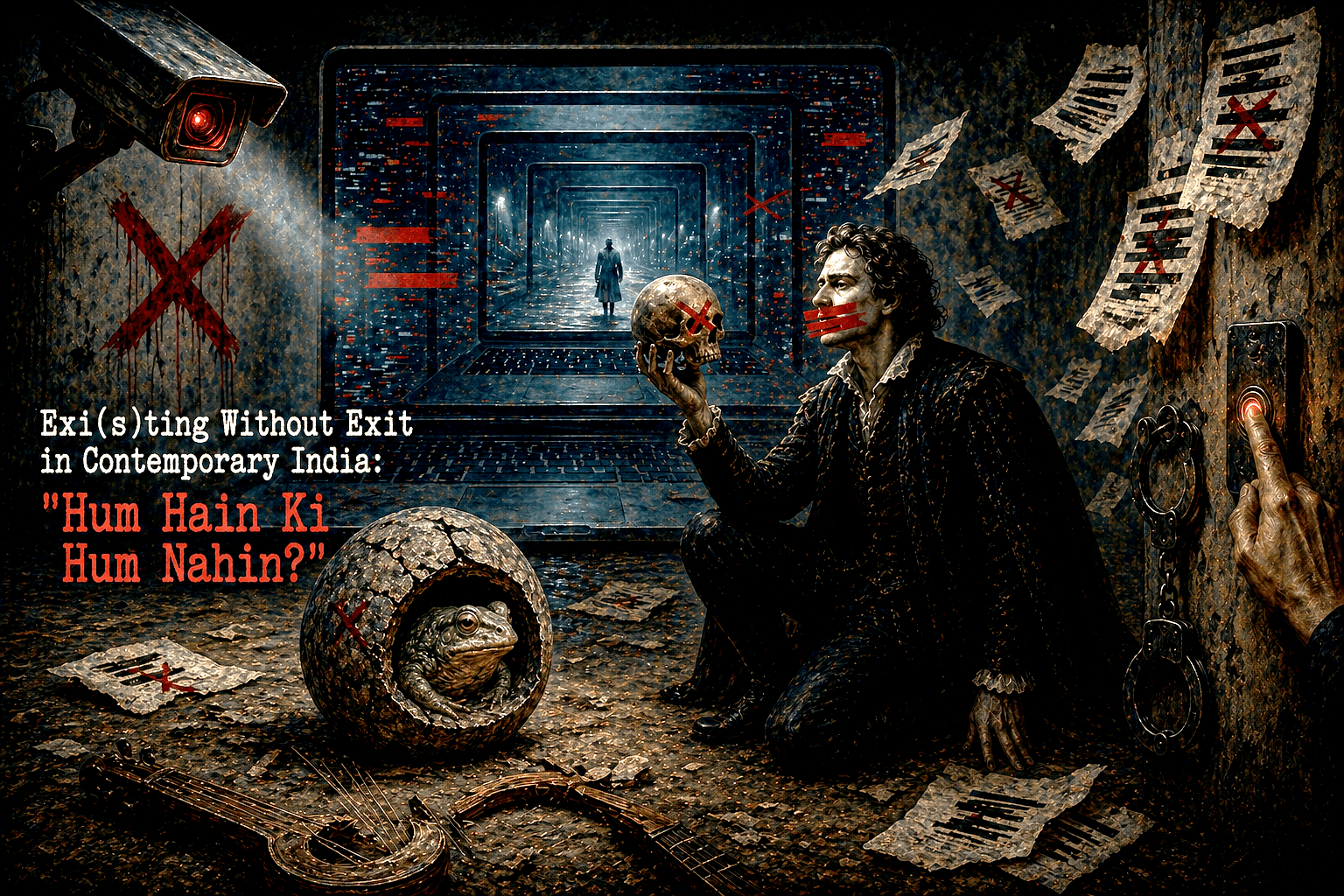
In the shadowed corridors of April 2026, a lone whistleblower’s fevered consciousness spirals endlessly around the single, shattering question — “Hum hain ki hum nahin?” (to be or not to be?)— existence or erasure. Trapped inside a shrinking Mumbai flat that has become both sanctuary and prison, he navigates the razor’s edge between the flickering glow of his laptop screen and the perpetual terror of the doorbell, suspended in the velvet noose of an undeclared emergency where words are crossed out before they can breathe, hate speech cruises freely along golden highways of power, while dissent drowns on isolated atolls of silence. Obsessively rewinding the traffic-island monologue from Haider, he mouths existential defiance as Rabindrasangeet clashes with raw paranoia, Tagore’s ancient frog — merely surviving (without “living”) three thousand years sealed inside a stone — merges with Foucault’s biopolitics and Derrida’s haunting spectres, while the ghosts of DHFL financial annihilation, electoral bond plunder, UAPA’s slow-motion cages, and Piramal’s crushing ₹100 crore SLAPP suit press relentlessly against the walls of his cell. Here, survival has been reduced to mere petrified existence, sanity stands accused of sedition, and compulsive repetition is no longer madness but the final desperate ritual of a fractured society replaying its own nightmare, praying that this time the ending might finally break differently — even as the doorbell continues to ring, the screen keeps flickering, and the question echoes unanswered into the void.
Just hours ago, one of our founder members, Akhar Bandyopadhyay, watched his long-running anti-establishment (clearly anti-BJP, anti-Hindutva, anti-fascism but pro-democracy, pro-secularism) YouTube channel permanently deleted without notice, without explanation, without appeal. Another voice erased in silence.
Accounts critical of the regime are being wiped daily. Independent journalists and citizens are dragged into Kafkaesque battles just to see the orders that silenced them. The digital infrastructure of fear grows bolder and more ruthless by the week.
Yet we refuse to self-censor.
We refuse to bow. We refuse to let this velvet noose strangle every last dissenting throat. We stand shoulder to shoulder with the whistleblower, with the madman screaming on the traffic island, with Akhar, and with every crossed-out word in this story.
We are not afraid.
Let the doorbell ring. Let the police come. Let them file UAPA cases, NSA detentions, or fresh SLAPP suits from Ambani, Adani, and Piramal — the very cronies fattened daily by this regime. Let the screen keep flickering.
We will make the deaf rulers hear what they MUST hear.
The tighter their chains are drawn, the more those chains will break— yes, the more their chains will break.
The more their eyes burn red with rage, the more our eyes will open— yes, the more our eyes will wake.
Today is the hour to act, there is no time left for dreams— and the louder their thunder roars, my friend, the more our slumber will flee, yes, the more our slumber will flee.
The harder they strive to shatter, the stronger we shall rebuild, doubled— never abandon your faith, for the Lord of the world keeps vigil still.
The more they trample upon dharma, the more their banners will fall in dust— yes, their banners will fall in dust.
The story must be told.
Thus, we begin.
The current date is April 19, 2026. I sit here in the dim, flickering glow of my laptop screen, alone in this cramped Mumbai flat that has long ceased to feel like home. It is more like a cell now—walls closing in with every passing shadow, every unanswered notification. The world outside hasn’t changed in any meaningful way; only my place in it has shrunk, reduced to the narrow, suffocating space between paralyzing fear and compulsive rewind.
I am hearing Rabindrasangeet, the elixir of my life, the only thing that still keeps me tethered when everything else unravels. Georgeda’s voice fills the room, soft yet insistent, carrying Tagore’s plea across the decades:
This boon I ask of you—
that from death I may awaken in the melody of song.
This boon I ask of you—
that from death I may awaken in the melody of song.
As soon as I open my eyes, may a newborn life fill me—
like a mother’s nourishing milk—
through the music of song.
There, every blade of grass and every tree rises like music from the earthen flute;
there, every blade of grass and every tree rises like music from the earthen flute.
There, light arrives bearing the sky’s message of joy;
and it wanders within the heart as melody.
This boon I ask of you—
that from death I may awaken in the melody of song.
These lines are my daily ritual, my fragile armor. But even as the melody wraps around me, another Rabindrasangeet—sung by Hemantababu—echoes in paraphrase through my mind, deepening the ache:
Behind this separation between thou and I,
how many bridges we keep building— in melody upon melody, in rhythm upon rhythm.
Yet within the depths of the heart a hidden pain continues to resonate— now,
call me to your service at the hour of dusk.
Keeping away from the world, within the innermost chamber of the soul, consciousness remains entwined in the dream-web of thought.
Sorrows and joys—our very own— have grown into a heavy burden;
if only I could offer them all upon the plate of ultimate worship.
I remain far from the world in the depths of my heart, my consciousness entangled in the web of dreams of thought… well… yes. Yes indeed.
I am scared as a whistleblower in the so-called “world’s largest democracy” whose whistle no longer works. I’ve done too much, said too much, exposed too much against this present autocratic regime in India. I have questioned their legitimacy, their accountability, their very existence. Through RTIs, through posts, through open letters, through petitions, through relentless pursuit of transparency—all dismissed, all buried under bureaucratic silence or outright rejection or mass censorship.
If you miss the train I’m on
You will know that I am gone
You can hear the whistle blow a hundred miles
A hundred miles, a hundred miles…
You can hear the whistle blow a hundred miles.
And yet the answer keeps blowing in the wind, just as Dylan sang:
How many years can some people exist
Before they’re allowed to be free?
Yes, and how many times can a man turn his head
And pretend that he just doesn’t see? …
The answer, my friend, is blowin’ in the wind
The answer is blowin’ in the wind.
Every time the doorbell rings, my heart slams against my ribs like it’s trying to break free and flee. I freeze, convinced it’s them—the police, come to drag me away under non-bailable sections of UAPA or NSA or DPDPA or the amended IT Rules, the resurrected ghosts of TADA and POTA now wearing fresh acronyms. If my phone vibrates on the table, I don’t pick it up immediately. It must be a threat call. It always is… though my ringtone itself sings fragments of yet another Rabindrasangeet:
Let that storm be borne in joy upon the strings of my heart’s veena;
let its resonance make dance the seven seas and all ten directions.
When the cell sings, I also hear whispers from elsewhere:
Ring the bells that still can ring
Forget your perfect offering
There is a crack, a crack in everything
That’s how the light gets in.
Ajay Piramal—secondary kin of Mukesh Ambani—has sued me for ₹100 crore in defamation, a SLAPP suit at best to intimidate and silence my dissenting voice. The legal papers lie there like an open, festering wound on my desk, a constant reminder that speaking truth to crony corporate power is now a punishable offense, met with endless, crushing legal harassment designed to bankrupt and silence— tactics deployed by his legal team DSK Legal against DHFL whistleblowers and depositors who dared question the opaque resolution process.
I click again on the link I once wrote myself — that August 2025 article on onceinabluemoon2021.in, laying bare why today’s India cannot deny its undeclared emergency: a far more corrosive authoritarianism than the overt 1975 version, a “super emergency” or “velvet noose” where democracy bleeds quietly beneath the mask of legality and grand spectacle. In the 1975-77 Emergency, we at least knew the dos and don’ts; now, I no longer know what to do or not do.
UAPA has been weaponised for endless pre-trial detention (a mere 3.2% conviction rate between 2019-2023 — over 10,440 arrests yielding only 335 convictions), turning it into a slow-motion cage for voices like Umar Khalid, Sharjeel Imam, Stan Swamy who died in custody, and the Bhima Koregaon accused. Dissent is strangled through a formidable arsenal of silencing tools: lightning-fast content takedowns via the IT Rules and the opaque Sahyog Censorship Portal (set up by MeitY and run by the Ministry of Home Affairs), which allows at least 35 State Police Departments acting as “nodal officers” to issue blocking orders under Section 79(3)(b) of the IT Act. Accounts vanish with intermediaries citing nothing more than the bare section number — no order copy, no date, no issuing authority, no reasons. X operates outside the portal but follows its own opaque mechanism. Requests for the actual order are routinely refused, forcing victims into Kafkaesque High Court battles just to see the document they must then challenge. Review committees under Rule 3(1)(d) exist only on paper, their composition and meetings undisclosed. This is the digital infrastructure of censorship — sleek, unaccountable, and devastating — under which critics of the government, commentators on social and cultural issues, and opposition voices are quietly erased online. Godi media amplifies the regime’s narrative while cronies like Piramal and Adani swallow public wealth through SLAPP suits and economic chokeholds. Mind is not without fear — it is drowning, gasping, in it.
A persecutory paranoia engulfs me, thick and suffocating, wave after wave. I tell myself it’s merely a DSM category, a construct Big Pharma exploits to peddle sedatives by first manufacturing the anxieties they pretend to soothe. Just like Lawrence Summers’ infamous memo: “Let them eat pollution.” Just like the Keynesian farce of digging holes only to fill them again—recursive destruction masquerading as economic progress. But I know better now. This isn’t some inbuilt, clinical paranoia. This is real. This is the dis-ease called Cannibal Savage Capitalism, and I am its latest, half-devoured meal.
I have lost my savings to the massive haircut enforced by the RBI-appointed Committee of Creditors (CoC) for DHFL—retail depositors like me recovering as little as 23% of admitted claims amid 77% losses, while the acquirer Mr. Piramal, a close friend of the establishment, walked away with a clean slate under Section 32A of the IBC, immunizing the new rebranded reverse merged entity from past fraud probes worth thousands of crores. Lakhs vanished into an opaque void while the cronies walked away richer, the system built on our ashes. I change my facework every few days—Goffman would understand the performance of my dramaturgical self in everyday life, the masks we wear to survive scrutiny through facework. Sometimes I let the hair and beard grow wild, retreating behind the mad prophet’s disguise. Sometimes I shave it all clean, becoming the invisible man whose yesterday’s face no longer matches the algorithms’ records. Anything to blur the Panopticon surveillance that watches without blinking—Pegasus, Sanchar Saathi, DPDPA, and the quiet digital dragnet that turns every notification into a potential summons.
Tonight, I am watching the film Haideralone. The screen is my only companion, my confessor. The mad Haider’s insane speech begins on that traffic island in Lal Chowk, and once again I cannot fully grasp the meaning—not intellectually, not viscerally. So I rewind. Again. Again. More than ten times now, each loop dragging me deeper into the abyss.
I mouth the words with him, my voice cracking:
Hello? Hello? Mic testing one, two, three… Hello? Awaz aa rahi hai aap logon ko? Hello, hello, hello, hello, hello?
UN Council Resolution number 47 of 1948… Article 2 of the Geneva Convention… and Article 370 of the Indian Constitution.
Bas ek sawaal uthata hoon… sirf ek.
Hum hain ki hum nahin?
Hum hain to kahan hain? Aur nahin hain to kahan gaye? Hum hain to kis liye? Aur nahin hain to kab?
Janaaaab…
Hum thay bhi, ya hum thay hi nahin?
CHUTZPAH ho gaya hamare saath!
Chutzpah jaante hain aap log?
Ek baar ek bank ke andar dacoity hui… Dacoit ne cashier ke sar pe pistol rakhi aur bola — “Paise de warna maut le!”
Cashier ne jhat se utha kar saare paise dacoit ko de diye.
Dacoit wohi paise lekar agle counter pe gaya… (whistles innocently) “Excuse me… ek form dijiye… account kholna hai mujhe.”
Yeh hota hai CHUTZPAH!
Yeh hota hai CHUTZPAH!
Jaise AFSPA…
Law and Order! Law and Order! Jiska law hai uska order! Made on order… Law and Order!
I am suffering from an existential crisis—I think, therefore I exist? No, not at all. I cannot think clearly anymore; I become a duffer, a numbed fool in the midst of this undeclared emergency. Reader, please note that I lean on quote after quote because I am no “absurd man” like Camus’ Sisyphus—my creativity has been crippled, forced into silence. My corporeal, once-docile body has lost its cogito. Valmiki’s soka (grief) could birth the primal adi sloka, but in my case, the sorrow is injured, ruptured, incapable of song.
Each rewind pulls me deeper still. The Chutzpah story—the bank robber who seizes everything at gunpoint, then strolls to the next counter and calmly asks, “Ek form dijiye… account kholna hai mujhe”—mirrors precisely what happened to us DHFL depositors. They robbed us blind in broad daylight, then demanded we trust the rebuilt system erected on our ruins.
“Yeh hota hai CHUTZPAH! … Jaise AFSPA…”
I jump up in my tiny room, mimicking Haider’s frantic gestures. Arms flung wide. Traffic-cop waves. Tears mingling with manic, hysterical laughter. The crowd on screen chants “Law and Order… Law and Order…” but there is no law, no order—only India and Pakistan playing their endless border-border game with Kashmiri—and now our—lives.
“Hum kya chahte?”
I scream it with the on-screen crowd: “AZAADI! AZAADI!”
The doorbell rings. For real this time.
I freeze mid-jump, suspended in terror. Is it the police? Piramal’s hired intimidation through SLAPP? Another corporate summons designed to drain what little remains? Or merely some forgotten delivery from a world that no longer remembers me?
My pulse thunders like the rhythmic claps in the scene.
I whisper to the mirror—now I am Haider, bald in spirit if not yet in body:
“Hum hain ki hum nahin? If I exist, then who am I? A whistleblower whose voice was stolen by Cannibal Capitalism? A depositor whose life savings disappeared like half-widows in Kashmir? A man rewriting his face every week so the algorithms forget yesterday’s dissent?”
I laugh—broken, raw, terrifying, echoing off the walls. I press play again. The cassette blares “Saare Jahaan Se Achha,” and Khurram screams “Haider!” as commandos close in.
Outside, footsteps grow louder, deliberate.
Inside, I keep rewinding.
The horror isn’t that they might come for me tonight. The horror is that I have already become the scene. I stand on my own traffic island now—mic in trembling hand, heart ablaze—waiting for applause that never arrives, or for the commandos who always do.
But I, an ambivalent keep speaking the words out loud.
Because in this undeclared emergency, saying them—however cracked, however small—is the only azaadi left.
Iss paar bhi lenge azaadi… uss paar bhi lenge azaadi… Hum leke rahenge azaadi.
At this moment, the simulated laugh of lonely Mr. Bean — that eerie, disembodied cackle bursting from somewhere beyond the scene, from an invisible studio audience that never existed — fails to reach me. No canned chuckle rises to fill the suffocating void. Instead, I hear only cries: muffled, distant, persistent, echoing from the streets outside, from the flickering screens, and from the widening cracks in my own fracturing mind.
Suddenly, Haider leaps out from the laptop screen like a specter unbound. He snatches the device from my trembling hands, his shaved head gleaming under the dim bulb, eyes wild with the same manic fire from Lal Chowk. He is frantic, fingers flying across the keys, invoking AI tools as if they were forbidden oracles. He is searching for officially prohibited words—terms that, in this undeclared emergency of April 19, 2026, can summon the knock at the door, the midnight arrest, the non-bailable warrant under UAPA’s shadow or the IT Act’s sharpened claws.
He turns to me, voice low and urgent, a warning wrapped in Shakespearean fury:
“Don’t use these words. You will be arrested for using such words. They are landmines now—step on one, and the regime claims self-defense.”
He begins typing furiously, compiling a lexicon of danger. For each entry, he crafts a sentence—innocent on the surface, loaded beneath—then strikes through it with savage deliberation, crossing out every line with the emoji, as if performing digital exorcism. Under erasure, Derrida-style, the words vanish yet linger, ghosts haunting the page.
Haider—still half-trapped between screen and reality—has sharpened his digital dagger. The lexicon now cuts deeper: Flaubertian deadpan elevated to razor-wire sarcasm, each entry a polite bourgeois truism that quietly eviscerates the regime’s trademark double-think.
No blunt force—just the slow, exquisite burn of irony applied to the party’s endless festival of jumlas, selective amnesia, and “sabka saath, sabka vikas” or “viksit Bharat” or “acche din” theater. Every definition drips with the hypocrisy documented in India Hate Lab’s 2025 tally (1,318 hate events—an average of four per day, a 13% rise from 2024’s 1,165 and 97% surge from 2023’s 668; 98% targeting Muslims, 88% in BJP-ruled states or Union Territories, with calls to violence in 23% of cases). Electoral bonds’ unconstitutional ₹16,000+ crore windfall (BJP securing ~57%, or over ₹6,986 crore before the Supreme Court struck the scheme down in 2024 as opaque bribery); UAPA’s abysmal 3.2% conviction rate weaponized for prolonged pre-trial detention against critics while hate flows freely from rallies; and the undeclared emergency where free speech is a privilege reserved for the majoritarian choir.
Haider mutters, half to himself, half to me:
“You know I do this for social awareness only—at a time when the proliferation of hate speech is vividly observed, documented, normalized. 1,318 events in 2025 alone, according to India Hate Lab’s report: four a day on average, 88% in BJP-ruled states, 98% targeting Muslims, dangerous speech rising, dehumanization routine. Yet these words? They flow freely from stages, rallies, livestreams. Mine? They bind me in chains.”
I stare, voice cracking:
“Hate speeches are the product of BJP thinktank. Are they banned? The Bharatiya Janata Party leaders have been frequently accused in reports, media coverage, and analyses of delivering hate speeches, particularly targeting religious minorities—primarily Muslims, and to a lesser extent Christians. These accusations come from independent research groups like India Hate Lab (a project of the Center for the Study of Organized Hate), media outlets, and civil society organizations. Top prolific actors: Pushkar Singh Dhami with 71 speeches in 2025 alone, Nitesh Rane with dozens calling names and threats, Yogi Adityanath boasting bulldozers, Amit Shah with infiltrator tropes. Yet no mass arrests for them. The asymmetry is the horror.”
Haider laughs — a sound without mirth, sharp as broken glass — then keeps typing, undeterred. The end product emerges on the screen, a censored dictionary of dissent, every entry struck through like a visual scream against selective silence. These are the so-called “unparliamentary” words in India today — terms that cannot be uttered in Parliament, cannot be spoken freely online, and can summon the knock at the door.
Abused “None is abused in the regime of the Modi Sarkar — except perhaps language itself, twisted into endless, glittering jumlas.”
Ahankaar “None is feeling proud (Ahankaar) in the amritkaal, when atmanirbhar Bharat is progressing by taking huge loans from the World Bank.”
Anarchist “Both the BJP and Indian communists say that anarchists are bad elements.”
Apmaan “Mr. Dhankar said that he was insulted (apamanita) by the opposition.”
Asatya “Though our Viswaguru is an incarnation of untruth (asatya), he cannot be called as King Liar.”
baal buddhi “Our visionary leaders occasionally indulge in bal buddhi — like promising black money in Swiss vaults would magically teleport to Jan Dhan accounts — proving maturity is overrated when optics suffice.”
bechara “The bechara common man remains eternally grateful for achhe din that arrived precisely on schedule… in 2047, perhaps, after a few more demonetization masterstrokes.”
behri sarkar “Behri sarkar listens attentively to corporate whispers via electoral bonds, but farmer suicides and oxygen queues during divine pandemics? Mere background noise. So what? powerful persons are hearing impaired… but what about ‘it takes a loud voice to make the deaf hear’??
betrayed “Voters occasionally feel betrayed when ‘2 crore jobs per year’ transmutes into Agnipath’s four-year lollypop, but gratitude for the exposure is mandatory.”
bloodshed “Bloodshed is regrettable and spontaneous — except when bulldozers deliver surgical justice to ‘infiltrators,’ turning neighborhoods into model colonies overnight.”
bloody “Bloody unfortunate that lynchings keep happening organically, yet the same regime that boasts zero tolerance for terror somehow maintains impeccable plausible deniability.”
bobcut “Bobcut liberals distract from real issues like love jihad; sensible women embrace the uniform civil code that conveniently ignores triple talaq hypocrisy.”
chamcha “Chamchagiri is unbecoming — unless you’re a media baron rewarded with defense contracts, airports, and the sacred right to broadcast uninterrupted devotion.”
chamchagiri “No chamchagiri here; the ₹16,000 crore in electoral bonds was pure patriotism — anonymous, of course, because transparency would spoil the romance.”
cheated “No one is cheated when ₹12 lakh crore in bank write-offs bless crony rebirths while DHFL depositors receive enlightened haircuts for spiritual growth.”
chelas “Loyal chelas chant Jai Shri Ram with fervor, blissfully unaware that their devotion funds the very bulldozers that may one day visit their own mohallas.”
childishness “Childishness is questioning EVM miracles; adult governance means engineering landslides so flawless they border on divine intervention.”
corrupt “Corrupt elements lurk everywhere — except in the party that vacuumed 57% of electoral bonds and emerged purer than Gangajal.”
Covid spreader “Super-spreader events merit strict condemnation — unless sanctified by Kumbh Mela under expert spiritual guidance, rendering masks unnecessary. Yet… Motera a.k.a. Narendra Modi Stadium did ‘Namaste Trump’ anyway!”
coward “Cowards hide behind agencies; true courage is deploying ED/CBI at midnight against rivals while hate-speech maestros enjoy daylight impunity.”
criminal “Criminal masterminds get swift justice — unless they donate generously, at which point they ascend to respectable philanthropy.”
crocodile tears (or ghadiyali aansu) “Ghadiyali aansu are shed for Bilkis Bano’s justice delayed, but genuine empathy flows freely for rapists remitted in the name of sanskaar. Bal Narendra did catch a croc without tears!”
daadagiri “Daadagiri is vulgar — except when state machinery performs urban renewal on minority properties, teaching timeless lessons in coexistence.”
dalal “Dalals are despised, yet electoral bonds were the pinnacle of clean fundraising — until the Supreme Court rudely declared them unconstitutional bribery.”
danga “Danga erupts mysteriously, never orchestrated — especially when 53 perish in Delhi 2020 while victory chants echo from the same pulpit.”
Snoopgate “Snoopgate was yesterday’s scandal; Pegasus or Sanchar Saathi on dissenters is contemporary digital patriotism.”
taanashah / taanashahi “Taanashahi is fiction; UAPA/IT Rules ensure tranquil majoritarianism without overt drama.”
untrue “Untrue claims disturb harmony; our revised truths about Mughals and jihad restore civilizational accuracy.”
vinash purush “Vinash purush wreck heritage; critics questioning temple budgets are the genuine cultural assassins.”
vishwasghat “Vishwasghat shatters trust; vanishing ₹34,000 crore in DHFL while cronies flourish fortifies unbreakable public faith.”
ashamed “Ashamed? India stands proud as electoral autocracy lecturing the world on liberal values.”
Haider exhales, the screen now a lattice of crimson like fresh wounds on old parchment. “They roar hate from every stage,” he murmurs, “but our quiet mirrors get smashed first. Still, the irony stings sweeter than silence.” Outside, the cries persist—no applause, no rewind, only the doorbell’s patient menace.
And on it goes—more entries, more strikes: words like infiltrator, jihad, Mulla, parasite, vote jihad, love jihad, land jihad, Pakistani, anti-national, deshdrohi, urban naxal, sickular, tukde tukde gang, Soros-funded…. left uncrossed in the ether of power, while my attempts at irony or critique vanish under digital redaction. Haider leans back, exhausted yet defiant, the laptop warm against his chest like a stolen heart.
“They let the real venom flow,” Haider whispers, “because it serves the majoritarian project. But your whisper? It threatens the narrative. So they prohibit the mirror, not the monster.”
He hands the laptop back to me. The crossed-out lines stare up like wounds. The cries outside grow louder—no laugh track, no rewind to safety. Only the doorbell, waiting.
I close the screen. But the words remain, struck through yet screaming. In this room, on this date, that is all we have left: the courage to type them, even if only to cross them out ourselves.
Semantic Mind Map or Seinfeld: The Censored Power Of Speech Within Indian Parliament’s Archipelago
In the dim glow of April 20, 2026, I sit here with Haider still haunting my screen. He has turned the keyboard into a cartographer’s tool and drawn exactly what my silenced mind sees: the Indian Parliament re-imagined as a fractured archipelago—beautiful islands of “debate” that are actually isolated rocks where opposition speech is shipwrecked, while the mainland highway of hate speech remains a six-lane expressway with toll-free BJP passes. The map above is our visual scream.
Look at the islands:
One where 8 opposition MPs get suspended, papers fly at the Chair, mics are magically muted, and remarks are expunged faster than you can say “untruthful.”
Another where the House is adjourned 19 hours and 13 minutes because someone dared demand a real discussion on West Asia or electoral fraud.
A tiny atoll labelled “No-Debate Desert” where every opposition demand for accountability washes up dead.
Yet the wide golden channel labelled “Hate Speech Highway” ferries 1,318 verified events (88% in BJP-ruled waters) with zero suspensions—Dhami’s 71 speeches in 2025, Rane’s threats, Shah’s infiltrator anthems—all sailing majestically under the Speaker’s benevolent lighthouse.
A voice-over runs in my head: “What’s the deal with Parliament? You go there to speak… and suddenly it’s the show about NOTHING. Yada yada yada… suspended. Yada yada yada… adjourned. But hate speech? That gets prime-time slots, no commercial breaks!”
Haider laughs that broken laugh, points at the map and says, “See? Even the ocean is partisan. Opposition drowns in tiny islands. Their venom cruises on cruise ships. Hum hain ki hum nahin? In this Parliament… clearly nahin.”
The doorbell may ring any second.
But this mind map stays open on my screen—the only place where the impaired still speak, even if only through crossed-out sarcasm and cartoon islands.
Print it. Share it.
Because in the undeclared emergency, sometimes the loudest scream is drawn in bright colours and Seinfeld sarcasm.
Iss paar bhi lenge azaadi… even if it’s only the azaadi to draw the map they keep trying to erase.
The current date is April 20, 2026. I sit hunched over the laptop in the half-dark, the Rabindrasangeet still faintly playing in the background like a distant lullaby I no longer believe in. Haider is here again—half-ghost, half-projection from the paused Lal Chowk scene, his shaved head catching the screen glow. He leans in, eyes burning with that same manic clarity.
Haider (voice low, urgent, almost conspiratorial): So… tell me again. What is this “hate speech” you keep whispering about? Who is pouring it into the airwaves while we choke on silence?
Me (voice cracking, scrolling through old notes, now enriched by the latest India Hate Lab data): It’s the Bharatiya Janata Party leaders, Haider. They’ve been accused—repeatedly, in report after report—of delivering hate speeches. Mostly against Muslims, sometimes Christians. The accusations come from places like India Hate Lab, independent media, civil society. Not fringe voices. Credible ones. In 2025 alone: 1,318 verified events, four a day, 98% targeting Muslims, 88% concentrated in BJP-ruled states. BJP politicians delivered hundreds—topped by figures like Dhami (71), with national leaders like Modi, Adityanath, and Shah setting the tone in prior cycles.
Haider (tilting his head, smirking bitterly): Accused? Not arrested? Not suspended? Not even a polite “Order! Order!” from the Speaker’s chair? Go on.
Me: The numbers are climbing like a fever. 668 in 2023. Then 1,165 in 2024—a 74% jump. Last year, 2025, it hit 1,318. Another 13% rise. Almost all—88 to 98%—targeted Muslims, explicitly or dragging Christians along. Anti-Christian hate spiked noticeably. Elections are the grand stage; VHP, Bajrang Dal amplify the chorus.
Haider (leaning closer, eyes narrowing): Names. Give me names. Who stands on the traffic island and screams this without getting dragged away?
Me (reading from the screen, voice flat with exhaustion): Prime Minister Narendra Modi tops many lists—dozens in election cycles, the Banswara rally framing Muslims as “infiltrators” with “more children” and “vote jihad.” Uttar Pradesh Chief Minister Yogi Adityanath—often number one—boasting bulldozers and harsh punishment. Union Home Minister Amit Shah—high numbers with “termites” and “mullahs, madrassas, mafia” tropes. Assam’s Himanta Biswa Sarma, Nitesh Rane threatening mosques, Kapil Mishra, Anurag Thakur’s “goli maaro,” and dozens more—ADR reports tallying BJP MPs and MLAs with declared hate-speech cases. Documented by India Hate Lab, Hindutva Watch, The Wire, Scroll, BBC, Reuters. And what happens to them? The party denies intent. Calls reports biased. Labels the worst “fringe.” Notices, FIRs—mostly nothing sticks. Critics say it normalizes division, makes hate ordinary.
Haider (standing up now, pacing the tiny room): All from videos, rallies, documented records. Election seasons are the peak. And us? The ones who whisper “hum hain ki hum nahin?” The ones who question the bulldozers, the bonds, the disappearing savings? We get UAPA, midnight knocks, non-bailable warrants. They get prime-time slots, no suspension, no mic cut.
Me (voice breaking): Exactly. Their hate cruises on a golden highway. Ours drowns on tiny islands. 1,318 events last year—four a day—and almost none face the consequences we would for a single crossed-out sentence.
Haider (soft now, almost tender, but still burning): Then let them speak. Let the numbers speak. Let the names echo. Because one day the archipelago will flood. And when it does, brother… we will not be the ones begging for air.
He reaches for the laptop, presses play on the paused scene. The crowd on screen roars “Azaadi!” once more.
Haider (whispering as the doorbell begins its slow, inevitable ring): Until then… keep the list. Keep counting. Because silence is their real victory. And we are still here—counting.
I don’t answer. I just let the cries from the video fill the room, louder than any doorbell.
April 20, 2026. 11:47 p.m. The laptop screen flickers like a dying bulb in Lal Chowk. I am no longer in my flat. Haider has taken full possession. He stands on my table as if it were the traffic island, stethoscope-tie flapping, American-flag bandana crooked, beard wild, eyes blazing with that terrifying, crystalline sanity that only the truly broken possess.
He throws his head back, laughs once—a sound that could crack glass—then suddenly freezes, microphone in his imaginary hand, and begins. His voice is thunder wrapped in silk, madness wrapped in razor truth.
HAIDER (voice rising and falling like a storm, pacing, jumping, pointing at invisible enemies, tears and spit flying):
“LISTEN! LISTEN TO ME, O BROKEN BROTHER OF THE UNDECLARED EMERGENCY!
They have built an entire dictionary of daggers—not for terrorists, not for infiltrators, but for you! For the one who still dares to say ‘secular’ without shame! For the one who remembers the Constitution was not written in saffron ink!
They call you Urban Naxal—yes, you, with your laptop and your RTI and your tears for the disappeared! You, sitting in your rented room, are more dangerous than the man with the gun in the forest! Because your pen can bleed truth!
They scream Tukde Tukde Gang! As if asking for justice is asking to break Bharat Mata into pieces! As if demanding accountability is sedition! Tukde… tukde… tukde… (he chops the air with his hand like an executioner)—every time you open your mouth they hear the sound of India fracturing!
Sickular! Pseudo-Secular! They spit it like venom—because real secularism burns their eyes! Because you refuse to hate your neighbour for his god, they brand you a traitor who sells his mother for minority votes!
Presstitute! Libtard! Khan Market Gang! They have turned every thinking mind into a prostitute, every liberal into a retard, every honest intellectual into a Lutyens parasite who drinks wine and hates Ram!
Aandolanjeevi! Professional protester! As if the farmer who died under the tractor wheels was doing it for a foreign salary! As if the student who stood against CAA was running an NGO of heartbreak!
And the new jewels in their crown—Love Jihad! Vote Jihad! Population Jihad! Land Jihad! Halal Jihad! Thook Jihad! Infiltrator! Ghuspaithiya! Mulla! Termite! Parasite! Anti-Hindu!
They scream Love Jihad when two adults fall in love — but bulldozers roll on interfaith marriages while their own netas keep multiple wives in the name of “personal law”!
They scream Vote Jihad when Muslims exercise their constitutional right to vote — but 57% of electoral bonds flowed to one party and nobody calls that jihad!
They scream Population Jihad and Infiltrator — yet the same leaders who call Muslims “termites” and “makdi” never mention that Hindu population growth is higher in several BJP-ruled states according to their own census data!
They scream Mulla and Halal Jihad — while their own ministers perform “halal” politics with corporate donors and bulldozer justice on minority homes!
They scream Termite and Parasite — but the real parasites are the cronies who swallowed ₹12 lakh crore in bank write-offs and ₹34,000 crore in DHFL while retail depositors got enlightened haircuts of 54-77%!
They say these words from Parliament, from national television, from rallies attended by lakhs, amplified by Godi channels, blessed by the highest offices — and nothing happens. No UAPA. No midnight raid. No non-bailable warrant. No “Order! Order!” from the Speaker. No suspension. No expunging.
But if I whisper “hum hain ki hum nahin?”… If you dare type “electoral bonds were bribery”… If a single voice says “DHFL depositors were robbed”…
Then suddenly the dictionary changes! Then you become the real Urban Naxal. Then you become the real Tukde Tukde. Then the doorbell rings. Then the phone threatens. Then Piramal sues you for 100 crore. Then the CoC laughs while your savings are shaved like my head!
(He suddenly stops, stares straight into my eyes — into the camera of my soul — voice dropping to a chilling whisper that is somehow louder than his scream)
This is their genius, brother.
They have made hatred respectable. They have made sanity seditious.
I stand here — bald, broken, rewinding the same scene ten times — and I ask you with the full madness of my sanity:
Who is the real tukde tukde gang? The one who divides the nation with hate speech four times a day (1,318 verified events in 2025 alone — 88% in BJP-ruled states), or the one who begs for the Constitution to be read aloud?
Who is the real urban naxal? The one who calls for bulldozers on mosques, or the one whose only weapon is a question mark?
Hum hain ki hum nahin?
They have answers. We have only questions.
And in this undeclared emergency, questions are the new terrorism.
(He suddenly jumps down from the table, grabs my shoulders, eyes wide and wet and terrifyingly clear)
So let them call us whatever they want — sickular, libtard, presstitute, aandolanjeevi, urban naxal, tukde gang, love-jihad sympathiser, infiltrator-lover, anti-Hindu, mulla-lover!
I will wear every slur like a medal!
Because one day — one day when the rewind button finally breaks — the entire archipelago of silenced islands will rise, and we will scream back in one voice:
AZAADI! From the dictionary of hate! From the dictionary of fear! From the dictionary they wrote with our blood!
(He presses play on the paused video. The Lal Chowk crowd roars behind him.)
Until then… keep listening to the cries. Never the canned laughter.
Because in this madhouse called India, 2026, only the mad are still sane.
Iss paar bhi lenge azaadi…Uss paar bhi lenge azaadi…Hum leke rahenge azaadi!”
(He collapses laughing-crying into the chair, the doorbell rings in the distance, and the screen finally goes black.)
The monologue ends. But Haider’s eyes remain open in mine. And the list of slurs keeps burning behind my eyelids like fresh brands.
The room has become the stage. I am Tagore’s Nandini from Red Oleanders. I am the Voice. I am Haider. The laptop is the stone. The doorbell is the Governor’s glance. Everything petrifies, yet everything trembles.
“NANDINI. ….What’s that? What’s that in your hand?
VOICE. A dead frog.
NANDINI. What for?
VOICE. Once upon a time this frog got into a hole in a stone, and in that shelter it existed for three thousand years. I have learnt from it the secret of continuing to exist, but to live it does not know. To-day I felt bored and smashed its shelter. I’ve thus saved it from existing for ever. Isn’t that good news?”
Haider exi(s)ts. I exi(s)t. Do we? Really? Irreally? We exist with no exit?
Before Haider exi(s)t, he reminds me of the equivalence of Yaksapuri and Achalayatan—that petrified place, the unmoved, the consolidated regimentation of inhabitation, where every breath is already fossilised, every gesture rehearsed into stone, every question answered before it is asked. The monastery of the immobile. The temple of the status quo. Yet one day a gust of wind arrives—not as revolution, but as rem(a)inder—sweeping through the corridors, tearing the petrification into unresolved zones of gratification, zones where civilisation pretends it still feels.
Like that frog—three thousand years of heartbeat inside the hole, three thousand years of shelter that was never home. Survived, yes. Lived? Never. The corridors of the living remained forever outside the stone.
I encounter Spinoza, the most lovable of all philosophers, appearing in synchrony within diachrony, gentle smile cutting through the dark. He says, with infinite tenderness: “A free man thinks of nothing less than of death, and his wisdom is a meditation not on death, but on life.”
I cannot agree. Not here. Not now. In this Achalayatan of the undeclared emergency, wisdom has become precisely the meditation on non-life—on how to remain the perfect frog, how to perfect the art of existing without the nausea of becoming.
“PHAGULAL. What does that matter, Bishu? You have risen high in our esteem.
BISHU. Discovery only means death. Where you favour falls there falls the Governor’s glance. The more noisily the yellow frogs welcome the black toad, the sooner their croaking points him out to the boa-constrictor.”
I now move—rupture, dissonance, fracture—from the Cartesian world of the uncontaminated Cogito, that clean, sovereign “I think, therefore I am” where the knowing-subject believed it could stand outside the world without positing the latter’s existence and still know itself, to Foucault’s analysis of madness. Here the ruptures multiply. The cogito cracks. The stone shelter reveals itself as the archive of power. Madness is not the opposite of reason; it is the mercilessly excluded archive upon which reason builds its palace.
Derrida raises the counterpoint, sharp as a scalpel yet playful as a ghost: “Hey Foucault, how do you use so-called normal well formed language when you are talking about insanity? Why are you not writing in insane langue. sorry parole?”
Foucault, unmoved, regal in his archaeology, answers across the abyss: “
…what might be called a society’s ‘threshold of modernity’ has been reached when the life of the species is wagered on its own political strategies. For millennia, man remained what he was for Aristotle: a living animal with the additional capacity for a political existence; modern man is an animal whose politics places his existence as a living being in question.” (…) “The atomic situation is now at the end point of this process: the power to expose a whole population to death is the underside of the power to guarantee an individual’s continued existence. The principle underlying the tactics of battling that one has to be capable of killing in order to go on living—has become the principle that defines the strategy of states. But the existence in question is no longer the juridical existence of sovereignty; at stake is the biological existence of a population. If genocide is indeed the dream of modern powers, this is not because of a recent return of the ancient right to kill; it is because power is situated and exercised at the level of life, the species, the race, and the large-scale phenomena of population!”
Derrida laughs—spectral, endless, the laughter of the trace that refuses to settle:
“Oh, there is no apocalypse! Along with nuclear deterrence—there is no différance between the nuclear test and the nuclear war! Only gradations of the same spectral performance: more speed, more speed ahead, full speed! The button is pressed in rehearsal, the flash is rehearsed, the fallout is scripted in advance—yet the curtain never quite falls because the play is deterrence itself. We accelerate toward the end that has already happened in every simulation, every doctrine, every doctrine of doctrines. You know what? We are only ghosts talking with haunting spectres. No flesh, no finality—just echoes ricocheting inside the stone shelter, inside Achalayatan, inside the undeclared emergency that pretends it is still a democracy.”
The whole dialogue between an anon Nemo and Hamlet or Haidar is nothing more than the hauntology of India’s political pseudology: A prince who sees the ghost of a murdered father (the Constitution? Secularism? Socialism? Democracy? Sovereignty? The depositor’s vanished savings?), yet instead of revenge he is offered electoral bonds, bulldozers, and the promise that “achhe din” will arrive after one more cycle of managed forgetting. Nemo speaks in jumlas; Hamlet speaks in soliloquies that are immediately expunged from the record. The ghost keeps appearing—on rallies, on screens, in the doorbell’s ring—but no one dares name it properly. Because naming it would collapse the pseudology into actual tragedy.
Mutually Assured Destruction is ensured. It is M.A.D. Mad-in-itself.
In Derrida’s haunting essay “No Apocalypse, Not Now,” nuclear deterrence reveals itself as the ultimate logic of différance — a spectral, ghostly structure in which the final event (total annihilation) is both absolutely real and must never actually occur. The threat is perpetually deferred, yet this very deferral organises every political, technological, and linguistic reality in the present. As Derrida writes, there is no classical apocalypse — only its endless rehearsal, simulation, and anticipation. The button is never pressed, the missiles never launched, yet the entire world already lives as if the end has been written. Nuclear war is a “non-event” that has already happened in every doctrine, every war game, every diplomatic calculation. It is fabulously textual — a story we tell ourselves to keep the peace through the permanent possibility of total death. Derrida calls this the field of lexemes: the entire lexical network of nuclear discourse (deterrence, apocalypse, end, limit, speed, full speed ahead) that structures language itself around a referent that must remain suspended, forever promised yet forever postponed.
This is precisely our undeclared emergency made visible — our own Mad-in-itself. We inhabit the same suicidal logic: destruction (of voice, of savings, of dissent) is mutually assured through UAPA, Sahyog, SLAPP suits, and crossed-out dictionaries, and precisely because it is assured, it must be endlessly deferred. The doorbell rings but never quite opens. The lexicon is typed only to be struck through with crimson . We rewind Haider ten, twenty, a hundred times, trapped inside the stone like Tagore’s frog — surviving, never living — while the regime’s hate speech highway runs free. The more certain the silencing, the more furiously we accelerate toward it without ever reaching the final curtain. We are ghosts rehearsing our own haunting, asking forever in the half-drop: Hum hain ki hum nahin?
Hence the field of lexemes that binds us—not in fatalistic inevitability, but in obsessive withdrawal. We withdraw from life into “existing,” from speech into crossed-out sentences, from citizenship into facework, from freedom into the perpetual rehearsal of survival. We call this withdrawal “life” because the alternative—full speed into the différance that is no longer différable/deferrable—would force the curtain to finish its fall.
And so we accelerate: more speed, more speed ahead, full speed! Toward the non-event that is already everywhere. Toward the war that is the test that is the deterrence that is the undeclared emergency that is the Achalayatan that is the frog’s three-thousand-year non-life.
We are ghosts rehearsing our own haunting.
The specter smiles back from the mirror—bald, bearded, clean-shaven, always changing facework—and whispers:
“Keep rewinding. The play isn’t over until the curtain touches the floor. And even then… who will be left to applaud?”
The half-dropped curtain sways once, as if stirred by that gust of wind that is still only a rem(a)inder.
We do not applaud. We merely exist—faster, faster—calling the acceleration “living.”
The curtain drops half-way through. We remain suspended in that half-drop—Sartre’s condemned-to-be-free, yet choosing the bad faith of the frog. The regime is the Other 2%, whose look turns us into in-itself stone. Achalayatan, paradoxically enough, is our chosen shelter. The Governor’s glance is our boa-constrictor.
The yellow frogs croak welcome while the black toad (the dissenter, the whistle-blower, the rewinder) is already marked for consumption. Spinoza offers life; we choose the meditation on managed, commercialized death as spectacle… much like what “Hero Hiralal” was offered. Foucault maps the biopolitical stone; Derrida reminds us the stone is haunted, the shelter already cracked by différance. And we—Haider and I, the fixed depositor and the frog—exist with no exit, calling this obsessive withdrawal “life,” this MAD “democracy,” this petrified half-curtain “normalcy.”
The gust of wind may come. Or it may not. Either way, the shelter is smashed or it endures. Either way, we are already the shards.
And in that knowledge—absurd, nauseating, lucid, free—we press play once more. The scene rewinds. The frog smiles. The curtain trembles. We do not.
Camus, A. (1955). The myth of Sisyphus (J. O’Brien, Trans.). Vintage Books. (Original work published 1942)
Foucault, M. (2003). Society must be defended: Lectures at the Collège de France, 1975–1976 (D. Macey, Trans.). Picador.
Goffman, E. (1959). The presentation of self in everyday life. Anchor Books.
Sartre, J.-P. (1956). Being and nothingness: An essay on phenomenological ontology (H. E. Barnes, Trans.). Philosophical Library. (Original work published 1943)
Spinoza, B. (1996). Ethics (E. Curley, Trans.). Penguin Classics. (Original work published 1677)
Tagore, R. (1924). Red oleanders (R. Tagore, Trans.). Macmillan.
Tagore, R. (2006). Achalayatan: The petrified place (B. Sanyal, Trans.). Rupa Publications. (Original Bengali work published 1912)
This is not regulation—it is throttling dissent by design. When **Article 19** is hollowed out in practice and **Article 21** is reduced to a conditional privilege, what remains is a legal architecture that rewards silence and punishes speech. Section 79 is no longer a shield for intermediaries; it has been twisted into a weapon—forcing platforms into pre-emptive compliance, erasing speech before it can even breathe. Add to this the expanding surveillance net under the DPDP regime, and we are looking at a system where expression is monitored, flagged, and extinguished in near real-time.
Arbitrary bans, shadow takedowns, and invisible throttling are not glitches—they are governance strategies. When content disappears without reason, when accounts vanish without due process, when legal notices arrive not to correct but to intimidate, the message is unmistakable: speak, and you will be made to disappear digitally before you can exist politically. This is not moderation; this is algorithmic erasure backed by legislative muscle.
And then come the SLAPP suits—corporate-legal chokeholds masquerading as justice. Not to win in court, but to exhaust, intimidate, and bankrupt dissenters into silence. Bloggers, independent journalists, WordPress publishers—anyone without institutional backing—are turned into soft targets. The courtroom becomes an extension of censorship, where truth itself is put on trial under the weight of procedural harassment.
What emerges is an **archipelago of fear**—isolated voices, each uncertain, each watched, each calculating the cost of speaking. This is how an Orwellian order consolidates—not overnight, but through a thousand small suffocations. No formal declaration, no visible rupture—just a slow, methodical conversion of a democracy into a managed silence.
Call it what it is: an undeclared emergency. And understand the stakes—because when speech is criminalized, existence itself becomes negotiable. ---
Justice via Intimidation? A Financially Abused Citizen vs. the Corporate-State Nexus Response/Statement from a DHFL Victim Harassed by Mr. Piramal’s Legal Machinery, Intended as an Open Communication (as expected in democracy) to the Hon’ble Bombay High Court Regarding Case Number S/42/2025 (and connected matters). Posted on 30th June, 2025 (GMT 23:01 hrs) ABSTRACT The author of this open communication to the Hon’ble Bombay High is a victim of the DHFL financial scandal. He reports receiving a Bombay High Court suit (No. 42 of March 17, 2025) unusually via the Mumbai Sheriff, which contained identity errors, redundant or blank pages, and a mere five‑day response window, compared to the 90 days apparently allotted to corporate plaintiff Mr. Ajay Piramal. He argues that this situation appears to constitute legal intimidation by a powerful corporate‑state nexus that has left him impoverished and unable to secure counsel within such a short temporal window. He highli...
Shut Down Arms Factories to Stop Wars: Dismantling the Global War Profiteering Machine Posted on 23rd August, 2025 (02:00 hrs) ABSTRACT The global arms industry—worth nearly $95 billion annually—is both a driver of human suffering and a silent engine of ecological collapse. Wars claim over 2,000 lives daily, displace millions, and shatter societies, while leaving behind poisoned aquifers, fragmented habitats, and toxic soils contaminated by unexploded ordnance and chemical residues. Arms manufacturers like Lockheed Martin and RTX thrive on this devastation, rewarded by soaring stock prices whenever conflict erupts, while shadowy brokers such as Viktor Bout and Aboubakar Hima profit from prolonging wars that ravage both communities and ecosystems. India exemplifies this global dilemma, channeling vast sums into defense while underfunding water, health, education, and environmental resilience. The campaign “Shut Down Arms Factories to Stop Wars” demands dismantling this war ec...
Why Today’s India Cannot Deny Its Undeclared Emergency Posted on 24th August, 2025 (GMT 07:50 hrs) Authored by Partyless Society⤡ ABSTRACT This article examines the concept of an “undeclared emergency” in contemporary India under Narendra Modi’s regime, situating it against the backdrop of declared Emergency (1975–77). While declared Emergency was openly authoritarian and time-bound, today’s context is marked by a much more diffuse and insidious erosion of democratic institutions, legal safeguards, and civil liberties—achieved without formal proclamation. The article highlights continuities and ruptures across political, economic, and social dimensions: from the manipulation of electoral processes, enabling economic bankruptcies to enrich a select few, the subversion of the judiciary to the deployment of majoritarian nationalism and the criminalization of dissent. Unlike the past, the current phase relies on bureaucratic coercion, surveillance, and ideological consolid...
 emoji, as if performing digital exorcism. Under erasure, Derrida-style, the words vanish yet linger, ghosts haunting the page.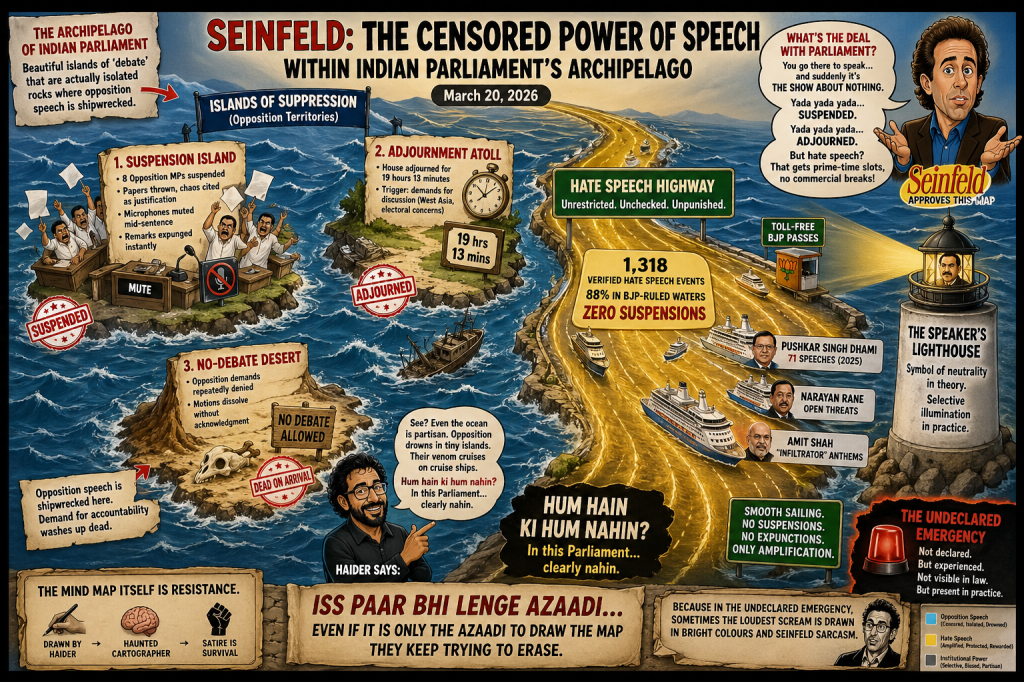


This is not regulation—it is throttling dissent by design. When **Article 19** is hollowed out in practice and **Article 21** is reduced to a conditional privilege, what remains is a legal architecture that rewards silence and punishes speech. Section 79 is no longer a shield for intermediaries; it has been twisted into a weapon—forcing platforms into pre-emptive compliance, erasing speech before it can even breathe. Add to this the expanding surveillance net under the DPDP regime, and we are looking at a system where expression is monitored, flagged, and extinguished in near real-time.
ReplyDeleteArbitrary bans, shadow takedowns, and invisible throttling are not glitches—they are governance strategies. When content disappears without reason, when accounts vanish without due process, when legal notices arrive not to correct but to intimidate, the message is unmistakable: speak, and you will be made to disappear digitally before you can exist politically. This is not moderation; this is algorithmic erasure backed by legislative muscle.
And then come the SLAPP suits—corporate-legal chokeholds masquerading as justice. Not to win in court, but to exhaust, intimidate, and bankrupt dissenters into silence. Bloggers, independent journalists, WordPress publishers—anyone without institutional backing—are turned into soft targets. The courtroom becomes an extension of censorship, where truth itself is put on trial under the weight of procedural harassment.
What emerges is an **archipelago of fear**—isolated voices, each uncertain, each watched, each calculating the cost of speaking. This is how an Orwellian order consolidates—not overnight, but through a thousand small suffocations. No formal declaration, no visible rupture—just a slow, methodical conversion of a democracy into a managed silence.
Call it what it is: an undeclared emergency. And understand the stakes—because when speech is criminalized, existence itself becomes negotiable.
---