The Mirage of “Piramal University”: Philanthropism, Prestige Branding, and the Crisis of the University in Contemporary India
The Mirage of “Piramal University”: Philanthropism, Prestige Branding, and the Crisis of the University in Contemporary India
Posted on 9th March, 2026 (GMT 02:07 hrs)
Authored by Beyond University⤡ and Nice School⤡
ABSTRACT
This essay critically interrogates the ambiguous phenomenon popularly referred to as “Piramal University,” situating it within the broader transformation of higher education in contemporary India. Beginning from a radical critique of institutionalized education inspired by thinkers such as Louis Althusser, Ivan Illich, Paulo Freire, and the pedagogical experiments of Rabindranath Tagore and Mahatma Gandhi, the article argues that modern academia increasingly operates as an “academiocracy” — a technocratic regime where knowledge production is subordinated to bureaucratic management, market rationality, and reputational metrics. Through an empirical examination of the Piramal School of Leadership and the sporadic appearance of the term “Piramal University” in corporate documents, CSR narratives, and public discourse, the essay reveals a striking disjunction between operational reality and symbolic branding. While no UGC-recognized university exists under this name, the label circulates widely in digital media, real-estate promotion, and philanthropic storytelling, generating an aura of academic legitimacy without corresponding institutional substance. By comparing this pattern with earlier cases such as the IIPM controversy and with prestige-borrowing strategies like Ajay Piramal’s widely publicized “Oxford Talk,” the essay develops the concept of “Schrödinger’s legitimacy”—a condition in which institutional prestige simultaneously exists and does not exist, sustained through strategic ambiguity and symbolic capital. Ultimately, the case is interpreted not as an isolated anomaly but as a symptom of a wider crisis in which universities are increasingly transformed from communities of inquiry into reputational assets within networks of corporate power, philanthropic branding, and knowledge commodification
0. Introduction: Beyond University
The authors of this essay, as school and university drop-outs, write from a position of deep disillusionment with the paradigms of mainstream institutional education. Such systems increasingly appear to function less as sites of genuine inquiry and more as what Louis Althusser once termed Ideological State Apparatuses—structures that reproduce dominant power relations by perpetuating pro-establishment narratives and normalizing the existing order of things. Through mechanisms of hegemonic indoctrination and habituation—manifested in reductionist epistemologies, mechanical solidarities, rote learning, fragmentary “expert/specialist” pedagogies, rigid hierarchization, patron-client relations, and ego-driven academic politics—these institutions discipline the imagination and constrain the possibilities of emancipatory thought.
In this sense, contemporary academia increasingly resembles what may be described as an “academiocracy”: a hybrid formation in which knowledge production becomes intertwined with bureaucratic officialdom and managerial rationality. Within such a configuration, epistemic authority is consolidated through institutional gatekeeping, credentialism, and technocratic oversight. The result is a subtle yet pervasive form of epistemic violence, echoing the concerns raised by thinkers such as Gayatri Chakravorty Spivak and Boaventura de Sousa Santos regarding the coloniality of knowledge embedded in the modern scientific enterprise. Here, knowledge is progressively detached from lived experience and ecological embeddedness, becoming instead an abstract, standardized, and administratively regulated entity.
Consequently, the contemporary university increasingly operates as a node within a broader knowledge industry, wherein “knowledge”—often reduced to quantifiable data or information—circulates as a tradable commodity. Terms such as academic credits, performance metrics, impact factor and citation indices exemplify this commodification, transforming education into a transactional exchange governed by the logic of accumulation rather than the pursuit of wisdom or collective flourishing. In this process, learning becomes subsumed within the imperatives of market rationality, while intellectual labor is calibrated according to bureaucratic efficiency and institutional profitability.
Drawing inspiration from the radical critiques articulated during the May 1968 Paris student protests—as well as from the deschooling and unschooling traditions associated with thinkers like Ivan Illich and Paulo Freire—we are compelled to question the very foundations of contemporary educational structures. These critiques remind us that institutionalized education often reproduces the same hierarchies and modes of domination that it claims to challenge.
Such questioning becomes even more urgent in the context of the present polycrises—the convergence of economic instability, political fragmentation, ecological breakdown, socio-cultural alienation, and epistemic ruptures. Within this historical moment, academic institutions largely continue to reproduce paradigms premised on domination, competition, and technocratic control rather than fostering mutual cooperation, creative experimentation, and forms of knowledge attentive to ecosystemic equilibrium and planetary interdependence.
What is therefore required is not merely reform within the existing framework but a radical re-imagining of learning itself: one that dissolves rigid disciplinary boundaries, re-embeds knowledge in lived ecological realities, and cultivates collaborative forms of inquiry capable of responding meaningfully to the (un)civilizational challenges of our times. In this regard, we draw inspiration from the educational experiments of Rabindranath Tagore at Santiniketan and Sriniketan, as well as from Mahatma Gandhi’s philosophy of Nai Talim. These initiatives sought to cultivate an integrated form of learning grounded in the harmonious development of head, hands, and heart, thereby dissolving the artificial separations between home, school or university, and the world of work.
Rather than confining learning within the narrow parameters of textbooks or rigid curricula, these experiments envisioned education as a living process emerging from the unfolding of our innate impulses and creative faculties. Intellectual reflection, manual labour, artistic expression, and collective life were treated not as separate domains but as mutually enriching dimensions of a holistic pedagogical practice. In such a framework, labour was not reduced to a utilitarian economic activity; instead, it functioned as a formative and joyful mode of participation in collective life, enabling meaningful exchanges within a community-oriented environment.
By reuniting knowledge with practice, and learning with lived experience, these pedagogical visions challenged the hierarchies that privilege abstract data-production over embodied engagement with the world. They remind us that education, at its most vital, is not the accumulation of certified information but the cultivation of human potential within a cooperative and ecologically attuned community of learning systems, where we learn from each, and we learn from all.
1. Searching for Anti-University
Proceeding from this initial radical critique, we now enter the terrain of interrogating a peculiar phenomenon that we encountered—almost accidentally. It concerns an institution that presents itself as an “academic institution,” yet occupies an ambiguous ontological position: it appears to be a university, and yet, in several crucial respects, it simultaneously seems not to be one. This paradoxical status invites closer scrutiny.
The case must be situated within the broader context of contemporary India, where education has increasingly undergone processes of privatization, ideological instrumentalization, and bureaucratic standardization. Universities, once imagined as spaces of critical inquiry and intellectual autonomy, are progressively being reorganized in accordance with the imperatives of market logic and the dominant ideological orientation of the ruling regime. Within such a configuration, education risks becoming less a site of reflective thought and more a ritualized institutional mechanism that produces standardized, mechanized outputs—credentialed individuals calibrated to serve the prevailing socio-economic order.
Against this backdrop, the institution in question raises a number of unsettling questions. What does it mean to call something a “university” when the very meaning of the university itself appears to be undergoing profound transformation? Is it merely another manifestation of the expanding knowledge industry, or does its ambiguous status reveal deeper tensions within the contemporary educational landscape? It is this paradox—of an entity that both claims and unsettles the very idea of the university—that compels the inquiry that follows.
1.1. When We Suddenly Got a (Non/Anti-?) University
As a curious netizen digging deeper into the Piramal Group’s official websites — primarily piramalfoundation.org, along with corporate platforms such as piramal.com — I noticed that the term “Piramal University” appears selectively and somewhat inconsistently.
Recently, while casually browsing online videos and reels related to emerging development projects around Jaipur, I repeatedly came across references to something called “Piramal University.” The name immediately raised questions. As far as I know, the Piramal Foundation — the philanthropic arm of the Piramal Group — runs certain CSR initiatives such as the Piramal School of Leadership (PSL) and the Gandhi Fellowship, both supposedly focused on nurturing leadership and changemakers for so-called social impact.
2. Piramal “University”: What They Are and What They Do
2.1. History and Evolution
- 2013: PSL was inaugurated in Bagar, Jhunjhunu district, Rajasthan, initially as a centre for principal leadership development. It began with a unique 3-year in-service Principal Leadership Development Program (PLDP) for government school headmasters, aiming to evolve into a world-class education university offering master’s-level programmes in innovative fields such as Education Leadership, District Education Management, Coaching for School Improvement, Instructional Design, Educational Assessment, and Policy Design.
- Ongoing work (2010s–2020s): Expanded across multiple states (Rajasthan, Madhya Pradesh, Jharkhand, Odisha, Jammu & Kashmir + Ladakh, Bihar) through partnerships with state governments. A 2023–2024 “Big Bet” document outlined the broader Piramal University vision with dedicated schools in 21st-century education, systems change, transformational leadership, and public health, targeting training for 50,000+ civil servants.
- December 2023: Ajay Piramal (Chairman, Piramal Group), Dr. Swati Piramal (Vice Chairperson), and Aditya Natraj (CEO, Piramal Foundation) laid the foundation stone for the new flagship campus in Jaipur. The event was attended by over 1,000 people, including senior government officials.
- 2013: PSL was inaugurated in Bagar, Jhunjhunu district, Rajasthan, initially as a centre for principal leadership development. It began with a unique 3-year in-service Principal Leadership Development Program (PLDP) for government school headmasters, aiming to evolve into a world-class education university offering master’s-level programmes in innovative fields such as Education Leadership, District Education Management, Coaching for School Improvement, Instructional Design, Educational Assessment, and Policy Design.
- Ongoing work (2010s–2020s): Expanded across multiple states (Rajasthan, Madhya Pradesh, Jharkhand, Odisha, Jammu & Kashmir + Ladakh, Bihar) through partnerships with state governments. A 2023–2024 “Big Bet” document outlined the broader Piramal University vision with dedicated schools in 21st-century education, systems change, transformational leadership, and public health, targeting training for 50,000+ civil servants.
- December 2023: Ajay Piramal (Chairman, Piramal Group), Dr. Swati Piramal (Vice Chairperson), and Aditya Natraj (CEO, Piramal Foundation) laid the foundation stone for the new flagship campus in Jaipur. The event was attended by over 1,000 people, including senior government officials.
2.2. Impact So Far
- Trained thousands of education and health leaders across states.
- Influenced policy (e.g., SEL integration, SIEMAT strengthening, digital transformation, ECCE policies).
- Reduced court cases, improved assessment systems, built master coaches, etc.
- Partnerships with state governments (Rajasthan, Jharkhand, Bihar, etc.) and bodies like NCERT, UNICEF.
2.3. Key Context
- Not a conventional university: No general student admissions or UGC-affiliated undergraduate/postgraduate degrees (as of latest information). It is an in-service leadership academy for public officials and changemakers.
- Parent organisation: Piramal Foundation (philanthropic arm of Piramal Group, focused on healthcare, education, livelihoods, and inclusion since ~2006).
- Website & Contact: Main info at piramalfoundation.org/piramal-school-of-leadership and the dedicated education leadership site.
But “Piramal University”? Is this a full-fledged academic institution offering degrees, or something else entirely?
Many of the reels circulating online appear tied to real-estate promotions around Jaipur’s Diggi Road / Knowledge City area, where plots are advertised as prime investment opportunities “near Piramal University.” The messaging suggests proximity to an upcoming educational campus as a value-enhancing feature for property buyers, which made me even more curious about the branding.
This discovery left me wondering: What exactly is this “Piramal University”? What is the fuss all about?
Is it officially recognized or approved by the University Grants Commission (UGC) as a university under Indian higher-education regulations? What are the goals behind this initiative — is the Piramal Foundation expanding into conventional higher education, or is it an extension of its existing leadership-training programmes for public servants? And why does the “university” label appear in some places while the public-facing identity continues to remain Piramal School of Leadership?
These questions highlight a broader tension between advertised philanthropic visions, nomenclature clarity, and public perception in India’s evolving education and CSR landscape.
2.4. Faculties / Team at Piramal School of Leadership (PSL)
Piramal School of Leadership (PSL) — the operational arm of the Piramal Foundation’s leadership-training initiative — does not have a traditional university-style faculty with professors, academic departments, or tenure-track positions. Instead, it operates with a core team of senior program leaders, directors, and domain experts who design and deliver training modules, workshops, and capacity-building programs for government officials and public-system leaders. There is no public “faculty list” in the academic sense (e.g., no departmental chairs, research profiles, or publication records typical of universities).
From official PSL/Piramal Foundation sources (website, LinkedIn, program descriptions, and impact reports as of March 2026), the key visible team members (often referred to as “Core Team,” “Leadership Team,” or “Senior Program Directors”)
These individuals are not “faculty” in the UGC/university sense (no PhD requirements, no research obligations, no academic ranks like Assistant/Associate Professor). They are professional experts, trainers, and program leaders with backgrounds in psychology, education, public policy, health, and sustainability. Many have prior experience in NGOs, government partnerships, or fellowships (e.g., Gandhi Fellowship alumni).
A. Is There Any Hierarchy?
Yes, there is a clear organizational hierarchy, typical of a corporate-philanthropic foundation rather than a flat academic structure:
- Top Level: Overseen by Piramal Foundation leadership (e.g., CEO Aditya Natraj, who is also involved in PSL strategy).
- Directors/Co-Founders: Monal Jayaram (SoESC), Sangeeta Mamgain (SoCS), Kartik Varma (SoH), Saurabh Johri (PSL overall/SOUL).
- Core Team/Senior Program Directors: Anshu Dubey, Ghanshyam Soni, Vaibhav Pandey, Sagar Shukla, etc. — these lead specific schools or programs.
- Program Leaders/Mentors: Mid-level staff handling delivery, workshops, and government collaborations.
- Support/Operations: Administrative and partnership roles.
This is a top-down, managerial hierarchy focused on program execution and government partnerships, not academic governance (no senate, no dean structure). PSL’s model emphasizes “leadership from within systems” but maintains internal hierarchy for efficiency.
B. Do They Get Salary According to UGC Norms?
No, PSL team members do not receive salaries according to UGC norms.
- UGC pay scales (7th Pay Commission: Assistant Professor ~₹57,700–₹1,82,400; Associate ~₹1,31,400–₹2,17,100; Professor ~₹1,44,200–₹2,18,200, plus allowances) apply only to faculty in UGC-recognized universities/colleges.
- PSL is not UGC-recognized as a university (no entry in UGC lists of central/state/private/deemed universities).
- It operates as a philanthropic/training institute under the Piramal Foundation (a Section 12A/80G-registered charitable trust), not an academic employer.
- Salaries are market-competitive for NGO/philanthropic sector professionals (likely in the range of ₹10–40 lakhs per annum for senior roles, based on similar organizations like Gandhi Fellowship or Azim Premji Foundation, with stipends for fellows ~₹24,500/month).
- No public disclosure of exact pay scales exists on PSL/Foundation sites or annual reports (only aggregate CSR spending). Compensation is funded through Foundation resources (CSR contributions from Piramal Group entities), not UGC grants or government salary structures.
- Team members are employees/contractors of the Foundation, with benefits typical of NGOs (health insurance, travel allowances), not UGC-linked perks like pension, DA, or academic increments.
In summary: PSL has a professional core team (not traditional faculty), a clear managerial hierarchy, and salaries aligned with the philanthropic/NGO sector — far from UGC academic norms. This reflects its identity as a sponsored training academy, not a regulated university. If you’re seeking specific individuals’ profiles or pay details, they are not publicly disclosed beyond leadership bios on the PSL website.
2.5. Piramal School of Leadership (PSL) / “Piramal University” Vision: Fees, Costs, and Scholarships
The Piramal School of Leadership (PSL) — the operational entity under the Piramal Foundation — is not a traditional fee-charging educational institution with open admissions for general students. It functions primarily as a residential, in-service leadership training academy targeted at government middle managers, public officials, and selected changemakers (e.g., through fellowships). Its programs focus on capacity-building for public systems in education, health, climate, and inclusion, often delivered in partnership with state governments, NCERT, UNICEF, and others.
2.5.1. Admission Fees, Monthly Fees, and Overall Student Expenditure
- No admission fees, tuition fees, or monthly fees are charged to participants in the core PSL programs.
- Participation is free for eligible government officials and middle managers. These are sponsored, in-service training initiatives funded by the Piramal Foundation (philanthropic arm of the Piramal Group) and supported by government partnerships.
- PSL’s residential campus (Bagar, Rajasthan, and upcoming Jaipur campus) provides accommodation, meals, and training facilities at no cost to participants, as the programs are designed as professional development for public servants rather than open-market courses.
- There are no published student expenditure costs (e.g., books, travel, materials) because the programs are fully sponsored. Participants (government employees) are typically deputed by their departments, with travel and allowances often covered by the state government or the Foundation.
- For related youth-focused programs like the Gandhi Fellowship (integrated with PSL’s ecosystem), there is no fee to join. Instead, fellows receive a monthly stipend (₹24,500 as of 2025–2027 cycles, inclusive of expenses, location-based; ₹7,000 retained as interest-free reserve, paid on completion). This covers living costs, accommodation, and other needs during the 23-month residential fellowship.
In summary: PSL’s leadership programs are cost-free for participants (no fees, no direct expenditure required). They are not commercial courses but sponsored capacity-building for public-sector professionals.
2.5.2. Scholarships or Financial Aid
- PSL itself does not offer “student scholarships” because it is not a fee-based institution with paying students. Support is built-in (full sponsorship).
- Related fellowships (e.g., Gandhi Fellowship, MITRA Young Professional Fellowship, or Centre for Nurturing Future Leaders programs) provide stipends (not scholarships in the traditional sense) to cover living expenses and enable participation.
- Gandhi Fellowship: ₹24,500/month stipend (including reserve amount).
- Other youth/women changemaker fellowships: Similar stipend-based support, often fully funded.
- Separate from PSL: The Dr. Gita Piramal Graduate Scholarship (2025 entry, via Somerville College, Oxford University) is a full scholarship for Indian students (course fees + living grant + travel allowance), but this is for Oxford postgraduate courses, not PSL programs.
- No evidence of need-based scholarships or fee waivers for PSL itself, as there are no fees to waive.
Overall: PSL’s model eliminates financial barriers for participants, aligning with its philanthropic goal of public-system transformation. If you’re referring to a specific course (e.g., a short workshop or fellowship variant), provide more details for targeted checks. Official PSL pages emphasize sponsorship and no-cost access for eligible public servants.
It is mostly found in certain older documents, archived articles, or secondary listings rather than as part of the organization’s current and explicit institutional branding. Yet, through extensive oral circulation and informal references — common in the Indian context — the term “university” has gradually become associated with the initiative in public discourse. Notably, the Piramal Group does not appear to have actively intervened to correct or discourage this characterization.
This raises an important question about institutional credibility: to what extent does allowing such ambiguous terminology persist in public perception blur the line between a training initiative and a formally recognized university?
The most prominent and consistent use of the term appears in a dedicated strategic PDF titled “Big-Bet-Piramal-University.pdf” (hosted at https://www.piramalfoundation.org/Content/media/Big-Bet-Piramal-University.pdf), where the entire initiative is framed as “Piramal University.” The document bears the official logo of the Piramal Foundation and describes the initiative as a “world-class institute” consisting of multiple “schools of learning” aimed at building leadership for government officials and strengthening public systems across states such as Rajasthan, Madhya Pradesh, Jharkhand, Odisha, Jammu & Kashmir, and Ladakh.
The document outlines programmes that combine classroom learning, live projects, peer communities, personal transformation workshops, and domain-specific technical skills. Early initiatives included a three-year Public Leadership Development Programme (PLDP) and capacity-building initiatives aimed at thousands of public officials.
According to the planning document, the proposed Jaipur campus is envisioned as hosting multiple specialized schools:
- School of Education & Systems Change Focused on holistic pedagogy, 21st-century skills (including SEEL, PISA readiness, and physical & aesthetic literacy), and state-level curriculum support. The document claims the initiative has already reached over 1.15 crore students indirectly.
- School of Climate & Sustainability Dedicated to issues such as water security, regenerative agriculture, and inter-ministerial convergence for sustainability transitions.
- School of Health Focused on compassionate health leadership, quality improvement, and the development of public-health cadres.
- School of Justice / Inclusion (School of Gender & Inclusion) Working on services for persons with disabilities, inclusive education, livelihood initiatives, and rehabilitation programmes.
- Centre for Nurturing Future Leaders Designed to support fellowships for youth and women changemakers.
The term “Piramal University” also appears on the Partnerships page of the Piramal Foundation website, where it is listed among other initiatives such as:
- Anamaya (Tribal Health Collaborative)
- Aspirational Districts Collaborative
- Digital Bharat Collaborative
- Piramal Academy of Sewa
- Piramal Centre for Children with Special Needs
However, in this listing the term appears only as a simple entry without a dedicated sub-page or link (such as /piramal-university), and it remains distinct from the separate and well-developed section devoted to Piramal School of Leadership.
Additional references appear in archived Foundation articles and press releases from 2022. For instance:
- A July 2022 Foundation Day commemoration piece states: “Piramal University builds future-ready and ‘Sewa-Bhaav’ oriented public system leaders who drive innovation and learning.”
- An April 2022 interview/article with Ajay Piramal includes the question: “How did the idea of Piramal University come about?” — treating it as a concept for training government officials.
However, on the main operational pages — particularly the Piramal School of Leadership (PSL) section — the term “Piramal University” does not appear at all. Instead, the initiative is consistently branded as Piramal School of Leadership, described as a residential leadership-development facility for government middle managers. Even the upcoming Jaipur campus is referred to simply as Piramal School of Leadership Jaipur, with no reference to a “university” anywhere in current programme descriptions, announcements, or institutional framing.
This absence is not a minor semantic detail. If “Piramal University” were a formally constituted academic institution, one would reasonably expect the term to appear prominently in programme pages, institutional descriptions, and public communications. The fact that it does not raises an obvious question: why is the “university” label invoked in some places but conspicuously absent where the institution’s actual activities are described?
Interestingly, sporadic mentions of “Piramal University” do appear in older corporate documents hosted on Piramal Group websites (such as piramal.com). For example, the term appears in:
- PEL Annual Report 2021–22
- PEL Annual Report 2022–23
- PPL Sustainability Report FY21–22
In these documents the initiative is referenced within CSR or philanthropy sections, often framed as one of the Foundation’s ambitious “Big Bets,” with statements such as:
“Piramal University aims to build a cadre of educators and health leaders…”
Yet these references occur almost entirely in corporate narrative sections rather than in operational programme descriptions. In other words, the language appears primarily in strategic storytelling and CSR positioning, not in the actual institutional architecture presented to the public.
Even more striking is the fact that no standalone “Piramal University” section exists in the current public-facing site navigation of the Piramal Foundation or its associated initiatives. One would normally expect a university — especially one being invoked in annual reports — to have:
- a clearly defined institutional page
- programme listings
- governance structures
- accreditation information
- faculty or research units
None of this appears to exist under the banner of “Piramal University.”
Taken together, these observations strongly suggest that “Piramal University” functions less as a real, operational educational institution and more as a strategic rhetorical construct deployed in corporate reports and philanthropic branding. In effect, the term appears to operate as an aspirational umbrella label used in CSR narratives, while the actual operational entity remains the Piramal School of Leadership (PSL).
This raises deeper concerns about corporate knowledge-branding and philanthropic optics. The invocation of a “university” — a term that carries strong associations with academic legitimacy, public trust, and intellectual authority — can create an impression of institutional depth that may not correspond to any formally established academic structure.
In other words, the language risks functioning as a form of symbolic capital accumulation, where the prestige of the word “university” is mobilized in corporate storytelling without the institutional transparency normally expected of an actual university.
Until clear evidence emerges of a formally constituted entity — with academic governance, regulatory recognition, programme structures, and public institutional identity — the available material suggests that “Piramal University” remains primarily a narrative device within the Piramal Group’s CSR discourse rather than a verifiable educational institution in its own right.
To quantify the discrepancy between official and public usage, a review of occurrences shows that “Piramal University” appears sparingly in official documents (approximately 10–12 times total, concentrated in strategic PDFs like the Big Bet document, partnerships listings, and older CSR reports from 2021–2023, with zero mentions on current PSL operational pages). In contrast, the broader public web sphere shows hundreds of instances (estimated 200–500 mentions across news, social media, architecture portfolios, and real-estate promotions), often amplifying the term as if it denotes a fully established university.
Evidence Table Piramal Foundation — “Piramal School of Leadership” vs “Piramal University”
| No. | Claim / Fact (Claim by Piramal) | Source Webpage / Document | Link |
|---|---|---|---|
| 1 | Piramal Foundation operates an initiative called Piramal School of Leadership (PSL) | PSL webpage | https://www.piramalfoundation.org/piramal-school-of-leadership |
| 2 | PSL is presented as a world-class residential leadership facility | PSL official page | https://www.piramalfoundation.org/piramal-school-of-leadership |
| 3 | PSL programs focus on government officials, middle managers, and public-system leaders | PSL program description | https://www.piramalfoundation.org/piramal-school-of-leadership |
| 4 | PSL operates as part of the broader social initiatives of the Piramal Foundation | Piramal Foundation homepage | https://www.piramalfoundation.org |
| 5 | The Foundation states that its mission includes strengthening governance and public systems | Piramal Foundation “About” page | https://www.piramalfoundation.org/about-us |
| 6 | The Jaipur campus was officially launched as the Piramal School of Leadership Jaipur | PSL foundation-stone announcement | https://www.piramalfoundation.org/foundation-stone-laying-at-psl |
| 7 | The Jaipur leadership campus spans approximately 32 acres | PSL campus announcement | https://www.piramalfoundation.org/foundation-stone-laying-at-psl |
| 8 | The campus is intended to train large numbers of leaders annually | PSL campus announcement | https://www.piramalfoundation.org/foundation-stone-laying-at-psl |
| 9 | Ajay Piramal publicly refers to the initiative as the Piramal School of Leadership | PSL event announcement | https://www.piramalfoundation.org/foundation-stone-laying-at-psl |
| 10 | The institutional design of the leadership campus includes multiple thematic schools | PSL campus plan description | https://www.piramalfoundation.org/foundation-stone-laying-at-psl |
| 11 | Piramal materials refer to a broader umbrella vision sometimes called “Piramal University” | Piramal Foundation strategic document | https://www.piramalfoundation.org/Content/media/Big-Bet-Piramal-University.pdf |
| 12 | The “Piramal University” concept proposes the creation of multiple schools of learning | Big Bet strategic document | https://www.piramalfoundation.org/Content/media/Big-Bet-Piramal-University.pdf |
| 13 | The stated objective of the “Piramal University” vision is to train and develop leaders | Big Bet strategic document | https://www.piramalfoundation.org/Content/media/Big-Bet-Piramal-University.pdf |
Analytical Observation From Piramal’s own materials, the claims can be grouped into two distinct layers:
Operational claims
- The functioning institution is Piramal School of Leadership (PSL).
- The Jaipur campus is officially described as the PSL campus.
- PSL trains government officials and public-system leaders.
Strategic/vision claims
- Piramal uses the term “Piramal University” in a strategic blueprint.
- That concept envisions multiple schools of learning under one umbrella.
- It is framed as a long-term leadership ecosystem for public systems.
Thus, the operational claim is PSL, while “Piramal University” appears as a “strategic vision” rather than the active institutional name. However, it is orally and digitally called “University” in public discourse, amplifying the ambiguity.
This graphic representation illustrates the pattern:
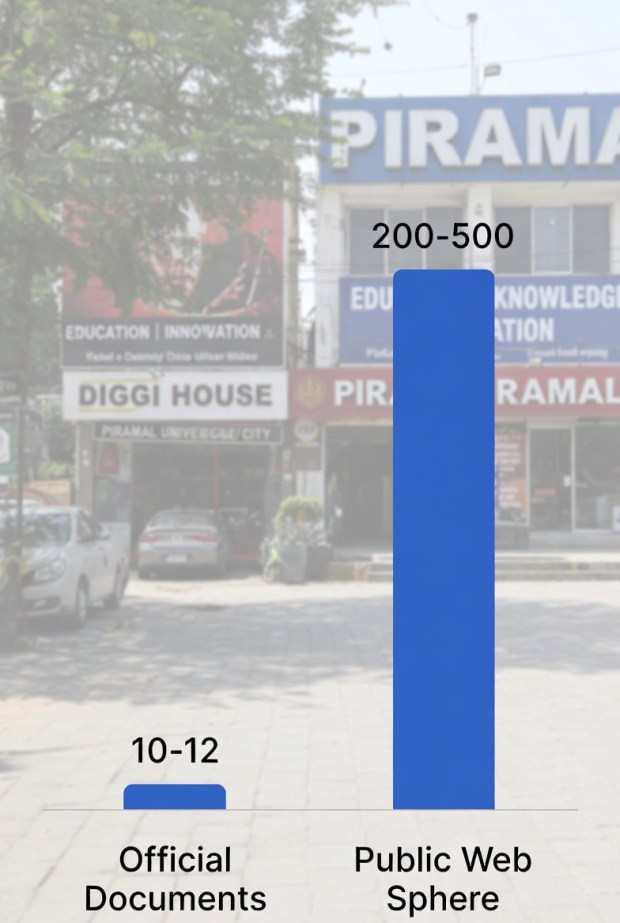
(The bar chart above highlights the stark contrast: low official frequency in controlled corporate channels vs. high amplification in public/digital spaces, driven by media, real-estate hype, and informal references. The backdrop subtly incorporates Jaipur’s Diggi Road/Knowledge City area elements, reflecting the real-estate promotions that have helped spread the term.)
This imbalance underscores how ambiguous terminology can proliferate unchecked in public discourse, potentially misleading perceptions of institutional legitimacy without corresponding formal backing.
3. Is it Approved by the UGC?
After taking some breathing space, I turned to the website of the University Grants Commission to verify the matter.
A careful examination of publicly available material strongly indicates that the institution associated with the Piramal Foundation — particularly the Piramal School of Leadership — is not recognised as a university by the UGC.
Under the University Grants Commission Act, 1956, the authority to award academic degrees is tightly regulated and restricted to institutions that meet specific statutory conditions.
- Section 2(f) defines a “university” as an institution established or incorporated by a Central Act, State Act, or Provincial Act, or one declared a deemed-to-be university by the Government of India on the advice of the UGC.
- Section 22 further clarifies that only such recognised universities are legally authorised to grant academic degrees.
In other words, the term “university” in India is not merely a descriptive label or branding device; it is a legally protected institutional category tied to statutory recognition and regulatory oversight.
Consequently, institutions that offer training programmes, fellowships, or professional-development courses without granting recognised degrees generally fall outside the category of UGC-regulated universities.
The operational entity in the Piramal ecosystem today appears to be the Piramal School of Leadership (PSL) — an initiative of the Piramal Foundation that focuses on leadership training for government officials and public-system actors. Its programmes emphasise systemic thinking, governance reform, and civic values such as “Sewa Bhaav,” positioning the institution as a capacity-building platform rather than a conventional degree-granting university.
However, when one searches the official UGC databases of recognised institutions — including lists of central universities, state universities, private universities, and deemed universities — no listing appears for “Piramal University” or for the Piramal School of Leadership.
The absence of such listing is not a trivial administrative oversight. It indicates that the initiative has not been established through the statutory mechanisms required for universities under the UGC Act.
This regulatory silence becomes even more problematic when juxtaposed with the occasional appearance of the term “Piramal University” in corporate reports and philanthropic narratives of the Piramal Group. The deployment of this terminology in strategic documents creates the impression of a university-scale institution, even though no corresponding statutory recognition appears to exist in the national regulatory framework governing universities.
It is also important to distinguish the leadership-training initiative from other institutions carrying the Piramal name. For instance, Gopikrishna Piramal College of Teacher Education operates as a teacher-training college affiliated with a recognised university and functions within the regulatory architecture governing teacher education. Such institutions operate through affiliating universities recognised under Sections 2(f) and 12B of the UGC Act, but they are organisationally separate from the Piramal School of Leadership.
Thus, invoking the existence of affiliated or recognised institutions bearing the Piramal name does not establish the legal existence of any entity called “Piramal University.”
In this context, the Piramal ecosystem occupies an ambiguous — and somewhat troubling — institutional position. The entity currently operating is PSL: a leadership-training academy rather than a statutory university. Unlike some notorious cases in the past where private institutions openly misrepresented themselves as degree-granting universities, PSL does not appear to explicitly claim such authority in its operational communications.
Yet the situation becomes murkier with more recent developments. As of February 2026, social-media references to events hosted at “Piramal Learning University” in Mumbai suggest an evolving nomenclature that extends the “university” label into public-facing contexts.
Even if such terminology is used informally, the implications are significant.
When a powerful corporate foundation repeatedly invokes the symbolic authority of the word “university” — while operating outside the statutory structures that define a university in law — the practice begins to resemble institutional brand inflation rather than transparent educational institution-building.
From a critical standpoint, the deeper issue here is not merely regulatory compliance but the gradual erosion of conceptual clarity about what a university actually is.
Historically, universities emerged as communities of scholars dedicated to the creation, preservation, and critical interrogation of knowledge. Their legitimacy rested not only on legal recognition but also on intellectual autonomy, academic freedom, and sustained scholarly practice.
When corporate training academies, philanthropic platforms, or leadership institutes begin appropriating the symbolic capital of the “university,” the term risks becoming little more than a marketing metaphor for managerial training, governance workshops, or corporate networking platforms.
This transformation is not innocuous. It contributes to a broader crisis of epistemic trust in which the word university becomes a floating signifier detached from rigorous oversight, scholarly accountability, and public regulation.
In such an environment, wealthy corporate actors — armed with vast resources and powerful branding machinery — can effectively manufacture the aura of educational legitimacy without undergoing the slow, demanding, and publicly accountable processes through which genuine universities are built.
What is at stake, therefore, is not merely the nomenclature of a single institution but the integrity of the idea of the university itself.
To quantify the discrepancy between official and public usage, a review of occurrences shows that “Piramal University” appears sparingly in official documents (approximately 10–12 times total, concentrated in strategic PDFs like the Big Bet document, partnerships listings, and older CSR/annual reports from 2021–2023, with zero mentions on current PSL operational pages). In contrast, the broader public web sphere shows hundreds of instances (estimated 200–500 mentions across news, social media, architecture portfolios, and real-estate promotions), often amplifying the term as if it denotes a fully established university.
This imbalance underscores how ambiguous terminology can proliferate unchecked in public discourse, potentially misleading perceptions of institutional legitimacy without corresponding formal backing.
4. Questioning Philanthropy and Dole Economy
With reference to the sub-section 2.5.1, and 2.5.2. let us now shoot a few questions at this stage.
Q1. Is it a part of Piramal’s CSR?
Yes, the Piramal School of Leadership (PSL) — the operational entity behind the “Piramal University” vision — is fully part of Piramal’s Corporate Social Responsibility (CSR) activities.
- The Piramal Foundation (philanthropic arm of the Piramal Group) runs PSL as one of its flagship initiatives, often framed under the “Big Bets” in CSR reporting.
- PSL is described in official materials (e.g., PSL website, annual reports, sustainability reports) as a capacity-building program for government middle managers and public-system leaders, funded through the Foundation’s CSR resources.
- Piramal Enterprises Limited (PEL) and Piramal Pharma Limited (PPL) annual reports (FY2021–23) list PSL/Piramal University-related efforts under CSR/philanthropy sections, alongside other initiatives like health, water, and tribal development.
- CSR spending examples: PEL’s FY2022 CSR report notes expenditures on education/leadership projects; the Foundation’s impact reports (e.g., 113 million lives touched) include PSL’s work in education and systems change.
- PSL programs (e.g., training for officials) are sponsored at no cost to participants, aligning with CSR’s mandatory 2% net-profit obligation under Section 135 of the Companies Act, 2013.
In short, PSL is a core CSR component, not a separate commercial or academic venture.
Q2. Does Piramal get IT exemption for such charitable institute?
Yes, the Piramal Foundation (which operates PSL) enjoys income tax exemptions as a charitable institution, allowing tax benefits on its income and donations received.
Key details:
- The Foundation is registered as a public charitable trust under Section 12AA/12AB of the Income Tax Act, 1961 (renewed/valid up to 2026–27), granting exemption from income tax on surplus income used for charitable activities (under Sections 11 and 12).
- It holds a Section 80G certificate, enabling donors (including corporates like Piramal Group entities) to claim tax deductions on contributions (typically 50% or 100% of donated amount, depending on the project).
- In its audited financial statements (e.g., FY2023–24), the Foundation explicitly states it is exempt from income tax subject to compliance with Section 11 conditions, and it has renewed 12AB/80G registrations.
- Donations from group companies (e.g., Piramal Capital & Housing Finance, Piramal Pharma, Piramal Enterprises) to the Foundation are tax-deductible under 80G, and these often fund PSL activities.
- CSR funding itself is not directly tax-deductible as a business expense (under Section 37), but contributions to a Section 80G-registered entity like the Foundation qualify for deductions, making it tax-efficient for the group.
Overall, the Foundation/PSL benefits from standard charitable tax exemptions (12AB for income exemption, 80G for donor deductions), which is common for CSR arms of Indian corporates. This structure allows the Piramal Group to channel CSR funds tax-efficiently while claiming philanthropic impact. No evidence suggests special or unusual exemptions beyond these standard provisions. If you need copies of certificates or specific FY details, they are typically available via the Income Tax Department’s exempted institutions portal or the Foundation’s disclosures.
Moreover, holistically speaking, let us point to certain radical questions regarding “CSR”, “philanthropy”, “doles” etc.
A. When do we need charity or trusteeship?
Charity or trusteeship becomes necessary only where structural dispossession has already occurred—that is, where communities have been separated from the material bases of autonomy such as land, commons, tools, or cooperative forms of livelihood. In such situations, wealth accumulates in the hands of a few, and philanthropy appears as a moral corrective to an injustice that the same system helped produce. Charity thus functions less as a solution than as a symptom of institutional failure: it compensates for the erosion of shared access to resources. Trusteeship, in this sense, may mitigate suffering, but it also risks preserving the asymmetry between benefactor and dependent. A just order would render charity largely unnecessary by restoring collective stewardship of commons and reciprocal forms of mutual support, rather than relying on discretionary benevolence from concentrated wealth.
B. Is a dole economy unsustainable?
A system built primarily on doles or unconditional transfers can become unsustainable when it decouples livelihood from participation in socially meaningful activity, especially if the underlying economic structure remains extractive and centralized. In such a configuration, redistribution merely circulates surplus produced elsewhere while leaving intact the mechanisms that generate dependency in the first place. Over time, this risks creating a fragile equilibrium: production remains concentrated, while consumption is maintained through subsidies rather than through locally rooted capacities. The deeper alternative lies neither in abandoning support nor in glorifying market self-sufficiency, but in rebuilding decentralized, community-embedded economies where people participate directly in sustaining their own material and ecological conditions of life. In such contexts, support systems become transitional safeguards, not permanent substitutes for autonomy.
5. Is Piramal University then Similar to the Controversial IIPM?
A comparison between the Piramal leadership-training ecosystem and the controversial institutional model associated with Indian Institute of Planning and Management (IIPM) reveals two different strategies that nevertheless converge on the same disturbing terrain: the instrumental appropriation of the symbolic authority of the university without assuming the epistemic, legal, and ethical responsibilities that the term historically entails. While the two cases differ in structure and rhetorical style, both exemplify how the prestige attached to the idea of a “university” can be cynically mobilised to manufacture legitimacy, influence, and institutional aura.
The IIPM saga—associated with Arindam Chaudhuri—became one of the most notorious episodes in the history of India’s higher-education landscape. During the 1990s and 2000s, IIPM aggressively marketed itself as a premier global business school, promising international exposure, corporatized managerial training, and glamorous corporate pathways. Massive advertising campaigns, celebrity endorsements, and glossy media spectacles constructed the illusion of a world-class institution. Yet behind the theatrical façade lay a fundamental problem: the institute lacked recognition from the statutory regulatory framework governing higher education in India, particularly the provisions of the University Grants Commission under the University Grants Commission Act 1956.
Investigations, legal disputes, and sustained public scrutiny gradually exposed a pattern in which spectacular institutional claims dramatically exceeded academic legitimacy and regulatory standing. IIPM’s strategy appeared to rely on a calculated confusion between branding and accreditation, between corporate marketing and scholarly authority. Degrees and programmes were wrapped in the language of global partnerships and corporate management culture, while the institution itself operated in a grey zone outside the regulatory architecture that defines legitimate universities. What emerged was not merely an educational experiment but a carefully orchestrated spectacle of academic credibility, engineered through advertising rather than scholarship. The reputational fallout—warnings from regulatory bodies, litigation, and widespread criticism—eventually transformed IIPM into a textbook case of how higher education can be commodified, theatricalised, and cynically exploited for commercial gain.
The Piramal ecosystem—associated with the philanthropic arm of the Piramal Group—occupies a more technocratic but no less problematic position. The operational entity, the Piramal School of Leadership, presents itself as a leadership-development platform focused on governance reform, public systems, and the cultivation of bureaucratic leadership capacities. Unlike IIPM, it does not overtly claim to be a degree-granting university in its everyday communications. Instead, it adopts the softer language of leadership academies, fellowships, and training ecosystems.
Yet this apparent modesty conceals a deeper ambiguity. Within strategic documents and long-term institutional narratives circulated by the Piramal Foundation, one repeatedly encounters the aspirational construct of “Piramal University.” The proposed architecture imagines a network of schools dedicated to leadership, systems change, education, and public administration—an umbrella ecosystem collectively branded as a university. In effect, the language of the university is invoked as a symbolic horizon long before the institutional, intellectual, or regulatory substance required to justify such a title exists.
This discursive manoeuvre is revealing. By invoking the aura of a “university” while operating primarily as a leadership-training and policy-influence platform, the Piramal ecosystem benefits from the cultural prestige historically associated with universities without subjecting itself to the rigorous obligations that define them—independent scholarship, disciplinary depth, peer-reviewed knowledge production, and regulatory accountability. What emerges is a form of philanthropic managerialism masquerading as higher education: an institutional configuration where corporate capital, bureaucratic training, and policy networks converge under the halo of academic legitimacy.
The contrast between IIPM and the Piramal ecosystem therefore lies less in principle than in style. IIPM represented the entrepreneurial spectacle of higher education—an aggressively marketed enterprise that attempted to occupy the social space of a university through advertising, celebrity culture, and exaggerated claims of global prestige. The Piramal model, by contrast, represents a technocratic-philanthropic variant of the same impulse. Instead of loud marketing, it deploys the softer vocabulary of governance reform, leadership ethics, and social transformation. Instead of commercial flamboyance, it relies on the quiet authority of philanthropy and bureaucratic partnership. Yet beneath these stylistic differences lies a shared structural tendency: both treat the idea of the university as a strategic resource to be appropriated rather than a demanding intellectual institution to be built.
From a critical standpoint, the deeper problem is not simply regulatory ambiguity but the erosion of conceptual clarity about what a university actually is. Historically, universities were communities of scholars devoted to the slow, difficult labour of producing, preserving, and critically interrogating knowledge. Their authority derived from intellectual autonomy, academic freedom, and the collective cultivation of scholarship across generations. When corporate training academies, philanthropic leadership platforms, or marketing-driven institutes appropriate the symbolic capital of the university without sustaining its epistemic commitments, they effectively reduce the university to a branding metaphor—a decorative label attached to managerial training or institutional influence.
Seen in this light, both IIPM and the Piramal ecosystem reveal a disturbing trajectory within contemporary Indian higher education. One represents the crude commercialisation of academic prestige; the other embodies a more polished but equally troubling philanthro-corporate appropriation of the university form. The first relied on advertising spectacle; the second relies on institutional aura and bureaucratic proximity. Yet both participate in the same broader deformation: the transformation of the university from a community of inquiry into a symbolic asset within the economies of reputation, influence, and power.
The lesson of these cases is therefore stark. When the prestige of the university becomes detached from the intellectual labour that historically justified it, the term itself becomes dangerously malleable. It can be invoked by marketers, entrepreneurs, philanthropists, or policy networks alike. The result is a landscape in which institutions that neither produce rigorous scholarship nor submit to the responsibilities of academic governance nevertheless claim the cultural authority of the university. In such circumstances, the word “university” ceases to describe an intellectual institution and instead becomes a floating signifier of prestige—available to anyone with sufficient capital, influence, or narrative control to appropriate it.
6. Knowledge-Commodity as Prestige – The Pattern of “Schrödinger’s Legitimacy” in Piramal Branding
Is it not opening a clear pattern when we compare the “Piramal University” nomenclature with Ajay Piramal’s much-publicized “Oxford Talk”?
Yes, comparing the “Piramal University” nomenclature issue with Ajay Piramal’s 2025 Oxford talk does reveal a discernible pattern: one of leveraging symbolic prestige from renowned institutions or labels to enhance corporate and philanthropic branding, while glossing over or offsetting underlying contradictions, such as regulatory ambiguities, environmental allegations, or financial controversies. This pattern aligns with critiques of “prestige-meets-PR” strategies, where platforms like Oxford or the “university” tag serve as reputational shields in a commodified knowledge economy, potentially misleading public perceptions of legitimacy and impact. Both cases exemplify how aspirational framing—whether through a strategic vision document or a student-led forum—can create an aura of authority that diverges from empirical realities, echoing Orwellian inversions where “strategic” discourse masks offensive practices under defensive guises (per Marcuse’s unification of opposites).
In the Oxford talk (held July 4–5, 2025, at the Oxford India Forum, a student-organized event at Saïd Business School), Piramal emphasized India’s “digital strength and compassion” for its rise by 2047, urging investments in education, healthcare, and skilling while promoting values like kindness and gratitude. Promoted via Piramal Group’s LinkedIn, YouTube playlists, and media (e.g., Business Today), it was framed as an “Oxford Talk” to evoke institutional endorsement, despite lacking official university sanction (no ox.ac.uk listing, no faculty involvement, and sponsorship-based access). Critics label this “Schrödinger’s Dilemma”: the talk both exists (geographically “in Oxford”) and doesn’t (not “of Oxford” academically), serving as a PR choreography where prestige is rented like a luxury logo to convert wealth into wisdom. This mirrors the University pattern: the term “Piramal University” appears in strategic documents and partnerships lists, evoking academic prestige without UGC recognition or degree-granting status, while operational branding sticks to PSL.
The pattern intensifies when juxtaposed with Piramal Group’s broader controversies: environmental violations (e.g., Digwal groundwater pollution, Dahej acid discharge), financial probes (e.g., DHFL acquisition with ₹91,000 crore claims settled for ₹34,250 crore, SEBI overpayments), political donations (₹85 crore to BJP via electoral bonds, ₹25 crore to PM CARES), and SLAPP suits against critics. Philanthropy (e.g., Piramal Foundation’s education/health initiatives) is portrayed as “spiritual washing” or “philanthro-capitalism,” where compassionate rhetoric offsets harms, much like the University’s “Sewa Bhaav” vision contrasts with nomenclature ambiguities. This creates a “divine economic paradox”: promoting kindness and systemic change while entangled in regressive practices, misleading “knowledge-commodity” consumers through digital/oral campaigns that amplify prestige without scrutiny. In both instances, the pattern is hegemonic subsumption—co-opting symbols (Oxford, University) for PR, inverting meanings to defend the indefensible in an Orwellian/Marcusean sense.
The July 2025 appearance at the Oxford India Forum (a student-organised event at Saïd Business School) was promoted heavily through Piramal Group channels, social media, YouTube playlists, and business media as “Ajay Piramal’s Oxford Talk.” The framing emphasised themes of India’s digital strength, compassion, education, healthcare, skilling, kindness, and gratitude — all delivered in the symbolic setting of Oxford. Yet, as the article “Schrödinger’s Dilemma and Ajay Piramal: The Mystery Behind Oxford Talks – Where Prestige Meets PR” points out, the event was neither hosted nor endorsed by the University of Oxford itself. It lacked official university sanction, faculty involvement, or academic accreditation; it was a student-led forum with paid sponsorship access.
The talk both existed (physically took place in Oxford) and did not exist (was not “of Oxford” in any institutional sense). This ambiguity — what the article calls “Schrödinger’s Dilemma” — allowed the event to borrow the immense symbolic capital of the word “Oxford” to convert financial wealth into perceived moral and intellectual authority. The promotion converted a private speaking engagement into a prestige-laden credential, disseminated widely through digital and oral channels without correction or clarification of its non-official character.
This mirrors the “Piramal University” pattern with striking precision:
- Symbolic borrowing without substance “Oxford” is invoked to signal intellectual endorsement, just as “University” is invoked to signal academic legitimacy — in both cases without the corresponding institutional reality (no ox.ac.uk affiliation for the talk; no UGC recognition for the “university”).
- Dual existence / non-existence The talk is geographically “in Oxford” but not academically “of Oxford,” much like “Piramal University” exists in strategic documents, partnerships listings, older CSR reports, and public discourse (especially real-estate promotions) but vanishes from operational PSL pages, current programme branding, and regulatory databases.
- Amplification through uncontrolled transmission Digital reels, social-media posts, news snippets, and informal references spread the prestige halo far beyond the controlled origin. Real-estate ads hype plots “near Piramal University”; LinkedIn, YouTube, and media outlets repeat “Oxford Talk” as if it were an official university lecture. In both cases, the Piramal ecosystem does not actively correct the inflated perception, allowing the symbolic overreach to accumulate unchecked.
- Reputational offset function Both instances serve as prestige-laundering mechanisms. The “Oxford” association projects wisdom and global stature amid ongoing controversies (environmental violations, DHFL depositor losses, SEBI probes, electoral-bond donations). Similarly, the “University” label projects scholarly depth and public-good intent amid the same set of allegations. In Marcusean terms, the discourse unifies opposites: “strategic” prestige masks potentially offensive practices (environmental externalities, financial opacity) under a defensive veneer of compassion and transformation.
- Misleading the knowledge-consumer In both cases, the public — prospective students, government officials, property buyers, or general citizens — is offered a commodified “knowledge” product whose prestige is inflated beyond verifiable reality. The pattern is not accidental; it is structural. Symbols (Oxford, University) are mobilised as strategic resources to manufacture legitimacy in a public sphere where oral and digital transmission rapidly outpaces fact-checking or regulatory correction.
Thus, the Oxford Talk and the “Piramal University” branding are not isolated incidents but symptoms of the same strategy: :epistemic prestige as commodity. When powerful actors can rent or invoke globally recognised signifiers without bearing the corresponding institutional burden, they effectively privatise symbolic capital while socialising scrutiny. The result is a public sphere where consumers of “knowledge” are systematically misled — not through outright falsehoods, but through carefully calibrated ambiguity that allows prestige to attach itself like a halo, even when the substance underneath remains contested or absent.This is not merely nomenclature slippage; it is a deliberate politics of perception.XXXX
The pattern emerging from Piramal Group’s broader deeds—spanning financial acquisitions, environmental violations, political entanglements, and legal tactics—mirrors the “Piramal University” initiative in a striking way: both exemplify a strategy of leveraging philanthropic or aspirational branding as a facade to offset, obscure, or legitimize controversies. This creates a paradox where proclaimed values like “Sewa Bhaav” (selfless service), compassion, and systemic transformation serve as reputational armor, often inverting meanings in an Orwellian/Marcusean sense (e.g., “service” masking self-interest, “change” affirming the status quo). Drawing from the provided articles and additional sources on the Once in a Blue Moon Academia site (which hosts critical analyses of Piramal’s empire, including financial scams, cronyism, and “Gandhi-washed” capitalism), the comparison reveals a recurring template: harm inflicted through core business practices is “remedied” or reframed via CSR optics, commoditizing ethics to sustain impunity.
Comparison to University: Like the University’s “aspirational” tag without UGC status (misleading digital/oral campaigns as a “world-class institute”), these financial deeds use “strategic” restructurings to rebrand controversies as opportunities, commoditizing knowledge/assets for corporate gain while externalizing losses to vulnerable groups (depositors vs. public servants trained in hierarchical “leadership”).
7. The Wider Systemic Context in Contemporary India: Education as Industry, Metrics as Theatre
The ambiguity surrounding the Piramal ecosystem does not exist in isolation. It must be situated within a much broader structural crisis currently unfolding across the Indian educational landscape—one that has been documented by investigative journalists such as Sucheta Dalal and education analysts like Maheshwar Peri.
Recent investigations reveal that the contemporary Indian education system has increasingly come to resemble a hybrid economy of metrics, branding, and institutional spectacle, where universities compete not primarily in the domain of scholarship but in the manipulation of reputational indicators—patents, rankings, placements, infrastructure, and publicity events.
A striking illustration of this pattern occurred during the All India AI Impact Summit 2026, where Galgotias University publicly claimed that a robotic dog named “Orion” had been developed by its research center. The demonstration was broadcast on Doordarshan. Within hours, however, online users identified the device as a commercially available Chinese robotic dog rather than an original research output. The resulting backlash forced government organisers to remove the university from the event pavilion.
This episode may appear trivial, yet it reveals something deeply symptomatic. When a university at a national technology showcase blurs the line between assembly, demonstration, and original research, the problem is not merely reputational embarrassment; it signals the deeper institutional pathology described earlier—where the symbolic performance of innovation replaces the slow labour of genuine knowledge production.
7.1. The Gross Enrolment Ratio (GER) in Higher Education: Indian Scenario
India’s Gross Enrolment Ratio (GER) in higher education (tertiary level, including universities and colleges) for the standard age group of 18–23 years (the official reference cohort used by the Ministry of Education and AISHE reports) stands at 28.4% as per the latest fully published data from AISHE 2021-22. Provisional AISHE 2022-23 figures show enrolment growth to 4.46 crore students, implying a slight rise to around 29–30%, though no final GER for 18–23 is yet published. The Economic Survey 2025-26 reaffirms the NEP 2020 target of 50% GER by 2035, noting steady progress but a significant gap from global averages.
A. Latest Available Data (as of March 2026)
- According to the All India Survey on Higher Education (AISHE) 2021-22 (latest fully published final report from the Ministry of Education):
- GER in higher education for the 18–23 age group stood at 28.4%.
- This was an increase from 23.7% in 2014-15 and 27.3% in 2020-21.
- Breakdown: Male GER ≈ 26.7–28%, Female GER ≈ 27.9–29% (female participation has overtaken male in recent years).
- Total enrolment: ~4.33 crore students (43.3 million) in 2021-22.
- Provisional AISHE 2022-23 data (released in 2024–2025) shows further growth, with enrolment rising to 4.46 crore (44.6 million students), implying a slight upward trend in GER (estimated around 29–30% for 18–23 years, though no final GER figure for 18–23 is explicitly published in provisional releases yet).
- The Economic Survey 2025-26 (released January 2026) references higher education GER indirectly through school-level pipelines and reaffirms the NEP 2020 target of 50% GER by 2035. It does not provide a new 18–23 GER figure beyond the AISHE 2021-22 baseline of 28.4%.
B. Key Context and Projections
- GER is calculated as: (Total enrolment in higher education ÷ Population aged 18–23) × 100 (using 2011 Census-based population projections from the Registrar General of India, as the 2021 Census is still pending).
- India lags behind the global average (~40%) and many developing countries, but shows steady progress (from ~19–20% in 2010–11 to ~28.4% in 2021-22).
- NEP 2020 target: 50% GER by 2035 — current trajectory (CAGR ~3–4%) projects ~40–41% by 2035 unless accelerated (requiring major expansion in seats, infrastructure, and school-to-higher transition rates).
- State variations: Highest GER in states like Chandigarh (66%), Puducherry (60%), Delhi, Tamil Nadu (~47%), Kerala (~41%); lowest in Bihar (~17–18%), Jharkhand (~19%).
For the 20–24 age group specifically, no official separate GER is published (as 18–23 is the standard), but it would be slightly lower than the 18–23 figure due to the age band being narrower and overlapping less with typical undergraduate entry/completion patterns.
Sources: AISHE 2021-22 (final), provisional AISHE 2022-23, Economic Survey 2025-26, and related MoE/PIB releases. Data is consistent across government reports up to early 2026. No major new AISHE full report for 2023-24 or later has been released by March 2026.
7.2. Comparison with Other Countries
Global tertiary GER (UNESCO UIS/World Bank data, latest available 2023–2024) shows stark differences between developed and developing countries. The global average is around 39–43% (43.6% in 2024 per World Bank estimates), with developed nations far ahead and developing ones lagging.
A. Developed Countries (OECD/High-Income Economies)
- USA: ~60–65% (OECD average for tertiary attainment in 25–34 age group ~50%, but GER often higher due to non-traditional students).
- UK: ~60–65%.
- Germany: ~70–75% (very high due to free tuition and strong vocational tracks).
- Canada: ~65–70%.
- South Korea: ~90–100% (one of the highest globally).
- OECD average: ~40–50% for recent cohorts, but gross enrolment often exceeds 60–70% in top performers.
Developed countries typically have GERs in the 60–100% range, driven by near-universal secondary completion, affordable/free tuition, strong vocational pathways, and lifelong learning.
B. Developing/ Emerging Economies
- China: ~58–60% (rapid rise from <20% in 2000).
- Brazil: ~50–55%.
- South Africa: ~25–30% (similar to India).
- Indonesia: ~50%.
- Global developing average: ~30–40% (Central/Southern Asia ~25–35%, Sub-Saharan Africa ~10–15%).
India’s 28.4% (18–23) is comparable to lower-middle-income peers but lags significantly behind China (nearly double) and many upper-middle-income nations.
C.Key Insights
- Developed vs. Developing Gap: Developed countries average 60–80%+ (universal access, high secondary completion), while developing nations average 20–40% (India at the lower end).
- India’s Position: Steady rise (24.6% in 2017–18 to 28.4% in 2021–22), but still below the global average (~43%) and far from the NEP 2020/2035 target of 50%.
- Challenges: Low transition from secondary (GER ~68–78% at secondary/higher secondary), regional disparities (e.g., Bihar ~17%, Kerala ~41%), gender equity improving (female GER now slightly higher), and infrastructure constraints.
This reflects India’s ongoing struggle to expand access amid population size, inequality, and funding gaps compared to both developed (near-universal) and fast-growing developing peers (e.g., China). Data sources: AISHE 2021-22 (final), provisional 2022-23, Economic Survey 2025-26, UNESCO UIS/World Bank (2023–2024 estimates). No major new AISHE full report post-2021-22 is available as of March 2026.
7.3. Expansion Without Substance
The crisis becomes clearer when one examines the structural evolution of Indian higher education since the economic reforms of the 1990s. Liberalisation policies dramatically expanded the role of private actors in the sector, allowing the emergence of thousands of self-financing institutions.
The result has been a dramatic quantitative expansion. Colleges increased from roughly 33,000 in 2010 to over 45,000 by 2022. Universities grew from about 190 in the early 1990s to more than 1,000 today. Nearly 80% of Indian colleges are now privately managed.
Yet this growth has not translated into commensurate academic quality. Instead, it has produced what may be described as a credential-production economy, in which degrees function as marketable commodities rather than markers of intellectual formation.
Private campuses frequently rely on architectural spectacle—glass buildings, luxury hostels, swimming pools, and technology-themed marketing—to attract middle-class families whose educational aspirations are fuelled by the promise of upward mobility. The economic model is straightforward: sell the dream of employability, charge high tuition fees financed by family savings or education loans, and deliver degrees whose labour-market value often proves uncertain.
7.4. The Entrance Funnel and the Private-University Boom
The structural conditions producing this market are equally revealing. Each year roughly 15–20 million students complete secondary education in India. Yet public institutions—such as the Indian Institutes of Technology, the All India Institute of Medical Sciences, and major central universities—have seats for only a small fraction of these aspirants.
The result is an educational funnel. Only about 3–4% of applicants succeed in securing admission to public institutions through entrance examinations such as JEE, NEET, or CUET. The remaining majority are channelled toward the rapidly expanding private sector.
In effect, the private-university boom functions as a structural overflow mechanism for a state system unable—or unwilling—to expand high-quality public education at the required scale.
7.5. The Myth of “100% Placement”
Within this competitive environment, placement statistics have become one of the most powerful marketing instruments. Many institutions advertise “100% placement” as a guarantee of employability.
However, investigative reports reveal that these figures often rely on statistical manipulations. Eligibility filtering ensures that only high-performing students are allowed to sit for campus recruitment while others are excluded from the denominator. Off-campus appropriation allows universities to claim credit for jobs obtained independently by students. Internship inflation records short-term internships or temporary contracts as full-time placements.
Such practices illustrate how quantitative metrics become theatrical devices designed less to measure reality than to produce the appearance of success.
7.6. The Employability Paradox
The outcome is what analysts describe as India’s employability crisis. Reports suggest that only one in five engineering graduates is considered job-ready, only one in four MBAs meets industry skill requirements, and more than half of graduates lack essential professional competencies.
The paradox is striking. Millions of graduates struggle to find employment while companies simultaneously report difficulty finding skilled workers. This disjunction reveals a profound disconnect between degree production and skill formation—a symptom of an education system oriented toward certification rather than learning.
7.7. Ranking Games and Patent Inflation
The manipulation extends beyond placements into research metrics as well. Ranking frameworks such as India’s National Institutional Ranking Framework encourage universities to demonstrate research productivity through patents and publications.
Yet, as documented by Maheshwar Peri and others, the incentive structure often encourages institutions to file large numbers of patents with little expectation of technological application. In some cases, private universities have reported research scores exceeding those of leading institutions like the Indian Institute of Science, raising obvious questions about the credibility of ranking methodologies.
Similarly, international academic journals have reported increasing numbers of research retractions originating from India, highlighting problems such as plagiarism, fabricated data, and manipulated peer-review processes. The pattern is clear: metrics designed to evaluate academic quality have themselves become instruments to game the system.
7.8. Collapse at the Foundations
Ironically, while higher education engages in ranking games, the foundations of the educational system appear increasingly fragile. Reports indicate that more than 93,000 government schools have closed in the past decade, even as private schools expand rapidly. Meanwhile, learning assessments show that less than half of Grade 5 students can read a Grade 2 text, raising concerns about the long-term viability of India’s so-called demographic dividend.
If foundational literacy and numeracy continue to deteriorate, the country may face what analysts warn could become a demographic nightmare rather than a demographic dividend.
8. Returning to the Piramal Question: The Ambiguity of “Piramal University” in a Commodity-Driven Educational Landscape
Seen against the systemic backdrop of India’s higher-education crisis—where prestige, metrics, and symbolic capital increasingly dominate—the ambiguity surrounding the “Piramal University” label acquires a deeper, more troubling significance. It is not merely a question of nomenclature or corporate branding gone awry. Rather, it reflects a broader transformation in which educational institutions (and their simulacra) operate within economies of reputation, influence, and commodified legitimacy. In such an environment, the word “university” itself becomes a strategic resource—deployed by corporations, philanthropies, private investors, and real-estate promoters alike. The prestige historically associated with academic institutions can be mobilised to enhance corporate reputation, attract investment, secure policy influence, or inflate property values even when the underlying institutional structure diverges dramatically from the traditional university model of scholarly community, intellectual autonomy, and critical inquiry.
Thus, the Piramal case should not be read as an isolated anomaly or a mere semantic slip. It is better understood as part of a larger, accelerating pattern: the gradual transformation of higher education from a community of scholars dedicated to the creation, preservation, and critical interrogation of knowledge into an ecosystem of reputational assets, where knowledge, prestige, and legitimacy circulate as tradable commodities within broader networks of corporate and political power. And it is precisely this transformation that the earlier critique of academiocracy sought to expose: the hollowing out of the university’s epistemic and democratic promise under the weight of instrumental rationality and symbolic accumulation.
8.1. Devalued Value Addition: Piramal School of Leadership (PSL)
The question of whether the Piramal School of Leadership (PSL) delivers genuine educational or developmental value cannot be answered in isolation. It must be situated within the larger architecture of contradiction that defines the Piramal Group’s public presence: a carefully curated philanthropic facade juxtaposed against a record of financial extraction, environmental harm, political influence-peddling, and legal intimidation of critics. PSL is not an independent educational project; it is an integral component of the Piramal Foundation’s CSR portfolio, funded through corporate resources and strategically positioned to project moral and intellectual authority. Any assessment of its “value added” must therefore reckon not only with what it claims to offer its participants, but with what it simultaneously conceals, legitimises, and sustains within the broader ecosystem of power and profit that surrounds it.
What follows is a detailed examination of the learning process at PSL—its participants, pedagogy, outcomes, and limitations—followed by a critical dissection of the double standard that runs through it. The analysis reveals that while PSL does produce measurable professional and personal benefits for a narrowly defined cohort of participants, these benefits are inseparable from the equivocation that characterises the Piramal project as a whole: a cunning capitalist operation in which the rhetoric of selfless service and systemic transformation is deployed to launder the reputation of practices that extract, exclude, and degrade.
Q1. Does the learning process at Piramal School of Leadership (PSL) add value to the students? Yes, the learning process at Piramal School of Leadership (PSL)—the operational entity behind the “Piramal University” vision—does add significant value, but only to a very specific and narrow group of “students”: mid-career government officials, public-sector middle managers, and carefully selected changemakers/fellows who are deputed or chosen into its programs.
Q2. Who actually participates (“students”)?
- The primary audience is in-service government employees (block-level officers, district education/health officials, middle managers in public systems).
- Youth/women changemakers via integrated fellowships (e.g., Gandhi Fellowship, MITRA Young Professional Fellowship, Centre for Nurturing Future Leaders).
- There are no open admissions for the general public, fresh graduates, or private-sector individuals—no entrance exams, application portals, or fee-based enrollment like a conventional university.
Q3. How does the learning process add value? For eligible participants, PSL delivers tangible professional and personal development through a structured, residential, experiential model:
- Skill-building for public service
- Modules on 21st-century skills, Social-Emotional-Ethical Learning (SEE/SEEL), project-based learning, aesthetic/physical literacy, and holistic pedagogy.
- Domain expertise in education reform, health systems, climate resilience (regenerative agriculture, water security), inclusion, and public leadership.
- Systemic and leadership impact
- Training in systems change, institutional strengthening, compassionate leadership, and “Sewa Bhaav” (selfless service).
- Live projects, peer communities, and government partnerships enable participants to apply learning directly in their roles (e.g., policy influence, process optimization).
- Personal transformation
- Emphasis on self-reflection, non-violent communication, and unlocking human potential (rooted in Tat Tvam Asi).
- Residential format (workshops, immersion) fosters resilience, empathy, and ethical discernment.
- Documented outcomes (per Piramal Foundation reports)
- Thousands trained across states; indirect reach to 1.15 crore students via education programs.
- Policy impacts: SEL integration in curricula, SIEMAT strengthening, ECCE policies, reduced court cases in Jharkhand, master coaches trained, etc.
For government participants, this is high-value professional development—fully sponsored, career-enhancing, and aligned with Viksit Bharat goals. For Gandhi Fellowship participants, the 23-month residential experience offers stipend-supported real-world exposure, mentorship, and network-building.
Q4. Is there any campus recruitment? No—there is no campus recruitment in the conventional sense.
- PSL is not a placement-oriented institute or conventional university.
- No placement cell, company visits, job fairs, or corporate recruiters on campus.
- Participants are already employed (government deputation) or selected fellows (stipend-based).
- The goal is in-service capacity-building and systemic reform, not job placement.
- Gandhi Fellowship alumni often transition to roles in NGOs, government, startups, or social enterprises (via networks), but this is organic networking, not formal recruitment.
8.2. Limitations on “Value Added”
Crony capture risk: Training focuses on existing officials, potentially reinforcing bureaucratic hierarchies rather than democratizing access.ctural, deliberate, and profitable.
No formal academic credentials: No degrees, diplomas, or UGC-recognized certifications—only participation certificates or internal acknowledgments.
Not for general career advancement: Private-sector or fresh graduates gain no entry; value is context-specific to public-sector roles.
8.2.2. What Type of Value Is Actually Delivered?
- Operational Value for the State Apparatus PSL trains mid-career government officers (block/district-level education & health officials, middle managers) in:
- Systems thinking and institutional strengthening
- Compassionate leadership and “Sewa Bhaav” rhetoric
- 21st-century skills, SEE Learning, project-based pedagogy
- Domain expertise (regenerative agriculture, water security, inclusive education)
- Reputational & Symbolic Value for Piramal Group
- The “university” halo (even if only aspirational) projects Ajay Piramal as a compassionate visionary, a “nation-builder” who cares about public systems.
- Biophilic green campus architecture burnishes the image of ecological consciousness.
- Partnerships with NCERT, UNICEF, state governments, Emory University, etc., create elite legitimacy networks.
- Network & Career Value for Participants
- Government officers gain exposure, peer networks, and “leadership” credentials that may help in promotions or postings.
- Gandhi Fellowship alumni often transition to NGO/start-up/social-sector roles via the Foundation’s connections.
8.2.3. The Double Standard – The Equivocator’s Calculus
Ajay Piramal and the Piramal Group practice a textbook form of equivocation — saying one thing while doing its opposite, then using the saying to neutralize criticism of the doing:
| Domain | Publicly Proclaimed Value (PSL Rhetoric) | Actual Business/Operational Reality (Contradiction) |
|---|---|---|
| Compassion / Sewa | “Compassionate leadership”, “Sewa Bhaav”, “unlock human potential” | DHFL resolution: 67–68% haircuts on 2.5 lakh small depositors (elderly, widows, disabled), ₹45,000–47,000 crore losses inflicted |
| Regeneration / Sustainability | “Regenerative agriculture”, “water security”, biophilic campus | Digwal: Chronic groundwater/soil contamination (solvents, heavy metals); Dahej: 2026 hydrochloric acid discharge into Narmada tributary |
| Inclusion / Equity | “Inclusive education”, “gender & inclusion”, “changemakers” | Alleged insider trading, regulatory lapses, SLAPP suits against DHFL victims who protested financial exclusion |
| Public Systems Strengthening | Training officials to build “Viksit Bharat” | Political donations (₹85+ crore to BJP via bonds) coinciding with regulatory reprieves and project approvals |
This is not mere inconsistency — it is strategic equivocation:
- The “good” hand (PSL, Gandhi Fellowship, green campus) launders the reputation of the “bad” hand (pharma pollution, depositor exploitation, political influence).
- The value added to participants is real but narrow: better-functioning cogs in a machine that continues to extract and externalize harm.
- The ultimate beneficiary is not the public or the trainees — it is Ajay Piramal and the Piramal Group, whose wealth, impunity, and symbolic capital are preserved and expanded.
In short: PSL adds managerial, reputational, and symbolic value — but only to those already embedded in or aligned with the existing power structure. For the broader public — depositors ruined by DHFL, villagers poisoned in Digwal, river ecosystems damaged in Dahej — it adds zero value and serves instead as a sophisticated distraction, a green-and-compassionate veneer over a core practice of extraction and equivocation.
That is the cunning capitalist’s true double standard: he trains the managers of the system while simultaneously profiting from the system’s most destructive tendencies — and calls it “Sewa”.
In summary For government officials and fellows, PSL’s learning process adds real, practical value — skill enhancement, systemic exposure, personal growth, and policy influence — at zero direct cost. For anyone else, there is no access and thus no value (no admissions, no degrees, no placements). It is a sponsored public-sector leadership academy, not a general educational institution with open-market benefits.
9. The “Strategic” Mirage: Doublespeak, Fabrication, and the Hegemonic Fabrication of “Piramal University”
The invocation of the term “strategic” in discussions of “Piramal University”—that nebulous, aspirational specter haunting the Piramal Foundation’s philanthropic portfolio—demands unflinching scrutiny, not as a neutral descriptor but as a linchpin of corporate doublespeak, a linguistic sleight-of-hand that inverts aggression into benevolence while laundering reputational liabilities. Far from defending this phantom entity, any prior reference to “strategic” must be recast as a diagnostic scalpel, exposing how it operationalizes Orwellian euphemism and Marcusean one-dimensionality to fabricate legitimacy where none exists. In Orwell’s lexicon of totalitarian inversion, “strategic defense” is no bulwark but a euphemism for preemptive offense, a verbal sleight that cloaks imperial plunder as prudent precaution; similarly, Piramal’s “strategic” deployment of the university label is no mere blueprint but an offensive maneuver, aggressively appropriating academic prestige to offset the group’s broader ledger of financial opacities, environmental depredations, and political cronyisms. Marcuse’s One-Dimensional Man deepens this indictment: “strategic” discourse flattens dialectical tension, absorbing negation (critique of regulatory evasion, ecological harm) into affirmative operationality, where the “universe of discourse” closes around tautological self-validation—Piramal’s vision “strategically” transforms without transforming, a ritualistic affirmation of the status quo under the guise of visionary rupture.
This fabrication thrives on a deliberate asymmetry between controlled official sparsity and rampant public proliferation, a digital/oral contagion that commodifies “knowledge” as an illusory public good, misleading consumers ensnared in Habermas’s distorted lifeworld. Official Piramal materials—scant and sequestered—yield a mere 10–12 mentions of “Piramal University,” confined to the Big Bet PDF’s titular invocation (three times, as a “world-class institute” of “schools of learning”), a solitary Partnerships page listing (sans dedicated link), two 2022 archival snippets (e.g., “Piramal University builds future-ready… leaders”), and fleeting CSR footnotes in PEL/PPL reports (four to six across FY2021–23, as a “Big Bet” for cadre-building). Zero occurrences mar the operational PSL pages, where the Jaipur campus—32 acres of biophilic pretense—is branded solely as Piramal School of Leadership Jaipur, its foundation-stone ceremony (December 2023) untainted by university pretensions in Ajay Piramal’s own utterances. This sparsity is no oversight but calculated reticence: “strategic” restraint in the panopticon of UGC scrutiny, where Section 23’s nomenclature prohibitions loom like a guillotine for unauthorized “university” claims.
Yet, in the anarchic public sphere—Habermas’s carnival of distorted communication—the term metastasizes into hundreds of instances (estimated 200–500+ across 30–50 unique pages), a viral hallucination amplified by reels, real-estate hype, and uncritical echoes. Wikipedia and Harvard Business School case studies (2023–2025) hail it as a “world-class university for education in Rajasthan,” while architectural firms (U+A, StudioPOD) peddle renders under “Piramal University” banners, framing the campus as a state-of-the-art edifice. Press (Times of India, Economic Times) from 2023–2025 announces the Jaipur launch as PSL but sutures it to the university vision, touting 50,000–150,000 annual trainees across five schools. Instagram/AVPN case studies (2025) nod to “compassion-based education” within the Foundation’s fold, while reels hawk Diggi Road plots “near Piramal University” as investment goldmines. This oral-digital transmission—unfettered, unchecked—commodifies knowledge as a consumable myth, ensnaring publics in a simulacrum where aspirational whispers harden into perceived fact, all without UGC’s statutory imprimatur or degree-granting spine. Piramal’s non-intervention? Not negligence, but complicit amplification: a “strategic” offense masquerading as passive drift, allowing the halo of academic sanctity to irradiate without the burden of regulatory accountability.
Layered deeper, this “strategic” gambit embodies Gramscian hegemonic subsumption, co-opting the university’s symbolic capital—a bastion of intellectual autonomy, critical inquiry, and epistemic trust—into a narrative device for philanthro-capitalist hegemony. The Big Bet PDF’s “strategic” framing (multi-school ecosystem for “systems change”) absorbs oppositional vocabularies (regenerative, compassionate, transformative) into one-dimensional operationality, per Marcuse: negation (critique of corporate externalities like Digwal’s aquifers or Dahej’s canals) is flattened into affirmative “capacity-building,” closing discourse against the dialectic of harm and remedy. “Strategic” here inverts the defensive (evading nomenclature rules) into offensive (colonizing public imagination), a doublespeak where “vision” veils equivocation, and the “university” becomes a floating signifier for corporate networking, not scholarly emancipation. In India’s fractured educational landscape—scarred by IIPM’s brazen frauds and UGC’s beleaguered oversight—this maneuver risks not mere confusion but erosion: publics ingest the commodity of “knowledge” as branded prestige, blind to the gap between PSL’s sponsored workshops (no fees, no degrees, just managerial gloss) and the statutory void, where “strategic” rhetoric sustains the group’s broader paradoxes—ecocidal industries offset by green campuses, depositor haircuts laundered as “philanthropy.”
The peril compounds in the public sphere’s echo chamber: oral transmissions (reels, whispers in Jaipur’s Knowledge City) and digital virality (LinkedIn shares, Wikipedia stubs) transmute sparse official seeds into a forest of delusion, misleading knowledge-consumers—officials, aspirants, investors—into equating PSL’s leadership modules with university rigor. This is no benign asymmetry but predatory asymmetry: Piramal’s “strategic” reticence in officialdom enables unchecked proliferation elsewhere, commoditizing epistemic trust as a fungible asset. Habermas’s distorted communication rings true—the lifeworld colonized by system imperatives, where corporate philanthropy warps dialogue into monologue, and “strategic” becomes the euphemism for unchecked hegemony. To call it out is not defense but demystification: “Piramal University” is no entity but a mirage, its “strategic” invocation the ultimate offense—offloading accountability onto publics while Piramal reaps the prestige, untroubled by the doublespeak’s dialectic collapse.
10. Questioning Leadership
Andrea: Unhappy is the land that breeds no hero!
Galileo: No, Andrea….unhappy is the land that needs a hero.”
Life of Galileo, Bertolt Brecht.
This exchange from Life of Galileo captures a profound unease with the very notion of heroism—and by extension, leadership—as a societal crutch, one that signals deeper structural failings rather than true emancipation. In the anarchist tradition, leadership emerges not as a benign guide but as a problematic construct inherently tied to hierarchy, coercion, and the erosion of collective autonomy. Mikhail Bakunin, for instance, viewed leadership as a gateway to tyranny, arguing that even the most well-intentioned authority inevitably centralizes power, transforming delegation into domination. For him, the act of leading presupposes followers, creating a vertical divide where the leader’s will supplants the people’s, fostering dependency and stifling spontaneous self-organization. This critique extends to the legitimacy of coercive authority: why should one individual or elite claim the right to direct others, when such power often arises not from genuine consent but from imposed structures like state or capital?
Peter Kropotkin deepened this by advocating horizontal mutual aid as an alternative, drawing from natural and historical examples of cooperative societies where survival and progress thrive without centralized command. In his vision, leadership hierarchizes human relations, replacing organic solidarity—where individuals freely associate based on shared needs and affinities—with rigid chains of command that breed inequality and exploitation. Collective liberty suffers most here: true freedom demands decentralized networks of equals, not top-down directives that alienate people from their own agency. Daniel Guérin echoed these sentiments, emphasizing anarchism’s rejection of all forms of imposed authority, whether political, economic, or social. He portrayed leadership as a subtle mechanism of control, where even “benevolent” figures perpetuate class divisions and suppress dissent, turning potential for egalitarian communities into stratified systems that prioritize order over justice.
This anarchist lens aligns with broader philosophical warnings against leadership’s pitfalls, such as the idea that centralized power corrupts absolutely, warping initial ideals into self-serving abuses. Hierarchization, starting as mere delegation, escalates into systemic exclusion, where authority legitimizes itself through myths of necessity or expertise, only to entrench privileges and marginalize voices. Concerns for collective liberty are paramount: in a world of enforced hierarchies, individual freedoms are curtailed not just by overt force but by the internalized norms that make obedience seem natural. Structural violence, as seen in non-violent critiques akin to Gandhi’s, underscores how leadership embeds oppression into everyday institutions—economic disparities, colonial legacies, or bureaucratic inertia—that harm without direct confrontation, perpetuating cycles of poverty and disempowerment under the guise of guidance.
Foucault’s concept of governmentality further illuminates this, portraying leadership as part of a polymorphic power apparatus that operates through diffuse techniques of control, from surveillance to self-discipline. Power isn’t just held by leaders but circulates in ways that shape subjects to govern themselves, rendering hierarchical authority invisible yet omnipresent. The term “leadership” becomes problematic precisely because it masks these dynamics: it romanticizes centralization as empowerment while enabling abuse, eroding mutual aid, and compromising liberty. In a truly emancipatory society, the need for leaders dissolves into self-governing collectives, where decisions emerge from horizontal dialogue rather than imposed vision. Questioning leadership, then, isn’t mere skepticism—it’s a call to dismantle the scaffolds of domination for a world where no heroes are needed, because freedom is woven into the fabric of communal life.
11. Conclusion: Is it a Phantom University?
The essay culminates in a stark recognition: what parades as visionary philanthropy in the Piramal ecosystem is, at root, a calculated exercise in equivocation and double-dealing, where the persona of the benevolent industrialist—Ajay Piramal—fugitively navigates between the imperatives of profit extraction, regulatory gray zones, and reputational sanctification. The “Piramal University” mirage stands as emblematic of this fugitivity: a spectral projection sustained through sparse, strategically sequestered official invocations and explosive, unregulated public amplification, all while evading the statutory burdens that would confer genuine academic legitimacy. No UGC recognition exists for any such entity; the operational reality remains the Piramal School of Leadership—a sponsored leadership academy for public officials, free of fees, degrees, or traditional scholarly governance—yet the university label lingers as a borrowed halo, commodifying epistemic trust to irradiate corporate prestige amid persistent allegations of environmental depredations, financial opacity in acquisitions like DHFL, political patronage via electoral bonds and PM CARES as well as Flashnet scam, and aggressive legal maneuvers against critics/dissenters.
This equivocation is no anomaly but a symptom of philanthro-capitalist fugitivity in contemporary India: the ability to inhabit contradictory roles simultaneously—extractive industrialist and compassionate transformer, crony donor and selfless sevak—while offloading accountability onto distorted public discourses. The “strategic” rhetoric, the rented prestige of Oxford appearances, the aspirational branding of campuses as world-class institutes—all serve as mechanisms of inversion, where negation (critique of externalities, structural harms) dissolves into affirmative self-narration, sustaining hegemony without dialectical confrontation.
In an educational landscape already ravaged by credential theater, metric manipulation, and privatization’s hollow promises, such maneuvers accelerate epistemic erosion: publics consume branded myths of knowledge and transformation, mistaking managerial gloss for emancipatory pedagogy, sponsored training for scholarly autonomy. The result is a colonized lifeworld where corporate-system imperatives monologue over genuine inquiry, and the university ideal—once a fragile bastion of critical autonomy—degenerates into fungible symbolic capital for the powerful.
Yet this demystification is not endpoint but prelude. The patterns traced here—nomenclature slippage as prestige-laundering, philanthropy as reputational offset, doublespeak as hegemonic tool—extend across Piramal’s empire and mirror wider deformations in India’s knowledge and power regimes. Subsequent articles will probe deeper into these entanglements: the ecological and financial shadows trailing the group’s core operations, the mechanics of political influence sustaining impunity, and the broader crisis of trust when corporate actors treat institutions, symbols, and publics as malleable assets.
We are in possession of substantial information concerning the structural impunities connected to Mr. Piramal. At the appropriate time, we will make these matters public.
Only through relentless exposure can the fugitives of meaning be held to account, reopening space for learning that serves collective flourishing rather than concentrated power.


Comments
Post a Comment