Blooded Waters, Dirty Hands: An Elegy for Puṇyodaka
Blooded Waters, Dirty Hands: An Elegy for Puṇyodaka
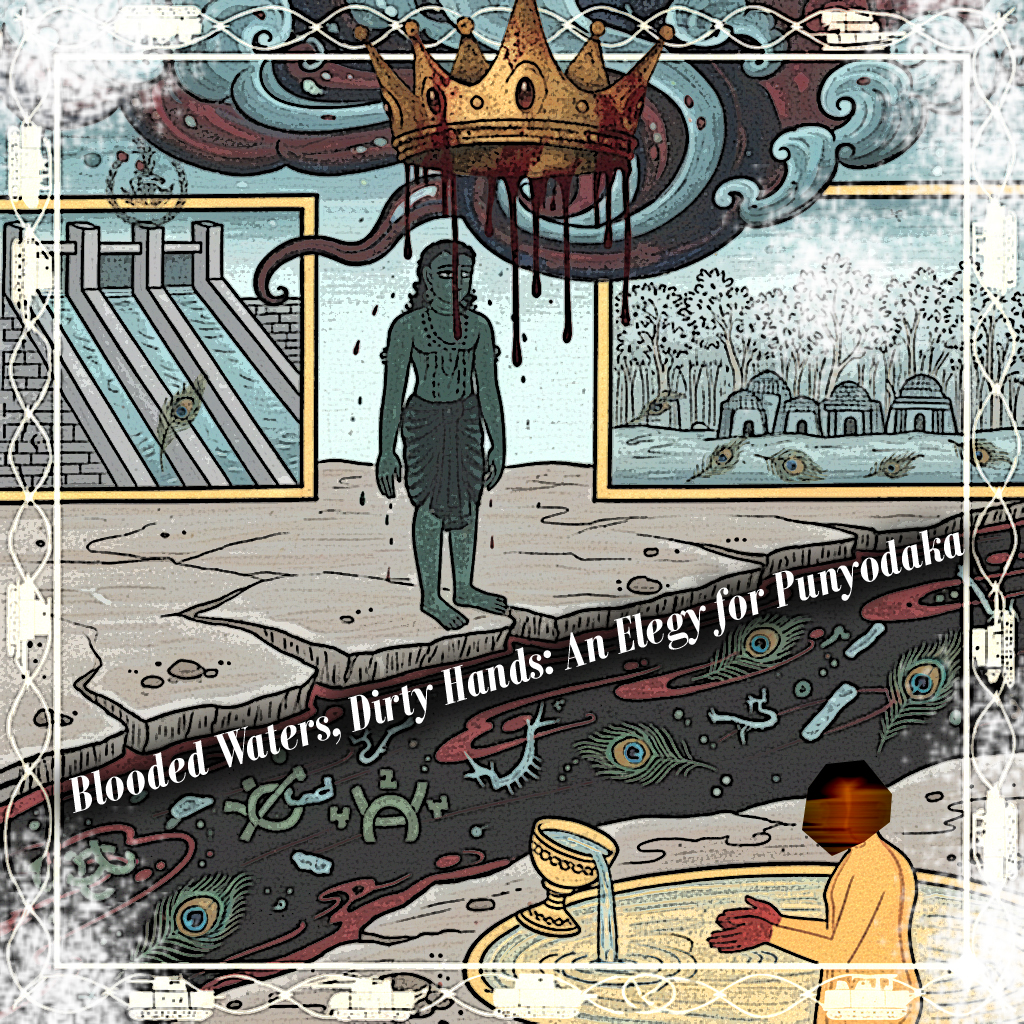
Posted on 1st February, 2026 (GMT 07:18 hrs)
Authored by Ecotopians of Alternity (EOA)⤡ under the Once in a Blue Moon Academia (OBMA) Platform
ABSTRACT
This text is an elegy for puṇyodaka—not as a lost ritual substance, but as a shattered moral condition. Moving across Kalidasa’s Meghadūta, the Vana Parva’s Yaksha-prashna, biblical plague, Macbeth’s indelible blood, and Sartre’s Dirty Hands, it traces how water—river, sea, confluence—has been converted into spectacle, alibi, and instrument of power. Empirical poisonings (heavy metals, fecal coliforms, ecological collapse) coexist with choreographed immersions, artificial ghats, and submarine devotions, revealing a regime of simulation where sanctity is performed while rivers rot and silences are enforced. The work argues that contemporary governmentality no longer seeks purity but stages it, laundering violence through ritual, nationalism, and necessity. Against Hoederer’s calculus and Macbeth’s despair, the Yaksha’s ancient answer—manomalatyāga, the renunciation of inner stain—returns as an indictment: when minds remain polluted by greed, vanity, and commanded quiet, no river can cleanse. Puṇyodaka vanishes not because water fails, but because power poisons meaning itself. What remains is refusal: the withdrawal of consent from any politics that needs blood to function, spectacle to survive, and dirty hands to rule.
This writing is dedicated to the pathological King Liar alias crony middleman a.k.a. mass pogrom-manufacturing equivocator—the 56 inch chested, self-proclaimed non-bio-logical (non-)being—whose hands bear the indelible stains of power, deception, and bloodied (ir)responsibility.
I wander, a shadow among ghosts, seeking a river unscarred by venom, echoing the exile’s lament from Kalidasa’s Meghadutam—
yakṣaścakre janakatanayā-snāna-puṇyodakeṣu
snigdhacchāya-taruṣu vasatiṃ rāmagiryāśrameṣu
(The Yaksha dwelled in Ramagiri’s ashrams, under trees of gentle shade, in waters blessed by Sita’s sacred bath.)
Puṇyodaka (पुण्योदक): “water (udaka) endowed with piousness (puṇya)”—that is, sanctified, sacred or holy water.
But puṇyodaka eludes me, a mirage in the dust— rivers twisted into sewers, arteries clogged with the filth of forgotten promises, spurious wastes seeping like tears from a wounded earth. Where is the snāna that purifies, not poisons? My soul aches, hollow as a cracked vessel.
I dragged my weary frame to the Mahakumbh, that chaotic carnival of faith, hoping for immersion in the divine confluence— but the water stared back, a murky abyss, too defiled for even despair’s touch.
| POISONOUS CHEMICALS IN THE GANGES AT MAHAKUMBH Amid the throngs at Prayagraj, the Ganges bears a toxic burden: lead (Pb) surging to 1,160 µg/L against safe thresholds of 50 µg/L, cadmium (Cd) at 960 µg/L (far beyond 5 µg/L), chromium (Cr) at 660 µg/L (exceeding 50 µg/L), and mercury (Hg) infiltrating neural pathways and kidneys. Industrial leachates, agrochemical runoff, and untreated sewage elevate biochemical oxygen demand (BOD) to 2.5–8.6 mg/L (above 3 mg/L for bathing), stripping dissolved oxygen (DO), breeding fecal coliforms 1,400-fold over limits, and embedding microplastics in the aquatic chain—silent assassins in the sacred flow. |
Oh, the fools, the blind devotees, plunging into that lethal brew, not merely bathing but gulping the curse, as if death were nectar. It pierces me, this echo of the COVID plague— when Hindus, in fevered delusion, smeared cow dung, swigged urine, chasing cures in the muck of myth, while the world crumbled, unhealed. Sorrow swells, a tidal grief, for faith turned folly, lives lost to lies.
In the dim hush of ritual, I murmur a psalm, summoning rivers into twin kosa-kusi, those humble Brahmin chalices for fire-offerings— a mantra secular as the sky, unbound by Hindutva’s chains:
gaṅge ca yamune caiva godāvarī sarasvati | narmade sindhu kāveri jale’smin sannidhiṃ kuru ||
(O Ganga, Yamuna, Godavari, Saraswati, Narmada, Sindhu, Kaveri—gather here in this humble water.)
Yet my plea scatters like ash on wind— no purity descends, only the globe’s foulest dregs, converging in India’s ravaged veins. Despair clutches my throat, a noose of neglect.
Tears carve canyons down my face as I gaze upon Narmada, her body broken by dams, her song silenced in concrete tombs. I weep for Varanasi’s ghats, drowned in the Ganges’ bloated rage, ancient steps vanished beneath the flood’s merciless kiss— visibility stolen, souls adrift. I mourn the Sundarbans’ mangroves, erased by creeping salt, deltas devoured; sweet-water fishes, those silver ghosts, extinct in the brine’s bitter embrace. What have we wrought? This endless elegy of loss, ecosystems unraveling like frayed threads.
Then, in mockery’s glare, I behold the sham— a fabricated Yamuna, conjured for the exalted PM’s dip, taxpayers’ coins squandered on illusion, a photo-framed farce for the Hindu Rashtra’s haze.
| THE ARTIFICIAL YAMUNA GHAT CONTROVERSY By late 2025, during Chhath Puja, Delhi’s BJP regime stirred outrage by erecting a “fake Yamuna” at Vasudev Ghat— a cordoned pond of treated water from Wazirabad’s plant, meant for drinking, tiled and isolated for Prime Minister Modi’s ritual bath amid toxic foam. AAP lambasted it as electoral theater, concealing pollution failures. Budget revisions spiked: Rs 33.03 crore added to the initial Rs 21 crore for 2025-26, totaling over Rs 54 crore on ghats and festivities. BJP countered as opposition envy, but post-event, the setup was swiftly dismantled, erasing traces of the extravagance. |
Modi’s words resound. A dagger in the dark gets sharpened: “Blood and water cannot flow together.”
After the artificial Yamuna’s glittering deception, another shadow falls— a river scene from years past, where waters once flowed clear in Jim Corbett’s embrace, the Ramganga, gentle and green, now stained in memory’s cruel light.
On that February day in 2019, as Pulwama bled— forty CRPF souls torn by suicide’s blast at 3:10 PM— the Prime Minister drifted in a boat upon the Ramganga’s reservoir, camera rolling for a wilderness tale with Bear Grylls, “Man vs Wild,” a scripted dance of survival amid untouched nature.
The convoy burned in Kashmir’s dust; here, the leader posed against jungle calm, oars dipping, smiles framed, while death’s news crept slowly through the trees.
Some say the shoot ended by 3 PM, thirty minutes before the explosion’s roar; others whisper it stretched into evening— past 5 PM, tea and snacks at a PWD guesthouse around 7, the river’s flow undisturbed by distant grief.
Then came Satyapal Malik’s voice, cracked open in 2023, former Governor of the wounded valley, speaking to Karan Thapar: “I called him to report the horror, the lapses— no aircraft for the jawans, negligence from the home ministry, incompetence laid bare.”
And the response? A quiet command across the line: “Tum abhi chup raho”— “You keep quiet right now.”
Even the NSA’s counsel echoed the same hush, silence urged while bodies lay unclaimed, intelligence ignored, they say, for electoral harvest— blame flung across borders, internal rot veiled in national fury.
| PULWAMA ATTACKS (MYTH AND/OR REALITY) On February 14, 2019, when a suicide attack in Pulwama killed 40 CRPF personnel, Prime Minister Narendra Modi was in Jim Corbett National Park, Uttarakhand, filming an episode of Discovery Channel’s Man vs Wild with Bear Grylls. Reports indicate that the shoot included activities around the Ramganga river/reservoir within the park, and that Modi continued filming in the Ramnagar area well into the evening, later stopping for tea and snacks at a PWD guesthouse around 7 p.m. The attack itself occurred around 3:10–3:15 p.m. In April 2023, Satyapal Malik—then Governor of Jammu and Kashmir—alleged in an interview with The Wire that when he attempted to inform the Prime Minister about the attack and associated security lapses, including the denial of aircraft to transport CRPF personnel, Modi was initially unreachable due to being in a remote area and later instructed him to “keep quiet.” Malik further claimed that the lapses stemmed from negligence within the Home Ministry, that NSA Ajit Doval similarly advised silence, and that the government chose not to act on prior intelligence inputs, later politically capitalizing on the attack by externalizing blame while downplaying internal accountability. |
Oh, rivers of silence, how you carry these burdens— Ramganga’s innocent current bearing the weight of staged valor, while Pulwama’s blood soaked the soil far away. No puṇyodaka here, only the poison of withheld truth, of priorities adrift like boats on indifferent waters.
The same hands that diverted sacred flows for photo rites once floated serene on a river’s pretense, as martyrs waited in vain for voices to rise.
Sorrow deepens, layer upon layer— not just poisoned waters, but poisoned silences, rivers that witness and never speak, yet carry the stain forever.
In this endless elegy, where does purity hide? The clouds themselves turn venomous messengers, bearing not love’s verse, but ash and accusation across the sky.
After the Ramganga’s silent witness to withheld grief, another sea calls— the Arabian’s depths off Panchkui beach, Gujarat, February 25, 2024, where the Prime Minister, at seventy-three, descended into the blue abyss, scuba gear gleaming, ochre robes beneath the helmet’s white dome, to fulfill a decades-old dream in the sunken kingdom of Dwarka.
| In February 2024, Prime Minister Narendra Modi undertook a symbolic scuba dive into the Arabian Sea off Gujarat’s Dwarka coast—near Beyt Dwarka island—to perform an underwater puja at the site believed to be the submerged ancient city associated with Lord Krishna. He offered peacock feathers (morpankh or “Krishna petal” in symbolic terms, as peacock feathers are iconic to Krishna) as a tribute while sitting cross-legged on the seabed, describing the experience as profoundly divine, connecting spiritual grandeur with historical echoes of Krishna’s eternal presence. Archaeological marine explorations, including those by the National Institute of Oceanography and ASI’s Underwater Archaeology Wing (with renewed dives in 2025 after a two-decade gap), have revealed stone structures, anchors, pillars, and remnants dating potentially to 1500–2000 BCE or earlier periods, supporting evidence of a planned ancient port city-state that aligns with scriptural accounts of Dwarka’s submersion after Krishna’s era, though scientific datings vary and do not fully match the mythical timeline; Modi’s visit highlighted this blend of faith, heritage, and ongoing discoveries, inspiring calls for further submarine tourism and deeper excavations to support commodified spectacles. |
He sat cross-legged on the seabed, hands folded in prayer, Navy divers steadying his form as he offered peacock feathers— Krishna’s emblem, drifting like lost plumes in the current— a submerged puja amid ruins archaeologists once mapped, the ancient city myth says vanished after the Lord’s departure, one of the Sapta Puri, holy pilgrimage drowned in time’s tide.
“A very divine experience,” he perhaps emerged to declare, “more than courage, it was faith”— touching grandeur of old while visions of modern India’s splendor flashed, hours after inaugurating Sudarshan Setu, the nation’s longest cable-stayed bridge, 2.32 kilometers linking mainland to Beyt Dwarka island, a spectacle of steel and devotion fused for the gaze of the world.
Weeks before, in Lakshadweep’s turquoise shallows, he had snorkeled, sharing glimpses of coral and fish, calling it exhilarating, a prelude to deeper immersion— promoting tourism, unveiling submarine tours for the masses to glimpse the “lost” city below, blending pilgrimage with spectacle.
Yet in these sacred plunges, sorrow stirs anew: the same waters that cradle ancient myth now bear the weight of staged sanctity, feathers offered while rivers elsewhere choke, ghats submerge in filth, mangroves fade to salt. Puṇyodaka sought in ocean’s embrace, but found only selective divinity— a leader communing with Krishna’s ghost while the living waters of the land turn venomous, ignored.
Oh, submerged dreams, how you mock the surface rot— feathers float, prayers echo in bubbles rising to indifferent sky, while the true rivers weep their poison unchecked. The quest deepens, the grief layers thicker: what holiness in depths curated for cameras, when the flowing veins of the nation bleed unchecked?
In this fractured hymn, the clouds gather heavier still, venomous messengers bearing not redemption, but the echo of every unheeded cry from poisoned shores.
After the ocean’s curated depths and Krishna’s submerged feathers, the Ganga herself beckons once more— Triveni Sangam, Prayagraj, February 5, 2025, amid the Maha Kumbh’s vast human sea.
| On February 5, 2025, Prime Minister Narendra Modi visited the Maha Kumbh Mela in Prayagraj and took a holy dip at the Triveni Sangam, the confluence of the Ganga, Yamuna, and mythical Saraswati rivers. He arrived at Prayagraj Airport in the morning, was received by Uttar Pradesh Chief Minister Yogi Adityanath, proceeded to Arail Ghat, and took a boat ride to the Sangam site. Dressed in a saffron jacket or robe-like attire with blue track pants and rudraksha beads around his neck, he performed the ritual immersion amid Vedic chants from priests, offered prayers including tarpan to the Sun and to the rivers, and later changed into a navy blue kurta or black kurta with a saffron sash and Himachali cap for additional rituals such as aarti and offerings of flowers, fruits, and a red chunari. This occurred on the day coinciding with Magh Ashtami and Bhishma Ashtami during the ongoing Maha Kumbh, which ran from January 13 to February 26, 2025, and had seen massive pilgrim attendance by that point. Following the Snan, Modi posted on X: “Blessed to be at the Maha Kumbh in Prayagraj. The Snan at the Sangam is a moment of divine connection, and like the crores of others who have taken part in it, I was also filled with a spirit of devotion. May Maa Ganga bless all with peace, wisdom, good health and harmony.” The event was covered by outlets including The Hindu, India Today, Business Standard, The Indian Express, ANI, and others, with reports noting the boat journey, full submersion, accompanying chants, and the visit’s timing amid the festival’s record crowds. |
The Prime Minister steps down from the boat at Arail Ghat, saffron robe vivid against the gray dawn, rudraksha beads clutched in prayer-folded hands, accompanied by Yogi Adityanath, gliding across the confluence where Ganga, Yamuna, and phantom Saraswati meet in myth and mud.
He submerges fully, body dipping in rhythmic devotion, Vedic chants rising from priests like smoke, “a moment of divine connection,” he later proclaims on X, “May Maa Ganga bless all with peace, wisdom, good health, and harmony.”
Yet the waters he enters are the same that repelled me earlier— toxic brew of heavy metals, fecal coliforms surging 1,400 times beyond limits, BOD elevated, oxygen starved, microplastics threading through the flow like invisible thorns in the sacred thread.
A week prior, a stampede had claimed dozens in the crush toward these banks— lives trampled in the rush for purity, bodies broken under faith’s fervent tide— and now, security cordons thick as crowds, the leader bathes serenely, offers prayers watched by millions, assesses arrangements, while the river, unchanged, carries its poison onward.
This is no first plunge: echoes of 2019 Kumbh, feet washed of sanitation workers; 2021 Varanasi, dip at Lalita Ghat amid temple inaugurations— each a tableau of Sanatana Dharma’s embrace, a leader’s immersion in heritage, yet the Ganga remains defiled, her blessing withheld from the masses who drink her curse.
Sorrow coils tighter in my chest: how the same hands that invoke Maa Ganga’s grace overlook her choking arteries, her blackened veins. Holy dip in polluted embrace— symbol of devotion, spectacle of selective sanctity, while the true snāna eludes, purity a ghost in the current.
The quest for puṇyodaka fractures further here, at the very heart of confluence, where faith and filth converge without redemption. Tears mingle with the river’s foam; the clouds above darken, venomous envoys carrying not absolution, but the weight of every drowned dream.
| Prime Minister Narendra Modi’s recent public acts of ritual devotion have been carefully staged, high-visibility events that fuse personal piety, political symbolism, and cultural nationalism. On February 5, 2025, during the Maha Kumbh Mela at Prayagraj, Modi took a holy dip (snan) at the Triveni Sangam—the confluence of the Ganga, Yamuna, and the mythical Saraswati—wearing saffron robes and accompanied by priests chanting Vedic hymns. He was joined by Uttar Pradesh Chief Minister Yogi Adityanath, arriving by boat amid intense security arrangements, especially in the shadow of a deadly stampede that had occurred days earlier. Modi described the act as a moment of “divine connection” and devotion, framing it within Hindu traditions of spiritual purification and moral renewal. Given the Maha Kumbh’s rare 144-year cycle in this specific astrological configuration, the spectacle functioned as a potent visual assertion of the BJP leadership’s identification with Hindu civilizational heritage, reinforced by his interactions with saints and inspections of pilgrim arrangements. This was not an isolated gesture. Modi has repeatedly used sacred geography and ritual performance as part of his public persona: in February 2019, he took a dip at the Prayagraj Kumbh and symbolically washed the feet of sanitation workers, and in December 2021, he performed rituals at the Ganga’s Lalita Ghat in Varanasi during the inauguration of the Kashi Vishwanath Dham corridor. Supporters read these acts as demonstrations of commitment to Sanatana Dharma and as efforts to connect emotionally with Hindu devotees across caste and class lines, while critics view them as carefully choreographed religious spectacles embedded in electoral and ideological strategy. The pattern extends beyond rivers to the sea. On February 25, 2024, Modi undertook a widely publicized scuba dive off the coast of Devbhumi Dwarka in Gujarat, descending with Indian Navy divers to the site believed—according to Hindu tradition—to be the submerged city of Lord Krishna. Performing an underwater puja and offering a peacock feather, he described the experience as “very divine” and the fulfillment of a decades-old aspiration. The event coincided with the inauguration of the Sudarshan Setu, India’s longest cable-stayed bridge, and announcements promoting underwater tourism to the Dwarka ruins. Along with his January 2024 snorkeling promotion in Lakshadweep, these episodes illustrate a consistent blending of spirituality, spectacle, heritage tourism, and state power—where devotion is not merely personal, but staged as a civilizational narrative performed by the head of government. |
…and yet the megalomaniac Modi, king of crafted illusions and simulated facades, parades his ostentation like a crown of thorns upon the nation’s brow— pinstripe suits embroidered with his name in golden thread, a Guinness record of vanity worn before Obama’s gaze, auctioned later as if charity could wash the excess; Montblanc pens clutched in speeches of simplicity, Movado watches ticking away public hours on his wrist, Maybach sunglasses, Rs 1.6 lakh shields against the sun’s judgment, memes exploding like distant bombs on Twitter’s battlefield— all while rivers rot, crises erupt, boat rides on Ramganga during Pulwama’s blood-soaked hour, scuba dives in divine pretense as floods claim the poor. King Liar, draped in luxury’s lie, preaching asceticism from silken thrones, his spectacles framing a world where puṇyodaka is but a prop for the next viral pose. Sorrow pierces deeper: how such finery mocks the naked grief of a land stripped bare, its waters weeping gold it cannot afford.
In the shadowed groves of Vana Parva, where the Yaksha—disguised as Dharma’s own voice— stood over the parched lake and the fallen Pandavas, he posed the question that cuts deeper than any arrow:
“What is the greatest snānam?”
Yudhishthira, weary yet unbowed, answered: Manomalatyāga— the abandonment of the mind’s impurities, the true ablution that no river can bestow.
Not the dip in Ganga’s swollen current, not the plunge into Ramganga’s indifferent flow, not the submarine gaze at Dwarka’s drowned stones, not the staged immersion in artificial Yamuna—
but the washing away of mental stains: greed that clogs the heart like industrial sludge, anger that foams like toxic froth on the banks, ego rising like microplastics threading every vein.
While bodies submerge in polluted sangams, seeking external purity amid heavy metals and coliforms, the mind remains defiled— unwashed by spectacle, untouched by silence, stained by withheld truths and selective devotion.
Manomalatyāga— renounce the inner filth, cast off the mala of unrighteous thought, still the turbulence of the heart’s hidden currents.
Yet in this age of fractured rivers, how shall we achieve it? The outer waters mirror the inner rot: Narmada dammed, Sundarbans salted, Ganga choked— and within, the same poisons linger: pride in photo-op puja, indifference to stampede’s blood, command to “chup raho” when negligence screams.
Yudhishthira’s wisdom revives no brothers here; the Yaksha does not yield, for the test is unending. We stand at the lake’s edge, brothers fallen around us, thirsty for puṇyodaka that no longer exists, yearning for manomalatyāga while the mind’s impurities swirl unchecked, darker than any monsoon drain.
True bath is not immersion, but renunciation— yet we plunge again and again into the very filth we should abandon.
But we have failed the test. The lake stays dry. Our brothers lie dead around us. The outer rivers mirror the inner rot so perfectly that no distinction remains: puṇyodaka is gone, manomalatyāga is a word we pronounce while continuing to drink the filth.
Yet once, in Vana Parva’s thirst-cracked grove, the Yaksha’s question lingered like smoke: “What is the greatest snānam?” And Yudhishthira, throat parched, eyes clear, spoke the word that should have saved us all— manomalatyāga— renunciation of every inner stain.
Now we stand at the same dry lake, brothers already corpses at our feet, and whisper the ancient cleansing verse as if it could still reach us:
oṃ apavitraḥ pavitro vā sarvāvasthāṃ gato ’pi vā | yaḥ smaret puṇḍarīkākṣaṃ sa bāhyābhyantaraḥ śuciḥ ||
“Om—impure or pure, in any wretched state, he who remembers the lotus-eyed One becomes clean without and within.”
We chant it on polluted banks, mouths still tasting cadmium and despair, hands folded toward cameras and crowds, hoping Vishnu’s gaze might rinse the mind while the Ganga carries mercury downstream, while saffron robes drip with the same black water that drowned the ghats, salted the mangroves, silenced the fish.
Bāhya śuciḥ—external purity— mocked by staged dips, artificial ponds, peacock feathers sinking in curated ruins. Ābhyantara śuciḥ—inner purity— the heart’s ablution, manomalatyāga itself— remains a dream we recite but never live.
We remember Puṇḍarīkākṣa with wet lips, yet the mind stays smeared: greed in golden threads of vanity, wrath in commands to “chup raho,” pride in luxury worn as dharma, delusion in every viral pose of devotion.
The śloka floats, fragile as river foam, then dissolves— no lotus-eyed vision descends, no inner filth is cast away. Only the outer rot reflects the inner, mirror to mirror, black on black, and the chant ends in silence deeper than any drowned city.
Sorrow thickens like sediment in the current: we invoke purity while steeped in poison, we seek manomalatyāga while hoarding every mala, and the Yaksha turns away, no brothers revived, no lake refilled, only this endless, weeping shore.
Blood and water flow together after all— in treaties broken, in silences commanded, in staged plunges and real drownings…
Sorrow settles like sediment on the riverbed: the greatest snānam remains unperformed, the mind’s mala endures, and the Yaksha waits, silent, eternal, for an answer we cannot yet give.
In this rift of nations, waters weaponized, I see the biblical omen—Exodus’ first plague, Moses’ staff striking the Nile, turning Egypt’s life-veins to blood: rivers, canals, ponds crimson-clotted, fish rotting in the reek, thirst unslaked for seven endless days. Apocalypse unfolds—the end of water, blood’s relentless bloom. My heart fractures, a vessel shattered on the shores of ruin.
“Here’s the smell of the blood still. All the perfumes of Arabia will not sweeten this little hand.” (Macbeth, Act 5, Scene 1)
In these rivers, mirrors of our fractured self, I drown in sorrow’s depths, a poem ruptured, unresolved— what redemption for this eternal wound?
Oh 56′ inch chested non-bio-logical (non-)being….
Blood and money—your feast.
You dance and sing on our blood money,
the blood money of India’s toiling citizens,
clinking glasses with Epstein’s ghosts.
Do You Think You Can “Govern” Innocently, that is, without dirtying your hands?
Then let’s name it without metaphor: Sartre’s Dirty Hands is not a cautionary footnote but the state’s operating manual. Hoederer stands on the riverbank, sleeves rolled, declaring that history has no time for purity—one must soil one’s hands to govern. King Liar inherits this creed and perfects it: blood becomes policy, contamination becomes “trade-off,” thirst becomes “collateral.” Hugo’s anguish is neutralized in advance—conscience is framed as childish idealism, dissent as treason to necessity. This is the alibi of power: once ends are declared sacred, means are baptized in reason, and murder learns to speak in white papers. The river, turned to blood, exposes the fraud—there is no tragic nobility here, only routinized violence pretending to be maturity.
Sartre’s question detonates at the heart of governmentality: if rule requires dirty hands, then sovereignty is structurally guilty; if innocence is impossible, then legitimacy is a lie told by those who benefit from the stain. The state survives by insisting that everyone get dirty together—shared guilt as social glue—while it alone claims the right to decide who bleeds. And so redemption cannot be managerial or gradual; it begins only when Hugo’s refusal is reclaimed against Hoederer’s calculus, when we say: a politics that needs blood to function deserves neither obedience nor reverence.
So let this be the last confluence—not of rivers, but of verdicts. The Yaksha still waits by the dry lake, Moses’ staff lies splintered on the bank, and Hoederer’s sleeves drip with a practicality that smells of blood. We have learned, too late, that no ritual can launder a lie, no staged immersion can rinse a crime, no doctrine of necessity can sweeten a stained palm. Puṇyodaka has vanished not because the rivers failed, but because power poisoned the very idea of spontaneous sanctity. Water remembers what power forgets. Rivers keep their archives in silt and bone, in mercury and silence, in the names that were told to “keep quiet.”
If there is an ending, it is not absolution but refusal: to step back from the poisoned flow and to name it not puṇyodaka, to deny the calculus that calls killing maturity, to choose the peril of clean hands over the comfort of shared guilt. Let governance tremble before conscience; let spectacle starve without belief. Only then might water loosen its grief, not into purity theatrically restored, but into truth reclaimed—where puṇyodaka is no longer a prop or a promise, but a moral condition yet to be earned, where blood is named blood, and hands are washed not by rivers conscripted into lies, but by renunciation itself.


Comments
Post a Comment