Manifesto for Scrapping the Ill-Conceived Insolvency and Bankruptcy Code (IBC) 2016
Manifesto for Scrapping the Ill-Conceived Insolvency and Bankruptcy Code (IBC) 2016
Posted on 22nd January, 2026 (GMT 07:55 hrs)
ABSTRACT
This manifesto advances a sustained, evidence-based critique of India’s Insolvency and Bankruptcy Code (IBC), 2016, arguing that the regime has evolved into a structurally predatory legal apparatus that facilitates large-scale transfer of public, depositor, and taxpayer-backed wealth into private corporate hands under the guise of “efficient insolvency.” Drawing on IBBI data up to 2025, landmark cases such as DHFL, Bhushan Power & Steel, Videocon, and Aircel, and recent Supreme Court jurisprudence, the analysis demonstrates how the IBC has systematically failed its own statutory promises of time-bound resolution, value maximization, equitable treatment, fraud recovery, and economic revival. Instead, prolonged delays, extreme haircuts averaging 67–68%, marginalization of retail depositors and public-interest claims, laundering of fraud through Section 32A immunity, and near-absolute deference to creditor “commercial wisdom” have produced a regime marked by judicial ritualism, moral hazard, and deep constitutional infirmities under Articles 14 and 21. The DHFL resolution is presented as a “laboratory case” exposing the IBC’s core pathologies—where a solvent, fraud-tainted institution was transferred at a steep discount, avoidance recoveries worth tens of thousands of crores were privatized, and lakhs of small savers were effectively dispossessed. Situating the IBC within a broader political economy of crony capitalism and opaque political funding, the manifesto rejects incremental reform as inadequate and calls for the complete scrapping of the Code in favor of a transparent, people-centric insolvency framework grounded in accountability, restitution, constitutional justice, and public interest.
A People’s Declaration Against Legalized Plunder
We, the People – Victims of Financial Abuse, Defenders of Justice, and Guardians of Public Wealth – declare this manifesto in the face of a predatory (or pre-debt-ory!) legal regime that masquerades as reform. The Insolvency and Bankruptcy Code (IBC), 2016, is not a tool for economic revival; it is a weapon of organized loot, designed to transfer public money into private pockets while crushing ordinary citizens. Born from crony capitalism and sustained by judicial abdication, it has failed every promise: time-bound resolution, value maximization, creditor protection, and equity. Instead, it has become a bankruptcy bazaar – a juridical marketplace where billionaires and their political patrons expropriate assets at fire-sale prices, laundering fraud through procedural finality and granting clean chits to the guilty.
The IBC is ill-conceived at its core. It overrides constitutional rights under Articles 14 and 21, imposes massive haircuts (averaging 67–68%), and delivers abysmal recoveries (~32% of admitted claims as of 2025). Processes drag on for 700+ days, far beyond statutory limits, eroding asset value and burdening the judiciary with endless litigation. The Committee of Creditors (CoC), dominated by banks, reigns as an unchecked “king,” sidelining small creditors, operational stakeholders, and depositors while prioritizing quick exits over justice.
The DHFL scam stands as the ultimate litmus test for legitimizing the IBC framework– a “laboratory state” where lakhs of innocent Fixed Deposit (FD) and NCD holders, mostly elderly and middle-class, were treated as guinea pigs. A solvent AAA-rated company with ₹90,000+ crore in assets was resolved for a fraction of its value, yielding only 23% recovery for victims (₹1,241 crore against ₹5,375 crore dues). Avoidance recoveries worth ₹45,000–47,000 crore were assigned a notional ₹1, accruing solely to the acquirer (Ajay Piramal), while Section 32A shielded prior offenses and Section 66 was ignored. Promoters’ full-repayment offers were suppressed, forensic audits flagged fraud linked to terror funding and underworld networks, yet the Supreme Court rubber-stamped the plan in April 2025. This is not resolution; it is capital punishment for the financially abused.
This pattern repeats: Videocon (95–96% haircut), Aircel (89% wipeout), Essar Steel (value destruction), Bhushan Power (fraud concealment leading to liquidation). The IBC dovetails with political funding loops – electoral bonds, donations from beneficiaries like Piramal (₹85 crore), Tata, Vedanta – creating a quid pro quo where haircuts free capital for cronies to donate to ruling parties. It privileges financial creditors over public-interest claims (tax, PF, municipal), contravenes other laws (SARFAESI, RBI Act, NHB Act), and enables asset stripping through shell entities.
We reject piecemeal amendments (over 35 since 2016) that mask systemic flaws. The IBC is not reformable; it is rogue – a regime of plunder aligned with oligarchy and hostile to the people. It inverts justice: equality before the law for corporations, vanishing jurisprudence for citizens; commercial wisdom for cronies, ritual for the rest.
Table 1 — IBC: Promises vs. Outcomes (IBBI Data and Case Law, up to 2025)
| Promise | Statutory Claim (IBC, 2016) | Actual Data / Reality (≈2025) | Case Illustration | Public Harm |
|---|---|---|---|---|
| Time-Bound Resolution | CIRP to be completed in 180 days, extendable up to 330 days including litigation (Sections 12, 33) | • Average CIRP duration: 650–750+ days • Over 75% cases breach 330-day limit • Several cases drag 5–8 years due to litigation, vacant NCLTs | BPSL: ~6+ years before SC intervention | DHFL: ~3.5 years | Videocon: ~4+ years | Asset value erosion, stalled businesses, mounting legal costs; justice delayed becomes value destroyed |
| Value Maximization | Core objective under Preamble and Section 25(2)(h) | • Average recovery ~31–33% of admitted claims • Haircuts 67–68% on average (worsening from ~43% in 2019) • Liquidation recoveries often 6–10% | Videocon: ~95–96% haircut | Aircel: ~89% haircut | DHFL: ~23% for FD/NCD holders | Massive destruction of public/taxpayer-backed wealth; fire-sale transfers to large corporates |
| Creditor Protection | IBC claimed to protect “creditors” as a class via CoC | In practice, only financial creditors (banks) dominate; retail depositors, operational creditors, employees sidelined | DHFL: ~2.5 lakh FD/NCD holders had no effective voice despite being major stakeholders | Middle-class savers, retirees, workers bear losses while banks exit early |
| Fair & Equitable Treatment | Section 30(2) read with constitutional guarantees (Arts. 14, 21) | • Distribution heavily skewed toward secured lenders • Public-interest claims (PF, tax, municipalities) routinely extinguished • No proportionality or minimum recovery norms | DHFL: 23% to FD holders vs control handed to acquirer | Real-estate CIRPs: homebuyers left stranded | Inequality before law; citizens absorb losses, corporates get certainty |
| Revival Over Liquidation | IBC prioritizes resolution of viable firms as going concerns | • High liquidation share (~45–50% of cases) • Many “resolutions” are de facto asset takeovers, not revivals | BPSL: Resolution annulled → liquidation | Many MSME & real-estate cases | Job losses, supply-chain collapse, local economic damage |
| Fraud Detection & Clawback | Sections 43–51 (avoidance) and 66 (fraudulent trading) | • Avoidance actions delayed or under-pursued • Massive recoveries assigned to resolution applicants at nominal value | DHFL: ₹45,000–47,000 crore potential avoidance recoveries assigned at ₹1 to Piramal | Fraud proceeds effectively privatized; victims denied restitution |
| Judicial Oversight | NCLT/NCLAT/SC to ensure legality and fairness | • Courts increasingly defer to “commercial wisdom” • Review reduced to procedural box-ticking | DHFL (SC, 2025): Plan upheld despite bias & fraud allegations | BPSL (SC, 2025): Plan scrapped for fraud | Inconsistency, unpredictability; perception of judicial abdication |
| Clean Credit Culture | Deterrence against default and wrongdoing | • Haircuts normalize strategic default • Section 32A grants post-resolution immunity even in fraud-tainted cases | DHFL: Prior offenses insulated post-resolution | Moral hazard; wrongdoing laundered through insolvency |
| Public Interest Alignment | IBC to strengthen economy & trust | • PSU banks absorb losses (taxpayer money) • Post-IBC beneficiaries emerge as major political donors | DHFL / Videocon era: Surge in corporate political funding | Reinforces crony capitalism; erosion of democratic accountability |
We demand the total scrapping of this ill-conceived code. Replace it with a transparent, equitable system that bans promoters from bidding, mandates minimum recoveries, severs political funding ties, and prioritizes public interest over profit. Until then, we stand in non-violent resistance.
Collective Call for Action!
This is our rallying cry – no shortcuts, no surrenders!
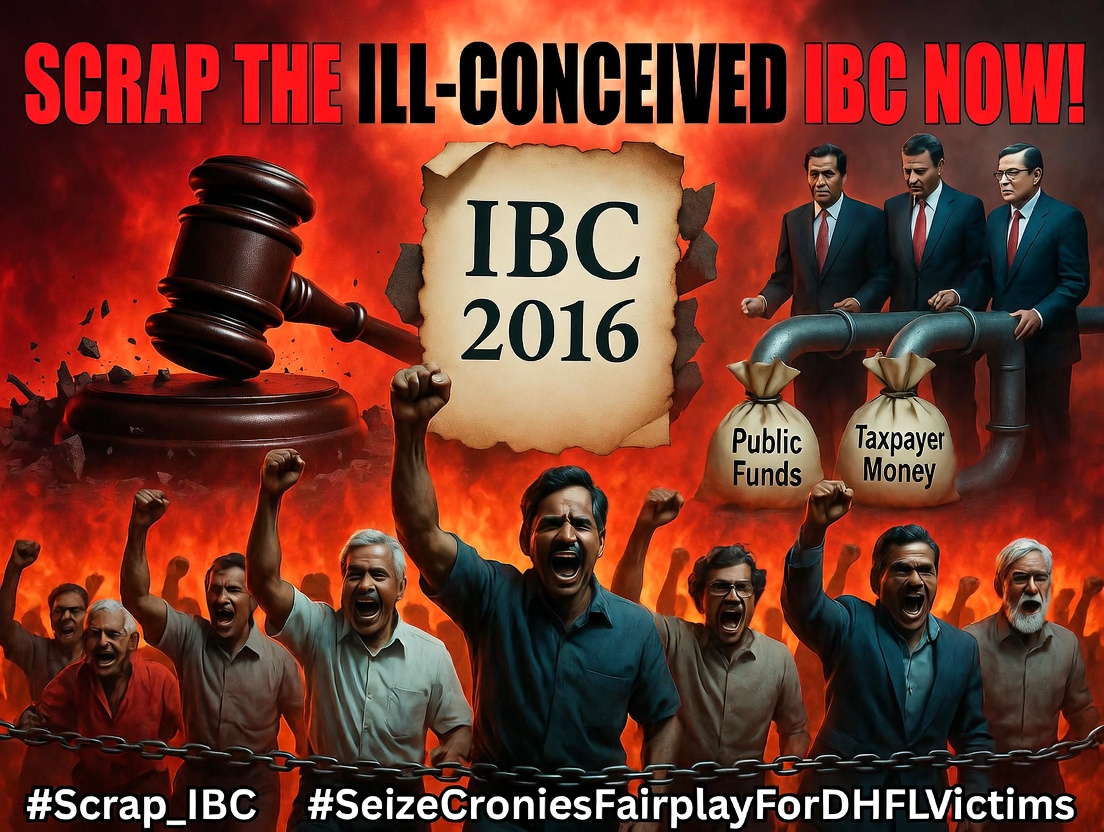
- Demand Immediate Scrapping of the IBC 2016: Petition the Government, Parliament, and Supreme Court to repeal the code in its entirety. Launch nationwide campaigns: #Scrap_IBC #ScrapIllConceivedIBC #SeizeCroniesFairplayForDHFLVictims.
- Unite as Victims and Allies: DHFL FD/NCD holders, other IBC-affected depositors, small creditors, and citizens – form coalitions. Amplify digital posters, share stories of financial abuse, and build mass petitions (e.g., via Change.org links for DHFL justice).
- Mobilize Non-Violent Civil Disobedience: Organize protests, sit-ins, and digital occupations. Boycott Godi media, expose crony nexus (BJP, Adani, Ambani, Piramal), and demand UN Human Rights Council intervention for violations of ICCPR and business-related human rights.
- Challenge in Courts and Public Forums: File fresh petitions highlighting constitutional invalidity, CoC bias, and fraud laundering. Submit public comments to IBBI demanding abolition. Pressure MPs and regulators to audit IBC failures.
- Amplify Resistance: Share this manifesto, repost digital posters, chant slogans: “Scrap IBC – Stop Corporate Loot!” “Justice for DHFL Victims is Justice for All!” “Public Money for People, Not Plutocrats!” Tag authorities, media, and influencers. Make the fight viral.
We strike while the iron is hot. The IBC is crumbling under its own contradictions – let us torch this edifice of plunder. Rise up, India! The time for justice is now.
Once In A Blue Moon Activists – We Will Not Be Silenced!
Use the following hashtags all across digital media platforms:
#Scrap_IBC #DHFLJustice, #EndCronyCapitalism, #PeopleOverProfit, #RuleOfLawForAll, #Alleged_Dawood_Mirchi_RKW_DHFL_BJP_Collusion, #Seize_Cronies_Fairplay_for_DHFL_Victims,
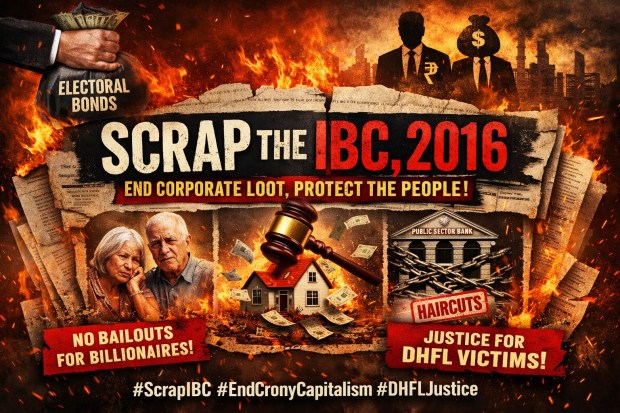
You might also wish to download and use the posters contained in the following post of ours:
Appendix: Why Scrap the IBC?
The Insolvency and Bankruptcy Code (IBC), 2016 was sold as India’s game-changing fix for a broken bankruptcy system—promising fast, transparent resolutions, value maximization for creditors, revival over liquidation, and a cleaner credit culture. Yet, after nearly a decade, the evidence from implementation, high-profile cases (especially DHFL as the “litmus test”), judicial outcomes, and systemic data paints a starkly different picture: an ill-conceived, predatory regime that often functions as a legalized mechanism for corporate expropriation, turning public/taxpayer-backed money into private windfalls while devastating small savers, depositors, and the broader economy.
This deep dive draws directly from the core arguments across our own research investigations, tribunal statistics, Supreme Court rulings, and patterns in cases like DHFL, Bhushan Power & Steel (BPSL), Videocon, and others. It highlights why many activists now call not for tweaks, but for outright scrapping.
1. Core Design Flaws Inherited and Amplified
The IBC consolidated old laws (SICA, RDDBFI, SARFAESI) into one code with creditor-in-control, time-bound (180/330 days) processes, and the Committee of Creditors (CoC) as near-absolute decision-maker under the “commercial wisdom” doctrine. But design biases and ecosystem weaknesses turned these into liabilities:
- CoC as Unchecked “King”: Dominated by large financial creditors (banks), the CoC often prioritizes quick, low-value exits over forensic accountability or equitable distribution. Small/operational creditors, retail depositors, employees, and public-interest claimants (tax, PF) get marginalized or pushed down the waterfall. In DHFL, retail FD/NCD holders (65%+ of claims by value in some views) had near-zero voice despite massive stakes.
- “Commercial Wisdom” as Shield for Bias: Courts defer almost completely to CoC decisions, turning judicial review into a ritual. This enabled alleged irregularities (biased bidding, suppressed offers) without meaningful scrutiny—e.g., DHFL CoC allegedly ignored promoter full-repayment proposals while favoring Piramal.
- Avoidance/Fraud Recovery Neutralized: Sections 43–51 (preferential/undervalued transactions) and 66 (fraudulent trading) were meant to claw back siphoned funds. Instead, they are routinely under-enforced due to under-resourced resolution professionals, CoC focus on speed, and assignment of massive claims at “notional ₹1” to resolution applicants (accruing solely to them). In DHFL, ₹45,000–47,000 crore in potential avoidance recoveries went to Piramal for effectively nothing, while victims got crumbs.
2. Chronic Delays and Value Destruction
The promise: swift revival. Reality: a backlog nightmare.
- Average CIRPs far exceed 330 days (often 600–900+ days; some 8+ years like BPSL).
- By 2025, ~77% of cases breach even the extended 270-day mark; tribunals overwhelmed with vacancies and litigation.
- Asset erosion is severe—delays freeze operations, scare away bidders, and devalue everything. Liquidations dominate in many sectors (especially real estate), with recoveries often 6–10% of claims vs. touted “170% of liquidation value” (a misleading metric based on depressed baselines).
3. Abysmal Recoveries and Massive Haircuts
Official IBBI data (up to 2025): average recoveries ~31–33% of admitted claims (~67–68% haircuts), down from ~43% in 2019 to ~25% in recent quarters. Public-sector banks (taxpayer money) bear the brunt.
- High-profile wipeouts: Videocon (~95–96% haircut), Aircel (~89%), real-estate cases (80–90%).
- Haircuts free up capital for beneficiaries, who then donate heavily to ruling parties (e.g., BJP electoral bonds surge from ₹780 crore in 2014 to ₹9,000+ crore in 2024; major donors include post-IBC winners like Piramal, Vedanta, Tata).
- This creates a perceived quid pro quo loop: IBC haircuts → freed cash → political donations → protection/impunity.
4. DHFL as the Ultimate “Litmus Test” / Laboratory State
DHFL (AAA-rated NBFC, ₹90,000+ crore assets) collapsed in 2019 amid fraud allegations (linked to terror funding, Dawood Ibrahim networks via Iqbal Mirchi, ₹2,200 crore suspect deals). It became the test case for IBC’s fairness toward retail victims.
- Process Allegations: RBI-appointed CoC allegedly manipulated bidding, suppressed Kapil Wadhawan’s 100% repayment offer (NCLT ordered reconsideration in May 2021; stayed/overturned), ignored Section 66 fraud probes.
- Outcome: Piramal acquired for ~₹34,250–37,250 crore against ₹87,000 crore claims → ~23% recovery for FD holders (₹1,241 crore vs. ₹5,375 crore dues); massive haircuts on 2.5 lakh mostly elderly/middle-class savers.
- Judicial Rubber-Stamp: Supreme Court (April 2025) upheld the plan, deferred to CoC wisdom, overlooked bias claims (Oaktree allegations), and assigned huge avoidance recoveries to Piramal at ₹1. NCLT/NCLAT noted “dubious-opaque-expropriative” elements but denied victims standing/remedies.
- Broader Message: A solvent entity was liquidated into private hands at steep discount; public safeguards (RBI/NHB Acts) overridden; fraud taint laundered via Section 32A immunity. Victims call it “capital punishment” and “financial abuse.”
5. Judicial Inconsistencies and Fragility Exposed
Diverging rulings highlight IBC’s unpredictability:
- BPSL (2025 SC): Overturned JSW plan (41% recovery) for fraud concealment, procedural lapses, Section 29A violations → ordered liquidation (recoveries crash to ~6%). CoC/RP slammed for negligence.
- DHFL (2025 SC): Upheld Piramal plan despite similar allegations, prioritizing “commercial wisdom” and procedural compliance over equity/bias concerns.
- Result: Uncertainty chills investments, erodes trust, and shows IBC as fragile—strong intervention in one case, deference in another.
6. Systemic Ties to Cronyism and Political Economy
Articles frame IBC as integral to India’s crony-capitalist order:
- Haircuts benefit large players → donations flow to BJP (85%+ of major inflows captured).
- Specific links: Piramal’s ₹85 crore bonds amid Flashnet scam (tied to Piyush Goyal); DHFL/Wadhawan donations; post-IBC windfalls for Vedanta, Tata, etc.
- Amendments (35+) are cosmetic, creating doctrinal confusion without fixing core predation.
Bottom Line: Why “Scrap” Over Reform?
The IBC has cleaned some bank books and achieved higher recoveries than pre-2016 in certain metrics—but at enormous cost: retail devastation, public-fund privatization, fraud laundering, judicial ritualism, and crony entrenchment. It inverts justice—commercial wisdom for the powerful, vanishing point for citizens. Piecemeal fixes (threshold hikes, pre-packs, digital tweaks) mask rot; the regime is seen as rogue, not reformable.
Activists argue: Scrap the ill-conceived IBC entirely. Replace it with a transparent system banning promoter bids on fraud-tainted assets, mandating minimum recoveries (e.g., 50%), severing political-donation loops, prioritizing public interest/depositors, and enforcing real fraud recovery. Until then, non-violent resistance continues—#Scrap_IBC, #SeizeCroniesFairplayForDHFLVictims, amplify victim stories, challenge constitutionally, occupy digitally.
For Detailed Analysis, you may also view the following:


Comments
Post a Comment